
Why Do Faucets Leak? Common Causes & How to Fix Them
You hear it when the house gets quiet. One drip from the bathroom sink, then another a few seconds later. By daytime, it feels easy to ignore. At night, it sounds like the faucet is tapping you on the shoulder until you deal with it.
Most faucet leaks start small, but they usually mean something inside the fixture isn't sealing the way it should. A washer wears down. An O-ring hardens. Mineral buildup roughs up a sealing surface. What looks like a harmless drip is often the early warning sign of a part that's reached the end of its useful life.
That matters for more than peace and quiet. Household leaks waste more than 1 trillion gallons annually in the United States, and one faucet dripping at one drip per second can waste more than 3,000 gallons per year, according to plumbing guidance citing EPA figures and water-use comparisons from Comfort Experts. If a leak has already spread beyond the fixture, especially into drywall above or below, it helps to understand the risk of emergency ceiling water damage before staining and swelling get worse.
The good news is that faucet leaks are often diagnosable by symptom. Where the water shows up usually points to the failed part. If you want a quick primer on why acting early matters, this guide on timely leak repairs that save money and protect your home lines up with what plumbers see every day. Small leaks stay small only if somebody fixes them.
Table of Contents
- That Drip Drip Drip Is More Than Just Annoying
- Uncovering the Common Causes of a Leaky Faucet
- How to Fix Simple Faucet Leaks Yourself
- When to Stop DIY and Call a Licensed Plumber
- Simple Maintenance to Prevent Future Faucet Leaks
- Your Go-To 24/7 Plumber in Los Angeles
That Drip Drip Drip Is More Than Just Annoying
A dripping faucet is one of those home problems people tolerate longer than they should. The sound is irritating, but the bigger issue is what the drip represents. Faucets don't leak for no reason. Water is getting past a seal that should be stopping it.
In the field, the pattern is familiar. A homeowner notices a little drip from the spout and keeps tightening the handle harder and harder. That rarely helps. It usually wears the internal parts faster and can make the next repair more stubborn because the handle, stem, or retaining parts get over-tightened.
Practical rule: If you have to force the handle to stop the drip, the faucet already needs attention.
There's also the waste side of it. Once a faucet starts dripping steadily, the lost water adds up in an unexpected way. The annoyance gets your attention first. The utility bill and the hidden moisture problems show up later.
A leak under the sink is even less forgiving. Water around supply lines, mounting hardware, or the faucet base can soak cabinet floors, loosen laminate, and create the kind of damp conditions that lead to staining and swelling. By the time you smell mustiness, the leak has usually been there a while.
If you're asking why do faucets leak, the short answer is wear. The useful answer is this: the leak location tells you what probably failed, and that tells you whether you're looking at a straightforward DIY repair or a situation where it's smarter to stop and bring in a plumber.
Uncovering the Common Causes of a Leaky Faucet
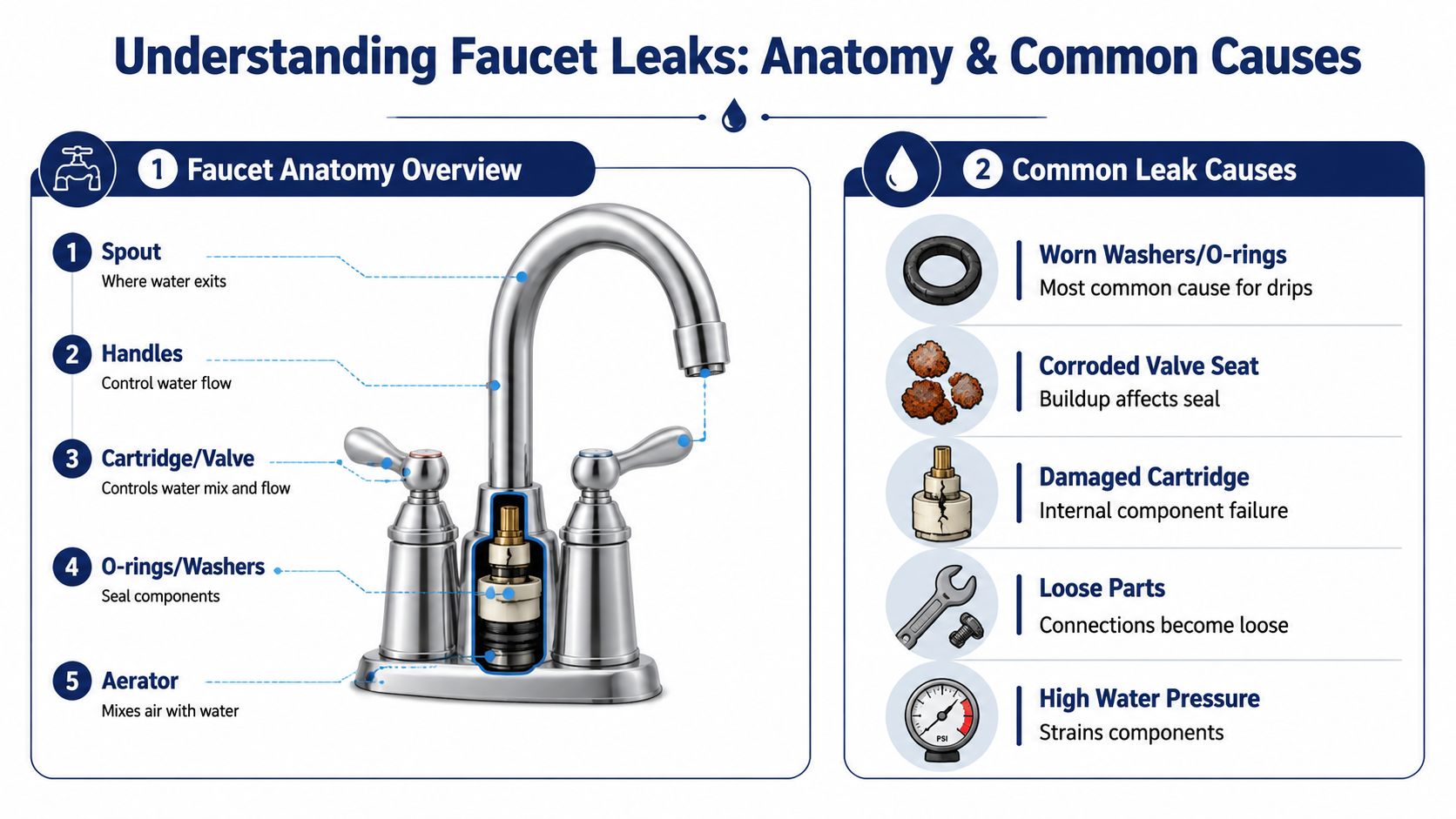
A faucet looks simple from the outside, but inside it has several sealing points. Water only stays where it's supposed to if those points remain clean, aligned, and in good shape. In most faucets, worn washers or gaskets, degraded O-rings, and corrosion at the valve seat are common leak sources because those are the parts that stop flow at closure points, as described by Maxwell-White.
What usually fails inside a faucet
Think of a faucet as a set of control parts and seal parts.
The control parts are the handle, stem, or cartridge that open and close water flow. The seal parts are the rubber or plastic components that stop the water. When the seal wears out, water sneaks through. When the control part loosens or cracks, water may leak around the handle or base instead of out of the spout.
Mineral deposits make this worse. Even a good replacement part won't seal well against a rough, dirty, or corroded surface. That's why some leaks return quickly after a rushed repair.
Match the symptom to the likely cause
Use the leak location as your first clue.
| Symptom | Most likely cause | What it usually means |
|---|---|---|
| Drip from the spout when faucet is off | Worn washer, worn seat seal, or failing cartridge | The water shutoff point inside the faucet isn't sealing fully |
| Water around the handle | Damaged O-ring or worn internal cartridge seal | Water is escaping around moving parts |
| Leak at the base of the faucet | Loose mounting, failed base gasket, or water traveling down from above | The source may be higher than it looks |
| Leak under the sink at supply connections | Loose connection or worn supply line seal | Often repairable without opening the faucet body |
| Intermittent drip at certain times | Pressure-related strain or debris preventing full closure | The faucet may seal sometimes and fail at other times |
A spout drip is the classic washer or cartridge symptom. In many older compression faucets, the washer presses against a seat to stop water. Once that washer gets hard, misshapen, or worn, the faucet never closes completely.
A handle leak usually points higher up in the assembly. O-rings and internal seals around the stem or cartridge wear from movement. If you see water at the handle base after turning the faucet on, that's a strong clue.
A base leak can fool people. They assume the faucet body is cracked, but often water is leaking from above and running down under the escutcheon or trim. Dry everything thoroughly, then use a flashlight and a dry paper towel to trace the first point where water appears.
Water follows gravity and the path of least resistance. The wet spot you see isn't always the part that's failed.
DIY or call a pro
Some leak causes are friendly to homeowners. Others turn into a bigger job fast.
- Worn washer or O-ring: Usually DIY-friendly if you can identify the faucet model and shut off water cleanly.
- Loose connection under the sink: Often DIY-friendly, especially if access is decent and the fittings aren't corroded.
- Cartridge failure: Possible DIY job, but only if the retaining clip, bonnet nut, or handle hardware comes apart without a fight.
- Corroded valve seat or badly mineralized internals: Better for a pro. These repairs can damage older fixtures if forced.
- Suspected pressure issue or recurring leak after replacement: Call a pro. Replacing the same part twice without solving the underlying cause wastes time.
How to Fix Simple Faucet Leaks Yourself
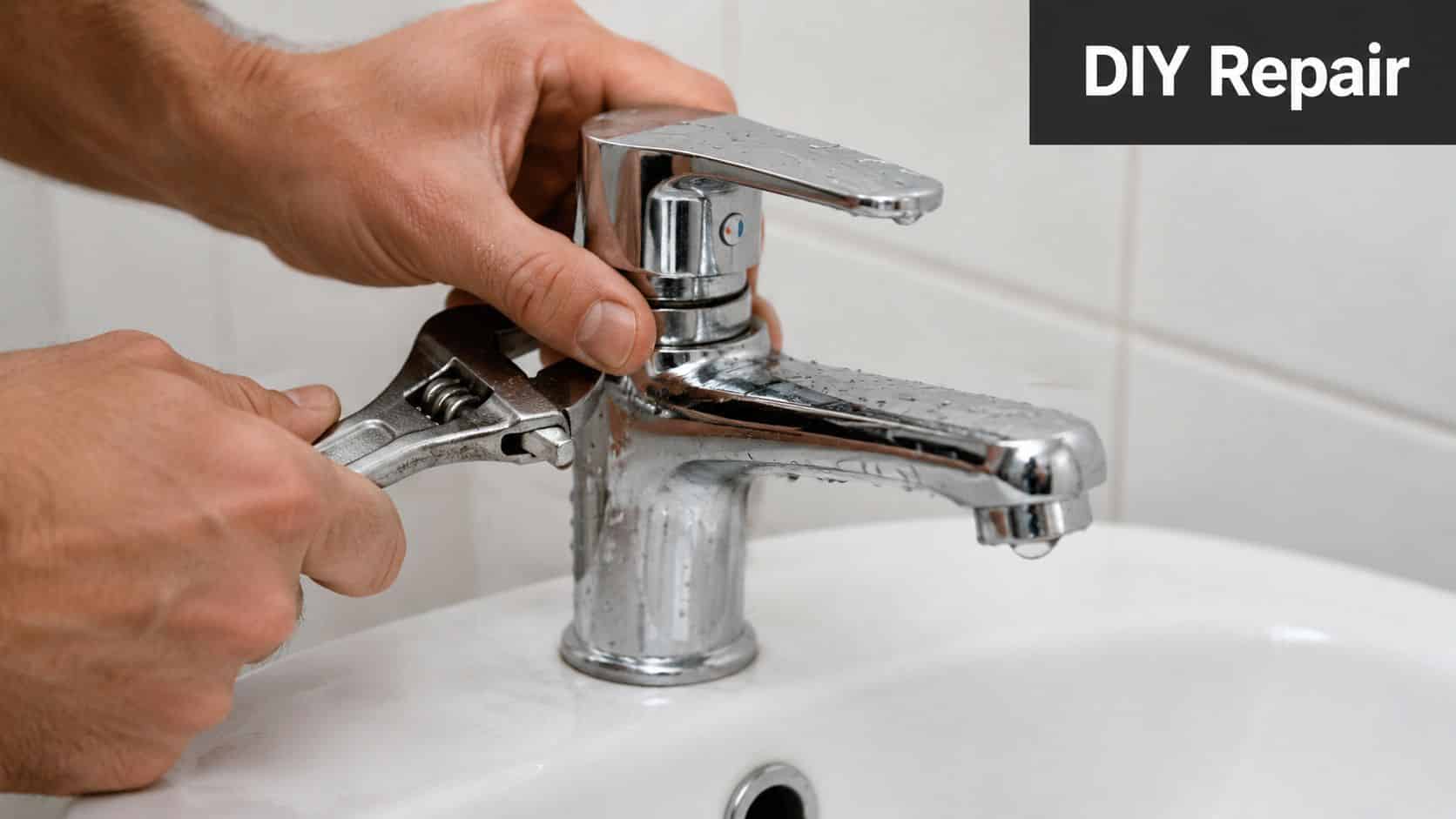
If the leak points to a washer, O-ring, or easy-to-reach seal, a careful homeowner can often handle it. The repair goes much better when you slow down, protect the finish, and keep parts in order as they come off.
Start with safety and the right tools
Before touching the faucet, shut off the hot and cold stop valves under the sink. Open the faucet to relieve pressure and confirm the water is off. Then plug the drain with a stopper or rag so screws and clips don't disappear.
A basic repair kit usually includes:
- Adjustable wrench: For retaining nuts and supply fittings
- Screwdrivers: Flathead and Phillips cover most handles
- Allen keys: Many single-handle faucets use set screws
- Needle-nose pliers: Helpful for clips and small parts
- Replacement washer or O-ring: Match the old part exactly
- Plumber's grease: A light coating helps seals move smoothly
- Towel and small tray: Keeps parts organized and protects the sink
If you're trying to find hidden moisture before or after the repair, this guide on how to detect water leaks before they cost you is worth reviewing. It helps homeowners separate a simple faucet issue from a broader leak around the cabinet or wall.
Washer and O-ring repairs that homeowners can handle
For a compression faucet, remove the decorative cap if there is one, unscrew the handle, and lift it off. Then remove the stem assembly. At the bottom of that stem, you'll usually find the washer secured by a screw. If the washer looks flattened, cracked, or hardened, replace it with the same size and shape.
For an O-ring leak, the repair is often higher up on the stem or around the cartridge body. Remove the old ring carefully so you don't scratch the metal. Clean the groove before installing the new one. A dirty groove can make a new O-ring fail early.
After replacing parts, wipe away mineral residue before reassembly. Debris left behind can keep the faucet from sealing correctly. Tighten parts snugly, not aggressively. Overtightening is one of the fastest ways to turn a simple repair into a stripped thread or cracked component.
If a handle resists removal, stop forcing it. A seized handle often means corrosion has bonded parts together, and that's where many DIY repairs go sideways.
When the faucet type changes the repair
Faucet design matters. Compression faucets usually fail at the washer and seat interface, while cartridge faucets leak when the cartridge or its internal seals wear, which changes the repair path, as noted by WM Henderson.
That means you should identify the faucet before buying parts. Two-handle faucets are often compression style, but not always. Many single-handle faucets use a cartridge, and those cartridges need the correct brand-specific replacement to fit and seal properly.
A visual walkthrough can help if you're comfortable working slowly and comparing what you see at the sink with the steps on screen.
One last trade-off from a plumber's point of view: replacing a simple rubber part makes sense on a serviceable faucet in decent condition. It doesn't make sense when the body is badly corroded, the hardware is frozen, or the replacement parts are no longer reliable. At that point, repairing the leak may still be possible, but it isn't always the best value.
When to Stop DIY and Call a Licensed Plumber
Some faucet leaks are honest little repairs. Others only look small from the outside. The trick is knowing when the symptom no longer matches a simple fix.
Signs the leak is no longer a simple parts swap
If you've already replaced the obvious seal and the faucet still drips, stop repeating the same repair. A second failed attempt often means the valve seat is damaged, the cartridge isn't the actual problem, or the leak is traveling from another connection.

Call a licensed plumber when you see any of these:
- Persistent leaking after new parts: The sealing surface itself may be worn or corroded.
- Water showing up inside the cabinet with no clear faucet source: The leak may be from supply lines, fittings, or a hidden crack.
- Heavy corrosion on nuts, stems, or shutoff valves: Old metal can split or seize during disassembly.
- Loose faucet body that won't stay tight: The mounting hardware or sink surface may need more than a quick adjustment.
- Leak signs in the wall or below the floor: That's no longer a faucet-only problem.
A lot of homeowners get stuck at the same point. They can identify the leak, but they can't get the faucet apart without risking damage. That's a legitimate reason to stop. There's no prize for snapping off a corroded stem and turning a controlled repair into an emergency.
What counts as urgent
Not every drip is a midnight emergency, but some conditions move fast.
If water is actively escaping under pressure, leaking into cabinetry, staining adjacent walls, or showing up on the ceiling below, don't wait. Shut off the fixture valves if they work. If they don't, use the home's main shutoff and call for help.
A steady faucet drip also deserves faster action than many people realize. A slow drip of 10 drips per minute wastes nearly 30 gallons a month, and the water waste plus potential repair damage can outweigh the cost of professional service, according to Geiler.
For homeowners weighing the decision, this explains why hiring a licensed plumber for your home matters when the issue goes beyond a routine seal replacement. The value isn't just the repair itself. It's getting the actual cause right before water reaches places it shouldn't.
Simple Maintenance to Prevent Future Faucet Leaks
Most faucet leaks don't come out of nowhere. The parts wear gradually, the handle gets tighter, mineral deposits build up, and the fixture starts giving small warnings before it fails outright.
A practical routine that actually helps
A short maintenance routine does more good than most homeowners expect.
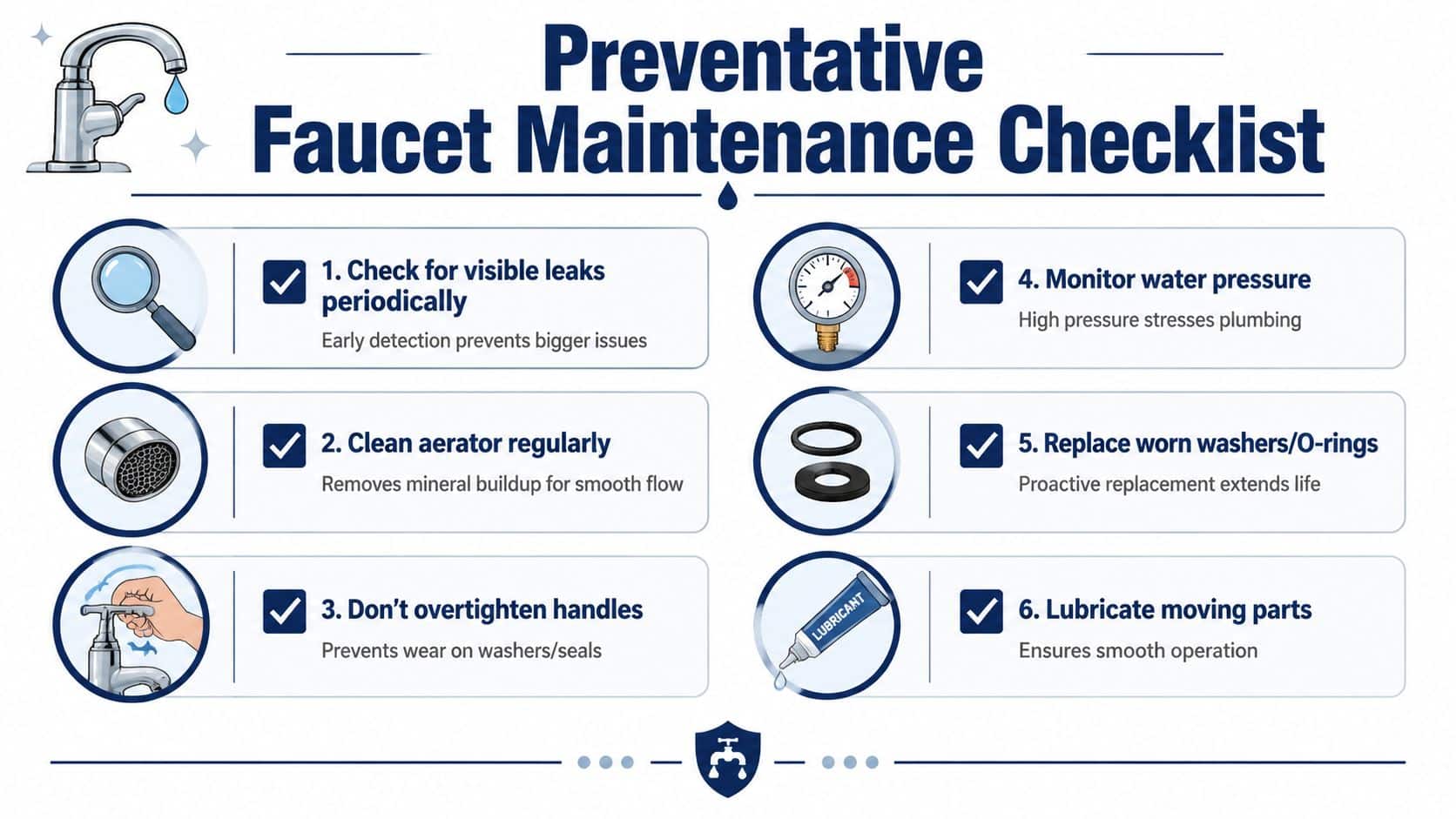
- Clean the aerator: Unscrew it and rinse out sediment if flow starts looking uneven.
- Use a gentle hand on handles: Cranking a faucet tighter doesn't fix seal wear. It stresses the parts more.
- Watch for early symptoms: A little moisture at the handle base or a drip that only happens occasionally is the best time to act.
- Check under the sink occasionally: A dry paper towel around the supply connections can reveal moisture before cabinet damage starts.
- Replace worn seals during minor repairs: If the faucet is already apart and nearby rubber parts look tired, it's smart to refresh them.
- Address hard water effects: In homes with heavy mineral buildup, regular cleaning and, in some cases, water treatment can help fixtures last longer.
A faucet lasts longer when it's used normally, cleaned periodically, and repaired at the first sign of trouble instead of being forced to keep working.
Your Go-To 24/7 Plumber in Los Angeles
A leaking faucet usually comes down to a failed seal, worn internal part, loose connection, or a sealing surface that has gotten rough with age. Once you match the symptom to the location of the leak, the next step gets clearer. Some repairs are simple. Some aren't worth forcing.
The safest approach is practical, not ambitious. If the faucet comes apart cleanly and the failed part is obvious, a careful DIY repair can work well. If corrosion, hidden leakage, stubborn hardware, or repeat dripping enters the picture, calling a licensed plumber protects the fixture and the surrounding property.
For Los Angeles homeowners, property managers, HOAs, and commercial properties, having a responsive plumber matters just as much as knowing the cause of the leak. Fast service keeps a routine repair from becoming cabinet damage, drywall damage, or a bigger plumbing problem.
If you need help with a leaking faucet or a plumbing issue that can't wait, EZ Plumbing provides licensed, insured service across Los Angeles with 24/7 emergency response and same-day scheduling for planned repairs. Serving the area since 1989, the team handles residential and commercial plumbing with clear communication and dependable workmanship. Call (818) 908-2710 or schedule online for prompt, professional service.