
Why Timely Leak Repairs Save Money and Protect Your Home
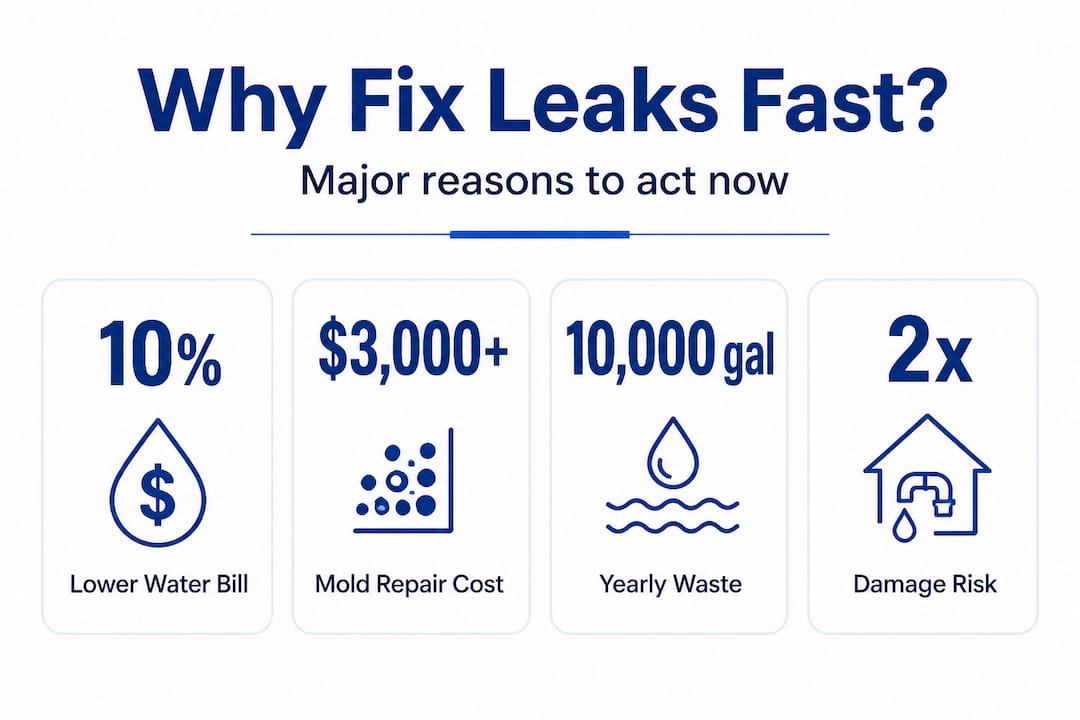
A single dripping faucet might seem harmless, but the reality behind that small sound is far more significant than most Los Angeles homeowners expect. Average household leaks can waste more than 10,000 gallons of water every year, quietly inflating your water bills and setting the stage for expensive property damage. This guide walks you through the real financial and structural consequences of plumbing leaks, how to catch them early, and why acting quickly is always the smarter move for your home and your budget.
Table of Contents
- Why ‘small’ leaks aren’t so small: The real cost of delays
- Risks to your property: Beyond the water bill
- How to spot leaks early and act fast
- The benefits of timely repairs: Saving water, money, and stress
- Why waiting is a gamble: An expert’s perspective on leak repairs
- Take action: Professional leak repairs across Los Angeles
- Frequently asked questions
Key Takeaways
| Point | Details |
|---|---|
| Small leaks add up | Even minor leaks can waste thousands of gallons of water and significantly increase bills. |
| Prompt repair saves money | Fixing leaks quickly can lower your water bill by around 10 percent a year. |
| Protect your property | Immediate action prevents extensive and costly water damage, mold, and structural issues. |
| Easy checks go far | Simple steps like checking your water meter can help catch leaks early before they escalate. |
| Call local experts | Professional leak detection and repair ensure thorough fixes and peace of mind. |
Why ‘small’ leaks aren’t so small: The real cost of delays
Most homeowners in Los Angeles think of a minor leak as something to deal with eventually. The problem is that “eventually” tends to arrive as a much bigger repair bill than the original fix would have cost. Water loss from small leaks accumulates faster than you’d expect, especially in older homes across neighborhoods like Echo Park, Silver Lake, and the San Fernando Valley, where aging galvanized pipes and worn fixture connections are common.
To put the numbers in perspective, consider how quickly small leaks add up:
| Leak type | Drips per minute | Gallons wasted per day | Gallons wasted per year |
|---|---|---|---|
| Slow dripping faucet | 10 drips/min | 3 gallons | 1,095 gallons |
| Leaky toilet flapper | Constant trickle | 25 gallons | 9,125 gallons |
| Running toilet | Full flow loss | 200+ gallons | 73,000+ gallons |
| Leaking supply line | Slow seep | 5 to 10 gallons | 1,825 to 3,650 gallons |
These figures are not hypothetical. A leaky toilet flapper, one of the most common plumbing issues we see in LA homes, can waste nearly as much water in a year as the average American household uses for all their showers combined. And because toilet leaks often happen silently, many homeowners have no idea the water is escaping.
According to EPA-cited guidance, 10% of homes have leaks that waste 90 gallons or more per day, and the average household can save about 10% on their water bill simply by fixing known leaks promptly.
On a Los Angeles water bill, that 10% savings is real money. With LADWP rates averaging among the higher end in California, a household spending $80 to $120 per month could be losing $100 to $150 annually to leaks they haven’t even noticed yet. For practical plumbing tips for LA homes, early awareness is the first line of defense.
The things that get worse when you delay a leak repair include rising water bills, water pressure drops, pipe corrosion spreading to adjacent fittings, subflooring saturation, and mold colonization behind walls. None of those are easier or cheaper to deal with in three months than they are today.
Risks to your property: Beyond the water bill
Water is patient. It finds its way into wood framing, drywall, insulation, and concrete over time, and by the time you see visible damage, the problem behind the wall has often been developing for weeks or months. This is the part of leak damage that most homeowners underestimate because the visible signs appear later than the actual harm.
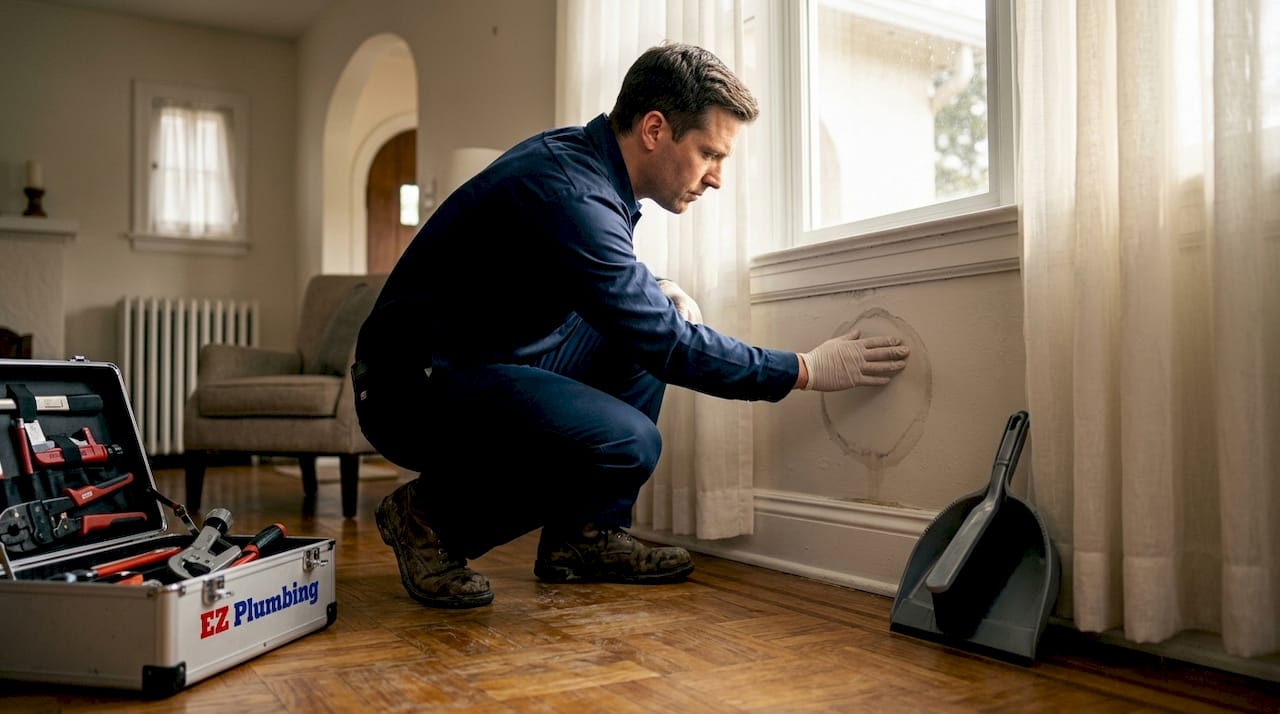
Leaking water creates long-term risks including mold growth and structural damage that can cost several thousand dollars to remediate. In Los Angeles, where many homes were built in the mid-20th century with materials that are now aging, the structural vulnerability is particularly real. Concrete slab foundations, which are common across much of LA County, can develop cracks and shifting when soil below them absorbs sustained water intrusion from a slow leak in a supply line or slab pipe.
The most common property areas at risk from unrepaired leaks include:
- Subflooring and floor joists beneath bathrooms and kitchens
- Drywall and insulation inside bathroom walls and under sinks
- Cabinets and vanity bases where supply lines connect
- Concrete slab foundations where in-slab pipes run
- Crawl spaces in older hillside homes across areas like Los Feliz and Glassell Park
- Ceilings below second-floor bathrooms
Mold is one of the most financially damaging secondary effects of water intrusion. Professional mold remediation in Los Angeles can run anywhere from $1,500 for a small bathroom area to over $10,000 for a spread that has reached wall cavities and framing. The cost of dealing with water damage after the fact always exceeds what the original plumbing repair would have cost.
When planning home updates or renovations, keeping an eye on the condition of your plumbing is equally important. Understanding the role of plumbers in renovations helps you avoid discovering an existing leak mid-project, which is one of the most disruptive and costly scenarios in any remodel.
Pro Tip: Schedule a plumbing inspection whenever you notice even a minor wet spot under a sink or discoloration on a ceiling. Early detection is genuinely the least expensive form of protection your home has against water damage.
How to spot leaks early and act fast
Los Angeles homes present specific detection challenges. The combination of older housing stock, significant temperature variation between inland and coastal zones, and a high proportion of slab foundation homes means that leaks here can hide in ways that differ from other parts of the country. Knowing what to look for and how to check makes a meaningful difference.
Here is a straightforward process you can work through yourself to check for early signs of a leak:
- Read your water meter before and after a two-hour period when no water is being used in the home. If the reading has changed, water is escaping somewhere in the system.
- Check under all sinks for moisture, discoloration, or soft cabinet flooring. These are early indicators of a slow supply or drain line leak.
- Inspect toilet tanks by placing a few drops of food coloring in the tank. If color appears in the bowl without flushing after 15 minutes, you have a leaking flapper.
- Feel exposed pipe connections in your garage or utility area. Any moisture or white mineral deposits around joints signal a leak or slow seep.
- Look for unexplained wet patches in your yard, especially in areas far from irrigation zones. These can indicate a broken main line or slab leak below grade.
- Listen for running water sounds inside walls or floors when all fixtures are off. That sound is a reliable warning sign of a leak behind the surface.
Pro Tip: Your water meter is your most reliable early warning tool. Most LA homes have them near the street in a small covered box. Check it monthly and note any unexplained increases in usage, which can signal a 10% savings opportunity once the source is found and repaired.
If your self-check suggests a leak but you cannot locate the source, that is the right time to bring in a professional. Our leak repair services are designed for exactly this situation. Camera inspection technology allows us to trace leak sources inside walls or below slabs without unnecessary demolition. For homeowners in the Pasadena area specifically, leak detection Pasadena service includes non-invasive diagnostic tools suited to the older home styles common in that part of LA County.
If you also maintain a pool, keep in mind that pool leak identification requires a separate process since pools lose water through both evaporation and plumbing, and distinguishing between the two takes specific testing methods.
The benefits of timely repairs: Saving water, money, and stress
When you fix a leak promptly, the benefits go well beyond stopping a drip. You are preventing a cascade of consequences that would otherwise grow quietly over weeks and months. Let’s put the two paths side by side.
| Factor | Delayed repair (3 to 12 months) | Timely repair (within days) |
|---|---|---|
| Water wasted | 10,000 to 73,000+ gallons | Minimal |
| Added water bill cost | $100 to $500+ per year | Near zero after fix |
| Mold risk | High, especially in humid seasons | Very low |
| Structural damage risk | Moderate to severe | Minimal |
| Repair cost | $500 to $15,000+ depending on damage | $100 to $800 typical |
| Stress and disruption | High, often involves restoration work | Low, routine plumbing repair |
The financial comparison makes a clear case on its own. But the stress reduction factor deserves more attention. Homeowners who deal with a water damage event, whether it is a wet ceiling, buckled flooring, or a mold discovery inside a wall, consistently describe it as one of the more stressful home experiences they have faced. It disrupts daily routines, sometimes requires temporary relocation, and involves coordinating multiple contractors across weeks of work.
EPA-cited materials confirm that savings from acting quickly on household leaks translate to roughly 10% lower water bills, a straightforward return on a relatively modest repair investment.
Beyond the numbers, there is real environmental value in fixing leaks. Los Angeles operates in a semi-arid climate and has managed water availability challenges for decades. Every household that addresses leaks promptly contributes in a small but real way to the regional conservation effort. That matters here more than in most cities.
Keeping drains healthy is another way to protect your plumbing system from related problems. Our drain cleaning guide for LA homeowners covers how regular maintenance reduces the pressure and backflow conditions that can stress pipe joints and connections, contributing indirectly to leak prevention.
For pool owners, pool water loss prevention follows a similar logic: understanding your system and acting quickly on unusual water loss prevents far larger repair costs down the road.
Why waiting is a gamble: An expert’s perspective on leak repairs
We hear it regularly: “It’s just a small drip, I’ll get to it.” The honest truth from years of working on Los Angeles homes is that this statement almost always precedes a more expensive repair conversation. Not because homeowners are wrong to prioritize their time, but because plumbing leaks are almost never static. They grow.
The DIY or delay mindset often backfires for a specific reason: what looks like a simple dripping faucet at the surface is sometimes the visible symptom of a corroding shut-off valve, a deteriorating supply line, or a connection that has been shifting due to ground movement. Los Angeles sits on an active seismic zone, and minor ground shifts, not just large earthquakes, cause micro-movement in pipe joints over time. A drip today can become a burst connection within a season.
What most articles on leak repairs won’t tell you is that leaks rarely travel alone. When we find one active leak in a home, a thorough inspection almost always reveals a second or third problem at a similar stage of development. Pipe systems age together, and if one fitting or connection has reached the point of failure, neighboring sections are typically close behind. You can solve common plumbing problems more cost-effectively when you address them as a group rather than one emergency at a time.
There is a myth that getting a plumber out quickly is the expensive choice. In practice, it is almost always the cheaper one. The repair itself is typically straightforward and affordable. It is the delay, the mold, the soaked drywall, the warped flooring, and the structural remediation that drives costs into the thousands.
Pro Tip: When you fix one leak, always ask your plumber to check adjacent pipe connections and shut-off valves. This one habit saves LA homeowners significant money by catching developing problems before they become emergencies.
Take action: Professional leak repairs across Los Angeles
If anything in this article sounds familiar, whether it is a slow drip you have been ignoring, an unexplained rise in your water bill, or a faint sound of running water inside a wall, this is the moment to act. EZ Plumbing brings licensed, insured expertise to leak detection and repair across the greater Los Angeles area, from the Westside to the San Gabriel Valley and everywhere in between.
Our team uses advanced tools including camera inspection and electronic leak detection to locate problems accurately before recommending any repair. We are fully licensed (C-36 License #583868) and code-compliant with LA municipal requirements, so every repair we complete holds up to city inspection. For fast and reliable professional leak detection, or if you are specifically searching for LA leak detection specialists who understand the local building stock and infrastructure, EZ Plumbing is ready to help. Call us today and protect what you have built.
Frequently asked questions
How much water can a household leak actually waste?
A typical household leak can waste over 10,000 gallons of water each year if left unfixed, with some running toilets losing tens of thousands more.
How soon should I fix a leak once I find it?
You should repair leaks as immediately as possible, since fixing leaks quickly reduces water waste, lowers bills, and prevents property damage from escalating.
Can a small leak really increase my water bill?
Yes, even a minor leak can raise your bill by about 10 percent or more, with the cost compounding the longer the problem is left unresolved.
Are there signs I can check for hidden leaks myself?
You can monitor your water meter before and after a two-hour no-use window, look for discoloration under sinks, or listen for running water inside walls when all fixtures are off.
What types of damage can leaks cause aside from high water bills?
Leaks can result in mold and structural damage over time, including warped flooring, compromised drywall, weakened framing, and expensive foundation issues in slab-based LA homes.