
Trenchless Sewer Repair Pros and Cons for Los Angeles Homes
A sewer line problem in Los Angeles usually shows up at the worst time. A camera run finds roots in the line, a crack under the driveway, or a section that's starting to fail under mature landscaping, and suddenly the key question isn't just how to fix it, it's how much of the property you're willing to disturb to get there.
That's where trenchless sewer repair pros and cons matter. Trenchless can save a driveway, protect hardscape, and shorten the job, but it's not magic, and it won't solve every pipe failure. The right answer depends on what the camera shows, how the line is built, and whether you're dealing with a single-family home, an HOA, a rental property, or a commercial site where downtime is just as important as the repair itself.
Table of Contents
- When Your Sewer Line Fails in Los Angeles
- How Trenchless Sewer Repair Methods Work
- Trenchless vs Traditional Sewer Repair Compared
- Where Trenchless Repair Falls Short
- Los Angeles Cost Ranges and Permitting Realities
- Is Trenchless Right for Your Property
- Choosing the Right Plumbing Contractor in Los Angeles
When Your Sewer Line Fails in Los Angeles
A homeowner in Los Feliz or Sherman Oaks usually doesn't call about trenchless work first. They call after slow drains turn into a backup, and the camera finds the bad news under something expensive, maybe a stamped driveway, a hedge row, or a patio they don't want torn apart. That's the moment the repair stops being theoretical and becomes a property decision.
If the line still has a usable path, pipe lining or pipe bursting may be on the table. If the pipe is fully collapsed or has lost grade, excavation starts making more sense, even if nobody likes that answer. The key is not to chase the trendiest method, but to match the repair to the pipe condition.
A proper inspection is the first move, not the last one. If you want to understand what the camera is looking for before anyone starts talking about replacement, this overview of a sewer line inspection is a useful reference point.
Practical rule: the more surface value a property has, the more the restoration math matters. In Los Angeles, that usually means hardscape, mature planting, and access constraints carry real weight in the decision.
For a single-family home, the goal is often to minimize disruption and preserve finishes. For an HOA or multi-unit property, the stakes widen fast, because one failed lateral can affect multiple residents, scheduling windows, and shared access. Commercial sites have a different pressure altogether, since downtime can become the most expensive line item even before the final patch is poured.
That's why the repair choice should never start with “trenchless is always better” or “just dig it up.” It starts with what the pipe can support, how much of the property you're trying to protect, and whether the line still gives a contractor a workable path. If the answer is yes, trenchless can be a smart fit. If the answer is no, forcing it usually wastes time.
How Trenchless Sewer Repair Methods Work
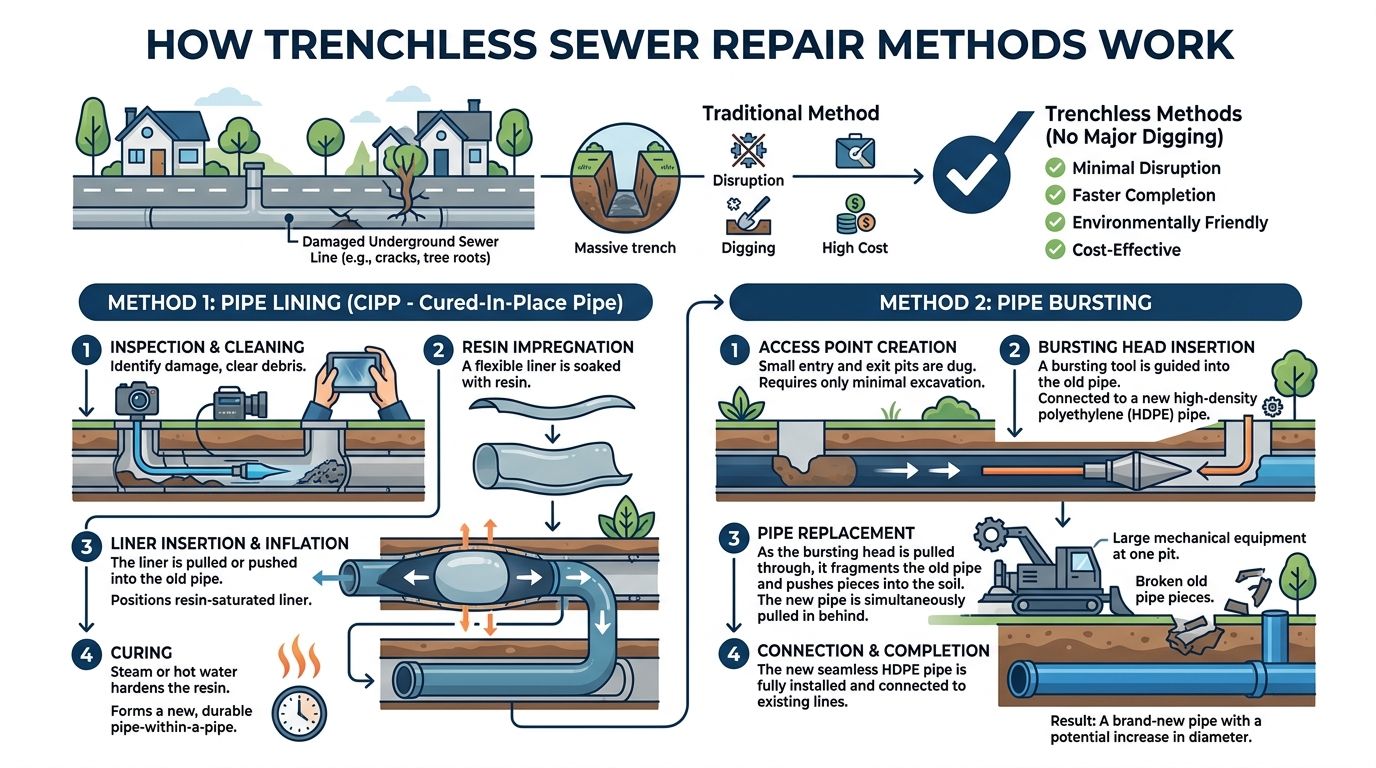
Trenchless repair usually comes down to two methods, cured-in-place pipe lining and pipe bursting. They solve different problems, but they share the same advantage, they don't require a continuous trench across the yard, driveway, or front walk.
Pipe lining
With pipe lining, the contractor inserts a resin-saturated liner through a small access point, then inflates it against the inside of the old pipe. Once cured, it forms a new pipe inside the old one, and that new interior is jointless. That matters when the original line has cracks, minor deterioration, or root intrusion, because joints and fractures are where roots usually keep coming back.
The liner follows the path of the existing pipe, so the host line has to be continuous enough to accept it. A line that's badly distorted or physically missing sections isn't a candidate, because there's nothing stable for the liner to conform to.
Pipe bursting
Pipe bursting works differently. A bursting head fractures the old pipe while pulling a new HDPE replacement into place. This is the trenchless option that can handle more severe damage, as long as the line still maintains a continuous path for the bursting setup to follow.
In practical terms, trenchless jobs usually need two small access points, one at each end of the run. That's the whole point. Instead of excavating the full length of the line, the contractor works through limited openings and leaves most of the surface intact. For homeowners staring at a driveway or mature planting, that difference is often the reason trenchless gets serious consideration.
If you're comparing repair methods and also thinking about root intrusion prevention, it helps to look at a resource like browse root barrier costs and steps so you can see how root management fits into the bigger sewer plan. Root barriers don't replace sewer repair, but they can be part of the long-term strategy around vulnerable laterals.
For a visual walkthrough of camera-based diagnosis before the work starts, this guide on sewer camera inspection pairs well with the repair methods above.
The takeaway is simple. Lining restores the inside of a pipe that's still basically there. Bursting replaces a pipe that's too damaged to rehab, but still gives the contractor a path to pull a new line through.
Trenchless vs Traditional Sewer Repair Compared
The cleanest way to compare these methods is to ignore slogans and look at what changes on the property. Trenchless usually preserves finishes, shortens the job, and reduces restoration work. Traditional excavation gives the contractor full access, which matters when the line is too far gone for rehabilitation.
| Criterion | Trenchless Repair | Traditional Excavation |
|---|---|---|
| Surface disruption | Small access points instead of a full trench, so driveways, landscaping, and hardscape are more likely to stay intact | Requires open digging across the repair path, which can tear up lawns, concrete, and planted areas |
| Project timeline | Many jobs are completed in one day or 1–3 days | Commonly takes 3–5 days, and some segments can run 7–10 days because excavation and restoration both take time |
| Total cost | Per-foot pricing is often higher, but restoration can change the final math | Per-foot pricing may look lower, but concrete, driveway, and landscape repair can push the total up |
| Durability | Jointless liners and HDPE replacements are commonly described as lasting 50+ years | A new open-trench replacement also gives long service life, but the surrounding surface has to be rebuilt afterward |
| Daily life impact | Less disturbance, but bypassing or temporary shutoff planning is still common on occupied properties | More noise, more access disruption, and more property interference during the work |
A contractor can quote trenchless at a higher per-foot number and still deliver a lower overall bill once restoration is included. That's why Los Angeles jobs often look more favorable to trenchless than a simple line-item comparison suggests. When the property has expensive hardscape, the savings usually show up on the back end.
What matters most: trenchless is often chosen because it protects what's already built. On a property with mature trees, patios, and decorative concrete, avoiding demolition can be just as important as the pipe itself.
The other big difference is the lived experience during the job. Trenchless still may require bypass pumping or coordinated shutoffs, especially on occupied buildings, but it usually avoids the long stretch of open construction that comes with excavation. Traditional digging gives full access, which is useful when the pipe needs to be rebuilt from scratch, but that access comes with noise, debris, and more moving parts.
For a deeper look at replacement options, this trenchless sewer line replacement resource fits naturally with the comparison above.
The comparison isn't really “fast versus slow” or “cheap versus expensive.” It's preservation versus full exposure, and the right answer depends on whether the line is salvageable enough to justify the less invasive route.
Where Trenchless Repair Falls Short
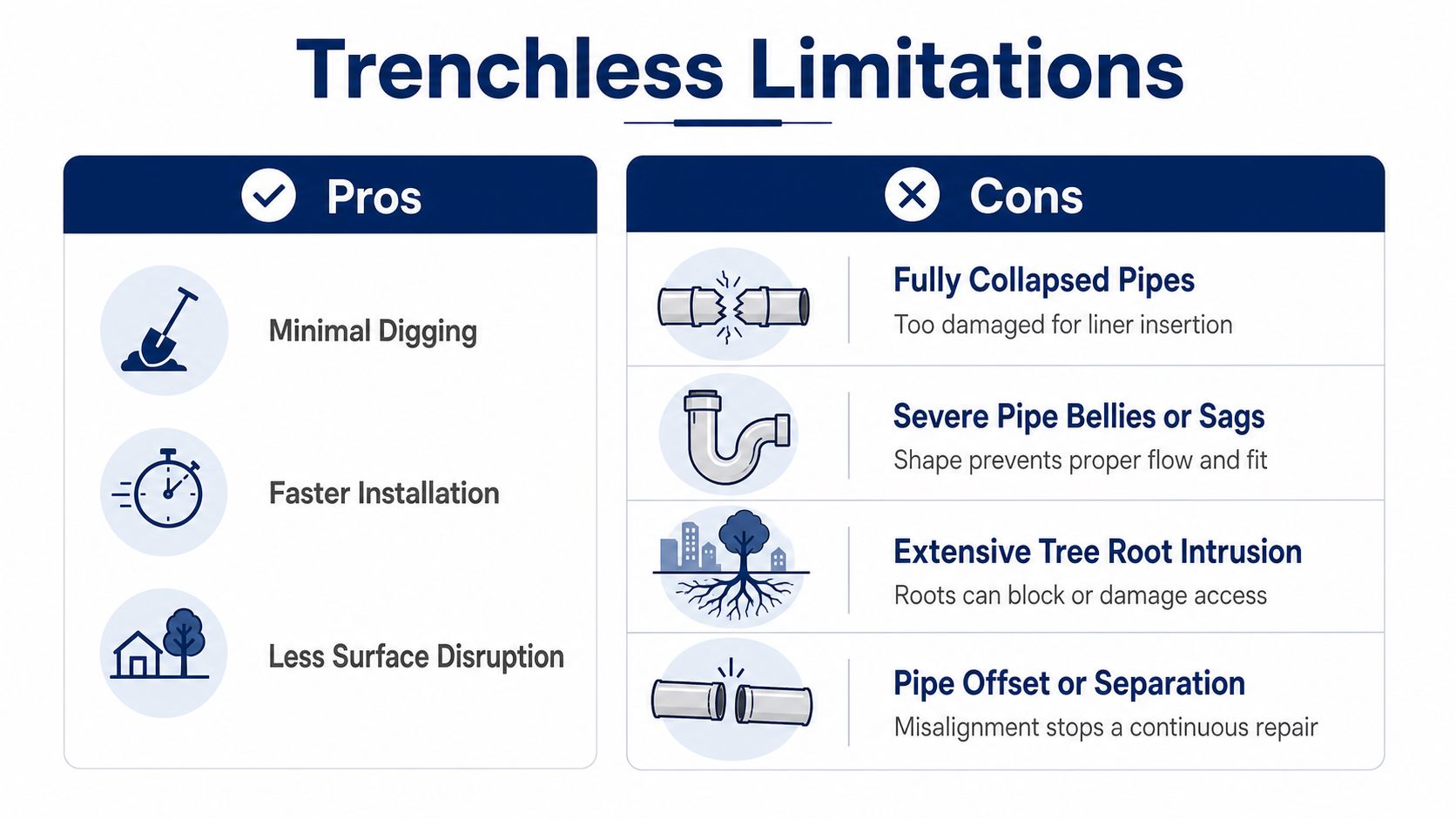
The biggest mistake homeowners make is assuming a camera inspection automatically leads to trenchless. It doesn't. If the pipe is fully collapsed, badly offset, or shaped by a sag that holds water, the liner or bursting head has nowhere reliable to go.
Structural problems that block trenchless
A liner follows the existing pipe path, so it can't re-engineer a bad slope. If the line has a belly, the sewer still has a belly after lining, even if the interior surface is smoother. That's why trenchless can be a strong rehabilitation method, but not a cure for every layout problem.
Bursting has its own limit. It can replace a damaged line, but it still depends on a continuous route through the old pipe. If the pipe path is broken beyond use, or the offsets are too severe, excavation becomes the honest fix.
Hydraulic trade-offs that get overlooked
Trenchless rehabilitation can also slightly reduce the pipe's internal diameter. That doesn't automatically make it a bad choice, but it does matter on older lines that are already undersized or prone to frequent surcharging. A smoother interior helps flow, but it doesn't erase the geometry of the original line.
A smooth new interior doesn't fix a sewer that sags. If gravity flow is wrong, the pipe needs structural correction, not just a new lining.
Old Los Angeles properties deserve extra caution. Soil settlement, prior patchwork, and years of root pressure can create conditions that look repairable on video until a contractor measures the grade and sees the underlying issue. A good plumber won't sell trenchless just because it sounds modern. They'll explain when the pipe is a rehab candidate and when it needs open replacement.
That honesty matters because trenchless content often overstates its reach. More useful information: trenchless is excellent for the right pipe, and a poor choice for the wrong one.
Los Angeles Cost Ranges and Permitting Realities
Los Angeles changes the repair math because the property itself often costs more to restore than the pipe does to access. On a lot with concrete, stone, a mature tree canopy, or tight frontage, the true bill is rarely just the excavation or liner price. It's the repair plus the restoration.
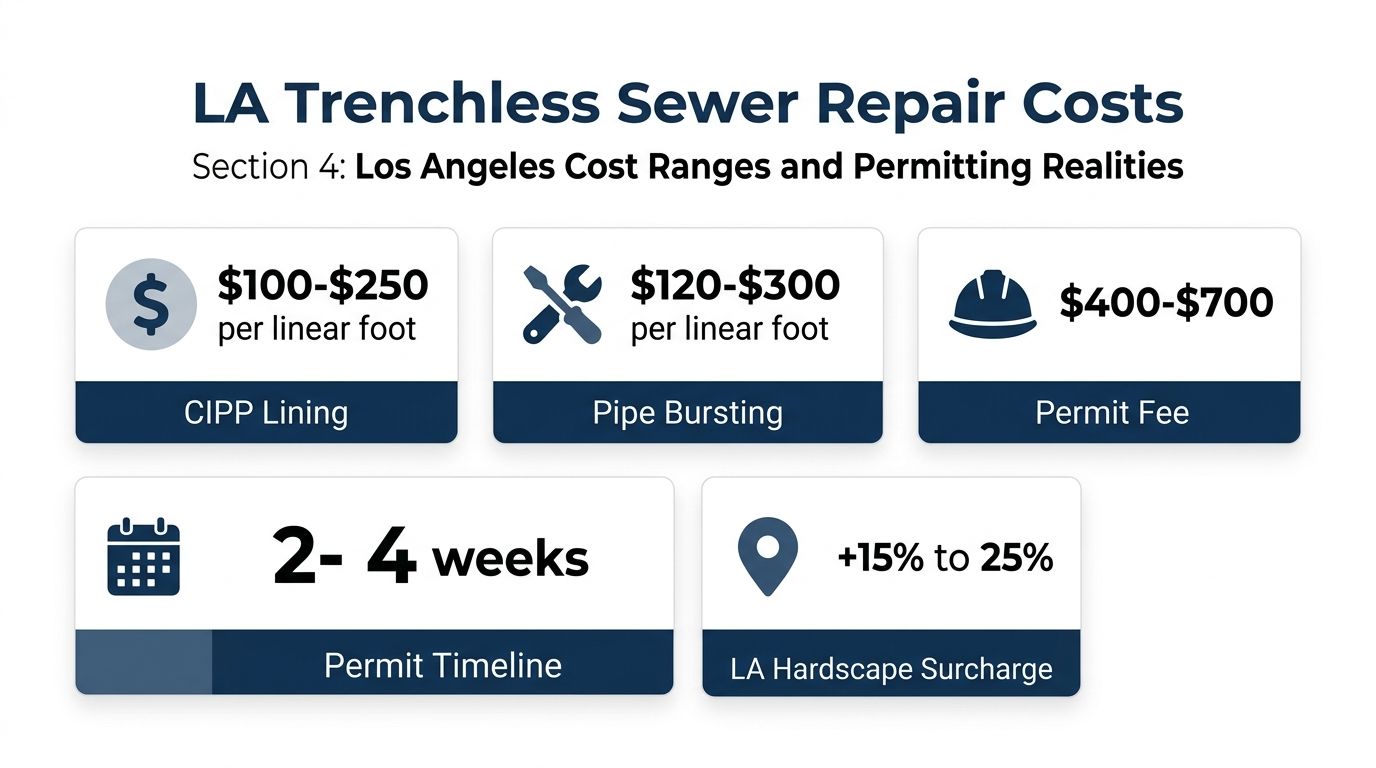
Industry comparisons put open-trench replacement around $65 to $163 per linear foot, while trenchless lining or pipe bursting runs about $78 to $325 per linear foot depending on method, and another source gives traditional digging at $50 to $150 per linear foot versus trenchless at $80 to $250 per linear foot. When landscaping, driveway, and hardscape repair are added, trenchless projects are reported to finish 30 to 40% cheaper overall, with some estimates citing 30 to 50% total savings on hardscape-heavy properties. Those numbers are why the cheapest-looking bid is not always the cheapest project.
In LA, permits and inspection sequencing can also shape the timeline. Sewer work tied to a private lateral often needs city oversight, and the contractor has to plan the repair around access, inspection sign-offs, and whatever the local permit path requires. For occupied buildings, that planning matters as much as the pipe method.
What the budget has to include
- Surface restoration: Concrete, pavers, driveway work, and landscaping can dominate the final invoice after open excavation.
- Method-specific access: Trenchless may save the yard, but the contractor still needs working room for equipment and entry points.
- Occupied-property logistics: HOAs and multi-unit buildings often need coordinated shutoffs, and bypass or diversion of flow may be required during the work and curing.
- Schedule coordination: Some projects can't start until tenants, managers, or owners are ready for a temporary plumbing interruption.
For landlords and property managers, that downtime piece is easy to underprice and hard to ignore later. Residents don't care that the repair is technically elegant if they can't use normal plumbing for part of the day. That's why the cheapest labor quote can be misleading if it leaves out coordination costs and restoration.
Is Trenchless Right for Your Property
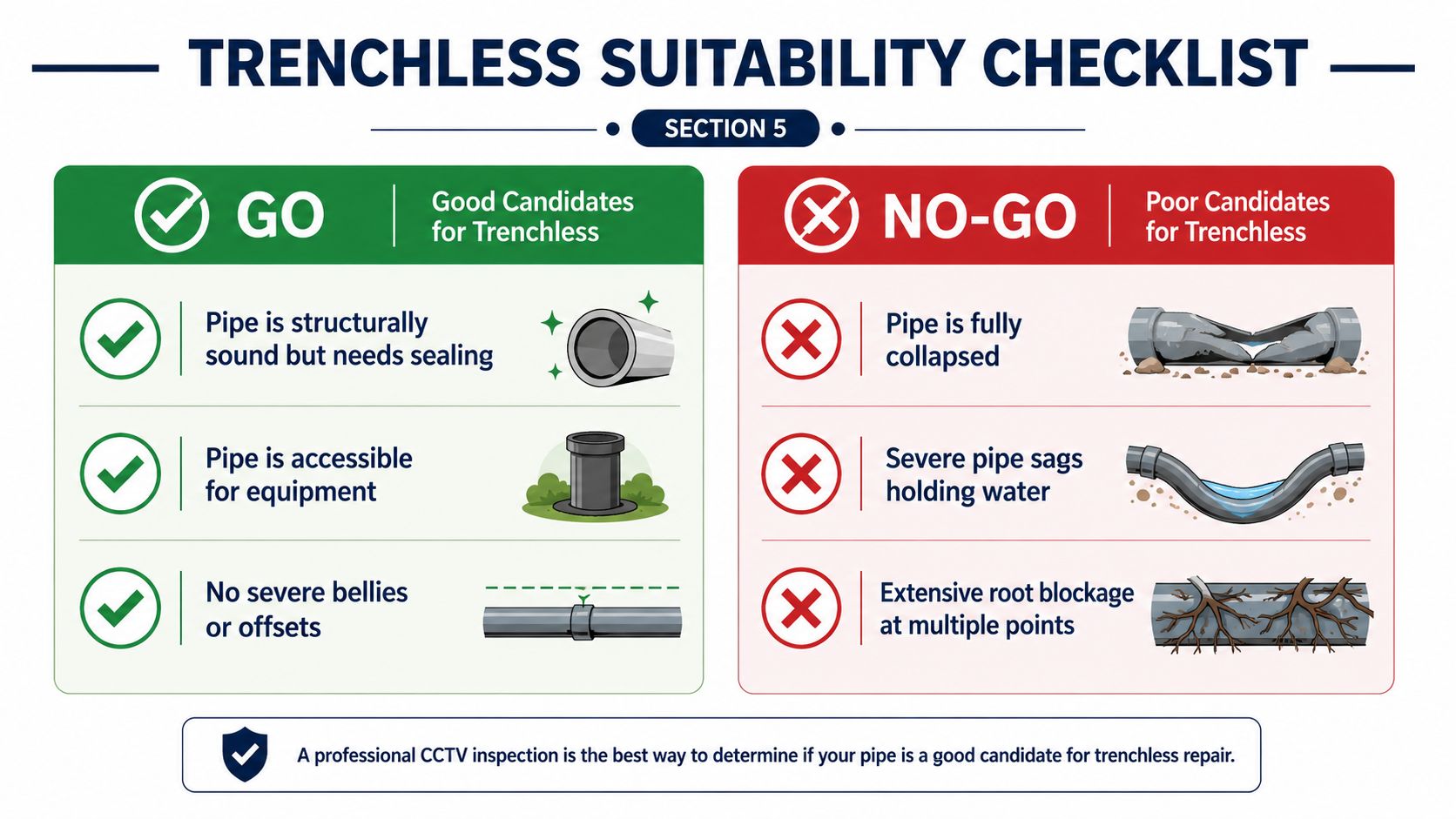
The decision gets easier when you sort the pipe into go and no-go categories instead of treating every failure the same way. A camera inspection gives the starting point, but the final answer depends on the pipe's structure, slope, and accessibility.
Quick suitability checklist
GO, structurally sound but damaged: The pipe is cracked, leaking, or root-intruded, but it still holds its path.
GO, access is workable: The contractor can reach the line with the needed equipment and small openings.
GO, no major grade defects: The line doesn't have a severe belly or offset that would trap water.
NO-GO, collapsed sections: The pipe has lost enough structure that a liner or bursting head can't move through it reliably.
NO-GO, bad slope or sag: Gravity flow can't be re-established by rehabilitation alone.
NO-GO, widespread offset or separation: The pipe path is too broken to support the method.
A practical rule helps here. If the line is salvageable and the property would be expensive to tear up, trenchless deserves a hard look. If the pipe has failed structurally or lost its proper slope, excavation is usually the cleaner fix even when it hurts the budget.
For occupied properties, the scheduling question matters just as much as the pipe condition. HOAs, multi-unit buildings, and commercial sites should ask how long shutoffs last, whether bypass pumping is needed, and who needs to be notified before work starts. If residents or tenants aren't prepared, even a good repair can turn into a bad day.
This is also where experienced contractors separate themselves. They don't just say whether trenchless is possible. They explain whether it's practical for the building, the occupants, and the timeline you're trying to protect.
Choosing the Right Plumbing Contractor in Los Angeles
A trenchless bid only matters if the contractor knows when not to use trenchless. Start with the basics, active California licensing, insurance, and a real sewer camera inspection before anyone recommends a repair. If the company won't show you the video or explain what it sees, keep looking.
Ask for a written scope that names the method, the access points, and the restoration boundaries. That should include whether the contractor expects bypass pumping, how long plumbing may be limited, and what the plan is for cleanup and surface repair. Good communication before the job is usually a strong sign of good communication during it.
Los Angeles experience matters too. Contractors who work here regularly understand root pressure from mature street trees, settlement in older neighborhoods, and the permit and inspection steps that can slow a job if they're handled poorly. A contractor who knows the local conditions can tell the difference between a line that can be rehabilitated and one that needs full replacement.
If you want one more practical filter, ask how the company handles bad news. The right answer is not a sales pitch. It's a straight explanation of why trenchless works for your pipe, or why it doesn't.
EZ Plumbing offers sewer camera diagnostics, trenchless sewer repair, sewer lateral replacement, and coordinated service for homes, HOAs, property managers, and commercial properties across Los Angeles. If you're staring at a failing sewer line and need a clear answer before you commit to repair, visit EZ Plumbing to schedule an inspection and get a straight recommendation based on the pipe, not the pitch.