
Trenchless Sewer Line Replacement: A Los Angeles Guide
You notice it in stages. A toilet starts bubbling when the washing machine drains. The shower takes longer to clear. Then the smell hits, or worse, sewage backs up where it absolutely shouldn't. For a Los Angeles homeowner, that moment brings two worries at once: fixing the pipe and protecting everything above it. Yard, driveway, patio, trees, planters, hardscape, maybe even a slab or a narrow side yard with no easy machine access.
The good news is that sewer replacement isn't limited to the old dig-a-trench-across-the-property approach. Modern trenchless sewer line replacement gives many LA property owners a way to solve the underground problem without tearing up the entire surface. In a dense city where access is tight and restoration can become the biggest part of the headache, that matters.
If you're already at the stage where backups or recurring clogs are happening, start with a proper sewer line inspection. Everything about the right repair depends on what the camera sees, not on guesswork.
Table of Contents
- That Sinking Feeling Your Sewer Line Has Failed
- What Is Trenchless Sewer Line Replacement
- The Two Main Trenchless Methods Explained
- Trenchless Versus Traditional Sewer Replacement
- Understanding Trenchless Repair Costs in Los Angeles
- Is Trenchless Repair Right for Your LA Property
- Hiring a Contractor and What to Expect
That Sinking Feeling Your Sewer Line Has Failed
Most homeowners don't call about the sewer line the first time something acts odd. They call after the second or third sign, when it stops feeling random. One drain is slow. Then several are slow. A downstairs toilet gurgles. Water shows up where it shouldn't. By then, people are often bracing for the worst: a torn-up yard, broken concrete, weeks of mess.
That fear is understandable. The older model of sewer replacement was exactly that. Find the pipe by excavation, open the line along its path, remove the failed section, rebuild the surface afterward.
But sewer work changed. As Roto-Rooter explains in its overview of traditional vs. trenchless sewer lines, trenchless replacement shifted the work from a highly disruptive dig-and-replace model to a targeted rehabilitation model. In a city like Los Angeles, where sewer lines often run beneath landscaping, paved areas, tight setbacks, and expensive exterior finishes, that shift isn't a luxury. It's often the reason a project stays manageable.
Why LA homeowners feel this problem differently
In Los Angeles, sewer jobs are rarely simple open-lot projects. Pipes may run under:
- Decorative hardscape like pavers, stamped concrete, or tile
- Mature landscaping with irrigation, roots, and retaining borders
- Tight access corridors between homes
- Hillside or stepped lots where excavation gets complicated fast
A sewer repair isn't only about the pipe. It's also about what sits above the pipe and what it will cost to put that surface back.
That's why trenchless methods get so much attention. They don't make every sewer problem easy, and they aren't the right answer for every failure. But when the line condition allows it, they can spare a property from the broad damage people usually picture when they hear the word replacement.
The first step is diagnosis, not demolition
The smartest move is to slow down long enough to get the facts. A camera inspection shows whether the pipe is cracked, root-invaded, offset, corroded, bellied, or collapsed. It also tells the contractor whether trenchless is realistic or whether partial digging will still be needed.
That distinction saves money. It also saves homeowners from buying the wrong repair.
What Is Trenchless Sewer Line Replacement
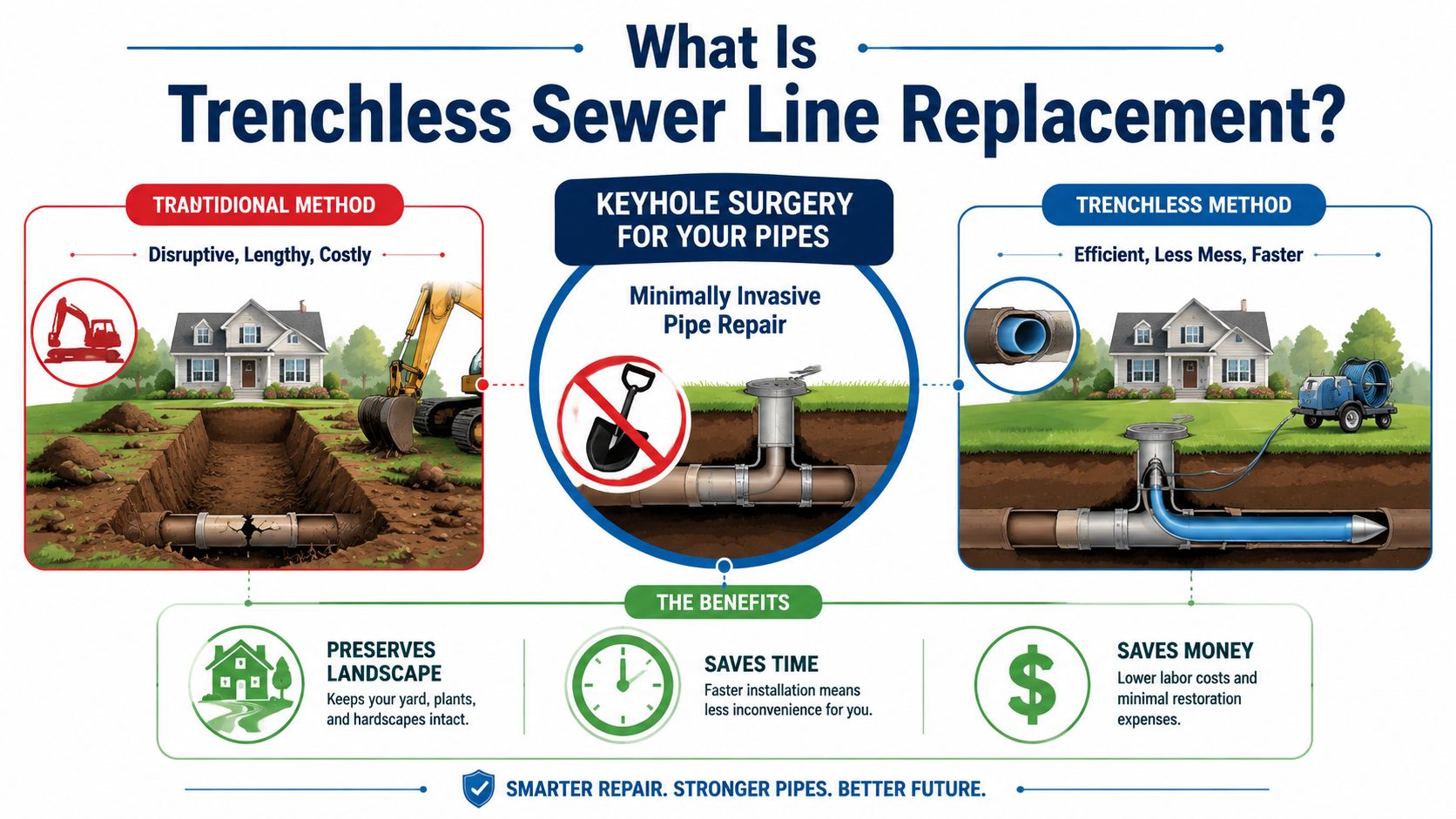
Trenchless sewer line replacement is a way to repair or replace an underground sewer line through small access points instead of digging a continuous trench from one end of the pipe to the other.
A simple way to think about it is keyhole surgery for your plumbing. Traditional excavation is open surgery. Everyone can see the work area because the whole path gets exposed. Trenchless work is more targeted. The crew reaches the damaged line through limited openings, then repairs or replaces the pipe underground.
What trenchless does and doesn't mean
It doesn't mean zero digging in every case. Crews still need access. They may use an existing cleanout or create small entry points. What it usually avoids is the long, destructive trench that runs across the yard, driveway, or patio.
It also isn't one single technique. Homeowners often hear "trenchless" as if it's a product. It isn't. It's a category that includes different methods, each with its own ideal use case.
Why the method matters on LA properties
On Los Angeles homes, the value of trenchless work often has less to do with the underground labor alone and more to do with what stays intact above ground. If a sewer line runs below a decorative walkway, mature planting, narrow courtyard, or hard-to-match concrete, preserving the surface can be just as important as fixing the pipe.
That makes trenchless especially attractive for:
- Homes with finished outdoor spaces
- Multi-unit properties with limited access
- Lots where excavation would interfere with parking or entries
- Sites where heavy digging would create extra risk or cleanup
Practical rule: Trenchless is best understood as a property-protection strategy as much as a pipe-repair strategy.
The core idea
The goal is straightforward. Restore sewer function below grade while disturbing as little as possible above grade. Sometimes that means installing a new pipe wall inside the old one. Other times it means pulling in an entirely new pipe along the same path.
Which version makes sense depends on the condition of the existing line. That's where the two main trenchless methods come in.
The Two Main Trenchless Methods Explained
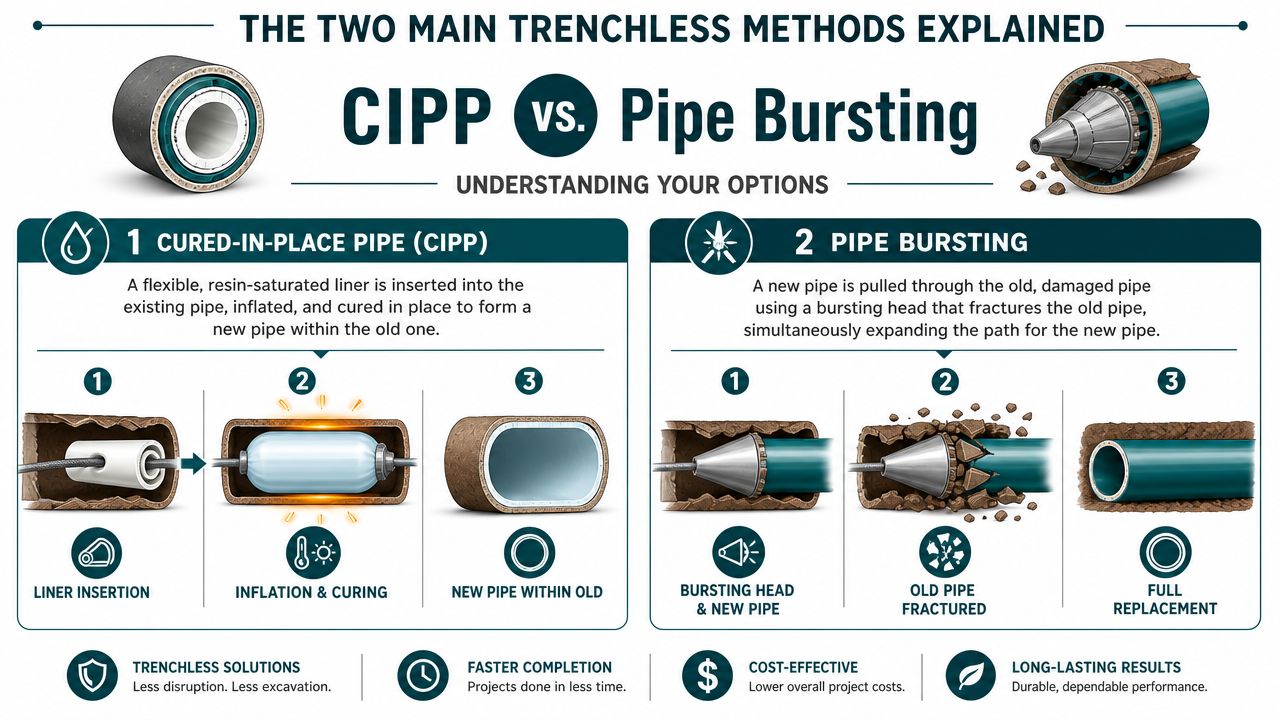
The two methods homeowners hear about most are Cured-in-Place Pipe lining, usually called CIPP, and pipe bursting. Both are trenchless. They solve different problems.
A good contractor doesn't start with a favorite method. The contractor starts with the pipe condition.
Cured-in-Place Pipe lining
CIPP is the method commonly referred to as "relining." A resin-saturated liner goes into the existing sewer line, is positioned inside it, then cured so it hardens into a new pipe wall within the old pipe.
It's like installing a durable sleeve inside a worn-out tube. The old pipe remains in place, and the new inner wall becomes the working sewer line.
As Pipe Restoration Solutions notes in its guide to trenchless no-dig pipe repair, the host pipe must be structurally stable enough to serve as a form. That's the key limitation. CIPP is best for pipes with cracks, leaks, corrosion, and localized deterioration when the original line still has enough shape to guide the liner.
Best fit for CIPP
CIPP usually makes sense when:
- The pipe still holds its basic shape
- Damage is structural but not total collapse
- You want minimal surface disturbance
- The line can be cleaned and prepared properly first
Here's a useful way to frame it. CIPP repairs from the inside out. It doesn't rebuild a path that no longer exists.
After the basic concept, it helps to see the method in action:
Pipe bursting
Pipe bursting is a replacement method, not just a lining method. Instead of creating a new inner wall inside the old pipe, the crew pulls a new pipe through the failed line while a bursting head fractures the old pipe outward.
Mechanically, it's more forceful than CIPP. The old line gets broken apart and displaced into the surrounding soil as the new pipe takes its place along the original route.
Best fit for pipe bursting
Pipe bursting is often the better option when the existing pipe is too far gone for lining but a path can still be established. It's also useful when the goal is a true replacement along the same alignment without opening a full trench.
One practical detail matters here. For pipe bursting, trenchless contractors typically use two small access points and pull the new pipe through the failed line while fracturing the old pipe outward. That sharply reduces surface restoration compared with full excavation. Some trenchless systems can also reach roughly 200 feet from a single access point depending on method and site conditions, according to Express Sewer's list of trenchless technology methods.
Side-by-side decision logic
| Method | What it does | Best when | Main limitation |
|---|---|---|---|
| CIPP | Creates a new pipe wall inside the old one | The host pipe still has enough structure to act as a mold | Won't solve a line that has lost its usable shape |
| Pipe bursting | Pulls in a new pipe while breaking the old one outward | The old line needs replacement, but the route can still be followed | May not fit situations with extreme collapse or lost alignment |
The mistake homeowners should avoid is treating these as interchangeable. They aren't. One depends on the old pipe remaining a workable shell. The other depends on being able to replace along the existing path.
Trenchless Versus Traditional Sewer Replacement
When homeowners compare options, they often ask which one is cheaper. That's not the most useful question. The better question is which method creates the best overall result for the property.
The direct plumbing work is only part of the bill. The rest can be demolition, hauling, access work, concrete replacement, outdoor area rebuilding, irrigation repair, and cleanup. That's where trenchless often changes the math.
According to this trenchless sewer replacement cost guide, trenchless sewer line replacement is generally priced at $60 to $250 per foot, with most residential projects landing between $4,000 and $15,000 overall. The same guide notes that CIPP commonly runs $80 to $250 per foot, while pipe bursting often runs $150 to $300 per foot. It also estimates trenchless repairs can be 30% to 40% less expensive than traditional excavation-based replacement in many cases because surface restoration is reduced or eliminated.
Where traditional digging still makes sense
Traditional excavation still has a real place in sewer work. If a line is badly collapsed, badly installed, tangled with other underground conflicts, or inaccessible for trenchless equipment, open digging may be the right call.
That approach gives the crew direct visual access to the pipe and surrounding conditions. On some jobs, that level of exposure is necessary.
But homeowners should look at the whole consequence, not just the pipe replacement itself. Traditional digging can mean removing hardscape, cutting roots, disrupting irrigation, and rebuilding finished surfaces. If a sewer line runs under an old driveway or a carefully designed front yard, restoration can become the most painful part of the project.
Where trenchless usually wins
Trenchless shines when the pipe problem is serious but the site itself is worth protecting. In Los Angeles, that often means homes with:
- Driveways and walkways above the lateral
- Backyards with mature planting or outdoor living areas
- Tight lot lines where excavation is awkward
- Tenant-occupied or heavily used properties where disruption matters
If the line is partially obstructed with roots or debris, pre-cleaning may also be part of the process. That's one reason homeowners often hear about hydro jetting as part of sewer prep work. Cleaning isn't the replacement, but it can be what makes an accurate inspection and a proper trenchless plan possible.
Trenchless isn't magic. It's a smarter fit when the underground problem can be solved without creating a second problem on the surface.
The value question
A trenchless quote can look high if you compare only pipe work to pipe work. It often looks much better when you compare full project to full project. That's especially true on LA properties where matching decorative surfaces or reworking access areas can be expensive and inconvenient.
So the comparison is this:
- Traditional excavation gives maximum exposure and maximum disruption.
- Trenchless replacement gives limited exposure and often much less restoration.
The best choice depends on the failure pattern, the property layout, and what has to be preserved.
Understanding Trenchless Repair Costs in Los Angeles
Cost is where homeowners want straight answers, and the straight answer is that trenchless pricing varies because the job conditions vary. Sewer work isn't priced like swapping a faucet. Length, access, depth, method, and pipe condition all change the number.
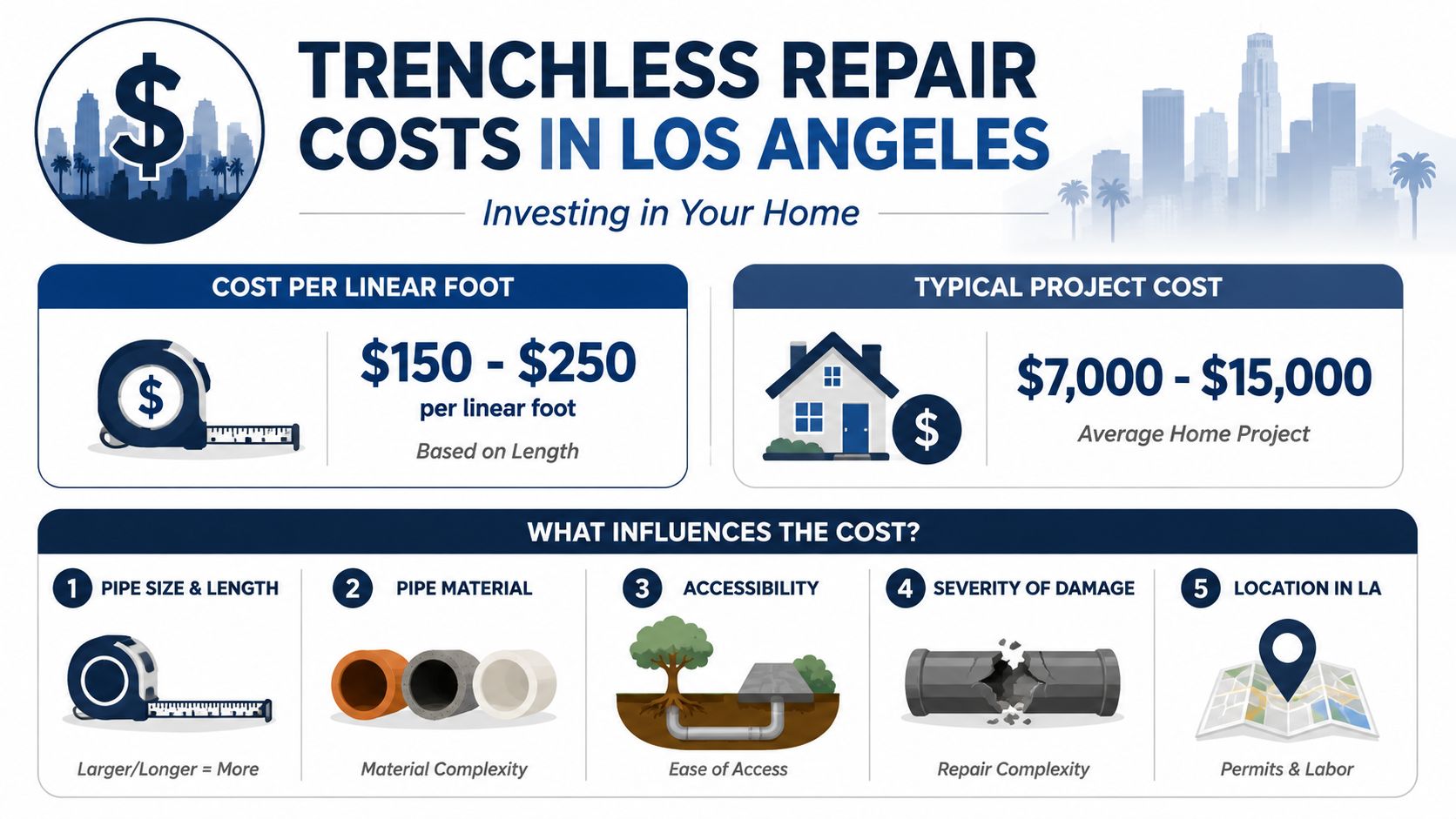
For trenchless sewer line replacement, market guides commonly place pricing at $60 to $250 per foot, with many residential jobs falling between $4,000 and $15,000 overall. For method-specific ranges, CIPP is commonly cited at $80 to $250 per foot, while pipe bursting is often listed at $150 to $300 per foot. Those figures are summarized in the cost fact provided above.
What drives the quote up or down
A solid estimate usually reflects a handful of practical factors:
- Length of the sewer run. More linear footage means more material, more setup, and more time.
- Chosen method. CIPP and pipe bursting solve different problems and have different equipment and material demands.
- Pipe depth. A deeper line can make access work harder even if the main repair is trenchless.
- Access conditions. A cleanout in a usable location is easier than a line buried beneath obstacles.
- Pipe condition. A line with routine cracking is a different job from one with severe deformation or sections that can't guide the repair.
Why LA jobs vary more than homeowners expect
Los Angeles adds its own complications. One house may have a straightforward run from cleanout to city connection. Another may have a line beneath mature ficus roots, a hillside walkway, old clay pipe with offsets, or a narrow side yard that limits equipment movement.
Permitting can also affect planning. Sewer laterals often involve city requirements, public right-of-way questions, and documentation. The better the contractor handles inspection, scope, and permit coordination, the fewer surprises homeowners face midway through the job.
Field note: When two trenchless quotes are far apart, the difference is often in scope. One contractor may be pricing the actual pipe work only. Another may be including prep, access creation, cleanup, permit handling, and verification.
How to read an estimate without guessing
Look for these details in writing:
| Item | Why it matters |
|---|---|
| Repair method | Tells you whether the contractor is lining or fully replacing |
| Footage or affected area | Shows what part of the line is included |
| Access plan | Explains where digging, if any, will occur |
| Pre-work cleaning | Important if roots or scale must be removed first |
| Post-work verification | Confirms how success will be documented |
If a quote doesn't explain those basics, it isn't complete enough yet.
Is Trenchless Repair Right for Your LA Property
Trenchless is a strong option for many Los Angeles properties, but not because it's trendy. It's a strong option when the line condition and the property layout line up with what the method can do.
The honest way to judge it is to look at your pipe in two layers. First, what failed underground. Second, what sits above that failure and what you'd rather not destroy to reach it.
Good candidates for trenchless work
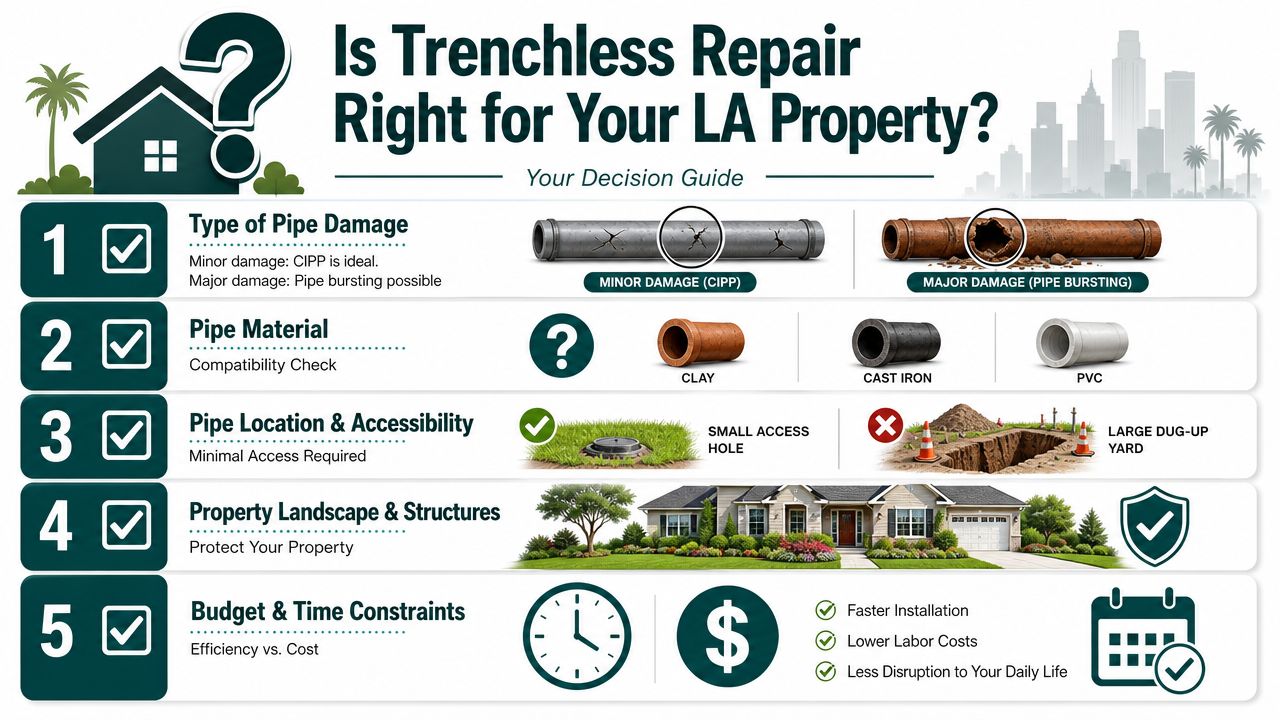
Many homes are worth serious trenchless consideration when the sewer line has damage but still presents a workable path. Good candidates often include properties where the line runs below valuable surface features or in places where excavation would be especially disruptive.
Here are common signs that trenchless may be a smart direction:
- The pipe has cracks, leaks, corrosion, or root intrusion rather than total collapse
- The line path is still traceable on camera and through locating equipment
- The property has hardscape or landscaping worth preserving
- Access is limited, making full trench excavation more disruptive than usual
- The owner wants to avoid broad restoration work after the plumbing repair
LA-specific site conditions matter too. Expansive soils, older clay lines, hillside lots, retaining features, and tight setbacks all make surface preservation more valuable. On many city properties, avoiding a long trench isn't just about appearance. It's about reducing the chain reaction of repairs that digging can trigger.
When trenchless is the wrong call
This is the part too many articles gloss over. Trenchless is not the answer to every sewer problem.
As NuFlow explains in its discussion of trenchless repair for collapsed pipes, trenchless replacement is not the right answer for lines that are completely collapsed or so badly misaligned that a path can't be established. In those situations, a hybrid approach with limited digging may be required.
That point matters because homeowners often get sold on the idea of "no-dig" before anyone confirms that the pipe is suitable for the technique.
Red flags that change the plan
A contractor should slow down and reassess if the inspection shows:
- Complete collapse
- Severe offsets or misalignment
- Missing sections of pipe
- A line that a camera can't pass and a path can't be re-established
- Conditions that prevent the old pipe from acting as a form for lining
If the sewer line has lost its route, trenchless equipment can't follow a path that isn't there.
A practical homeowner test
Ask one simple question after the camera inspection: What exactly allows this line to be repaired trenchlessly?
A good answer will be specific. It should mention the shape of the host pipe, whether alignment is intact, whether cleaning can restore a workable passage, and whether the recommendation is CIPP, pipe bursting, or a hybrid. If the answer stays vague, keep asking.
The right method isn't the one with the best marketing. It's the one that matches the failure pattern under your property.
Hiring a Contractor and What to Expect
Once you've confirmed that trenchless sewer line replacement is viable, the next challenge is choosing the crew and understanding the process from your side. Homeowners feel more in control when they know what should happen before, during, and after the work.
A reputable contractor should be comfortable documenting the condition of the line, explaining the method in plain language, and showing proof when the work is complete.
What the job looks like from your side
Most trenchless jobs follow a practical sequence:
Camera inspection first
The crew identifies the exact defect, location, and condition of the line. If you want to understand what the plumber is seeing, a dedicated sewer camera inspection overview helps explain the process.Method recommendation and written scope
You should hear why CIPP, pipe bursting, or limited excavation is being recommended. The scope should define what part of the line is included.Access preparation
The crew uses existing access where possible or creates small access points where needed. Water-use restrictions may apply during portions of the work.Repair or replacement
The actual trenchless procedure is performed with the selected equipment and materials.Final verification
A post-work camera review should confirm continuity, flow path, and finished condition.
Questions worth asking before you sign
Not every contractor who offers trenchless work has equal experience with each method. Ask direct questions.
- Who is pulling permits if needed? You want that responsibility stated clearly.
- Which trenchless method are you recommending, and why this one? The answer should tie directly to the inspection findings.
- What digging, if any, should I expect? "Trenchless" shouldn't hide the exact access plan.
- Will I receive post-repair video documentation? That record matters.
- What warranty applies to the work? Get it in writing.
- Who will perform the job? The estimator and the field crew aren't always the same people.
The best sewer contractor doesn't just promise less mess. They explain the limits, document the scope, and prove the result.
A sewer replacement is stressful enough. Clear inspection data, a method that fits the pipe, and a contractor who communicates well will make the project feel a lot more manageable.
If you're dealing with backups, sewer odors, recurring clogs, or a line that may be failing under your yard or driveway, EZ Plumbing can help you get clear answers fast. EZ Plumbing has served Los Angeles since 1989 with licensed, insured plumbing service for homes, HOAs, property managers, and commercial properties. If trenchless sewer line replacement is the right fit, you'll get a practical recommendation focused on protecting your property and avoiding unnecessary work. Call (818) 908-2710 or schedule service online to book an inspection.