
Toilet Water Level Drops: Causes, Tests and Fixes
When the water in your toilet bowl keeps sinking below its normal level, the cause is almost always one of five things: a flapper that leaks, a fill valve or refill tube set wrong, clogged rim holes, a partial clog or vent problem in the drain, or a crack in the porcelain or a failing base seal. Most of these can be told apart in about fifteen minutes with a dye test and a look inside the tank. This guide shows you how, what you can fix yourself, and when a licensed plumber is the better call.
TL;DR
- A bowl that slowly loses water between flushes usually points to a leaking flapper, a misadjusted fill valve, or a refill tube pushed too far into the overflow pipe.
- A bowl that drops right after a flush often points to a partial clog or a venting problem in the drain line.
- A dye test (food coloring in the tank, 10 minutes, no flushing) tells you whether the tank is leaking into the bowl.
- Water around the base, a hairline crack, or gurgling from other fixtures means it is time for a professional.
- We serve the greater Los Angeles area 24/7 if a leak or clog cannot wait.
Table of Contents
- What a normal water level looks like
- Start with the quick checks
- Is the tank leaking into the bowl? The dye test
- How to fix a low tank level
- When the problem is in the bowl or the drain
- Our perspective: what we see in LA homes
- When to call a plumber
- What a plumber visit costs and how we can help
- Preventing the problem
- FAQ
- Sources
What a normal water level looks like
Before you decide the level has dropped, you need to know what it should be. Lowe’s notes that a typical bowl is about one-third to one-half full, and that a low level can make clogging more likely. The exact level is engineered by the manufacturer for each model, which is why Family Handyman says the manufacturer’s fill line and instructions should take precedence over any universal rule about bowl height.
The tank has its own target. Many tanks have a mark on the inside wall. The Home Depot’s guide says the water should sit 1 to 2 inches below the top of the fill valve and overflow tube. American Standard gives a tighter target for its toilets: approximately 1/4 to 1/2 inch below the top of the overflow tube.
Two patterns matter more than the exact number:
- Sudden change: the level was fine last week and is low today. Family Handyman says a suddenly changed level can indicate a leak, a fill valve problem or a drain clog.
- Timing: does the water drop after a flush, slowly overnight, or only when no one has touched the toilet? The timing narrows the cause faster than anything else.
Start with the quick checks
Before you lift the tank lid, set up so a mistake does not become a mess. The Home Depot recommends placing towels or a bucket nearby, shutting off the supply, and flushing or sponging the tank dry before any repair work.
Then go through these in order:
- Supply valve. Make sure the valve on the wall is fully open. A half-closed valve fills the tank slowly and can leave the level low.
- Tank level. Lift the lid and compare the water to the fill mark or the overflow tube.
- Refill tube. This small flexible tube runs from the fill valve to the overflow pipe. The Home Depot lists a damaged or misplaced refill tube as a cause of low bowl water, and The Spruce adds a detached or broken tube.
- Float. Check that the float moves freely and is not rubbing on the tank wall or the flush chain.
On the refill tube, Fluidmaster explains that it should clip above the overflow pipe and discharge into it, not be pushed far down inside. Pushed too deep, it can siphon water out of the bowl and make the toilet cycle repeatedly. This is one of the cheapest fixes on the list, and it takes about ten seconds.
Is the tank leaking into the bowl? The dye test
A leaking flapper is the most common reason a bowl loses water without anyone flushing. Water seeps from the tank into the bowl, the fill valve tops up the tank, and the cycle repeats. New York City’s Department of Environmental Protection says the flapper and the fill valve are the two most common causes of toilet leaks.
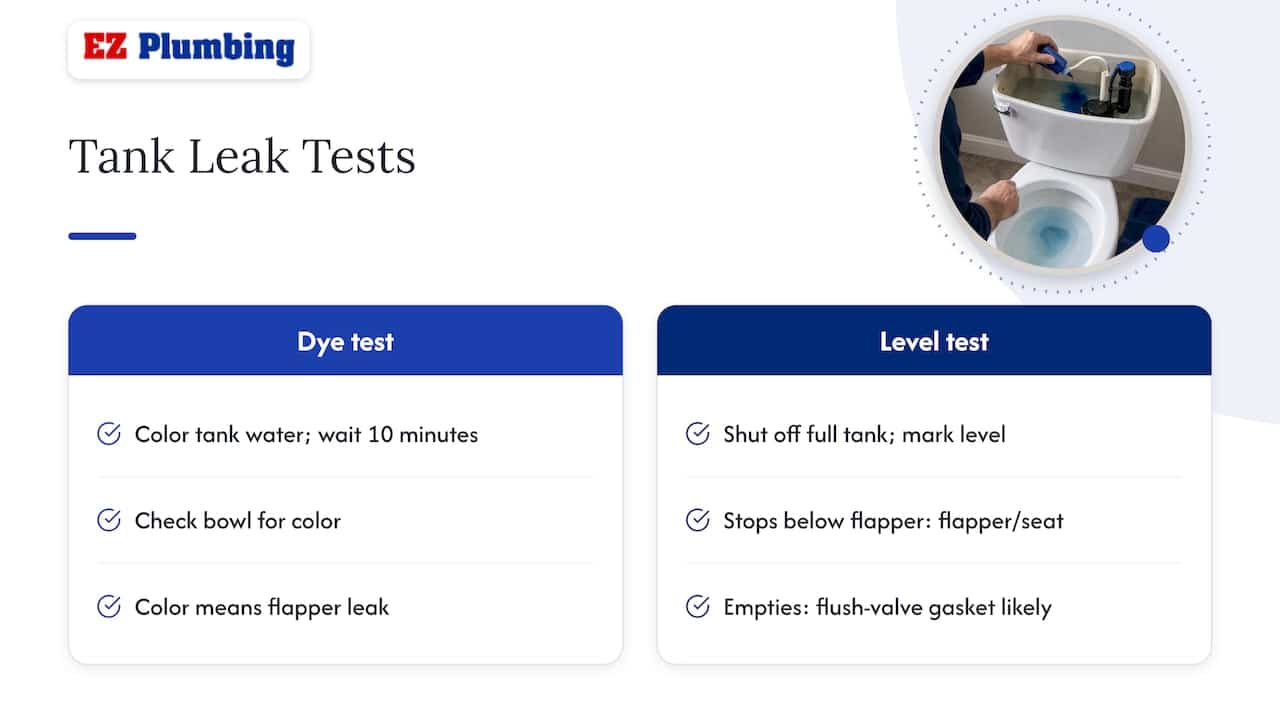
The test is simple. The City of Downey, California recommends coloring the tank water, waiting 10 minutes without flushing, and checking the bowl. Color in the bowl means water is escaping past the flapper. Downey’s guide also says more than 20% of gravity-flush toilets leak, so this is not a rare problem.
For a second opinion on the same issue, use the level test from Fluidmaster’s leak instructions: shut off the supply to a full tank, mark the water level, and wait. If the level drops and stops just below the flapper, the flapper or its seat is likely leaking. A tank that drains completely points more strongly to a leaking flush-valve gasket.
Flapper or fill valve?
NYC DEP offers a useful way to separate the two. If the tank water rises above its marked level and then falls, a flapper leak is likely. If it stops below the mark and then rises above it, the fill valve is the likely culprit.
The sound helps as well. Downey says a toilet that periodically refills without being flushed (often called phantom flushing) usually has a worn flapper, while continuous trickling commonly means water is running into the overflow tube. A trickle that never stops usually means the fill valve is shutting off too late, so the water level sits too high and spills over.
| What you notice | Most likely cause | First thing to try |
|---|---|---|
| Bowl dips, tank refills on its own every so often | Worn or dirty flapper | Dye test, then clean or replace the flapper |
| Constant trickle, water at the overflow tube | Fill valve set too high or failing | Adjust the float, then replace the valve if needed |
| Bowl low after every flush, then slowly recovers | Refill tube, clogged rim holes | Reseat the tube, clear the inlet holes |
| Bowl rises, then falls below normal after flushing | Partial clog or vent issue | Plunge, then auger, then call a plumber |
| Level drops and there is water around the base | Failing base seal or cracked bowl | Stop using it and call a plumber |
How to fix a low tank level
If the dye test is clean and the tank water sits below its mark, the fill valve or float needs adjusting.
The Lowe’s guide says to adjust the float according to the manufacturer’s instructions and replace a leaky fill valve if adjustment does not improve the level. On many modern toilets the float is part of the fill valve itself. American Standard says its universal fill valve has an adjustment screw: turning it counterclockwise lowers the tank level, and turning it clockwise raises it. Because brands differ, read the instructions for your own model before turning anything.
If the valve will not hold a level after adjustment, replacement is usually the fix, as Family Handyman notes for persistently low levels. A replacement fill valve is a standard part, and the job is within reach of many homeowners if the supply is shut off first.
Replacing a flapper
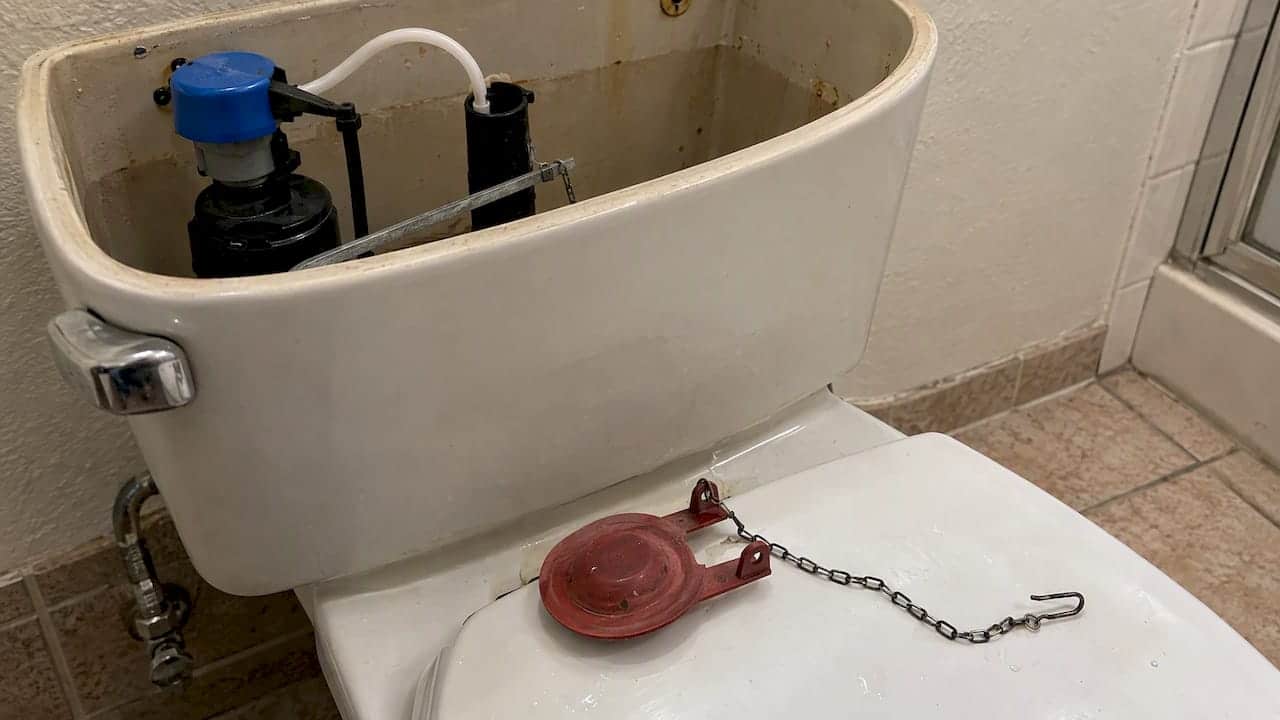
If the dye test showed color in the bowl, the flapper or its seat is the problem. Over time the rubber hardens or warps, and mineral deposits can roughen the seat. NYC DEP also warns that in-tank chlorine cleaners can corrode flapper components and cause leaks. If you use drop-in tablets, that may be why the flapper failed early.
Turn off the supply, empty the tank, unhook the flapper from its ears and chain, and bring it to a hardware store to match the size and style. Fit the new one so the chain has only a little slack. A chain that is too tight holds the flapper open slightly, and one that is too long can slip under it.
When the problem is in the bowl or the drain
If the tank is not leaking and the level looks right, look at what happens after a flush.
Clogged rim holes. Small inlet holes under the rim, and sometimes a siphon jet hole at the bottom of the bowl, can fill with mineral scale. The Home Depot lists clogged bowl inlet holes among the causes of low bowl water. Lowe’s recommends clearing blocked inlet holes as part of the fix. In Los Angeles, where tap water is often hard, scale buildup is common, and a small mirror and a wire or small brush can show you whether the holes are partly closed.
A partial clog. The Spruce says a partial clog can be the cause if the bowl rises during a flush and then falls below normal. It recommends a flange plunger or a toilet auger. If you have to do this often, our guide to a toilet that keeps clogging explains why plunging for 20 to 30 seconds before escalating makes sense, and a weak flush can have related causes, covered in our weak toilet flush guide.
A venting problem. Plumbing vents let air into the drain system. If a vent is blocked, draining water can pull air, and even bowl water, through the trap. HomeTips says a drop after flushing usually means air is being pulled through the drain system by a vent problem or partial blockage. A telltale sign is gurgling. If you hear it when a shower or sink drains, see our checklist on gurgling toilets when the shower drains, or our broader piece on why a toilet gurgles. A blocked vent is a roof-level job, and it is not one to attempt yourself.
A crack or a failing base seal. A hairline crack in the bowl or the trapway can let water out slowly, and it will not show up in the dye test. The Spruce lists a base-seal leak and a cracked toilet among causes, and Home Depot lists a cracked bowl. Check the floor around the base for dampness, soft flooring or stains. Our pages on leaks under a toilet and water coming from under a toilet cover what to look for. A cracked bowl cannot be repaired, only replaced.
If you are chasing a puddle and unsure whether it comes from the toilet at all, it is worth ruling out other sources. This guide on electric water heater leaks describes how to tell a tank leak from a connection leak, and the same logic of tracing water back to its source applies.
Our perspective: what we see in LA homes
Most toilet calls that start with a dropping water level end with a flapper, a fill valve or a refill tube, and we are glad when that is the case. The repair is quick and the cost is small. We tell customers to run the dye test before they call, because it gives us a head start and sometimes saves the visit.
The cases that worry us are the ones where the toilet is the symptom, not the problem. In older Los Angeles neighborhoods, clay sewer laterals and aging cast-iron drain lines can restrict flow, and a toilet that rises and then sinks, or gurgles when other fixtures run, can be the first sign of a partial blockage further down the line. In that situation we use a camera inspection to see the pipe rather than guess. Tree roots, offset joints and scale in older galvanized lines all show up that way.
We are a family-owned company that has served Los Angeles since 1989, so we know how the housing eras across the city differ, from 1920s bungalows to postwar slab homes. Our crews document the work for code compliance, and we give written pricing up front. If a quick fix does not hold, we would rather tell you so than keep you replacing parts.
— EZ
When to call a plumber
Downey’s guide advises contacting a licensed plumber if you are not comfortable doing the checks, and that is sound advice. Beyond comfort, call a professional if any of these apply:
- The dye test is clean, the flapper and fill valve are fine, and the level still drops.
- You see water around the base, a damp floor, or a crack in the porcelain.
- Other drains gurgle, back up, or run slowly, which points to the drain line or vent.
- The toilet has been replaced recently and still drops, which can mean an installation or seal problem.
- The bowl overflows. In that case, stop the water first and follow our emergency guide on how to fix an overflowing toilet.
If the water you are losing is not just in the bowl but is running somewhere you cannot see, a hidden leak may be involved. Our leak detection service uses specialized equipment to locate leaks without opening walls or floors needlessly, and our overview of water leak detection equipment explains how it works. For a general walkthrough of common fixes, see our toilet repair walkthrough. If the supply line itself is the problem, our toilet water line guide applies.
What a plumber visit costs and how we can help
Our residential plumbing rate is $150 to $280 per hour, and you can estimate your job on our rate calculator. Commercial work, for property managers and small businesses, is $120 to $240 per hour. Simple toilet repairs are quick, so a visit for a flapper, fill valve or refill tube is usually brief, and we give you written pricing before work begins.
We are licensed (C-36 License #583868), insured, and familiar with Los Angeles code requirements. If a toilet problem turns out to be a drain or sewer issue, we can handle drain cleaning and camera work in the same visit. For anything that cannot wait, our 24/7 emergency plumbing line is answered by real local staff, not a remote call center. You can also start from our home page.
Preventing the problem
A few habits keep the water level steady for years:
- Replace the flapper every few years, or sooner if the dye test shows color.
- Avoid in-tank chlorine tablets, which NYC DEP says can corrode flapper parts.
- Clean the rim holes occasionally if your water leaves mineral scale.
- Run the dye test once a year. It costs a few drops of food coloring and takes ten minutes.
- Do not flush wipes, even those labeled flushable, since they cause the partial clogs that make bowl levels fall.
For property managers and HOAs, a yearly check across all units catches slow leaks that never show on a single tenant’s complaint. We offer maintenance plans for this purpose, described on our commercial plumbing page.
FAQ
Why does my toilet bowl lose water but the tank is fine?
The tank level can look normal while the bowl drops because of a partial clog, a venting problem, clogged rim holes or a refill tube that siphons water. A hairline crack or base-seal leak can also let water out slowly. Check the floor for dampness, listen for gurgling elsewhere, and plunge or auger if the bowl rises and then sinks after flushing.
How do I know if the fill valve or flapper is bad?
Put food coloring in the tank and wait 10 minutes without flushing. Color in the bowl means a leaking flapper. If there is no color but the tank keeps running or trickles into the overflow tube, the fill valve is the likelier cause.
Is a low toilet bowl water level a problem?
It can be. A low level makes clogs more likely, and it can also mean a leak or a vent problem that wastes water. It is worth finding the cause rather than just topping up the bowl.
How do I fix low water in my toilet myself?
Confirm the supply valve is fully open, reseat the refill tube so it clips above the overflow pipe, clean the rim holes, and adjust the fill valve according to your manufacturer’s instructions. If the level still will not hold, replace the fill valve or flapper. If you are not comfortable doing this, call a licensed plumber.
Sources
- Common Toilet Problems and How to Fix Them (Lowe’s)
- How to Adjust the Water Level in a Toilet Bowl (Family Handyman)
- Common Toilet Problems You Can Easily Fix (The Home Depot)
- How do I adjust the water level in my tank? (American Standard)
- My Toilet Bowl Isn’t Filling With Water (Fluidmaster)
- Leaking Toilet Flapper (Fluidmaster)
- Toilet Leak Detection (NYC DEP)
- Finding Leaks Indoors (City of Downey, CA)
- 8 Reasons for Low Water Level in a Toilet Bowl (The Spruce)
- Toilet Water Level Drops After Flush (HomeTips)