
Water Leak Detection Equipment Explained for Homeowners
You notice the water meter moving when every fixture is off. Or you find a warm patch on the floor, a faint hiss near a wall, or a ceiling stain that seems too small to explain the worry in your stomach. In a Los Angeles home, especially one with a slab foundation, the visible symptom may be several feet away from the actual break.
That's where water leak detection equipment earns its place. A moisture meter can confirm dampness, but it may not identify the pipe that caused it. An acoustic sensor can hear a pressurized supply leak, while a thermal camera can reveal a temperature pattern that your eyes can't see. The right choice depends less on buying the most sensitive device and more on matching the tool to the building, pipe system, and surrounding noise.
Table of Contents
- Why Hidden Leaks Need Specialized Detection Tools
- How Water Leak Detection Equipment Actually Works
- The Main Types of Water Leak Detection Equipment and When Each Is Used
- Pros Cons and Limitations You Should Understand Before Choosing
- What to Expect During a Professional Leak Detection Visit
- Costs Red Flags and How to Choose a Qualified Leak Detection Contractor
- Making Smart Decisions About Water Leak Detection Equipment
Why Hidden Leaks Need Specialized Detection Tools
A homeowner usually discovers a leak through its consequence. Paint bubbles, flooring swells, a musty smell develops, or the water bill changes. Those clues tell you that water is somewhere it shouldn't be, but they rarely identify the exact source. A pipe under a concrete slab can release water without producing a visible stain, and water can travel along framing, insulation, or soil before appearing far from the damaged section.
Consider a bathroom with a damp baseboard on the opposite side of a wall from the shower. Removing the baseboard might expose wet drywall, but it won't necessarily tell you whether the problem is a supply line, drain connection, shower pan, or water entering from outside. Guessing can lead to unnecessary openings, repeated repairs, and a larger restoration area.
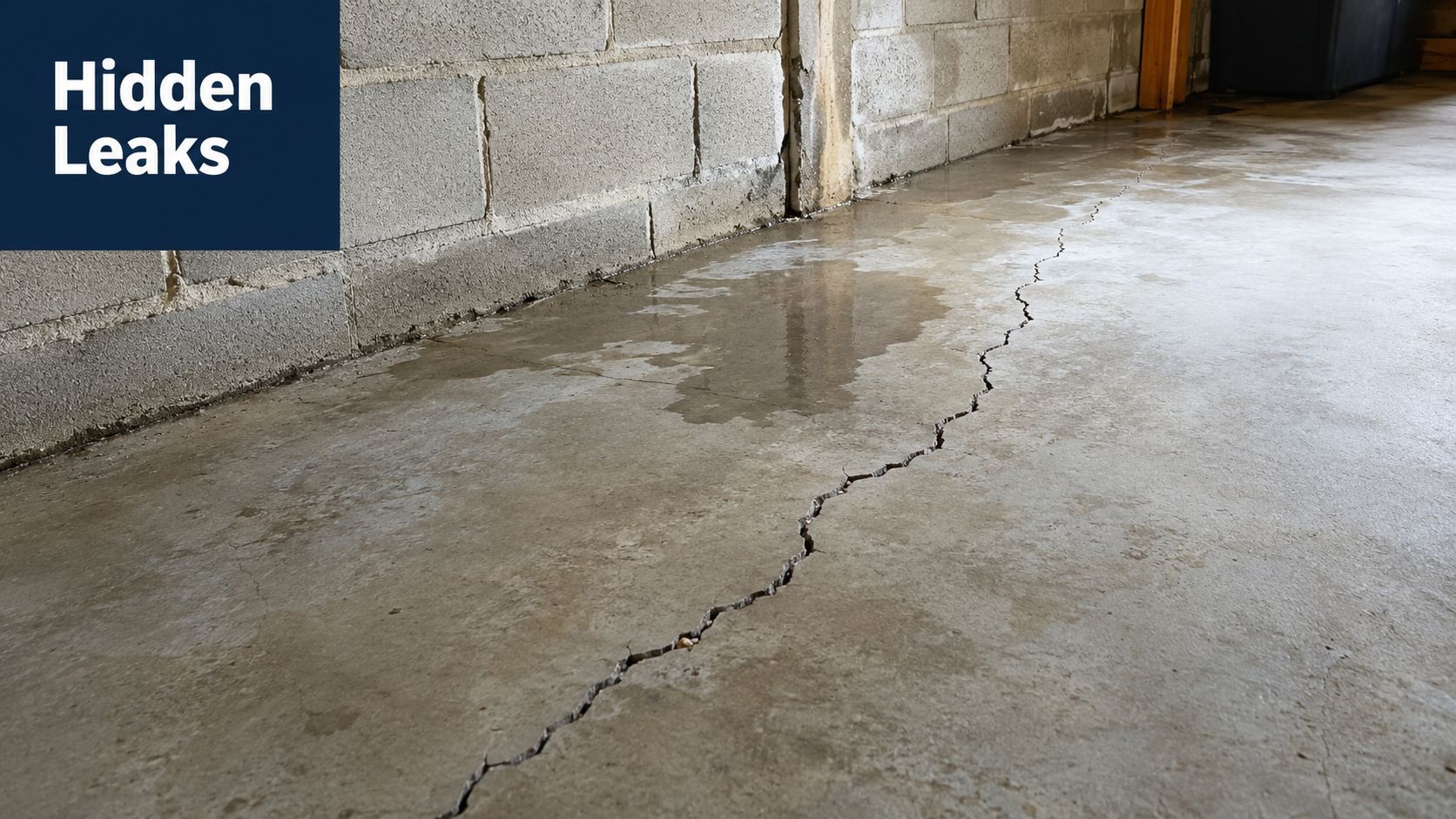
Finding damage is different from finding the source
A moisture meter answers a narrow question: is this material wetter than it should be? It doesn't automatically identify the leaking pipe. Professional diagnostics add information about sound, temperature, pressure, flow, or gas movement so the technician can narrow the search before cutting into a wall or floor.
Acoustic detection remains the most common hardware approach for pressurized water systems because escaping water creates vibrations in the pipe and surrounding material. In a U.S. test study, acoustic technology identified a minimum detectable leak size of 1 gallon per minute, according to the Defense Technical Information Center test report. That kind of sensitivity can help locate an early leak before surface damage becomes obvious.
Practical rule: A stain proves that water arrived. It doesn't prove where the water started.
Los Angeles properties add practical complications. Slab foundations limit access from below, older plumbing can run through concealed routes, and multi-unit buildings combine many fixtures, residents, pumps, and mechanical systems in one environment. Property owners looking for prevention guidance can also review these Atomic Exteriors water damage tips for broader ways to reduce exposure.
If you're unsure whether a symptom points to a hidden plumbing leak, this guide to how to detect water leaks can help you organize the first checks. The equipment decision comes afterward. You'll need to consider acoustic listening devices, thermal imaging, tracer gas, pressure and flow testing, sewer cameras, electronic locators, and connected sensors.
How Water Leak Detection Equipment Actually Works
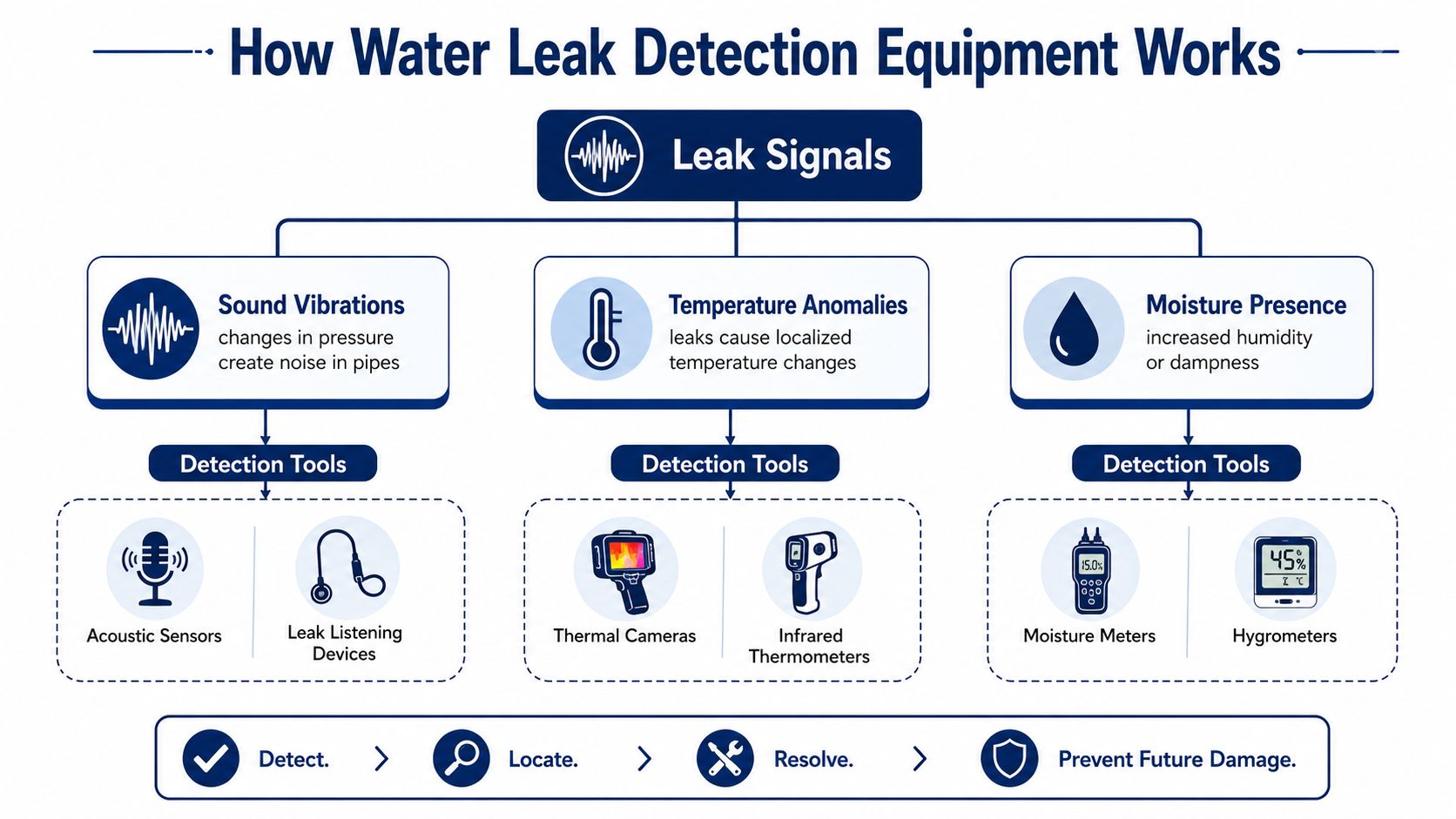
Every leak creates a signal. The technician's job is to identify which signal is strongest, measure it carefully, and separate it from ordinary activity in the building.
Sound vibrations in pressurized pipes
A pressurized water pipe behaves a little like a long instrument. When water escapes through a crack or pinhole, the change in pressure produces vibration that travels through the pipe, fittings, soil, or building materials. An acoustic listening device places a sensor against an accessible point, such as a valve, pipe, wall, or floor, and amplifies the sound.
The technician compares sound at multiple locations. A louder reading isn't automatically the source because pipe material, depth, fittings, and background noise affect how vibration travels. A trained operator looks for a pattern that becomes stronger as the sensor approaches the likely leak position.
Temperature differences
Thermal imaging works like a heat map. Escaping water can create a localized temperature difference when it is warmer or cooler than the surrounding slab, wall, ceiling, or soil. The camera doesn't see through concrete or drywall like an X-ray. It sees the surface temperature pattern produced by what's happening behind or beneath it.
That distinction matters. A thermal camera may show a useful path or warm area, but it usually needs supporting evidence before anyone opens the surface. Water temperature, building conditions, insulation, depth, and recent fixture use all influence the image.
Moisture, pressure, and flow changes
Moisture meters detect changes in material moisture, humidity, or conductivity. They're useful for confirming wet areas and tracing how far water has spread. Pressure gauges and flow measurements address a different question. They reveal whether a closed system is losing pressure or whether water is moving when no fixture should be using it.
The strongest diagnosis often combines signals. For example, a meter check can establish unexplained consumption, pressure isolation can confirm a supply-side issue, and acoustic or thermal equipment can narrow the opening point. These combined slab leak detection methods are more dependable than treating one reading as proof.
This video offers a visual introduction to the general principles behind leak detection equipment:
The Main Types of Water Leak Detection Equipment and When Each Is Used
No single instrument handles every leak. A technician chooses based on whether the water line is pressurized, whether the leak is inside a building or underground, and whether the suspected path is a supply pipe, drain, sewer, or pool line.
Acoustic listening devices and correlators
Electronic listening devices detect leak noise through contact sensors and headphones or a digital display. They're especially useful for pressurized water lines beneath slabs, walls, paved areas, and ground. A correlator can compare signals from sensors placed at two points and calculate the likely position between them.
Acoustic tools work best when the pipe carries pressure and the surroundings are quiet enough for the signal to stand out. They're less useful for an open drain that only carries water intermittently.
Thermal imaging cameras
A thermal camera scans for surface temperature differences. It can help trace warm-water leaks, identify damp patterns, and guide an inspection across floors, walls, and ceilings without immediate demolition. It's a locating aid, not a guarantee that the brightest area is the broken pipe.
Tracer gas systems
Tracer gas testing introduces a safe, detectable gas mixture into an isolated plumbing line. If the line leaks, gas can migrate through soil, cracks, or building materials and reach the surface, where specialized equipment detects it.
This method can help when acoustic signals are weak, the pipe is deep, or the environment is noisy. The line must be isolated properly, and the technician needs to interpret gas movement rather than treating every reading as an exact pipe-break coordinate.
Pressure and flow testing
Pressure testing checks whether an isolated section holds pressure. Flow testing and meter observation can identify unexplained movement in the water system. These tests establish that a problem exists, but they usually don't pinpoint the opening by themselves.
They're valuable first filters. Before investing time in detailed scanning, a technician can determine whether the suspected branch, fixture, or underground line is losing water.
CCTV sewer cameras
A sewer camera travels through an accessible drain or sewer line and sends video back to the operator. It can reveal root intrusion, collapsed sections, separated joints, standing water, and obstructions inside the pipe.
Camera inspection is the right match for recurring backups, sewage odors, or a suspected sewer defect. It won't diagnose a pressurized supply leak under a slab. For that situation, a dedicated sewer camera inspection may confirm the wrong system is being blamed, which can prevent an expensive misdirected repair.
Electronic locators and moisture meters
Electronic locators help trace buried or concealed pipe routes, while moisture meters verify dampness in accessible materials. They're often supporting tools rather than standalone answers. Used together with pressure, acoustic, thermal, or gas testing, they help a technician connect the symptom to the plumbing path.
For additional background on detection approaches and applications, readers can browse this leak detection tag.
| Leak symptom or location | Best equipment match | Why it works |
|---|---|---|
| Unexplained meter movement with fixtures off | Pressure and flow testing, then acoustic detection | Confirms water loss and narrows the pressurized section |
| Warm or cool floor patch | Thermal camera with pressure testing | Maps a surface temperature difference and verifies the system |
| Hissing beneath a slab | Acoustic listening device or correlator | Picks up vibration from escaping pressurized water |
| Repeated sewer backups | CCTV sewer camera | Shows the condition inside the drain or sewer line |
| Deep or noisy underground leak | Tracer gas with electronic locating | Provides another signal when sound is difficult to isolate |
| Damp wall, ceiling, or flooring | Moisture meter plus targeted inspection | Confirms moisture spread and supports source tracing |
Pros Cons and Limitations You Should Understand Before Choosing
The most powerful sensor isn't always the most useful sensor. In a quiet single-family home, acoustic sensitivity can help. In an HOA mechanical room, a dense apartment building, or a property beside heavy traffic, an overly sensitive device may hear pumps, valves, footsteps, vehicles, water use, and building vibration along with the leak.
Recent academic work identifies these sounds as major sources of false positive alerts in acoustic leak detection. The same research area reports that domain-knowledge-driven methods can reduce electrical noise by about 99.6% in leakage detection workflows, as described in this academic discussion of acoustic filtering and false alarms. The practical lesson is simple. Filtering, timing, and sensor placement can matter more than raw sensitivity.
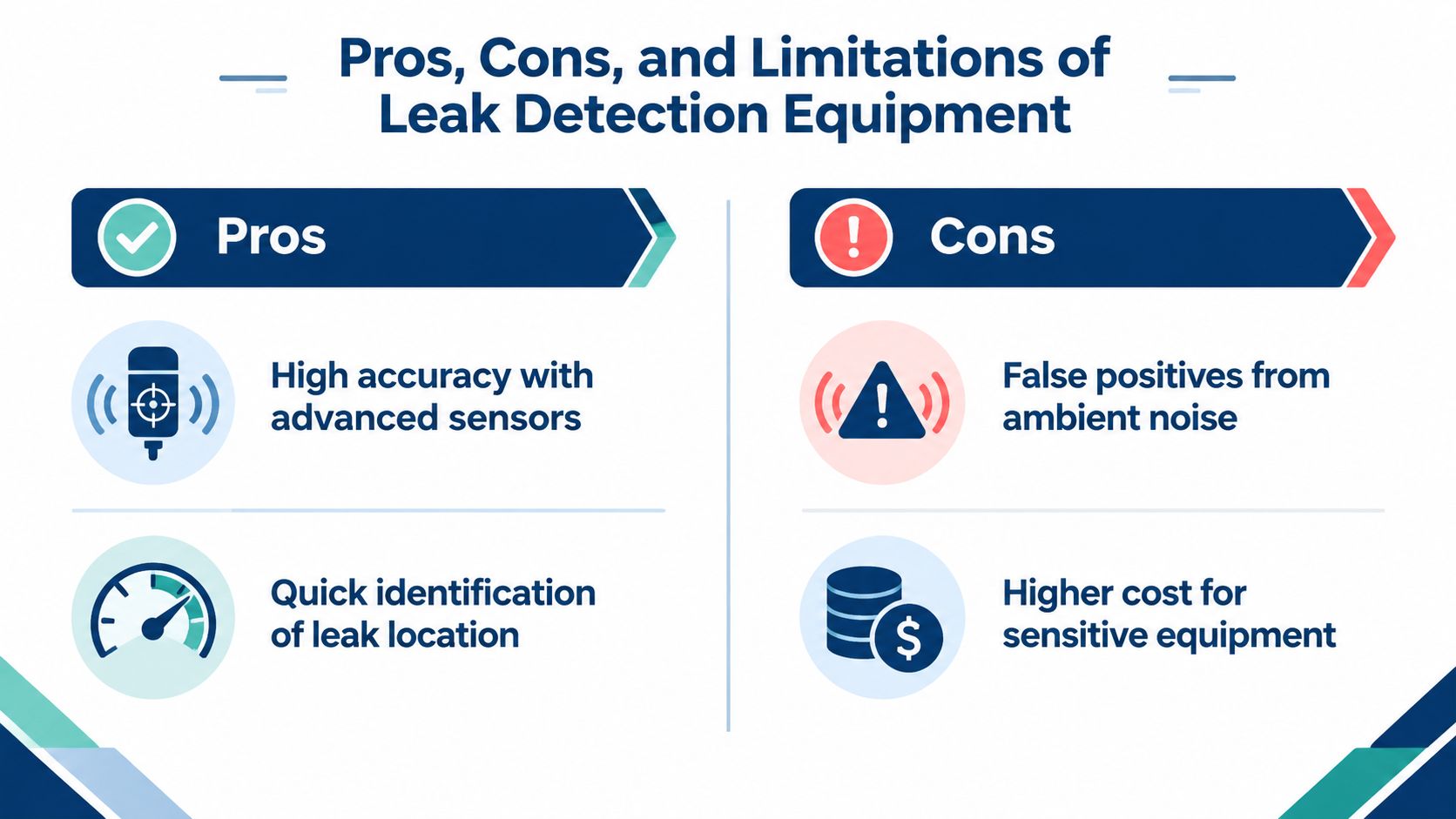
What each tool can and can't prove
Acoustic equipment can be highly effective on pressurized lines, but it may struggle with non-pressurized drains, insulated pipes, deep lines, or loud surroundings. Thermal cameras can reveal patterns across a broad surface, yet they can't directly see through concrete, and a temperature pattern may reflect moisture movement rather than the break itself.
Tracer gas can reach places sound cannot, but it requires careful isolation and interpretation. Moisture meters confirm wet materials, although they don't identify the original source. A sewer camera shows the pipe interior, but it won't inspect a separate water supply line.
The trade-offs in real buildings
Professional equipment reduces unnecessary demolition, but it doesn't eliminate uncertainty. A technician still needs access to valves, clean test conditions, a reasonable understanding of the plumbing layout, and time to compare readings.
Connected systems introduce another decision. The smart water leakage detector market is described by one market source as valued at USD 2 billion in 2025 and projected to reach USD 5 billion by 2034, while another forecast in the same source set places the sector at USD 9.77 billion by 2035. These figures are projections from independent market reporting, not a reason to select a device without considering the building environment. The more useful question is whether the system can distinguish a genuine leak from ordinary activity and whether someone will respond to its alerts.
What to Expect During a Professional Leak Detection Visit
A careful visit starts with questions, not a sensor. The technician should ask when the symptom began, whether the sound changes when fixtures operate, whether the meter moves while the property is vacant, and whether any repair or renovation recently altered the plumbing.
The first checks usually establish the basic facts. The technician may inspect the water meter, shut off fixtures, examine visible piping, and identify which branches can be isolated. That process prevents an acoustic search from starting in the wrong part of the system.
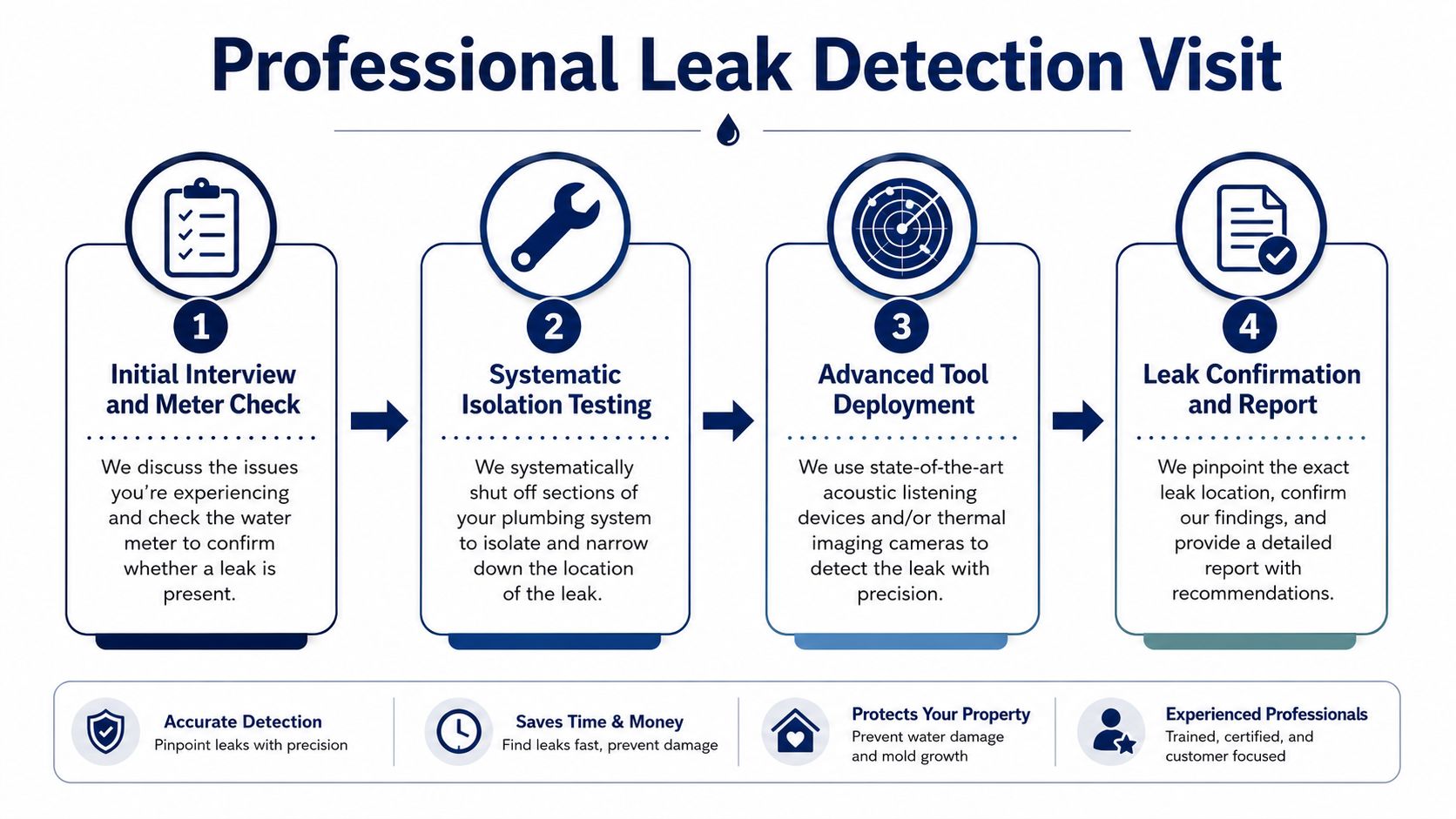
A methodical sequence reduces disruption
A typical diagnostic sequence looks like this:
- Initial interview and meter check: The technician documents the symptom and checks for unexplained water use.
- Systematic isolation testing: Valves or fixtures are isolated so the problem can be assigned to a smaller section.
- Advanced tool deployment: Acoustic sensors, thermal imaging, moisture meters, electronic locators, or tracer gas are selected according to the signal.
- Leak confirmation and report: The technician marks the suspected location, explains confidence and limitations, and provides repair options.
Good technicians don't rush to jackhammer the loudest spot. They compare readings, account for pipe routes, and use more than one clue when the consequences of an opening are significant.
What you should receive: A clear marked location, an explanation of the testing performed, a description of what the equipment confirmed, and a repair recommendation that separates known findings from assumptions.
Prepare by clearing access to the water heater, shutoff valves, cabinets, mechanical room, and suspected wet areas. For an HOA or rental property, notify residents about testing conditions and gather plumbing plans if they exist. Leak diagnostics have the same basic principle as efforts to find your roof leak fast, the visible damage may not sit directly below the point of entry or failure.
Costs Red Flags and How to Choose a Qualified Leak Detection Contractor
A leak detection quote reflects the problem's complexity, not just the presence of a particular device. Cost drivers include the suspected line, access to valves and test points, the depth or location of the pipe, the amount of background noise, whether the building is a single residence or multi-unit property, and whether the visit requires acoustic, thermal, gas, sewer camera, or combined testing.
Ask what the fee includes before approving the work. A useful quote should state whether it covers diagnosis only, written findings, marked locations, follow-up testing, and any repair estimate. It should also explain what happens if the first method produces an inconclusive result.
Questions that reveal competence
- Relevant experience: Has the contractor worked with slab foundations, shared risers, underground yard lines, and HOA mechanical rooms?
- Testing sequence: Will the technician isolate the system before interpreting sensor readings?
- Equipment fit: Which tools are being considered, and what makes them appropriate for this suspected leak?
- Documentation: Will you receive readings, photos, marked locations, or a written summary?
- Credentials: Can the company provide applicable licensing and insurance information?
- Repair boundaries: Is the diagnostic appointment separate from repair, and who approves any opening or demolition?
- Noise conditions: How will the technician handle pumps, traffic, residents, or mechanical equipment that may create false alarms?
Be cautious about unusually low flat-rate promises that ignore access and building conditions. A contractor who guarantees an exact location before testing may be selling certainty rather than performing diagnosis. A professional should be willing to describe limitations and explain when a second method is necessary.
Retrofit or new construction
Connected detection systems deserve a building-specific review. The market source cited earlier reports that 55% of industrial facilities deploy sensor-based automated leak detection solutions, and it also describes wired detectors as dominant in commercial and industrial installations while wireless units gain traction in residential use. Those findings point to a practical distinction, not a universal winner.
Wireless sensors can simplify retrofit work where opening walls or routing cable would be disruptive. Wired systems may suit large properties where uptime, scale, and integration take priority. For a new building, plan sensor locations, communications, power, shutoff control, and alert responsibility before finishes conceal the plumbing. For an existing home or HOA, start with the highest-risk rooms and areas where an alert can lead to a real response.
Making Smart Decisions About Water Leak Detection Equipment
Choose equipment by asking three questions: what signal is the leak producing, where is the plumbing located, and what noise surrounds it? A pressurized slab leak may call for pressure isolation followed by acoustic work. A damp ceiling may need moisture mapping and inspection above. A sewer backup points toward a camera, not a more sensitive water supply sensor.
Monitoring makes sense when the source is known, the area is accessible, and the condition is stable. Call for professional diagnostics when the meter moves with fixtures off, a slab or wall is persistently damp, the source remains unclear, or multiple units share the suspected line. Early investigation can limit unnecessary demolition and help prevent moisture from spreading into finishes and structural materials.
For Los Angeles homeowners, HOAs, landlords, and facility managers, EZ Plumbing offers electronic and acoustic leak detection, thermal imaging, moisture assessment, and tracer gas testing for hidden leaks behind walls, under slabs, in ceilings, pools, and yard lines. The company also provides licensed, insured plumbing service with same-day scheduling and emergency response.
Contact EZ Plumbing to discuss the symptom, building type, and access conditions before choosing equipment. Ask for a clear diagnostic plan, transparent findings, and a recommendation based on the actual leak signal rather than sensitivity alone.