
Avoid S-Permit Delays and Surprise Bills for LA Sewer Laterals
In Los Angeles, property owners are responsible for the entire sewer lateral, both the upper and lower sections, from the building all the way to the connection with the city main. The city maintains only the public mainline, and any lateral work that crosses into the public right-of-way needs special permits and a bonded contractor. That distinction determines who you call, who you pay, and who pulls the permit.
TL;DR:
- Property owners are responsible for both the upper and lower sewer lateral, regardless of whether the pipe runs beneath streets or sidewalks.
- Repairs that extend into the public right-of-way require a Class A S-Permit and must be performed by a Bonded Sewer Contractor to ensure proper inspection and compliance.
- Tree roots and pipe aging are the most common causes of lateral failures, with city street trees not usually the city’s financial responsibility unless negligence or mainline failure is involved.
- Homeowners should schedule CCTV inspections every 2 to 5 years and proactively treat roots to prevent costly emergency repairs.
- All repair work in LA must follow city-established permit and inspection procedures to avoid delays and additional costs.
Table of Contents
- What the sewer lateral is and how ownership differs from the city main
- Permits, bonded contractors, and inspections: when you need an S-Permit
- Common causes of lateral damage and how cause affects liability
- What to do after a sewer backup or suspected lateral failure
- Costs, payment responsibility, and options for a lateral repair bill
- Prevention: a maintenance checklist to avoid emergency repairs
- Our take on compliance-first lateral repairs in Los Angeles
- How EZ Plumbing handles sewer lateral repair for LA properties
- Official pages for permits, FAQs, and reporting
- Sources
- FAQ
What the sewer lateral is and how ownership differs from the city main
A sewer lateral is the private pipe connecting a building’s plumbing to the public sewer system. Los Angeles Sanitation splits it into two segments: the upper lateral, which runs from the building to the property line, and the lower lateral, which continues from the property line to the public main, often beneath the sidewalk or street. Both segments belong to the property owner, regardless of where they physically sit.
That might seem odd since part of the pipe runs under public pavement, but LA Sanitation’s guidance is direct about why: the lateral serves a single parcel, while the mainline serves the entire neighborhood. Ratepayer funds cover only infrastructure that benefits the public system as a whole, so a private connection point stays a private cost even when it sits under municipal property.
A few examples make the line clearer:
- A cracked pipe under your driveway is your lateral, and repair falls on you.
- A lower lateral segment under the sidewalk in front of your house is still your responsibility, not the city’s.
- A blockage in the public main itself, the pipe running down the middle of the street, falls under LA County Public Works or LA Sanitation, depending on jurisdiction.
- A tree root intrusion originating from a city-owned street tree does not shift lateral repair costs to the city.
For a deeper breakdown of where your lateral starts and ends on your specific property, our guide on who is responsible for sewer line repair walks through common lot configurations across LA neighborhoods.
Permits, bonded contractors, and inspections: when you need an S-Permit
Not every lateral repair needs the same paperwork. The permit path depends entirely on where the work happens.
- Work entirely on private property (your upper lateral, from the house to the property line) can be handled by a licensed plumber holding a valid C-36 contractor license and a City of Los Angeles business license.
- Work that extends into the public right-of-way, meaning any part of the lower lateral under the sidewalk, parkway, or street, requires a Class A S-Permit issued through the Bureau of Engineering, and it must be pulled by a Bonded Sewer Contractor, not just a general plumber.
- Reconnection at the property line typically requires a CCTV inspection before and after the work, confirming the new connection meets code before the trench is closed and the surface restored.
The Bureau of Engineering’s S-Permit procedures lay out this sequence deliberately: pre-repair camera inspection, permit issuance, on-site inspection during excavation, and a final CCTV pass to verify the reconnection. Skipping any of these steps is one of the most common reasons homeowners end up with stop-work orders or costly rework, since the city will not sign off on work it can’t verify.
Pro Tip: Ask any contractor bidding on right-of-way lateral work whether they are a Bonded Sewer Contractor, not just C-36 licensed. The two are not interchangeable, and only bonded contractors can legally pull an S-Permit.
Common causes of lateral damage and how cause affects liability
Most lateral failures in Los Angeles trace back to a small set of recurring problems, and knowing which one you’re dealing with helps set expectations before a contractor ever shows up.
- Tree roots are the most frequent cause, drawn into aging clay or cast-iron pipe joints by moisture and nutrients.
- Grease buildup narrows the pipe over time, especially in older multi-unit buildings with limited kitchen drain maintenance.
- Pipe age matters in neighborhoods built before the 1960s, where clay laterals are now decades past their expected service life.
- Seismic settling shifts pipe joints gradually, a slow but steady contributor in a region that sits on active fault lines.
- Contractor damage during unrelated excavation or landscaping work can crack a lateral that was otherwise sound.
Here’s the point that trips up a lot of homeowners: even when a root problem originates from a city-planted street tree, that doesn’t make the city financially responsible for your lateral. The legal reasoning is consistent across city and county guidance: the lateral serves your property alone, so its upkeep is yours no matter what’s growing nearby. The exception is when a mainline failure or documented contractor negligence caused the damage. In those cases, the recoverable party shifts, and you may have grounds to pursue the county, the city, or the contractor’s bond rather than absorbing the cost yourself. For root-specific fixes, our guide to roots in sewer lines covers the treatment options in more detail.
What to do after a sewer backup or suspected lateral failure
A backup rarely announces itself politely, so the first few hours matter for both safety and your paper trail.
- Stop using water immediately. Every flush or drain run adds pressure to a blocked or failing line and can push sewage further into the building.
- Avoid contact with standing water, which may carry bacteria, and ventilate the affected area if the smell is strong.
- Call an emergency plumber to assess whether the blockage sits in your lateral or further downstream.
- Photograph the damage and note timestamps, since insurance claims and any liability disputes depend on a clear timeline.
- Request a CCTV inspection to pinpoint exactly where the failure is, upper lateral, lower lateral, or mainline.
- Notify LA Sanitation or LA County Public Works if the camera work points to a mainline issue rather than your own pipe.
- Pull the correct permit before repair work begins: private plumbing permits for upper-lateral work, an S-Permit through a Bonded Sewer Contractor for anything in the right-of-way.
Pro Tip: Keep every CCTV inspection report and permit document from a lateral repair. If the same section fails again within a few years, that paper trail can support a warranty claim or a dispute over recent excavation nearby.
Costs, payment responsibility, and options for a lateral repair bill
The City of Los Angeles does not offer general financial assistance for lateral repair or replacement, a policy confirmed in county FAQ guidance on lateral responsibility. Whatever the repair costs, it comes out of the property owner’s pocket, whether that’s a homeowner, landlord, or HOA.
Several factors drive the final bill:
- Excavation versus trenchless repair, where trenchless methods often reduce surface disruption but aren’t suited to every pipe condition.
- Street or sidewalk restoration, required whenever right-of-way pavement is cut open for access.
- Permit and inspection fees tied to the S-Permit process for any right-of-way work.
- Contractor rates, which vary by scope and whether the job involves emergency dispatch.
Homeowner’s insurance sometimes covers sudden lateral collapse but frequently excludes gradual deterioration or root intrusion, so check your policy’s specific language before assuming coverage. Financing options through a contractor or a home equity line are common ways to spread out a larger repair. For a closer look at what drives cost differences, see our breakdowns on sewer lateral replacement cost and trenchless sewer repair pros and cons.
Prevention: a maintenance checklist to avoid emergency repairs
Waiting for a total collapse is the most expensive way to deal with a lateral problem. LA Sanitation’s guidance points to preventive CCTV inspection and early root treatment as the more affordable path, and the pattern holds across most LA neighborhoods.
- Schedule a CCTV inspection every 2 to 5 years, more often for properties with mature trees near the lateral path.
- Apply root-control treatments proactively rather than waiting for a backup to reveal the problem.
- Manage grease disposal in kitchens, especially in multi-unit buildings where several units share one lateral.
- Install a backwater valve if your property has a history of mainline surcharging during heavy rain.
- Log inspection dates across all units for property managers overseeing multiple buildings on staggered maintenance schedules.
Pro Tip: Property managers overseeing several buildings should stagger CCTV inspections by construction era rather than by calendar year alone. Pipe material and age matter more than a fixed schedule.
If a problem turns out to be on the public side, LA County Public Works handles mainline CCTV and emergency mainline repairs, and reporting an overflow there gets the right crew involved without delay.
Our take on compliance-first lateral repairs in Los Angeles
A licensed contractor that has worked on Los Angeles plumbing systems for many years, which means we’ve watched the permit and inspection process evolve alongside the city’s aging pipe infrastructure. Our approach to lateral work follows the same sequence the Bureau of Engineering expects: pre-repair CCTV, correct permit classification, inspection during excavation, and a final camera pass before the trench closes. Skipping steps might save a day, but it tends to cost homeowners more in corrections down the line.
— EZ
How EZ Plumbing handles sewer lateral repair for LA properties
Sewer lateral work in Los Angeles involves more than fixing a pipe. It means knowing which permit applies, whether a job needs a Bonded Sewer Contractor, and how to keep an inspection from turning into a delay. The coordination involves CCTV diagnostics, permit pulling, and physical repair, whether the job calls for trenchless methods or a full excavation, with attention to code requirements tied to LA’s older housing stock and its clay and cast-iron lateral systems.
If you’re dealing with a backup right now or want a lateral assessed before it becomes an emergency, our sewer line repair team is available, along with 24/7 emergency plumbing dispatch for active backups. You can also use our pricing calculator to get a sense of hourly rates before booking an assessment.
Official pages for permits, FAQs, and reporting
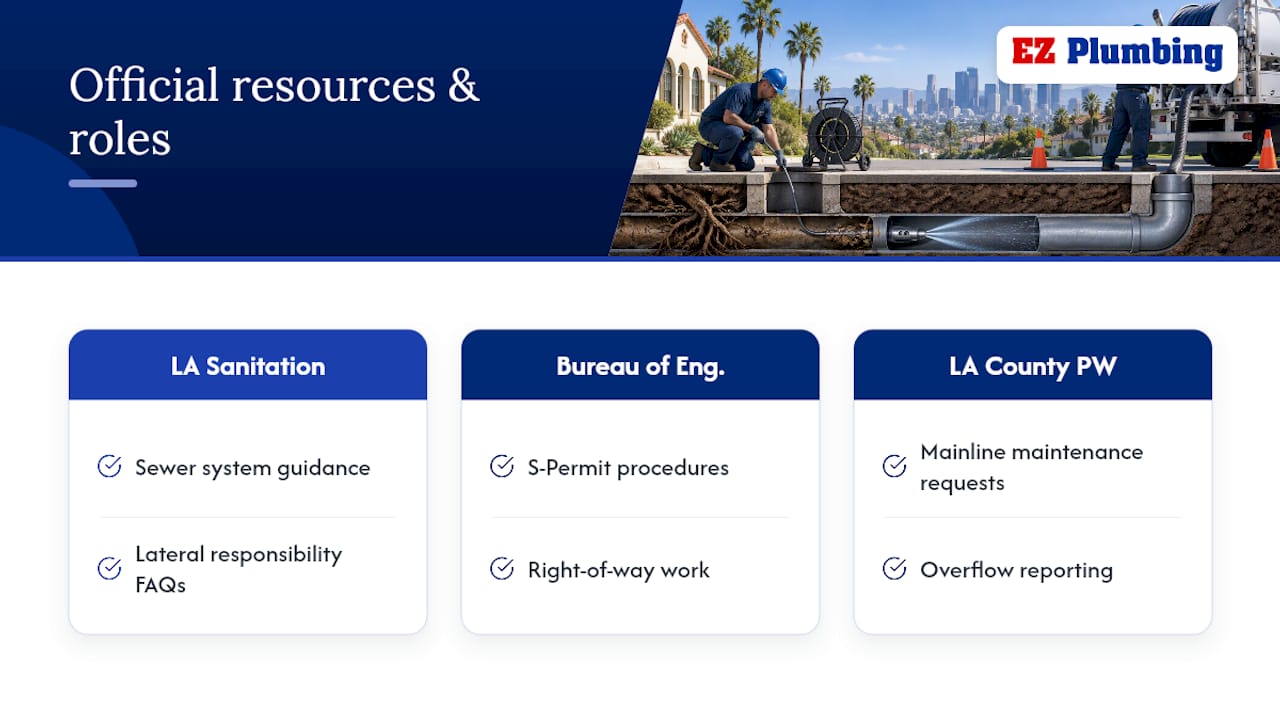
A few municipal resources cover most of what a homeowner or property manager will need. Use LA Sanitation’s sewer system guidance for general FAQs on lateral responsibility, the Bureau of Engineering’s S-Permit procedures for permit applications and right-of-way work, and LA County Public Works for mainline maintenance requests and overflow reporting. Each agency handles a distinct piece of the process, so matching your question to the right page saves a call transfer.
This article is general information, not a substitute for advice from a qualified lawyer. Consult a qualified legal professional about your own circumstances before acting on anything here.
Sources
- Managing and protecting LA’s underground sewer system | LA Sanitation & Environment
- 01 – S-Permit Processing Procedures | Bureau of Engineering
- Sewer maintenance – LA County Public Works
FAQ
How much of the sewer line is the homeowner responsible for?
A Los Angeles property owner is responsible for the entire sewer lateral, both the upper section from the building to the property line and the lower section from the property line to the public main. This holds true even where the lower lateral runs beneath a public sidewalk or street.
Who is responsible for sewage pipes?
Responsibility splits by pipe type: the property owner maintains the private lateral connecting their building to the sewer system, while LA Sanitation or LA County Public Works maintains the public mainline. The dividing line is the connection point at the main, not the property line.
Do I need a permit to fix my sewer line?
Work confined to your own property generally needs only a standard plumbing permit pulled by a licensed C-36 contractor. Work extending into the public right-of-way requires a Class A S-Permit pulled specifically by a Bonded Sewer Contractor.
How deep are sewer lines buried in California?
Burial depth varies by property grade, pipe age, and the point where the lateral connects to the main, and there’s no single fixed depth that applies citywide. A CCTV inspection through a licensed contractor, such as EZ Plumbing’s sewer line repair service, is the most reliable way to locate your specific lateral before any excavation begins.
Recommended
- Sewer Lateral Replacement Cost in Los Angeles
- Who Is Responsible for Sewer Line Repair in Los Angeles
- Avoid Permit Rework in Los Angeles: Which Agency Issues Yours
- Sewer Pipe Repair: A Los Angeles Homeowner’s Guide
Recent EZ Plumbing Jobs in Los Angeles
Real, recent work from our crews — updated automatically as jobs complete.