
Who Is Responsible for Sewer Line Repair in Los Angeles
A sewer backup rarely arrives at a convenient time. You flush a toilet and hear gurgling, wastewater rises in a shower, or a foul puddle appears near the cleanout. Then the practical question becomes urgent: who is responsible for sewer line repair, and who pays?
In Los Angeles, the answer usually depends on the exact pipe segment, the governing city or county rule, recorded easements, and the cause of the failure. A pipe under a sidewalk isn't automatically public, and a backup inside your home doesn't automatically mean the city caused it. Before approving excavation, identify the failing section and document the evidence.
Table of Contents
- Who Typically Pays for Sewer Line Repair in Los Angeles
- Private Lateral vs Public Main How Ownership Actually Splits
- Landlord Tenant HOA and Property Manager Duties
- How to Confirm Who Owns the Failing Pipe
- Step by Step Actions From Emergency Call to Permits
- Costs Timelines Insurance and Damage by City Contractors
- Quick Checklist and When to Call EZ Plumbing
Who Typically Pays for Sewer Line Repair in Los Angeles
The sewer system serving a property generally has three functional zones. First is the private sewer lateral, which carries wastewater from the building toward the public system. Second is the section that may continue through a driveway, easement, parkway, sidewalk, or street. Third is the public sewer main, the larger municipal pipe that receives flow from multiple properties.
Many jurisdictions divide responsibility at the property line. Under that common model, the homeowner maintains the upper lateral, while the municipality or sewer district handles the lower lateral and public main. That division isn't universal in Los Angeles, however. Los Angeles County sewer lateral guidance states that the property owner is responsible for the full lateral serving the parcel, including portions beneath a street or public right of way.
That creates the first important rule: physical location doesn't always determine legal responsibility. A lateral under asphalt may still be private if the local ordinance or dedication documents assign the entire lateral to the property owner. Conversely, a city main failure generally belongs to the municipality.
Start with the failure, not the bill
A plumber should first determine whether the problem is a stoppage, root intrusion, offset joint, crushed pipe, separated connection, or collapse. A drain snake can restore flow, but it won't prove who owns the damaged section. A CCTV camera inspection with a locator provides much stronger evidence because it can show the defect and its distance from the building, property line, wye, or main connection.
The pattern of the backup also matters:
- One fixture is affected: The restriction may be inside the building drain or a nearby branch.
- Several fixtures are blocked: The building sewer or lateral becomes more likely.
- Multiple properties are backing up: A shared line or public main deserves investigation.
- Wastewater is surfacing in the street: Notify the utility or city while arranging private diagnostics.
Practical rule: Don't accept a responsibility decision based only on where the plumber found standing water. The relevant question is where the defective pipe begins and ends.
For a rental, HOA property, or commercial parcel, ownership may involve leases, declarations, maintenance agreements, or easements. Get the diagnosis in writing before signing a replacement contract.
Private Lateral vs Public Main How Ownership Actually Splits
The phrase “private lateral” sounds simple, but Los Angeles property owners often discover that the legal boundary doesn't match the visible terrain. A sewer lateral can leave the building, cross the yard, pass beneath a sidewalk, and connect to the public main without changing ownership at each surface boundary.
In Los Angeles County, the owner may remain responsible for the entire lateral, including the portion in a public right of way. County guidance also describes house laterals and related appurtenances as owner-maintained components that must remain safe and sanitary. That differs from cities where responsibility changes at the property line or at a wye connection.
Neutral municipal guidance from Fullerton illustrates why a local check matters. Some cities assign the private owner the lateral up to a defined connection point, while the city maintains the public main. Other jurisdictions use a different division. The controlling document may be a municipal code, sewer service policy, recorded dedication, or easement.
Three boundaries to verify
The building connection marks where the property's internal plumbing becomes the building sewer or lateral. A break near the foundation is usually treated as private, but the contract and local rule still control.
The property line or easement may define a maintenance boundary in one city but not another. An easement grants rights to use land for a purpose, but it doesn't automatically transfer pipe ownership or repair duties.
The wye, tap, or main connection identifies where the lateral joins the public collection system. A city may maintain the main while assigning the connecting lateral to the parcel owner.
If you need a plain-language explanation of how a private pipe connects to municipal infrastructure, review this guide to municipal sewer connections. Then confirm the explanation against the rules for the property's actual jurisdiction.
The question isn't simply “private or public?” It's “which entity owns this segment under this ordinance and this recorded agreement?”
The practical trade-off is speed versus certainty. Calling the city may reveal a known main problem, but it won't replace a camera inspection of your lateral. Authorizing excavation without checking the boundary can leave you paying for work that should have been claimed against a public agency, or arguing about reimbursement after the ground is open.
Landlord Tenant HOA and Property Manager Duties
Responsibility changes when the occupant isn't the owner. A tenant may notice the backup first, but the landlord, HOA, property manager, and tenant don't carry identical duties. The lease and governing documents matter, yet habitability rules generally prevent an owner from ignoring a sewer defect that makes a rental unsafe to occupy.
The UK government's private renting repair guidance provides a clear general model. Landlords are responsible for structural and exterior repairs and for plumbing components such as sinks, sanitary fittings, pipes, and drains. California guidance similarly requires landlords to address conditions that make a rental unfit to live in. For a practical overview, property owners can also review California habitability standards.
Compare the parties
Landlord: Usually arranges and pays for a broken lateral, failed building sewer, or systemic drainage defect that the tenant didn't cause. A landlord should respond promptly when sewage enters the unit or the plumbing can't be used safely.
Tenant: Should stop using affected fixtures, report the issue quickly, and allow access for diagnosis and repair. A tenant may face responsibility for a blockage caused by misuse, but shouldn't be charged merely because the backup appeared during the tenancy.
HOA: May handle common-area lines, shared laterals, or infrastructure assigned to the association by the declaration and maintenance matrix. An HOA shouldn't assume that every pipe beyond an individual unit belongs to the association.
Property manager: Coordinates emergency access, vendors, notices, records, and owner approval. Management authority doesn't necessarily determine who ultimately bears the cost. The manager should obtain a written finding that separates the failed segment from restoration work.
For multifamily properties, ask whether the lateral serves one parcel, several buildings, or a shared private system. A shared line can create allocation questions even when the public main is functioning normally.
Keep photographs, invoices, inspection footage, tenant notices, and cleanup records. Those records help distinguish a tenant-caused blockage from age-related deterioration or a failure in a shared or public component.
How to Confirm Who Owns the Failing Pipe
Don't let a contractor classify the line from memory or surface clues alone. Ownership should be verified before a repair agreement fixes the scope and assigns the payer.
Use records in a deliberate order
Start with the assessor parcel map and the property deed. Look for the legal parcel boundary, access corridors, and recorded easements. An easement may explain why a lateral crosses neighboring land or a public corridor, but the document's language determines maintenance obligations.
Next, request available sewer records from the relevant Los Angeles sanitation authority, including an as-built sewer card or sewer service atlas information for the basin. Records can show the main, lateral alignment, connection point, and prior public work. Treat them as a starting point, because field conditions can differ from old drawings.
Check the curb cleanout and its relationship to the property line. Its position can offer a useful clue about where a lower lateral begins, but it isn't conclusive evidence of ownership. A city-installed cleanout inside an easement, conflicting maps, or an undocumented connection deserves a second opinion.
A camera inspection should produce more than a verbal conclusion. Request recorded footage, a written report, measured distances, and a site sketch showing the building outlet, cleanout, wye, tap, and observed failure. A sewer camera inspection is most useful when the technician also uses an electronic locator to mark the defect on the surface.
The 2017 SSSIP lateral program documents may help establish the usual property-line treatment for many single-family parcels, but don't treat a program document as a substitute for the parcel's current records. Multifamily, commercial, and easement-affected properties need closer review.
| Source | What It Shows | Where to Get It | Reliability |
|---|---|---|---|
| Assessor parcel map | Parcel boundaries and surrounding lots | County property records | Useful boundary reference |
| Deed and recorded easement | Access rights and possible maintenance language | Recorder or title records | Strong when language is specific |
| Sewer card or service atlas | Mains, laterals, and connection layout | Local sanitation records counter or public records process | Helpful, subject to field verification |
| Curb cleanout location | A physical clue about the lateral route | On-site inspection | Supporting evidence only |
| CCTV footage and locator marks | Actual pipe condition and failure location | Licensed plumbing contractor | Strongest field evidence when documented |
If the records conflict with the video, pause the repair decision. Reconcile the discrepancy before excavation, especially where an easement or public improvement is involved.
Step by Step Actions From Emergency Call to Permits
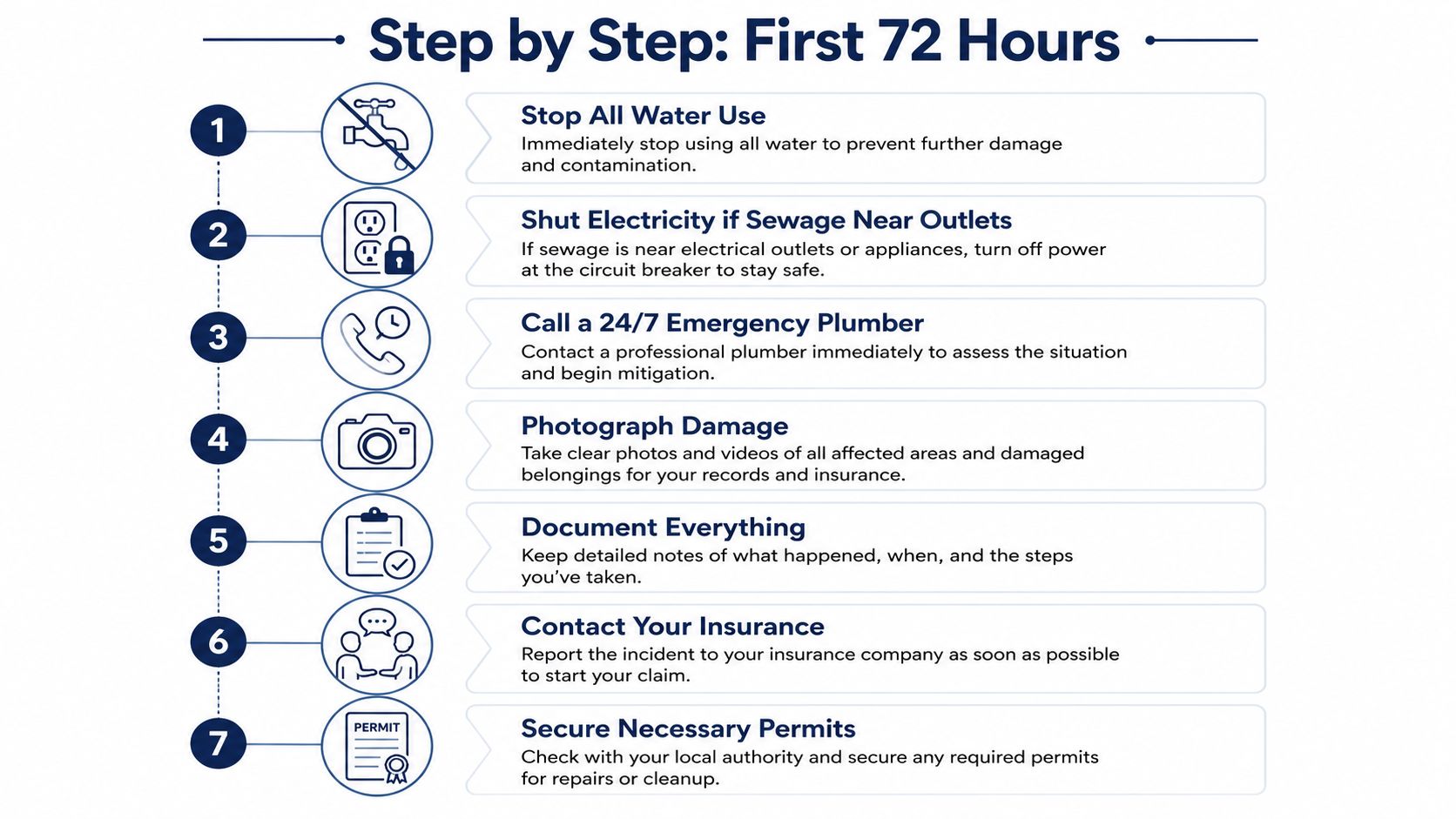
During an active backup, protect people and property before debating ownership. Stop using toilets, sinks, showers, washing machines, and other fixtures connected to the blocked system. If sewage is near outlets or electrical equipment, shut power to the affected area only if you can do so safely without entering contaminated water.
Call a 24/7 emergency plumber, then photograph the condition before cleanup or demolition. Capture standing wastewater, affected fixtures, walls, flooring, cleanouts, exterior surfacing, and any visible public-work activity. Keep damaged materials and save every invoice.
Establish the cause before choosing the repair
A response plumber may clear the immediate obstruction, but the next step is diagnosis. Depending on the symptoms, the contractor may use a hydrostatic test, CCTV inspection, electronic line locator, and written report with footage. Ask the report to identify the defect, its measured location, the wye or tap, and whether the line is suitable for lining or bursting.
Permit requirements depend on the work and location. Open-cut work in a parkway or sidewalk, structural replacement, and repairs within an easement can trigger permits or agency coordination through the Los Angeles Department of Building and Safety or another responsible authority. Confirm the requirements before cutting concrete or excavating near public infrastructure.
The contractor should also coordinate with LA Sanitation when bypass pumping or discharge affects the public sewer system. Don't discharge pumped wastewater into a public system without confirming the required notice and procedure.
Compare repair methods honestly
Pipe bursting replaces a damaged line while pulling a new pipe through the existing route. It can reduce surface excavation, but it needs suitable access, clearance, and approval at the connection.
CIPP lining installs a resin-based liner inside the existing pipe. It can work well when the pipe retains a usable route and diameter, but severe collapse, major voids, or complicated connections may rule it out.
Epoxy spot repair addresses a localized defect without replacing the entire run. It isn't a solution for a line with widespread deformation or repeated failures.
Open-cut replacement exposes the pipe directly and allows complete bedding and alignment correction. It usually creates more restoration work, but it may be the most dependable option when the line has collapsed or the grade is wrong.
Finish with a pressure or flow test, a final video of the repaired line, and written confirmation of the connection. If an easement release or record update applies, complete that documentation rather than leaving the next owner to reconstruct the repair history.
Costs Timelines Insurance and Damage by City Contractors
A sewer repair quote can change after the contractor exposes the pipe. Access, depth, soil, surface restoration, permits, connection details, and existing-pipe condition all affect the final amount. The following Los Angeles planning figures are ranges provided for this article, not a site-specific proposal. For more detail on lateral pricing, review this guide to sewer lateral replacement cost.
| Repair Method | Cost Range | Typical Duration | Permit Required |
|---|---|---|---|
| Spot repair | $3,000 to $7,500 | Depends on access and restoration | May be required |
| Full open-cut lateral replacement | $7,500 to $15,000 | Two to four days including concrete and parkway restoration | Often, when public surfaces or easements are involved |
| CIPP lining | $150 to $250 per foot | One day for a short run | Depends on connection and location |
| Pipe bursting | $80 to $200 per foot | Depends on access and approvals | Depends on connection and location |
These Los Angeles repair guidance figures are planning references, not guaranteed quotes. Permit-driven work can add one to three weeks to the schedule, even when the physical repair is shorter. Require the contractor to separate labor, restoration, permits, traffic control, and disposal in writing. The method also affects risk. Trenchless work may reduce surface damage, while open-cut work can provide better access when the pipe has collapsed or the grade is wrong.
Insurance has limits
Standard homeowners coverage commonly excludes wear, root intrusion, and many sewer backups unless the policy includes a sewer backup endorsement. Earthquake and flood coverage address separate risks, so a homeowner should not assume one general policy covers every wastewater source or ground movement.
Review the policy before an emergency. For contractors and property managers checking vendor documentation, this overview of insurance coverage for a contracting business explains contractor-side coverage, but it does not determine whether a homeowner's claim is covered.
When public work may have caused the damage
A city contractor may be responsible if public sewer construction or another project damaged the private lateral. Preserve evidence before the site changes. Photograph equipment, trench limits, fresh pavement, exposed pipe, markings, notices, and conditions before and after the work. Keep CCTV footage, invoices, plumber findings, agency communications, and repair records.
The provided guidance identifies the Bureau of Street Services as a claim path and references a six-month statute under Gov. Code 53060 for the relevant claim situation. Submit promptly because agency procedures and deadlines can be technical, and consider legal advice. Your file must connect the public work to the damage, not merely prove that a break exists. Ask the contractor to record the pipe location, failure point, and any signs of excavation impact in the written report.
Quick Checklist and When to Call EZ Plumbing
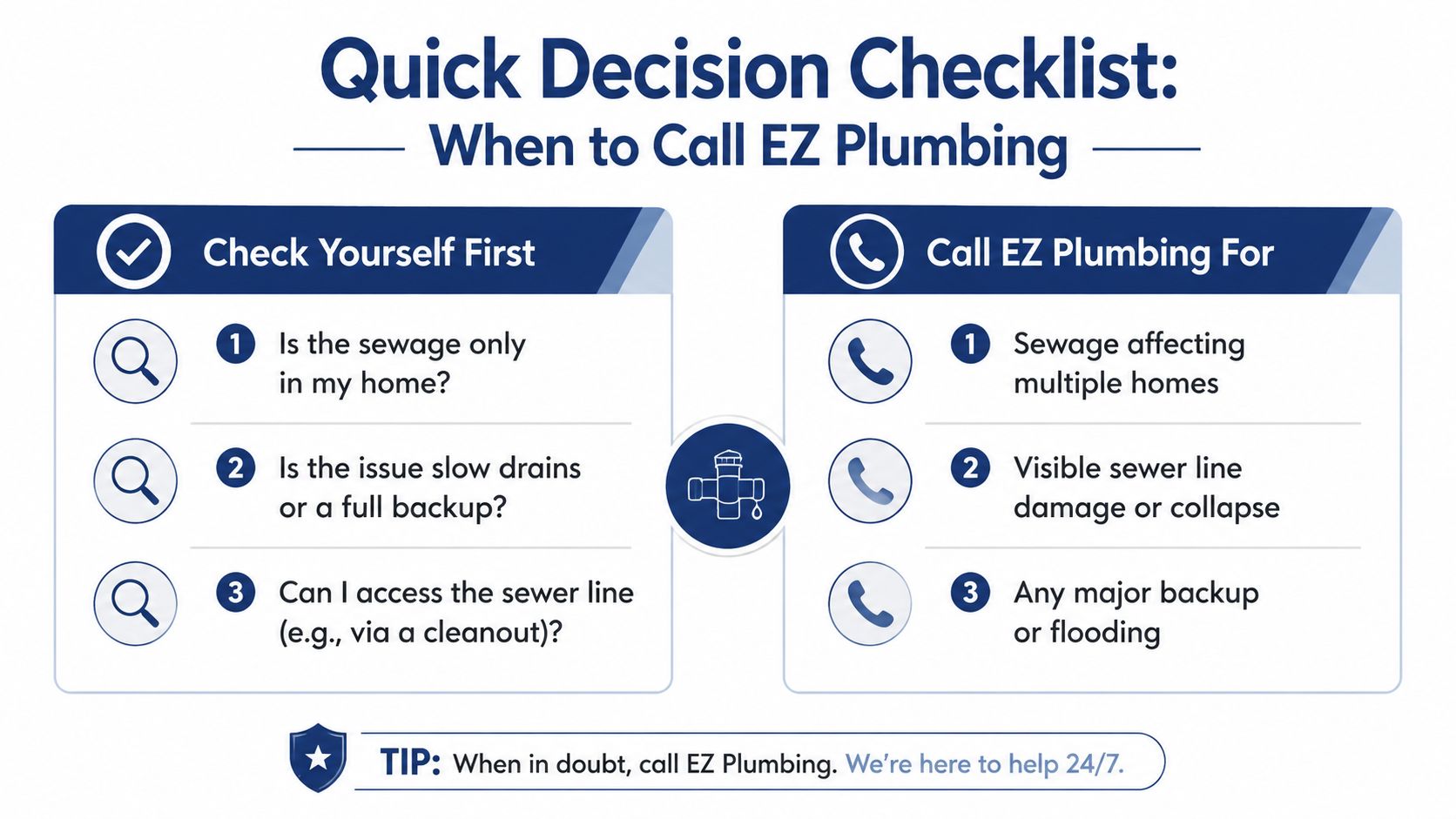
Begin with the pattern of the problem. Sewage confined to one property points toward a private building sewer or lateral, while backups affecting several homes or appearing in the street can indicate a shared line or public main. That pattern is a clue, not a final ownership ruling.
Use this checklist before approving major work:
- Control the flow: Stop using plumbing while drains are blocked. Keep people and pets away from contaminated water.
- Find the cleanout: Note its location, condition, and whether backups recur there or inside the building.
- Check the records: Review the deed, HOA declaration, maintenance matrix, easements, and municipal sewer information.
- Request a camera inspection: Ask for the wye, tap, break, root intrusion, collapse, and surface-located measurements.
- Build the claim file: Photograph sewage, affected fixtures, flooring, walls, cleanup, public work, and all repair activity.
- Demand a written scope: Require repair alternatives, permits, restoration responsibilities, connection work, and warranty terms.
- Escalate active failures: Call a licensed Los Angeles plumbing contractor for sewage inside the home, multiple blocked fixtures, visible collapse, flooding, or a suspected public-work connection.
A slow drain may allow time for records research. A full backup doesn't. Don't keep flushing to test the system, and don't authorize trenchless work until the camera confirms that the pipe's shape, access, and connection permit the proposed method.
EZ Plumbing provides 24/7 emergency response, sewer diagnostics, lateral locating, permit coordination, and trenchless or open-cut repair in Los Angeles. The useful outcome isn't just a cleared drain. It's a documented answer about the failed segment, the responsible party, and the repair that fits the pipe and the property.
If sewage is backing up or your lateral has failed, contact EZ Plumbing for 24/7 emergency response, camera inspection, locating, and permit-aware repair planning. Visit EZ Plumbing to schedule service and get a clear explanation of responsibility before excavation begins.