
Avoid Permit Rework in Los Angeles: Which Agency Issues Yours
If your property sits inside Los Angeles city limits, LADBS issues your plumbing permit. If it’s in unincorporated LA County, LA County Public Works handles it instead. Either way, the path is the same: apply, go through plan check if your project triggers one, pay the fees, and schedule inspections. Skip any of it and you risk fines now and a disclosure headache when you sell.
TL;DR:
- Permitting jurisdiction depends on whether the property is inside Los Angeles city limits or unincorporated LA County, and confirming this early prevents rework.
- Most plumbing projects, including sewer replacements, re-piping, gas line changes, and water heater replacements, require permits, with complex jobs needing plan check approval.
- Preparing proper documentation, such as site plans, plan sets, ownership proof, and appliance specs, is essential for smooth permit approval, which can be tracked online.
- Inspections include rough, gas, and final checks, with timelines ranging from a few days for simple swaps to weeks for complex projects, and delays often result from incomplete work or documentation issues.
- Skipping permits or hiring unlicensed scammers risks fines and serious safety or resale problems, emphasizing the importance of using official portals and licensed contractors.
Table of Contents
- Which Agency Handles Your Plumbing Permit: City or County?
- Do You Actually Need a Plumbing Permit for This Project?
- How Do You Apply for a Plumbing Permit in LA?
- What Happens During Inspection, and How Long Does It Take?
- How Much Does a Plumbing Permit Cost in Los Angeles?
- Who Can Pull a Plumbing Permit: You or a Licensed Contractor?
- What Are the Risks of Skipping a Permit or Falling for a Scam?
- Where Do You Find the Right Permit Forms?
- How EZ Plumbing Helps You Navigate Permits and Inspections
- When Should You DIY and When Should You Hire a Licensed Plumber?
- Let EZ Plumbing Handle Your Next Permitted Job
- Sources
Which Agency Handles Your Plumbing Permit: City or County?
Jurisdiction determines everything else about your application, so confirm it before you touch a portal or call a contractor. Properties inside the City of Los Angeles fall under the Department of Building and Safety, commonly called LADBS. Properties in unincorporated pockets of the county, places like East Los Angeles, Altadena, or parts of the Santa Monica Mountains that never got annexed into a city, fall under LA County Public Works.
This distinction trips people up constantly. Two houses on the same street can answer to different agencies depending on an old annexation line nobody remembers drawing. Confirming jurisdiction early is the single most common step that prevents rework, since filing with the wrong agency means starting over with new forms, new fees, and a fresh queue.
Here’s how to nail it down before you file anything:
- Check your address against LADBS’s ZIMAS parcel lookup, which shows city zoning and jurisdiction directly.
- Look for an unincorporated area designation on your property tax bill. County parcels usually list a community name rather than “Los Angeles.”
- Call the LADBS public counter or LA County Public Works directly if the online tools leave you unsure. A five-minute phone call beats a rejected application.
- Start your application through the correct portal from the outset. LADBS uses its PermitLA system for city properties, while LA County Public Works routes applications through its EPIC-LA portal.
Once you know your agency, the rest of the process, plan check, fees, inspections, follows a similar structure whether you’re filing with the city or the county.
Do You Actually Need a Plumbing Permit for This Project?
Most plumbing work touching your home’s water, gas, or waste systems needs a permit for plumbing work, full stop. The confusion isn’t usually about whether a permit is required. It’s about scale, and whether your project also triggers a plan check.
- New sewer lines or sewer lateral replacement always require a permit, and often an inspection of the connection point at the street.
- Rewiring or re-piping an entire bathroom’s supply and drain lines requires a permit, since you’re altering the fixture layout and drainage path, not just swapping a part.
- Gas piping changes, including adding a line for a new range, dryer, or outdoor fire feature, require a permit because gas work carries real safety risk if done wrong.
- Water heater replacement requires a permit in nearly every case, even a straight swap, though many jurisdictions let you file this through an express permit process rather than a full plan check.
- Repiping a house, replacing old galvanized or copper supply lines throughout, requires a permit and often a plan check depending on the fixture count.
Plan check enters the picture when a project gets complex enough that a counter technician can’t approve it on sight. According to LADBS guidance, plan check applies to drainage and vent systems above certain fixture-unit thresholds, medium or high-pressure gas piping, commercial water supply systems using 2-inch or larger supply mains, and pool circulation systems. If you’re adding a whole new bathroom wing or running gas to a six-burner commercial range, expect plan check.
On the other end of the spectrum, simple repairs like replacing a single toilet, a sink, or a faucet often qualify for express permit issuance the same day you apply, no plan check required. If your project is a one-for-one fixture swap, don’t assume you need the full review process. Check the express permit option first. It exists precisely so homeowners and contractors don’t wait weeks for something a technician can approve at the counter.
How Do You Apply for a Plumbing Permit in LA?
Getting an LA plumbing permit application approved on the first pass comes down to showing up prepared. Missing documents cause more delays than complicated plumbing scopes.
Before you file anything, gather:
- Site plan or plot plan showing the property and the location of the work, required for anything beyond a simple fixture swap.
- Plans stamped or prepared to code if your project triggers plan check (large drainage systems, gas piping upgrades, commercial supply lines).
- Proof of property ownership if you’re filing as an owner-builder rather than through a licensed contractor.
- Contractor’s license number and business information if a licensed plumber is pulling the permit on your behalf.
- Appliance specification sheets for water heaters, tankless units, or gas appliances being installed.
Once your documents are ready, submission depends on your jurisdiction. City of LA properties file through LADBS’s PermitLA portal, or in person at a district office if the scope calls for a full plan check rather than express issuance. LA County properties file through the EPIC-LA online system, uploading plans and supporting documents directly rather than mailing paper copies. Both systems let you track plan-check status once submitted, so you’re not calling a counter every few days wondering what’s happening with your file.
Here’s where a lot of homeowners get burned. If your project needs sign-off from a secondary agency, health department approval for a commercial kitchen, or fire department review for certain gas installations, and you don’t secure that approval before your plan check window closes, you can forfeit the plan-check fee you already paid. The application isn’t refunded just because you ran out of time chasing a second agency’s signature.
Pro Tip: Call any secondary agency before you submit your plumbing plans, not after. Confirming their requirements up front means you submit one complete package instead of restarting your plan-check clock.
What Happens During Inspection, and How Long Does It Take?
Every permitted plumbing job gets inspected, usually more than once, before the city or county considers it closed.
Inspectors typically check work at three stages:
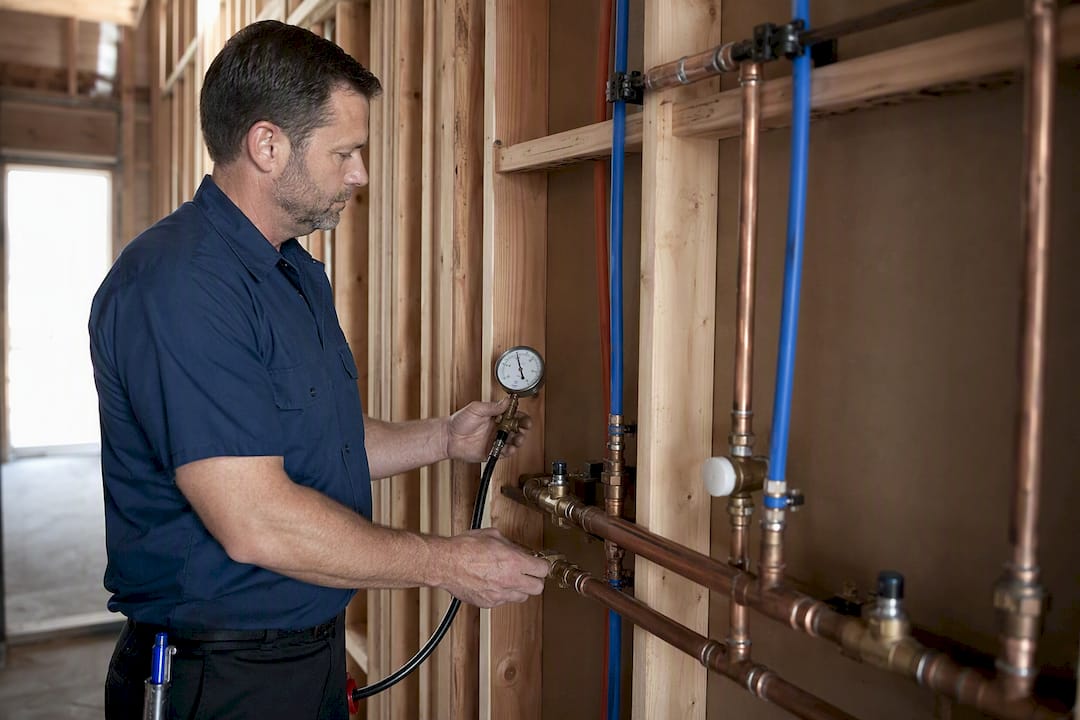
- Rough inspection, done before walls or floors are closed up, verifying pipe sizing, slope, venting, and support before anything gets covered.
- Gas inspection, checking pressure testing on new or altered gas lines before appliances are connected.
- Final inspection, confirming fixtures are properly connected, the system holds pressure, and the completed work matches the approved plans.
Timelines vary by project complexity and how busy the district office is that month. A same-day express permit for a water heater swap might get inspected within a few business days of the work finishing. A plan-checked project, a full bathroom remodel or a gas line extension, can take several weeks to move through initial plan review, and inspections themselves are usually scheduled within a few business days of your request once the work is ready.
Common causes of delay include incomplete rough plumbing that isn’t ready when the inspector arrives, missing test plugs or pressure gauges for gas lines, and work that doesn’t match what was approved on the plans. Scheduling is done online through PermitLA or EPIC-LA, and most inspectors give you a scheduling window rather than a fixed time. Final sign-off happens once every required inspection passes and the permit is marked complete in the system, which is the record you or a future buyer will need at resale.
How Much Does a Plumbing Permit Cost in Los Angeles?
The cost of a plumbing permit is built from several layers, not one flat number. You’re generally paying a base permit fee, then per-fixture or per-outlet charges on top, plus a separate plan-check fee if your project needed one, and occasionally an investigation fee if work started before a permit was pulled.
LA County’s plumbing application lists individual PLxx line items covering specific work types, including:
- Water heater installation or replacement
- Additional fixture outlets beyond a base allowance
- Gas meter and regulator line installations
- Drainage and vent system additions
These line items add up quickly on a multi-fixture remodel, which is why a full repipe costs more in permit fees than a single toilet swap even though both are “plumbing permits” on paper. One detail worth flagging twice: plan check approval is only valid for a limited period, commonly one year, and fees are forfeited if you let that window lapse without pulling the permit or securing required secondary approvals. For the exact dollar amounts tied to each PLxx code, check the LA County plumbing application form directly rather than relying on a secondhand estimate, since fee schedules get updated periodically.
Who Can Pull a Plumbing Permit: You or a Licensed Contractor?
Homeowners can act as their own owner-builder in many cases, but eligibility comes with real conditions attached.
- Owner-builders generally must prove ownership of the property, and some jurisdictions require the home be your primary residence rather than a rental or investment property.
- Come prepared with a deed or property tax bill at the counter. Applications commonly stall when owner-builders show up without proof of ownership in hand.
- Contractors pulling permits on your behalf need a valid license number tied to the scope of work, a plumbing contractor generally holds a C-36 classification.
- The Contractors State License Board advises hiring licensed contractors specifically because it protects you against poor workmanship and financial liability if something goes wrong.
- Verify any contractor’s license number directly on the CSLB website before they pull a permit, and ask to see current insurance documentation, not just a license card.
Hiring a licensed gas plumber for gas line work is especially important to handle carefully, since a poor connection poses a safety hazard beyond just a code violation.
What Are the Risks of Skipping a Permit or Falling for a Scam?
Unpermitted plumbing work doesn’t just risk a fine while the work is happening. It resurfaces at the worst possible moment: during a home sale, when a buyer’s inspector or the title company flags work with no permit history. Sellers are generally required to disclose known unpermitted work, and LA County Public Works treats permitting as a core safety and compliance mechanism, not paperwork for its own sake. Official applications also include investigation fee provisions specifically for work discovered after the fact, which typically costs more than pulling the permit up front would have.
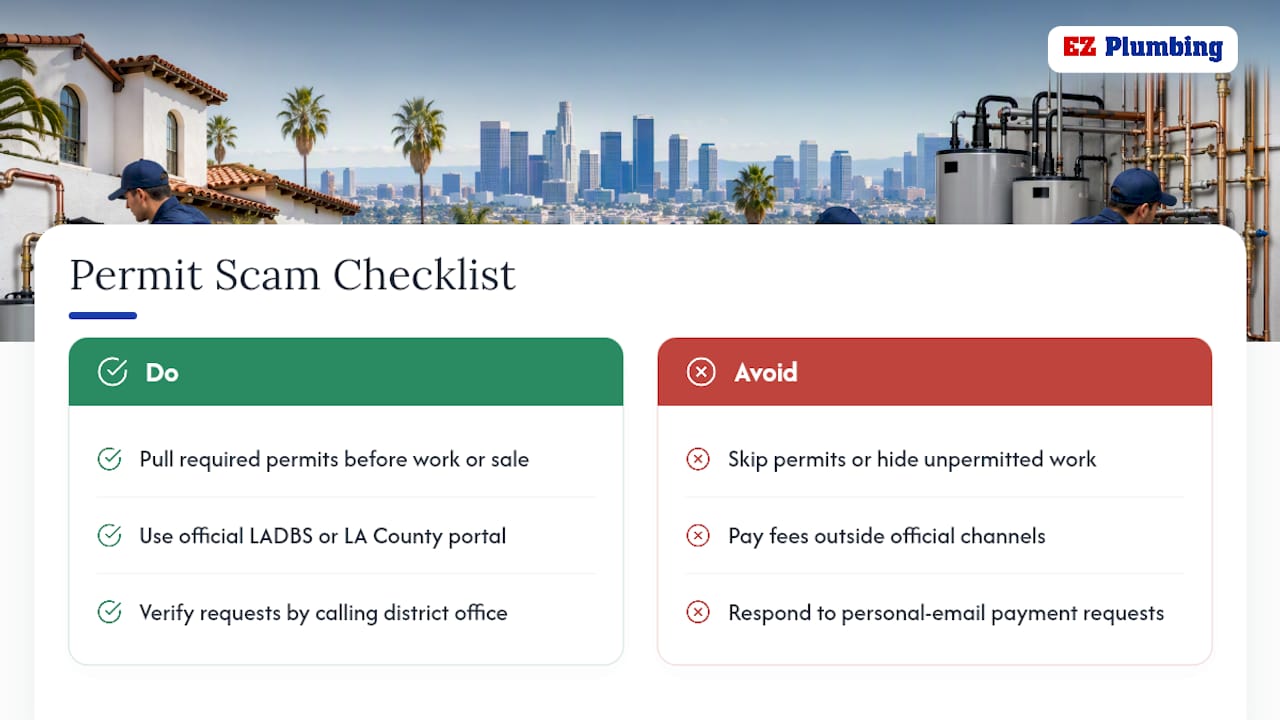
Scams are a separate but related risk. Fraudulent actors sometimes pose as permit “expediters” offering to speed up approval for a fee paid outside official channels. Government agencies warn that legitimate permit communications come from specific city or county domains, never a personal email address requesting payment via gift card or wire transfer.
Pro Tip: Never pay a permit fee to anyone outside the official LADBS or LA County portal. If a request feels off, call the district office directly to confirm before sending a dollar.
Where Do You Find the Right Permit Forms?
Gathering the right paperwork before you file saves a trip back to the counter.
- The LADBS plumbing permit page covers city applications, express permit eligibility, and plan-check requirements.
- The LA County plumbing application PDF lists PLxx fee codes for county filings.
- Bring proof of ownership, contractor license details, appliance specs, and a site plan if your scope calls for one.
Once your documents are together: confirm jurisdiction, submit through the correct portal, and track your plan-check status online rather than guessing.
How EZ Plumbing Helps You Navigate Permits and Inspections
Pulling permits correctly the first time is part of the job, not an afterthought. A licensed plumbing contractor can prepare permit-ready plans, attend inspections, and resolve plan-check corrections when an inspector flags something. On jobs like water heater installation or gas line work, having a licensed plumber handle the permit paperwork means one less place for the process to stall.
When Should You DIY and When Should You Hire a Licensed Plumber?
A simple rule of thumb: if the project qualifies for an express permit, a single fixture swap, a like-for-like water heater replacement, a confident DIYer with the right documentation can often manage the paperwork alone. Once a project touches gas piping, alters drainage layout, or triggers plan check, the calculus changes. Mistakes there aren’t just code violations. They’re safety hazards and future disclosure problems at resale.
Hiring a licensed plumber doesn’t just get the pipe fixed. It gets the paperwork right the first time, which matters more at sale than most homeowners expect.
— EZ
Let EZ Plumbing Handle Your Next Permitted Job
A practical alternative to juggling permit portals and plan-check corrections on your own is to hire a licensed, insured plumbing contractor who can pull permits, prepare permit-ready documentation, and attend inspections to help avoid prolonged back-and-forth with district offices.
Our team handles everything from straightforward fixture replacements to full water heater installation projects that require plan-check coordination, and we’re fully code-compliant with LA municipal requirements throughout the process. If you’re weighing a water heater replacement or another permitted job, get a quote on our water heater installation services page and we’ll walk you through what the permit actually requires before work starts. Homeowners juggling multiple renovation trades at once might also find One Day Doors & Closets useful for interior work happening alongside plumbing upgrades.
Sources
- Plumbing Permits | LADBS – City of Los Angeles
- Building and Safety – LA County Public Works Permits
- Plumbing application form (LA County Public Works) — PLxx fee line items
- Contractors State License Board — consumer guidance
Recommended
- Los Angeles plumbing code: A compliance guide for homeowners
- Avoid Permit Callbacks: CPC 608.3 Rules for Expansion Tanks in Los Angeles
Recent EZ Plumbing Jobs in Los Angeles
Real, recent work from our crews — updated automatically as jobs complete.