
Sewage Smell in Your Yard: Causes, Fixes, Who to Call
A sewage smell in your yard usually comes from one of four places: a dry or damaged drain trap, a blocked or badly placed roof vent, a cracked or open sewer cleanout, or a failing line underground. In most Los Angeles homes the first three are quick to confirm and fairly inexpensive to fix. The fourth is the one worth catching early, so this guide walks you through how to tell them apart, what you can safely check yourself, and when to bring in a licensed plumber.
TL;DR
- Start with the simple causes: a dry outdoor drain trap, a loose cleanout cap, or a blocked roof vent.
- Wet ground, soggy patches or visible wastewater outside means a leaking or broken line. Treat that as urgent.
- If the smell is a rotten-egg odor you suspect comes from a treatment plant or the street, report it to the agency, not a plumber.
- Sewer gas at low outdoor levels is mainly a nuisance, but a persistent smell points to a real fault in the system.
- A camera inspection finds the source without guessing or digging.
Table of Contents
- Why a yard smells like sewage
- The common causes, from simplest to most serious
- A quick table to narrow it down
- What you can safely check yourself
- When the smell means you should call a plumber
- Who to call if the smell is not from your property
- How a plumber finds the source
- Our perspective: smell is data
- What it costs to find and fix
- Need a plumber for a yard sewage smell?
- Preventing the smell from coming back
- Frequently asked questions
- Sources
Why a yard smells like sewage
Your plumbing is built to carry waste out and let gas escape safely above the roof. When any part of that path fails, the gas finds another way out, and that way is often a spot in your yard. The smell itself comes from the breakdown of organic material, which produces compounds that read as rotten eggs, ammonia or garlic. Los Angeles County Public Health notes that these odors are sensitive to weather and are strongest on hot, humid days.
That matters here. A smell you barely notice in January can be hard to ignore on a warm September afternoon, and a canyon or valley lot with little wind holds odor in place. Heat does not create the problem, but it makes an existing one obvious.
The pattern of the smell tells you a lot. Note these things before you start looking:
- Whether it is constant or only on certain days, such as hot afternoons, after rain, or after laundry.
- Where it is strongest: near a downpipe, along one side of the house, over the sewer lateral, or near the property line.
- Whether there is any wet or unusually green ground, or any gurgling or slow drains indoors.
The common causes, from simplest to most serious
A dry trap in an outdoor drain
Open-topped drains, such as a yard drain, an area drain near a patio or a laundry standpipe, rely on a U-shaped trap that holds a plug of water. That water blocks sewer gas. In a dry stretch, or in a drain that rarely gets used, the water evaporates and the gas rises straight through. University of Minnesota onsite sewage specialists describe this as a frequent and easily overlooked source of outdoor odor.
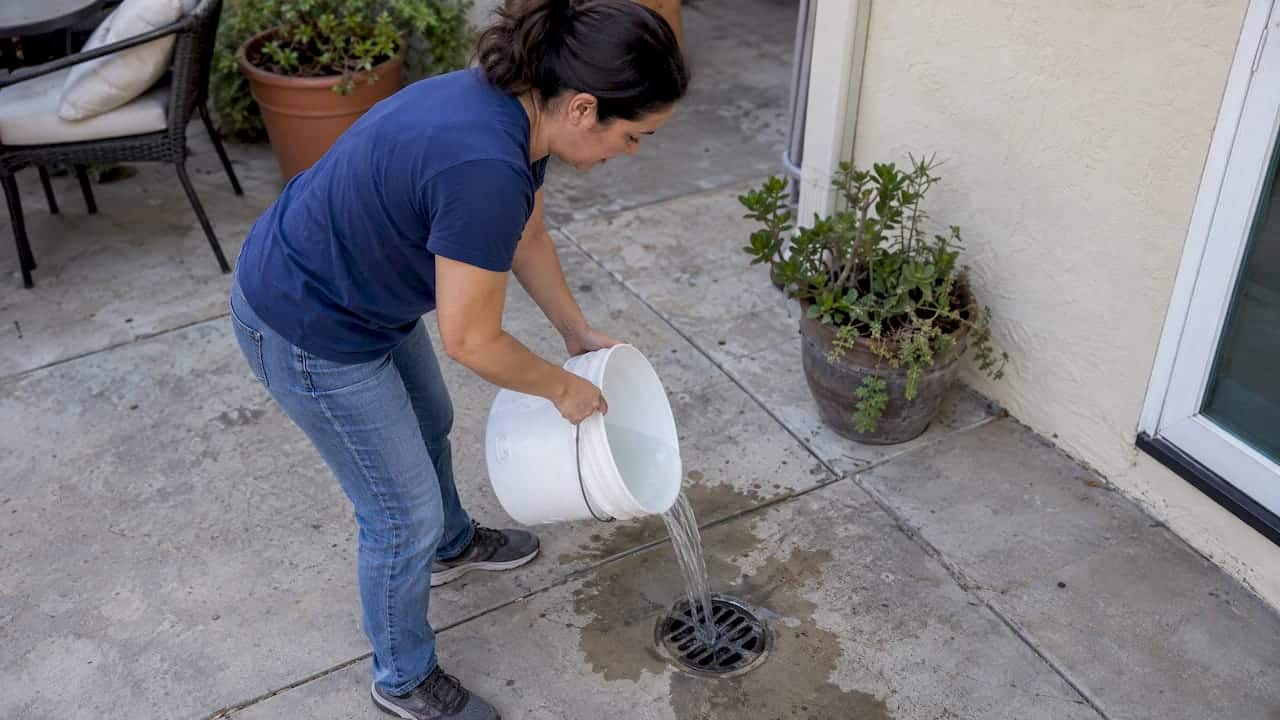
The test is simple. Pour a bucket of water into each outdoor drain and wait a few minutes. If the smell fades after refilling, you found it. If water disappears instantly or the drain never fills, the trap may be missing or the pipe cracked, and you should have it looked at.
A blocked or badly placed roof vent
Every drain system needs vents that let air in behind the water and let gas out above the roofline. When a vent pipe is clogged by leaves, debris or a nest, gas is pushed to other exits. Where the vent is short or sits near taller objects, such as a hillside, a neighbor’s second story or a mature tree, gas can also sink and drift down into the yard instead of dispersing. Hillside lots are common across Silver Lake, Highland Park, Echo Park and the Valley foothills, so this is a real local pattern.
Signs of a vent problem include gurgling in several drains, slow drainage throughout the house, and smells that come and go with wind and pressure changes. A single slow drain points elsewhere. If you cannot safely reach the roof, do not climb up there to check. A plumber can clear a vent with a cable or extend it higher.
A loose, cracked or missing cleanout cap
Most houses have a sewer cleanout, a capped pipe at ground level near the house or at the property line. If the cap is cracked, missing or not seated, gas escapes from it directly into the yard. Look for one, and check whether the cap is intact and snug. If it has a slimy residue or you can see standing wastewater inside, the line downstream is backing up. Do not open a cleanout if the line is full, since pressure can push wastewater out. Our guide to signs of sewer line problems covers what a full line looks like.
A cracked, rooted or collapsed sewer lateral
Older LA neighborhoods are full of clay and cast iron laterals that have been in the ground for decades. Joints separate, roots work into them, and pipe sections sag. A damaged lateral lets gas and sometimes liquid escape into the soil, and the smell shows up in the yard, often along the path between the house and the street. You may also notice a patch of lawn that stays wet, grows unusually lush, or sinks. Our write-up of sewer line repair tips for Los Angeles homeowners explains what typically goes wrong with older lines.
A septic system, if your property has one
Most of the city of Los Angeles is sewered, but some hillside and outlying properties still use septic tanks. If that is you, the EPA lists the warning signs: standing water or damp spots near the tank or drainfield, slow drains, gurgling, and sewage backing up into the house. Bright green, spongy grass over the drainfield, especially in dry weather, is another sign. A septic odor alongside any of these needs prompt professional attention, because untreated sewage at the surface is a health hazard.
A quick table to narrow it down
| What you notice | Most likely cause | First step |
|---|---|---|
| Smell near a yard drain or downpipe, worse in dry weather | Dry trap | Pour in a bucket of water and retest |
| Smell with gurgling or slow drains inside | Blocked vent or partial main line clog | Call for a camera inspection |
| Smell strongest at one pipe stub at ground level | Loose or cracked cleanout cap | Check the cap, do not open a full line |
| Smell plus wet, soft or very green ground | Leaking lateral or septic failure | Call a plumber promptly |
| Visible wastewater on the ground | Broken or overflowing line | Treat as an emergency |
| Rotten-egg smell across the neighborhood | Outside source, such as a treatment plant | Report to the agency |
What you can safely check yourself
Some checks cost nothing and carry no risk. Keep them to the ground level.
- Walk the yard when the smell is strongest and note where it peaks.
- Refill every outdoor drain with water, then check again in 15 minutes.
- Look at the cleanout cap for cracks or a loose fit, and look for damp soil around it.
- Run the washing machine and several fixtures indoors, then see whether the smell gets stronger outside, which can indicate a partial blockage.
- Check for gurgling, slow drains or toilets that bubble when another fixture drains.
Skip anything that involves opening a pressurized line, entering a manhole, or working on a roof. Sewer gas at low outdoor concentrations is typically a nuisance rather than a health danger, as University of Minnesota experts explain, but confined spaces and high concentrations are a different matter. Chemical drain cleaners rarely help with a yard odor either, and they can damage older pipe.
When the smell means you should call a plumber
Call a licensed plumber the same day if you see any of these:
- Wastewater pooling or flowing on the ground
- Sewage backing up into tubs, showers or floor drains
- A smell that persists after the dry-trap test and a cap check
- A sunken or persistently wet area along the sewer path
- Gurgling and slow drains in more than one fixture
Visible wastewater is not only a repair issue. In rental housing, Los Angeles County’s habitability inspection guide treats raw sewage flowing on the ground from sewer or drain lines as a critical violation that needs immediate correction. If you manage a rental property, that is your cue to move quickly and document the work.
If liquid waste has already reached the surface, keep children and pets away, and avoid hosing it into the storm drain. For general background on handling and disposing of liquid waste, this guide to disposing of liquid waste responsibly is a useful read, though local rules in California apply to your situation. Floor drain backups indoors are covered in our guide to floor drain backup safety steps.
Who to call if the smell is not from your property
Not every sewage smell starts in your pipes. If the odor is neighborhood-wide, comes from the street or a maintenance hole, or seems to blow in from a facility, report it to the agency that handles it.
- For a foul odor from a public street, sidewalk or maintenance hole in the city of Los Angeles, LA Sanitation and Environment runs a 24-hour line at 1-800-773-2489 and an online sewer odor form.
- For outdoor rotten-egg or sulfur odors that may come from an industrial source or treatment plant, LA County Public Health directs residents to the South Coast AQMD complaint system or its hotline at 1-800-288-7664. For odors inside your home, Public Health takes calls at 626-430-9820, Monday to Friday, 8:00 a.m. to 5:00 p.m.
A useful rule: if your neighbors smell it too and your own drains behave normally, start with the agency. If the smell stays in your yard and your drains gurgle or run slowly, start with your own plumbing.
How a plumber finds the source
A good diagnosis follows the gas back to its origin rather than guessing. The usual order looks like this:
- Inspect the accessible access points, such as the cleanout, for visible waste, standing water or a poorly seated cap.
- Check outdoor drains and their traps.
- Inspect the roof vents for blockages and assess whether they are tall enough or positioned where gas can disperse.
- Run a camera through the line to see cracks, offset joints, roots, sags and buildup, and locate any defect by distance from the cleanout.
- If the camera shows buildup or roots, clear it with a cable or hydro jetting, then re-inspect.
The camera step is what separates a lasting fix from a guess. It also tells you whether you need a spot repair or a larger replacement, and whether a trenchless option is possible. Our guide to sewer line repair without digging explains when that applies. If water is also leaking somewhere you cannot see, leak detection can pinpoint it before you open up any landscaping.
Our perspective: smell is data
We see the same misreading again and again. A homeowner assumes a yard odor means the sewer line has failed, and braces for a trench across the lawn. Or the opposite: they assume it is just a hot-weather smell and ignore it for a year. Neither is the right starting point.
Our approach is to treat the smell as a clue. Many of the calls we handle come down to a vent, a cap or a trap, and we would rather tell you that after a proper inspection than sell you a repair you do not need. When it is a lateral problem, early detection keeps the repair smaller. Clay laterals, galvanized corrosion and tree roots are all common in Los Angeles housing built before the 1970s, and a camera shows us in minutes which one we are dealing with.
We have been family-owned since 1989, we are licensed (C-36 License #583868) and insured, and the work is documented for code compliance. Our estimates are written and up-front, so you know the scope before we begin. You will speak with local staff, not a remote call center.
— EZ
What it costs to find and fix
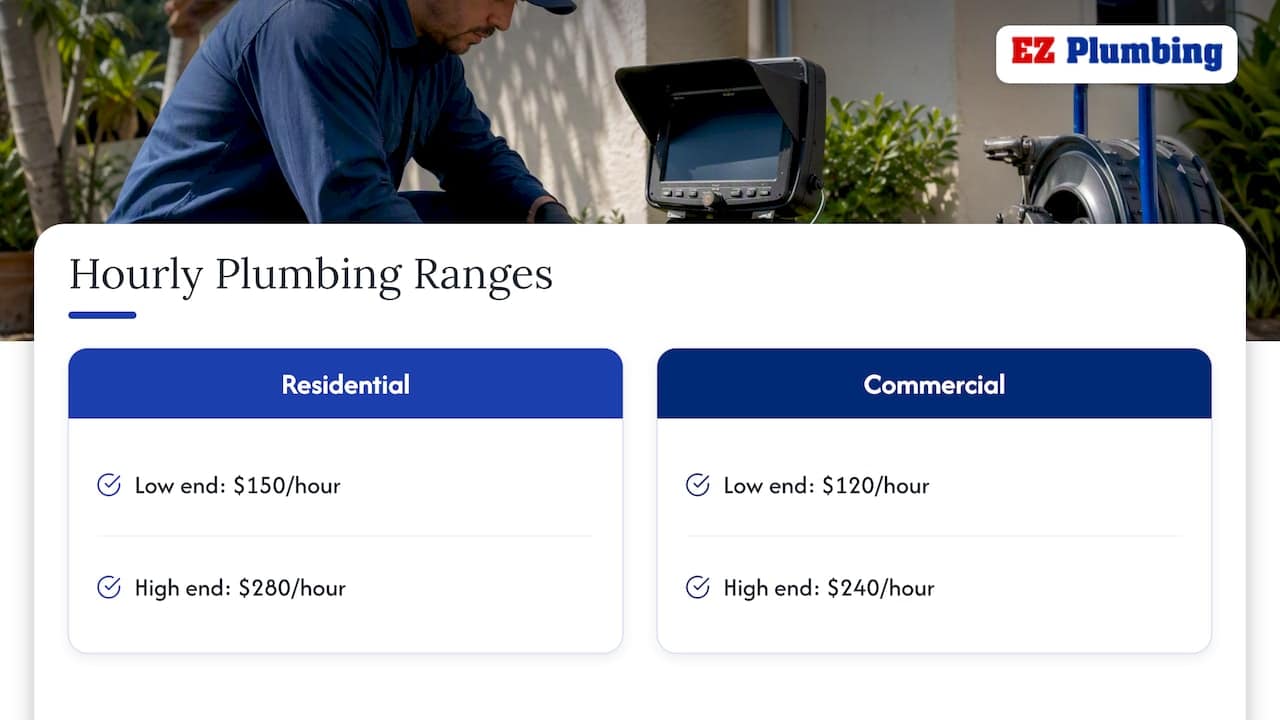
Cost depends on the cause. Refilling a trap or reseating a cap costs next to nothing. Clearing a vent or a partial clog is a short visit. A damaged lateral is a bigger project, and the scope depends on the depth, length and method used. We publish our hourly ranges: residential plumbing runs $150 to $280 per hour and commercial plumbing $120 to $240 per hour, and you can check them on our rate calculator. For any repair, we give you a written price before work starts.
Need a plumber for a yard sewage smell?
If the dry-trap test and cap check did not solve it, or you can see wet ground or wastewater, we can inspect the line with a camera and tell you exactly what is happening. We handle drain cleaning and hydro jetting, sewer line repair, and 24/7 emergency plumbing across the greater Los Angeles area. Property managers, HOAs and restaurants can also ask us about maintenance plans, which catch roots and buildup before they become odor complaints. Book through ez-plumbing.com.
Preventing the smell from coming back
A few habits cut the chance of a repeat.
- Run water in rarely used outdoor drains and laundry standpipes every few weeks in dry months.
- Keep the cleanout cap intact, and keep it accessible, not buried under mulch or planters.
- Keep grease, wipes and other non-flushables out of the system.
- Watch trees planted near the sewer path. Roots seek moisture and enter at joints.
- Schedule a camera inspection if your home predates the 1970s and has never had one, particularly before buying or after a root problem.
- Clear leaves and debris from reachable roof vents, or have a plumber do it.
For related odors indoors, see our guides on plumbing odors in your home and sewage smell in the bathroom, and our overview of warning signs of plumbing problems.
Frequently asked questions
Is a sewage smell in the yard dangerous?
At the low levels usually found outdoors, sewer gas is mostly a nuisance, according to University of Minnesota onsite sewage experts. A persistent smell still means something in the system is not venting or sealing properly. Visible wastewater is different: it is a health hazard and should be fixed immediately.
Why does my yard smell like sewage after rain or on hot days?
Weather changes how odors travel and how strongly they are produced. Heat and humidity increase biological activity, and still air in valleys and canyons keeps odor near the ground, as LA County Public Health describes. If it only appears in certain conditions, a vent or a dry trap is a likely cause.
How do I stop an outdoor drain from smelling?
Pour a bucket of water into the drain to refill the trap, then check again after a few minutes. If the smell returns quickly or the water drains away at once, the trap may be damaged or the pipe cracked. A plumber can confirm with a camera.
Who do I report a sewage smell to?
For odors from public streets or maintenance holes in the city of Los Angeles, call LA Sanitation and Environment at 1-800-773-2489. For outdoor rotten-egg odors from a suspected industrial or plant source, use the South Coast AQMD at 1-800-288-7664. If it is coming from your own property, call a licensed plumber.
Sources
- Resolving Septic System Malfunctions, US EPA
- Outdoor septic odor causes and solutions, University of Minnesota Onsite Sewage Treatment Program
- Hyperion Water Reclamation Plant, LA County Public Health
- Rental Housing Habitability Program Inspection Guide, LA County Public Health
- Sewer Odor Investigation, LA Sanitation and Environment
- Disposing of liquid waste responsibly