
Sewer Line Repair Without Digging: A Homeowner Guide
A soggy patch of grass beside the cleanout is rarely just a lawn problem. If several fixtures are slow, the toilet gurgles when the washing machine drains, or sewage backs up through the lowest fixture, the sewer lateral may be failing underground. The first thought is usually the worst one: excavation across the yard, a cut driveway, damaged landscaping, or access problems under a patio or parking area.
Sewer line repair without digging can avoid a continuous trench, but it isn't a magic phrase that makes excavation disappear. Most trenchless work still needs existing cleanouts or small access pits, and a severely collapsed, badly misaligned, or inaccessible line may still require open digging. The practical question isn't whether a contractor advertises “no-dig.” It's whether your specific pipe can safely accept lining, bursting, or a localized repair.
Table of Contents
- When the Yard Stays Put and the Pipe Still Gets Fixed
- Diagnosing the Line Before Anyone Touches It
- Comparing the Three Main No-Dig Methods
- What a Trenchless Repair Actually Costs in Los Angeles
- What to Expect on the Day of the Repair
- Choosing a Licensed LA Contractor You Can Trust
- Preventative Care and Common Questions Answered
When the Yard Stays Put and the Pipe Still Gets Fixed
The homeowner usually notices the failure before anyone sees the pipe. A cleanout may be wet, the grass may look unusually green, or wastewater may collect in a low area after several drains run. In Los Angeles, the line may pass beneath a new patio, a concrete walkway, a mature tree, or a shared driveway. A conventional repair could disturb all of it.

On a suitable line, a trenchless crew reaches the damaged run through an existing access point or a small launch and receiving pit. With cured-in-place pipe lining, the crew installs a resin-saturated liner inside the existing pipe and cures it into a new structural surface. With pipe bursting, a bursting head breaks the old pipe outward while a replacement pipe follows the same route. A sectional repair addresses one defect rather than rehabilitating the entire run.
The surface impact is the main reason property owners consider these methods. You may avoid the long excavation associated with dig-and-replace, although equipment, hoses, resin handling, pits, and temporary wastewater controls still occupy part of the site. A straightforward residential project may be completed in a day, but the actual schedule depends on access, cleaning, curing, branch connections, permits, and whether the crew finds an unexpected obstruction.
Practical rule: A “no-dig” proposal should identify every access point and every surface that may still be opened.
The line has to qualify. A liner needs a host pipe that can be cleaned, inspected, and shaped well enough to receive it. Bursting needs a viable route, suitable soil conditions, and room for the new pipe to follow the old alignment. If the pipe has a long collapse, severe belly, major offset, or impossible bend, a hybrid repair or open excavation may be the more dependable answer.
Diagnosing the Line Before Anyone Touches It
A trenchless recommendation should begin with evidence, not a guess based on symptoms. Slow drains throughout the building suggest a downstream restriction, while a single fixture problem may point to a branch line. Repeated cleanout backups, outdoor sewage odors, gurgling, or wet soil help a plumber decide where to start, but they don't establish the repair method.
Start with symptom triage
The first visit should document which fixtures are affected, how often the problem occurs, whether backups follow heavy use, and whether prior snaking or hydro-jetting provided only temporary relief. Property managers should also identify every accessible cleanout, shutoff, tenant area, parking location, and route where wastewater may need to be controlled during the work.
A camera inspection then shows what is inside the line. The contractor should run the camera far enough to assess the relevant run, not stop at the first root or blockage. A self-leveling locator head helps the technician mark the defect's surface position and depth, which matters when a small access pit is unavoidable.
Record the details that determine eligibility
The inspection should identify:
- Pipe material: Clay, cast iron, Orangeburg, PVC, or another material can present different failure patterns.
- Pipe diameter and length: The liner or replacement pipe must match the existing route and capacity.
- Defect location: Record the distance from the access point, depth, and relationship to structures or utilities.
- Failure type: Root intrusion, an offset joint, crack, belly, missing section, or collapse each changes the recommendation.
- Branch connections: A liner may require internal reinstatement so connected fixtures can discharge properly.
You should receive the recorded video, a written report with measurements, and clear before-and-after documentation. The recommendation should explain why CIPP, bursting, spot repair, or excavation fits the observed condition. If a contractor won't show the footage or can't explain the limitation of the proposed method, don't sign a major rehabilitation contract.
For a practical overview of the inspection process and what a camera inspection can reveal, review EZ Plumbing's sewer line inspection service. The key deliverable isn't a sales label. It's a documented condition assessment that lets you compare proposals on the same evidence.
Comparing the Three Main No-Dig Methods
The three common choices solve different problems. CIPP relining preserves the existing route and uses the old pipe as the host. Pipe bursting replaces the host pipe along its alignment. Sectional spot repair targets a limited defect when the rest of the line remains serviceable.
CIPP relining
A CIPP liner is saturated with resin, inserted or inverted into the cleaned host pipe, and cured in place. Once cured, it forms a continuous pipe within the old one. This approach suits a line with cracks, leaking joints, or root intrusion when the pipe still has enough shape and continuity for the installation equipment to pass.
Lining doesn't correct every structural problem. A long collapse may block the liner, and a pronounced belly remains a grade problem unless the work includes excavation. Tight bends, unusual transitions, heavy buildup, and difficult branch connections also require careful design.
Pipe bursting
Pipe bursting uses a cable, rod, or pulling system to draw a bursting head through the old line. The head fractures and displaces the deteriorated pipe while pulling a new HDPE or comparable pipe behind it. It's useful when the old pipe is too damaged for lining but the route is reasonably direct and the surrounding ground can accept the displaced material.
Bursting usually needs access at both ends of the replacement section. It can also encounter trouble around utilities, fragile structures, shallow cover, severe bends, or a route that needs to move rather than follow the existing alignment.
Sectional spot repair
A spot repair is appropriate when the camera finds one localized defect in an otherwise sound run. A short liner or internal patch can seal a cracked joint, isolated root entry, or small damaged section without rehabilitating the entire lateral. It may be the wrong economic choice if the rest of the pipe shows widespread deterioration, recurring defects, or poor structural integrity.
| Method | Best Pipe Condition | Access Needed | Typical Lifespan | Disruption Level |
|---|---|---|---|---|
| CIPP relining | Cracked, leaking, or root-affected pipe that still holds its route and shape | Existing cleanouts or small access points, depending on the run | Product and installation dependent, confirm in the proposal | Low, with possible small access work |
| Pipe bursting | Severely deteriorated pipe that can be followed by a new pipe | Launch and receiving access points | New pipe product and installation dependent | Low to moderate, with pits and equipment |
| Sectional spot repair | One isolated defect in an otherwise serviceable line | Access to the affected section | Product and defect dependent | Low, unless the defect requires excavation |
A fair recommendation connects the method to the defect. If every failing pipe receives the same CIPP pitch, the contractor is selling a process rather than diagnosing a line.
What a Trenchless Repair Actually Costs in Los Angeles
A trenchless quote is difficult to judge when it contains one attractive total and no scope. The price should show how the crew will reach the line, clean it, rehabilitate it, test it, and leave the property. Surface preservation can be valuable, but it doesn't eliminate labor, equipment, permits, bypass arrangements, or restoration of the access points.
Read the scope before comparing totals
Ask the estimator to separate:
- Inspection and locating: Camera footage, defect measurements, and surface marking.
- Cleaning: Hydro-jetting or mechanical preparation before lining, bursting, or patching.
- Access: Existing cleanout work, launch pits, receiving pits, shoring, utility locating, and excavation.
- Rehabilitation: Liner materials and resin, curing process, bursting equipment, replacement pipe, or sectional patch.
- Connections: Reopening and sealing branch lines after a liner is cured or a replacement pipe is installed.
- Testing and documentation: Final camera inspection, flow or pressure testing where applicable, and warranty paperwork.
- Restoration and extras: Soil, concrete, paving, landscaping, traffic control, emergency hours, or weekend scheduling.
Pipe diameter, total length, depth, number of access pits, root severity, and the location of the line all affect the total. A run under a slab or driveway may justify trenchless work because restoration would be disruptive, while a shallow line across an unfinished side yard may not produce the same overall value.
For a Los Angeles-specific discussion of quote variables and method selection, see EZ Plumbing's trenchless sewer repair cost guide.
Use warranty language as a quality check
Don't treat a long material rating as the same thing as a long labor warranty. Liner manufacturers may publish service-life ratings, while the installing contractor may offer a separate workmanship period with exclusions for movement, misuse, inaccessible defects, or unrelated sections of pipe. Pipe bursting warranties likewise depend on the replacement product, joints, connections, and installer terms.
| Method | Typical LA Price Range | Average Lifespan | Warranty, Material / Labor | Best Fit |
|---|---|---|---|---|
| CIPP relining | Must be itemized after inspection, access review, and design | Confirm the selected liner system and design documents | Request separate manufacturer and contractor terms | Cracks, leaks, and roots in a structurally suitable host |
| Pipe bursting | Must be itemized by length, diameter, pits, and replacement pipe | Confirm the new pipe product and installation terms | Request product, connection, and workmanship coverage | Replacement where the route can accept a new pipe |
| Spot repair | Must be itemized by defect location, access, and patch system | Confirm the sectional product and defect limitations | Usually narrower than full-run coverage, get exclusions in writing | Isolated damage in an otherwise stable line |
A low single-number quote is a warning when it omits access, bypass pumping, reinstatement, final camera verification, or restoration. The cheapest proposal may only be cheaper because it leaves necessary work undefined.
What to Expect on the Day of the Repair
The workday starts before the pipe installation. Clear furniture, vehicles, stored materials, and tenant belongings from the cleanout and equipment area. Tell the crew where water shutoffs are located, identify occupied units, and ask how wastewater use will be handled while the line is out of service.
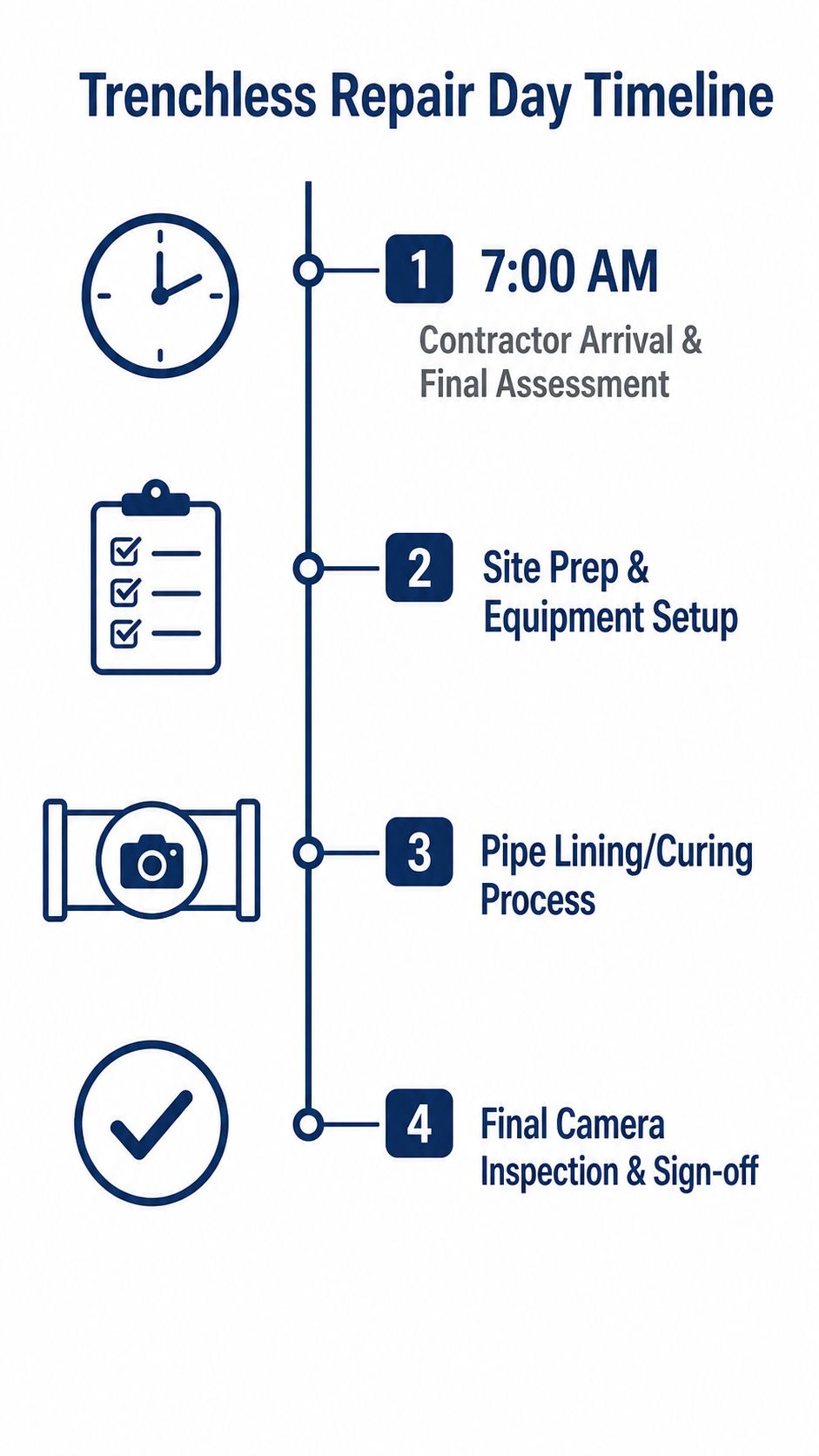
The sequence on site
At arrival, the crew confirms the route, access, utilities, and planned work area. They may set up bypass pumping or temporary wastewater controls, protect nearby surfaces, position hoses and curing equipment, and open a small pit if an existing cleanout won't provide the required access.
The pipe is then cleaned and inspected again. For CIPP, the crew prepares and inserts the liner, cures it using the specified process, and reopens branch connections. For bursting, the crew pulls the bursting head and replacement pipe through the prepared route, then reconnects the ends. A spot repair uses a packer or comparable tool to position and set the localized patch.
Noise comes from pumps, jetting equipment, generators, and pulling machinery. Water use may be restricted during cleaning, installation, and curing, so follow the crew's instructions rather than flushing or running appliances because the work appears quiet outside.
This short video gives a visual introduction to the equipment and sequence involved in trenchless sewer work.
Before the crew leaves, request the final recorded camera video, test results appropriate to the installed system, a written scope of completed work, and the warranty packet. If the final inspection shows a closed branch, wrinkle, incomplete cure, or unresolved defect, the contractor should explain the correction before sign-off.
Choosing a Licensed LA Contractor You Can Trust
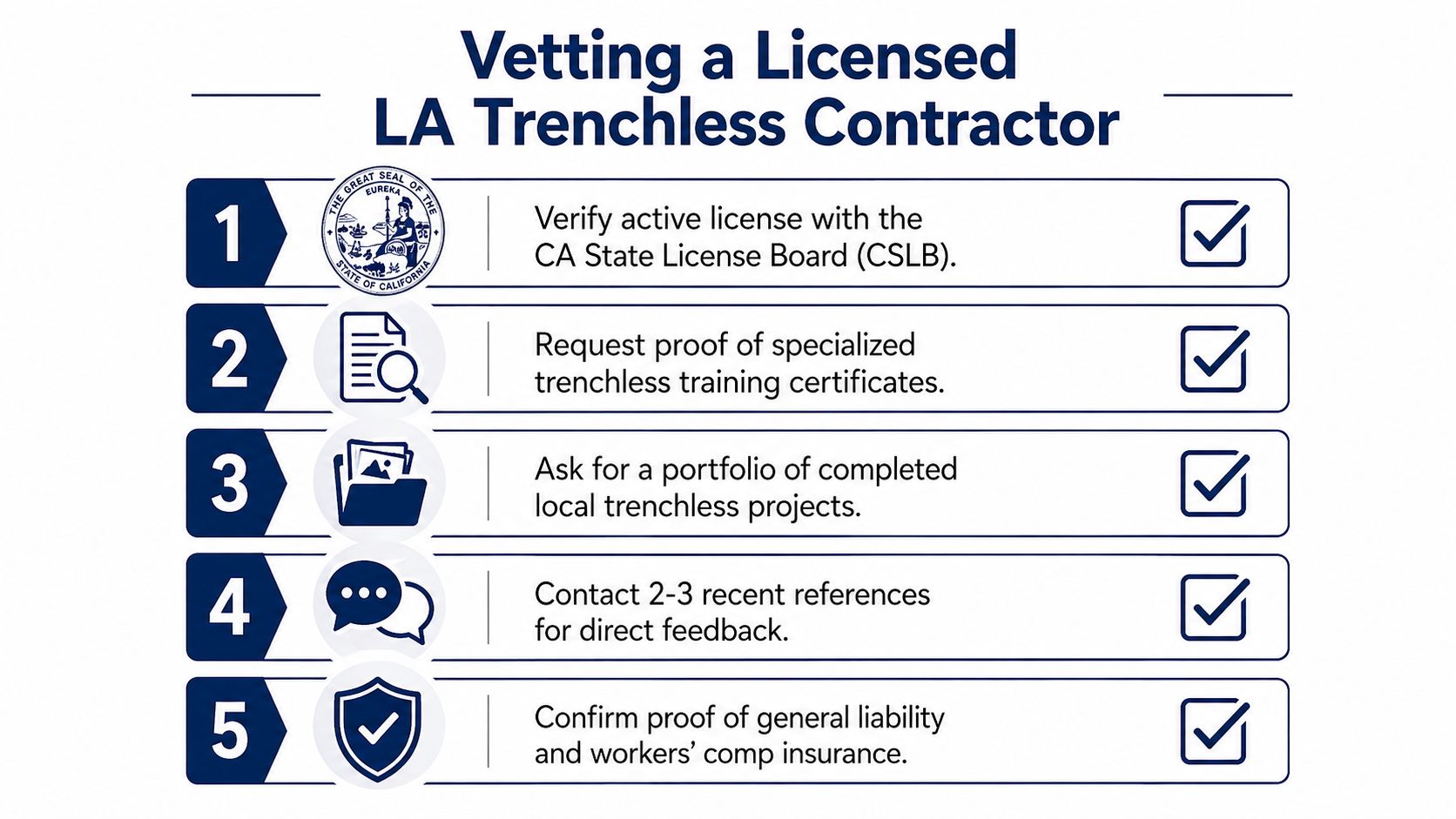
A general plumbing license doesn't automatically prove trenchless competence. Start by verifying the contractor's active California license through the California State License Board, then confirm that the license classification and company details match the proposal. Ask for current general liability and workers' compensation documentation, especially when the crew will excavate access pits or operate heavy equipment.
Look for method-specific proof
The contractor should be able to identify the liner manufacturer or bursting system, explain the curing process, and provide written installation requirements. Ask whether the crew performs camera inspections with recording equipment, who handles branch reinstatement, and how the company documents the completed work.
For projects involving a sidewalk, street, easement, or shared property, ask who pulls permits and coordinates inspections. A trustworthy proposal names the responsible party instead of leaving the homeowner to discover a missing approval after the equipment arrives.
Ask questions that expose weak proposals
Use these questions during the estimate:
- What did the camera show? Ask the contractor to identify the defect on recorded footage and explain its location.
- Why this method? Have them compare lining, bursting, spot repair, and excavation for your pipe.
- What cure system and product are you installing? The answer should include the manufacturer, resin or pipe type, and installation process.
- How will you reinstate branch connections? A liner that blocks a lateral isn't a finished repair.
- What happens if testing fails? The contract should explain correction, retesting, and responsibility.
- Is the price fixed or time-and-material? Clarify what changes the price and who authorizes extra work.
Before work begins, collect the written scope, access plan, restoration responsibility, permit responsibility, insurance certificates, payment schedule, warranty terms, and the pre-repair inspection file. EZ Plumbing's sewer line repair service is one local option to evaluate alongside other licensed contractors using those same documents and questions.
Preventative Care and Common Questions Answered
A rehabilitated line still benefits from sensible maintenance. Keep the cleanout cap intact, avoid sending grease, wipes, rags, or hard debris into the drainage system, and don't rely on harsh chemicals to solve recurring sewer restrictions. In older Los Angeles properties, mixed materials and transitions between clay and PVC deserve particular attention during future inspections.
For root-prone laterals, schedule periodic camera reviews based on the line's history and the contractor's recommendation. Enzyme-based drain care may be gentler than aggressive chemical products, but it won't repair a displaced joint, collapsed section, or structural defect. Maintenance can reduce avoidable blockages, not replace condition-based repair.
Questions property owners ask
| Question | Answer |
|---|---|
| How long does relining last compared with pipe bursting? | Neither answer should be based on a generic promise. Relining depends on the selected liner system, host-pipe suitability, installation quality, and warranty. Bursting uses a new replacement pipe, so ask for the product specification, connection details, and written service-life and warranty terms. |
| Does homeowners insurance cover trenchless work? | Coverage depends on the policy, cause of loss, exclusions, and whether the issue is sudden damage or long-term deterioration. Ask the insurer before authorizing major work, and keep the camera report and written diagnosis. |
| What happens if the host pipe collapses during pull-through? | The crew may need to stop, excavate the obstruction, or change to a hybrid repair. The contract should state how unforeseen access or excavation work is approved and priced. |
| Is a permit needed for a spot repair? | Requirements depend on the location, scope, public right-of-way, and local authority. Ask the contractor to identify required permits before work starts rather than assuming that a small repair is exempt. |
| How do I verify a C-36 license and CIPP certification? | Check the active license with the California State License Board, match the legal business name to the contract, and request current method-specific training or manufacturer documentation for the CIPP system being proposed. |
The next step is practical: schedule a recorded camera inspection, request two written quotes itemized by method and access, and compare the defect description rather than only the totals. Confirm who pays for pits, bypass pumping, branch reinstatement, permits, restoration, testing, and unexpected excavation. Get the warranty terms in writing before anyone begins.
EZ Plumbing provides video-based sewer diagnostics and trenchless options such as CIPP lining and pipe bursting for Los Angeles homes, HOAs, property managers, and commercial sites. Visit EZ Plumbing to request an inspection and an itemized recommendation that shows whether your line is a true candidate for sewer line repair without digging.