
Pros and Cons of Water Softeners: A Homeowner’s Guide
You notice it at the sink first. The dishwasher leaves cloudy glasses, the shower door gets that chalky white edge again, and the towels feel rough even when you used the good detergent. Then the water heater starts making that low rumble a few years earlier than you expected, and suddenly the pros and cons of water softeners stop sounding like a generic home improvement topic and start sounding like a real property decision.
In Los Angeles, this comes up fast because a lot of homes are dealing with mineral-heavy water every day. If you own a single-family home, manage an HOA, or keep getting complaints from tenants about spots, soap scum, and appliance wear, the question is simple. Do you pay to solve the hardness problem at the house, or do you live with the buildup and keep replacing parts sooner than you should?
Table of Contents
- Why LA Homeowners Are Asking About Water Softeners Right Now
- How a Water Softener Works
- Practical Benefits of Water Softening
- The Honest Trade-Offs Nobody Loves Talking About
- Softener Types Compared Side by Side
- Your Pre-Purchase Checklist Before You Buy
- Alternatives Worth Considering First
- Making the Call and Getting Professional Help in Los Angeles
Why LA Homeowners Are Asking About Water Softeners Right Now
A lot of homeowners do not start out shopping for a softener. They start with the same problems showing up over and over. Glassware comes out of the dishwasher with a haze, shower trim picks up a hard crust that does not scrub off easily, laundry feels stiff, and the water heater starts acting older than it should.
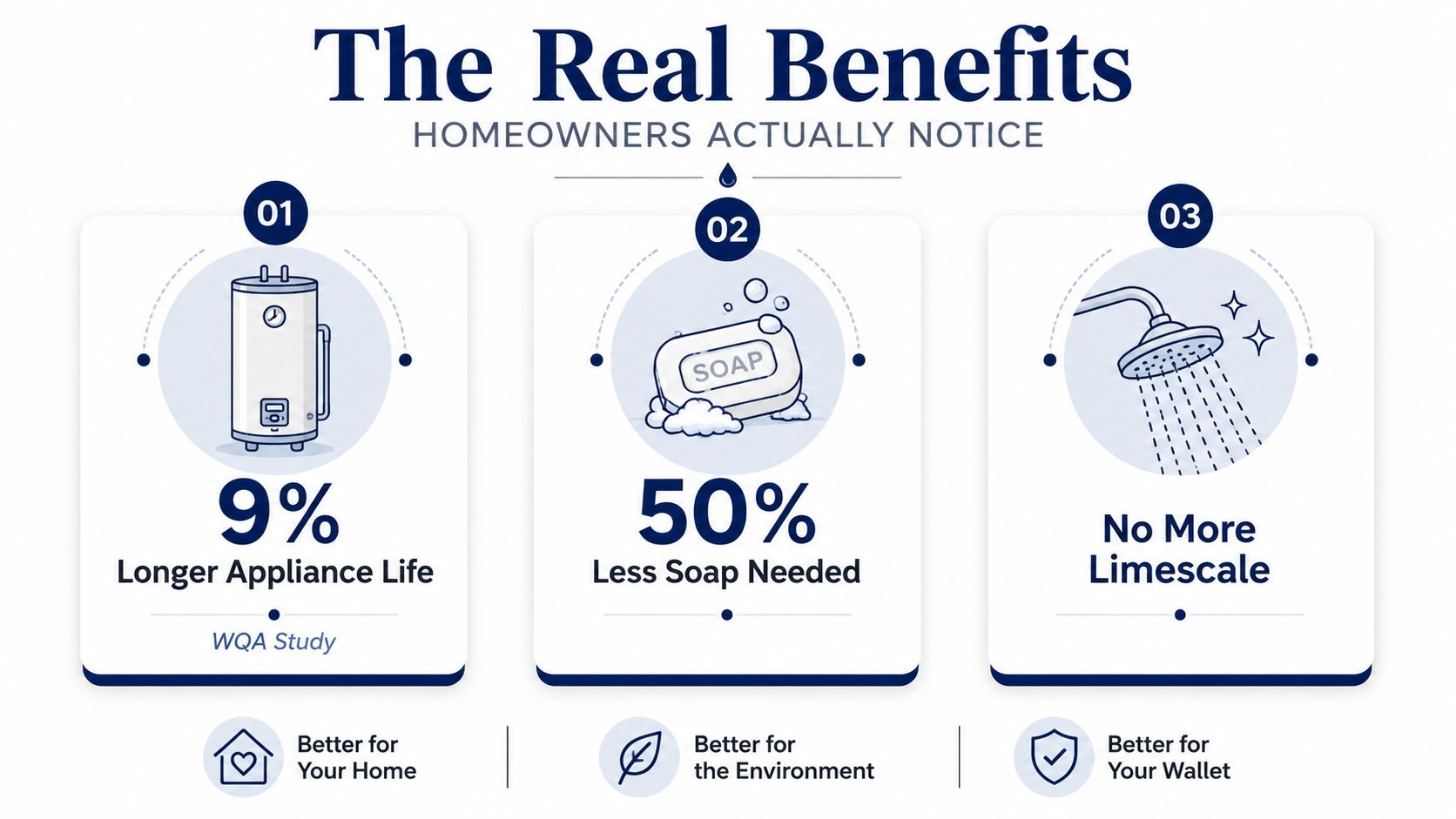
That is a real plumbing issue, not just a cleaning gripe. Hard water carries calcium and magnesium, and those minerals leave scale in pipes, fixtures, and heaters. The WQA study in the brief is one reason softeners keep coming up in real-world decisions. Gas storage tank water heaters running on softened water held their original factory efficiency rating over a 15-year lifetime, while hard water could cut efficiency by as much as 24% (WQA study).
Why the decision feels more urgent in LA
Los Angeles and the San Fernando Valley deal with hardness that shows up on fixtures, showerheads, and water heaters, not just on a lab report. Consumer guidance says water above 180 mg/L is considered very hard by the U.S. Geological Survey, and softening starts making practical sense once hardness climbs above about 10 grains per gallon (Consumer Reports).
That pressure hits landlords and property managers first. Tenants do not file a ticket because the water is “technically hard,” they call because the dishwasher looks bad, the heater is noisy, or the fixture finish is getting chewed up. In a multi-unit building, those small complaints turn into repeat service calls and steady wear on shared plumbing.
Practical rule: if you are scrubbing scale more than once in a while, the question is no longer about taste. It is about protecting equipment and cutting avoidable upkeep.
The trade-off is real. A softener can protect hardware, but it also adds cost, salt handling, and environmental baggage. In Los Angeles, that is the decision homeowners are making, along with HOA rules, property-manager requirements, and whether a cheaper alternative like templating or a point-of-use filter does the job well enough for the house.
How a Water Softener Works
Hard water contains calcium and magnesium, and those minerals are what leave scale inside pipes, heaters, and fixtures. A salt-based water softener removes them through ion exchange before they reach the rest of the plumbing.
The ion-exchange process in plain English
Water enters the tank carrying calcium and magnesium. Inside the tank, resin beads are charged so they attract those hardness minerals. As the minerals stick to the beads, the system releases a small amount of sodium or potassium into the water in their place.
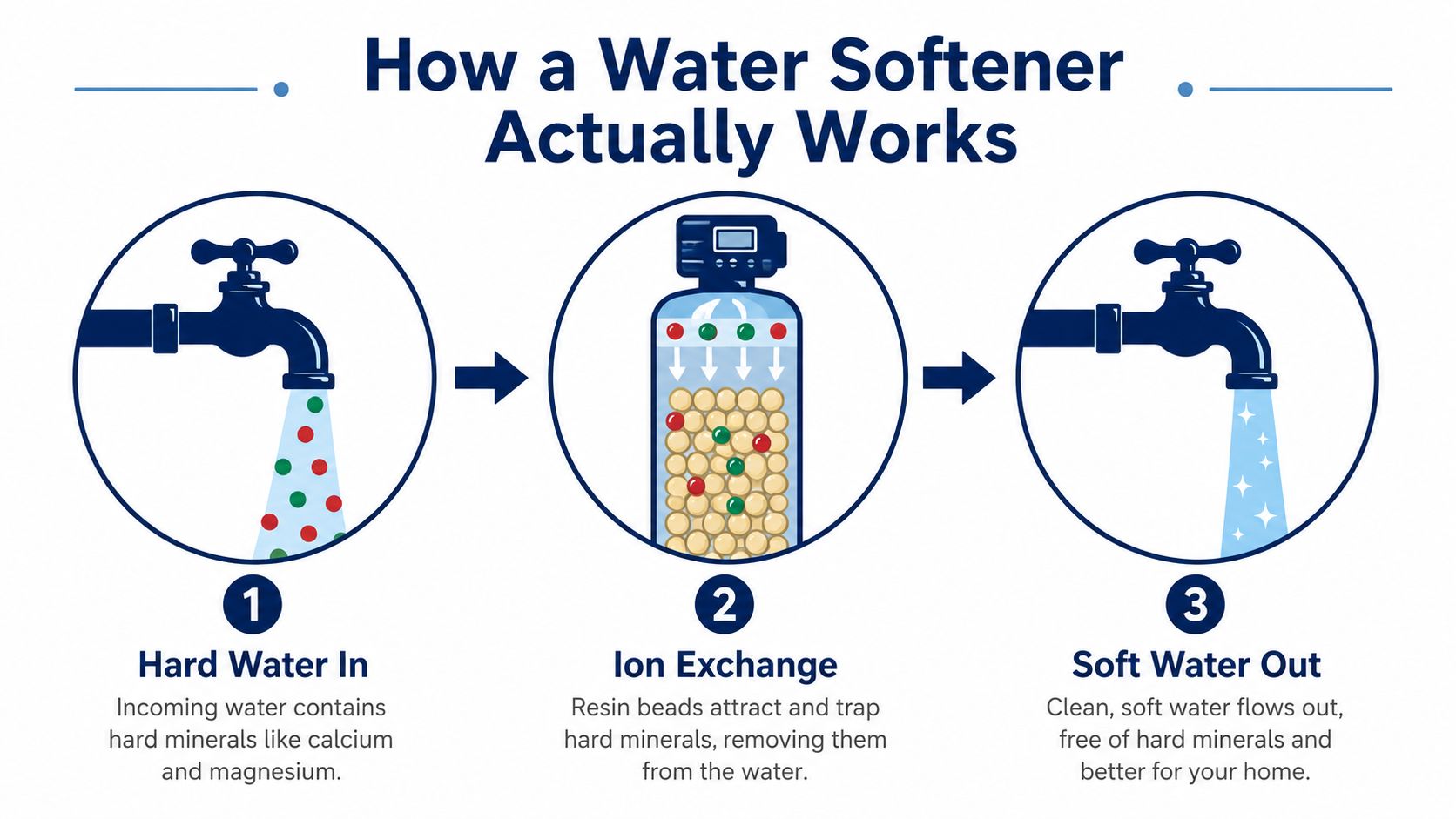
That change is what people notice at the tap. Soap rinses cleaner, fixtures do not get coated as fast, and scale stops building up as quickly in the places that matter most. The calcium buildup in water that keeps eating at heaters, valves, and showerheads gets reduced before it becomes a maintenance problem. The Minnesota Department of Health also links softening to less scale, less soap film, and longer appliance life (Minnesota Department of Health).
What grains per gallon means
Hardness is usually measured in grains per gallon, or GPG. You do not need to memorize the chemistry, just the practical cutoff. Once hardness gets above about 10 GPG, softening starts to make real sense for a lot of homes.
Once the resin beads are loaded with minerals, they have to be cleaned with a brine flush so they can start over. That is the part homeowners miss when they assume a softener runs by itself forever. It does not. It is a treatment system with a maintenance cycle.
Salt-free systems work differently. They do not remove hardness minerals, they change how those minerals behave. Magnetic and electronic devices sit even farther from true softening. That is why the label matters, because “water treatment” is not the same thing as removing hardness.
Practical Benefits of Water Softening
A softener pays off in the places homeowners deal with every week. Faucets wipe down faster, shower doors stay clear longer, and soap behaves the way it should instead of fighting mineral load. In Los Angeles, where hard water leaves a visible trail on fixtures and in appliances, that matters fast. The value shows up in less scale, less scrubbing, and less wear on the equipment you already paid for.
Appliance protection is the first payoff
Scale is hard on water heaters, dishwashers, washing machines, and the valves that keep them working. The buildup does not just sit there. It narrows passages, makes equipment work harder, and shortens the life of parts that already take heat and pressure every day. If you want a plain-language look at what that buildup does inside plumbing, our guide on calcium buildup in water breaks it down.
That is why a softener is worth serious attention in a house with a tank water heater, a busy laundry setup, or fixtures that keep collecting mineral crust. A building with multiple units feels this even faster, because one hard-water problem becomes a stack of service calls, replacement parts, and complaints about weak flow or stained fixtures. Property managers and HOAs care about this because they see the same failures repeat across shared plumbing and common-area equipment.
Daily comfort improves because the water behaves differently
Once hardness is removed, the daily routine gets simpler. Soap rinses cleaner, shampoo lathers without a fight, and towels do not come out with that rough mineral feel. Shower glass, sinks, and dishwasher interiors stay presentable longer because the residue is not sticking to everything.
That is the part homeowners notice first. Less time with a sponge. Less time wiping spots off chrome. Less time cutting through white crust on fixtures that should stay clean on their own.
Why property managers pay attention
For an HOA or apartment building, soft water cuts down on the complaints that come from hard water every month. Spotting, soap scum, and premature fixture wear all show up less often, and shared equipment tends to stay in better shape. That is not flashy, but it keeps maintenance from getting buried under repeat problems.
It also helps keep tenants from blaming the plumbing for problems that start with water quality. In a hard-water market like Los Angeles, that alone can save a manager from a lot of unnecessary back-and-forth.
The Honest Trade-Offs Nobody Loves Talking About
The bill is where a lot of homeowners pause. That is the right instinct. A softener is not a small purchase, and the installed cost swings with the system, the plumbing layout, and how much work the job takes. Industry and consumer guidance in the brief puts the average installed price around $1,500, with common total ranges from about $200 to $6,000 depending on the equipment and installation details (Aquasana). In Los Angeles, that spread matters because a clean swap in a garage is a different job from a cramped retrofit in a condo or a property with HOA rules around exterior equipment.
The ongoing cost is where people get caught
A softener needs salt or potassium refills, periodic testing, and routine maintenance to keep doing its job (Aquasana). If nobody checks the brine tank, the system does not keep helping in the background. It starts slipping, and the house goes right back to dealing with hard-water problems.
That is why I tell homeowners to treat a softener like a mechanical appliance, not a one-time fix. It needs attention, and it needs the right setup from the start. If you are already trying to keep hot-water equipment from scaling up, our guide on how to maintain a water heater is a good place to start before you decide how much of the plumbing system you want to protect.
Sodium, corrosion, and local restrictions are part of the decision
Sodium-based softeners add sodium to household water, so anyone on a sodium-restricted diet should take that seriously. Minnesota's health guidance also warns that softened water can contribute to higher lead and copper levels if corrosive metal is already being pulled from plumbing conditions that are not set up well (Minnesota Department of Health).
That does not mean every softened system is a corrosion problem. A properly configured softener does not make water more corrosive. The risk comes from the plumbing, the water chemistry, and the way the system is installed and maintained, not from the softener alone (Minnesota Department of Health).
The environmental side is harder to shrug off. Softened-water systems create wastewater during regeneration and many use electricity, which is why they are usually viewed as less eco-friendly than alternatives (Aquasana). In Los Angeles, that can become a real property issue fast. Some HOAs care about brine discharge, some property managers do too, and in tighter communities the rules can be stricter than the plumbing code. If your building already has sustainability targets or water-discharge concerns, that is not a small detail.
Softener Types Compared Side by Side
Not every product sold as a “softener” does the same job. The buyer usually ends up looking at three categories, and the differences matter more than the brand name on the front.
Water Softener Types at a Glance
| Type | How It Works | Typical Cost | Maintenance | Best For |
|---|---|---|---|---|
| Salt-based ion-exchange | Removes calcium and magnesium and replaces them with sodium or potassium ions | Usually the highest upfront cost in the group | Salt or potassium refills, resin care, regeneration wastewater | Homes with real hardness, appliance protection, and actual soft-water performance |
| Salt-free templating | Changes how minerals behave so they're less likely to form scale | Often positioned as a lower-maintenance alternative | Less routine upkeep, but performance depends on water conditions | Properties mainly trying to reduce some scale without true soft water |
| Magnetic or electronic devices | Claims to alter mineral behavior with an external field or electronic signal | Usually the cheapest category | Minimal visible maintenance | Renters or owners looking for a low-commitment experiment, not a full hardness fix |
Salt-based systems are the only option here that removes hardness minerals. That's why they're the workhorse for homes that want the shower, laundry, and heater benefits all at once. The trade-off is that you own the salt, the regeneration waste, and the upkeep.
Salt-free templating systems are different. They're conditioners, not true softeners. They can make sense when scale prevention matters more than soap performance or a slippery feel in the shower.
Magnetic and electronic devices are easy to buy and even easier to install, but I'd treat them cautiously. They may be fine as a low-risk trial in a rental or temporary setup, but they're not the same answer as a real ion-exchange unit.
Your Pre-Purchase Checklist Before You Buy
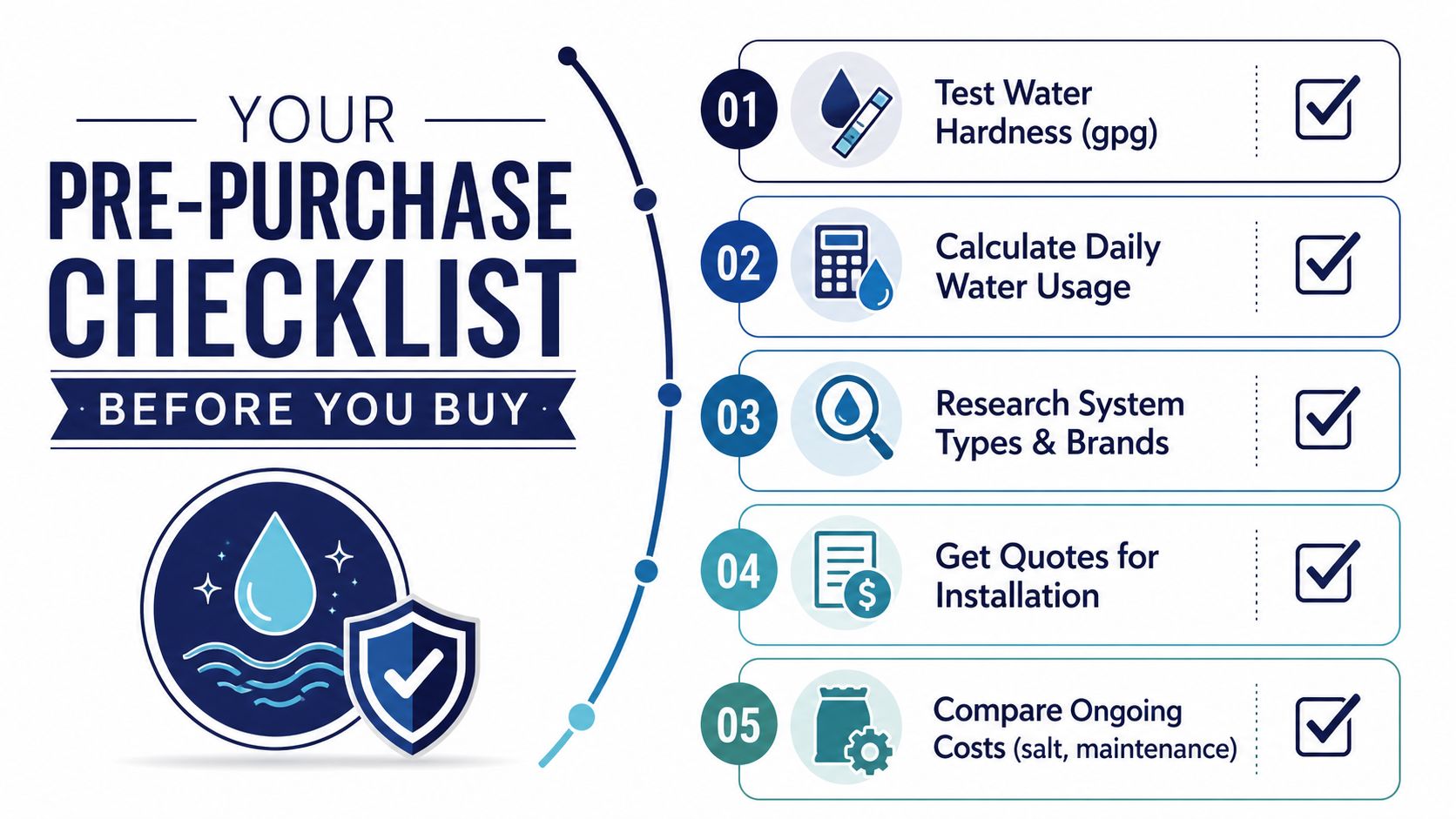
Don't buy a softener because the ad sounded convincing. Test the water first. A simple hardness strip or a lab panel tells you whether you're dealing with enough hardness to justify the equipment, and whether the problem is mild enough that a smaller solution might do the job.
The practical checks that matter
- Test the water hardness first. You need a real number before you size or price anything.
- Measure daily usage. A unit that's too small will regenerate at the wrong time and waste water.
- Check drain access. The brine discharge has to go somewhere.
- Confirm power nearby. Many systems need electricity to run properly.
- Measure the install location. Space near the main line entry can be tighter than people expect.
HOA rules matter too, especially if the property has restrictions around exterior discharge or utility modifications. Salt storage is another overlooked issue. If there's nowhere practical to keep bags of salt, the “easy maintenance” pitch falls apart fast.
For property managers, I'd add three more questions. How often do tenants turn over? Are the common-area fixtures taking a beating? Does the building already have a sediment pre-filter in front of the softener location? Those details affect whether one central system makes sense or whether targeted treatment is more practical.
If your building already runs on a closed-loop recirculating setup, or the hardness is low enough that the benefits barely show up, a softener can be the wrong answer. That's not me dodging the sale. That's me saving you from buying equipment you won't use correctly.
Alternatives Worth Considering First
A full softener isn't always the smartest purchase. If your actual problem is drinking water taste, a point-of-use reverse-osmosis system at the kitchen sink can handle that without treating the entire house. If your issue is just one bathroom with crusty fixtures and bad shower feel, a showerhead cartridge or aerator filter may solve the daily annoyance for far less money.
Match the tool to the problem
Renters and HOA-governed properties should look hard at non-invasive options first. Magnetic scale devices, descaling systems, and localized shower solutions can be more practical when you can't modify the whole plumbing system. They won't do everything a full softener does, but sometimes you don't need everything.
If your concern is conserving water, energy, and operating cost in the bathroom, this save water and energy resource from Western Bathroom Renovations is a useful companion piece because it focuses on one of the easiest places to cut waste without changing the whole house.
Use-case rule: if you only hate one symptom, buy the tool that solves that symptom. Don't install a whole-house system for a single tap problem.
For homeowners watching budget and sustainability at the same time, the decision becomes sharper. The right answer might be a small treatment system, not a whole-house softener. If you're also thinking about fixture replacement and water use, our guide to water conservation plumbing for LA homes is a good next read before you commit.
Making the Call and Getting Professional Help in Los Angeles
My opinion is straightforward. In Los Angeles, if you own a single-family home with meaningful hardness and a standard gas water heater, a properly sized ion-exchange softener usually earns its place. The combination of scale control, appliance protection, and lower day-to-day friction is hard to beat when you're fighting mineral buildup all year.
If you're in a condo, a rental, or a smaller household with one or two specific complaints, I'd look at targeted alternatives first. That's especially true if you're concerned about salt discharge, ongoing maintenance, or HOA restrictions. In those cases, you don't need a whole-house answer just because the water is hard.
What a smart decision looks like
The best decision starts with a hardness test, not a sales pitch. Then you match the treatment to the property, the plumbing, and the people who live there. If you want help with that part, EZ Plumbing provides water softener system installation along with the kind of property-specific plumbing assessment that keeps you from buying the wrong setup.
For homeowners who want a broader cost comparison before they commit, this guide to water filter expenses is a useful reference because it helps frame the softener decision against other filtration and treatment costs. The point is to compare the actual job, not just the sticker on one piece of equipment.
If you're a homeowner, HOA board member, or property manager in Los Angeles, get the water tested, check the install space, and get a real sizing recommendation before you spend the money. You'll make a cleaner choice, and you'll avoid the expensive mistake of treating the wrong problem.
EZ Plumbing handles hardness testing, water softener installation, and the plumbing details that make the system work the way it should in real Los Angeles homes. If you want straight answers for your house, HOA, or rental property, visit EZ Plumbing and set up an assessment so you can stop guessing and start fixing the problem correctly.