
Calcium Buildup in Water: A Los Angeles Homeowner’s Guide
You see it first on the easy surfaces. A chalky ring around the faucet. White crust on the showerhead. Spots on clean glasses that won't wipe off. Most Los Angeles homeowners treat that as a cleaning problem.
It usually isn't.
Calcium buildup in water starts where you can see it, then keeps working where you can't. Inside the water heater. Along the hot-water side of the plumbing. In valves, cartridges, appliance lines, and fixture internals. By the time the house starts showing low flow, noisy hot water, or repeated fixture issues, the cost of inaction is already much higher than a bottle of descaler and a scrub pad.
Table of Contents
- What Is Calcium Buildup and Why It Happens
- Signs Your Home Has a Scale Problem
- DIY Methods for Removing Limescale Deposits
- Preventing Future Buildup with Water Softeners
- When to Call a Professional Plumber
- Los Angeles Hard Water and EZ Plumbing Solutions
What Is Calcium Buildup and Why It Happens
Calcium buildup is the solid mineral residue left behind when water contains enough dissolved minerals, mainly calcium and magnesium, to form scale. In plumbing, that scale is often called limescale. It's not dirt, and it doesn't mean your fixtures are dirty. It means the water chemistry is leaving material behind.
A simple way to understand it is to think about sugar in hot tea. The sugar dissolves, so you don't see it floating around. But it's still there in the liquid. Hard water works the same way. The minerals are dissolved in the water until conditions change, then they come out of solution and stick to surfaces.
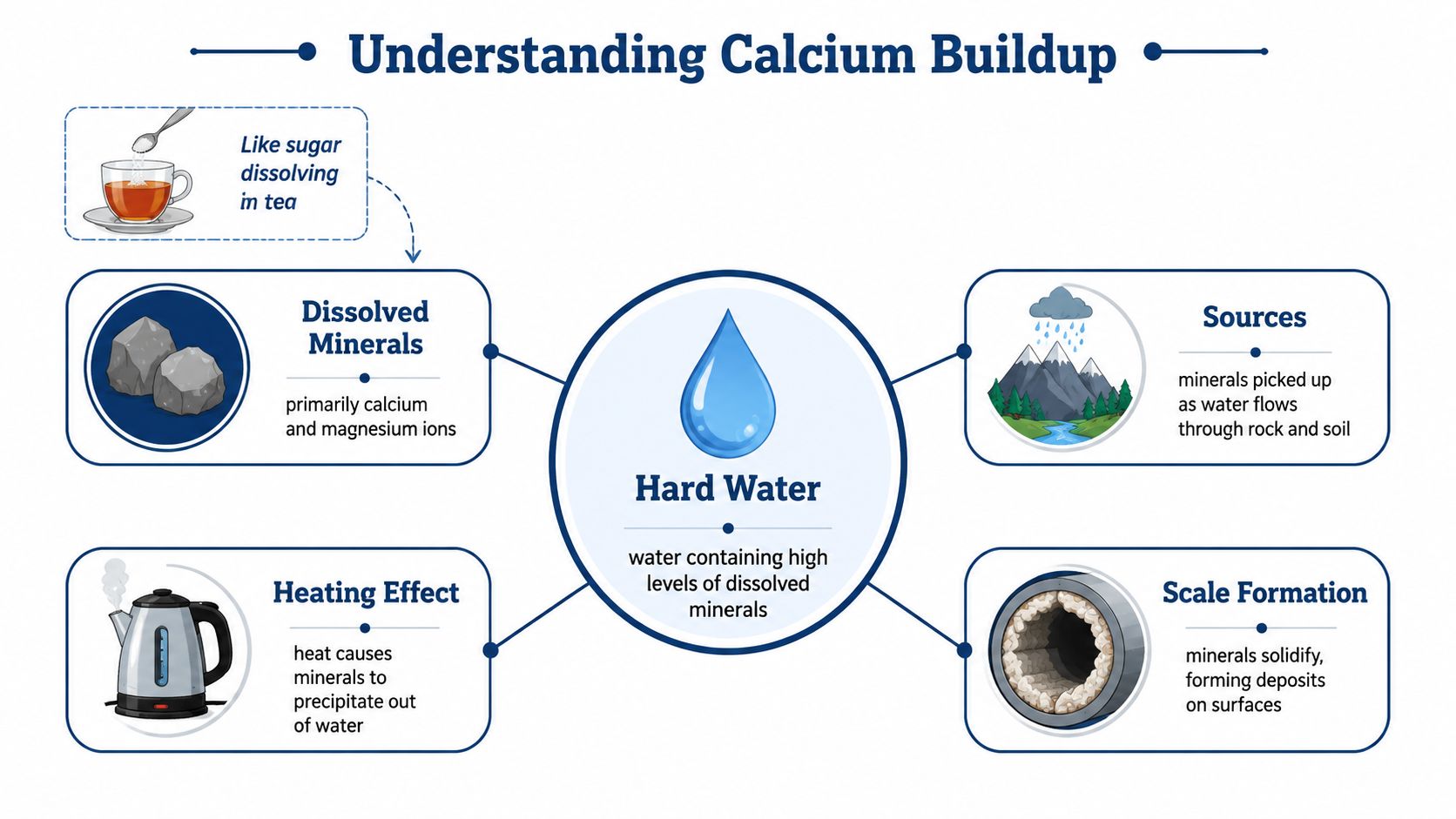
Hard water is the root of the problem
The standard benchmark most plumbers use for context is the USGS hardness scale. Water is classified as soft at 0–60 mg/L as calcium carbonate, moderately hard at 61–120 mg/L, hard at 121–180 mg/L, and very hard above 180 mg/L. Water with more than 200 mg/L is considered likely to cause plumbing and staining problems, according to the USGS hardness classification.
Those numbers matter because they tell you when dissolved minerals stop being a minor background issue and start becoming a mechanical one. Once water moves into the hard and very hard ranges, you're much more likely to see residue on fixtures and scale inside the system.
Practical rule: If you keep cleaning white crust off the same fixtures, the fixture usually isn't the problem. The incoming water is.
Evaporation and heat do most of the damage
Calcium buildup forms in two common ways.
- Evaporation on exposed surfaces: Water dries on faucets, glass, tile, and shower doors, leaving minerals behind.
- Heating inside equipment: Hot water pushes dissolved calcium salts toward scale formation, especially inside water heaters and on hot-side plumbing components.
- Repeated contact: Every cycle adds a little more material. Thin buildup becomes a hard layer over time.
This is why showerheads, faucet aerators, kettle elements, and hot-water fixtures usually show the problem first. It's also why people often notice the same kind of spotting on cars, windows, and boats after mineral-rich water dries. If you've dealt with removing stubborn boat water spots, you've already seen the same basic mineral residue problem on a different surface.
Why homeowners underestimate it
It is common to react only to what is visible. The trouble is that visible scale is just the symptom that announces the hidden buildup. The crust on a faucet is annoying. The same material inside a heater, recirculation line, or shutoff valve is expensive.
That's the core issue with calcium buildup in water. It rarely stays cosmetic.
Signs Your Home Has a Scale Problem
The first warning signs are usually small enough to ignore. A faucet starts spraying unevenly. The showerhead loses its clean pattern. Glassware comes out looking cloudy. Homeowners often clean the symptom and move on.
That approach works for a while. Then the hidden side of the problem starts showing up in performance.
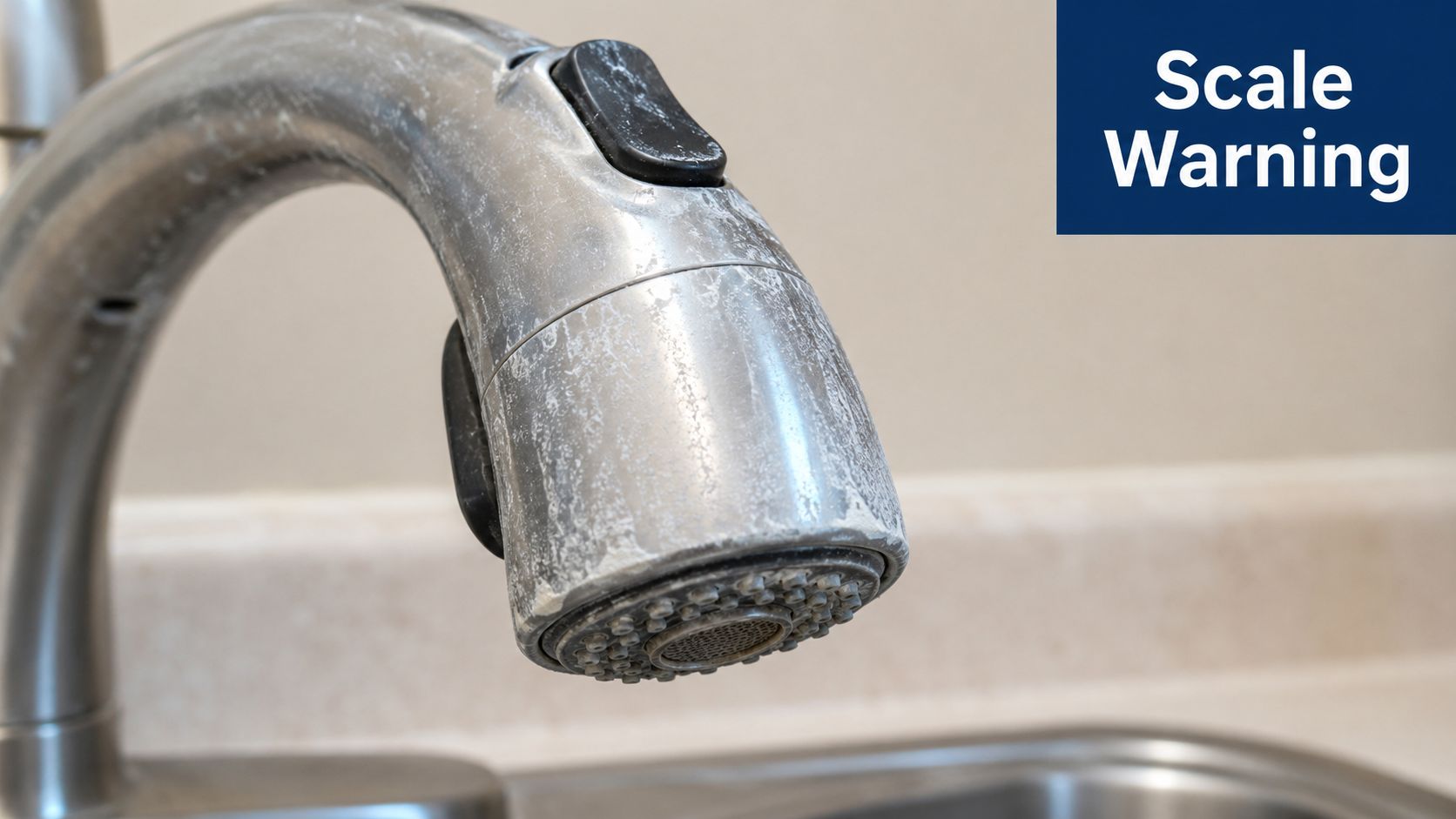
The obvious signs you can see every day
Look for these surface clues around the house:
- White crust on metal fixtures: Faucet bases, showerheads, and sink edges often collect a chalky deposit.
- Spots on dishes and glass: Even after a full wash cycle, mineral residue can dry into a cloudy film.
- Rough deposits around drains and handles: Scale likes edges, seams, and any place water sits.
- Soap that never seems to rinse clean: Hard water often leaves surfaces looking filmy instead of clear.
These signs are annoying, but they also tell you the water is depositing minerals every time it dries or heats.
The expensive signs most homeowners miss
The bigger costs show up in plumbing performance. Hard water doesn't just stain surfaces. When heated, dissolved calcium salts can precipitate as calcium carbonate scale, and the USGS notes that in water heaters this scale can reduce equipment life, raise heating costs, lower efficiency, and clog pipes, as shown in the USGS explanation of lime-scale buildup in heated systems.
That one mechanism explains several common complaints:
| What you notice | What may be happening behind it |
|---|---|
| Hot water takes longer to recover | Scale is insulating heating surfaces |
| Utility bills feel harder to control | The heater is working through mineral buildup |
| Hot water pressure is weaker than cold | Deposits are restricting hot-side pathways |
| Appliances seem to age badly | Internal parts are scaling up, not just wearing out normally |
Repeated hot-water problems are rarely random. When scale keeps showing up on hot-side fixtures, the water heater often belongs in the diagnosis.
How scale turns into real money
The cost of inaction usually arrives in layers, not all at once.
First, you spend more time cleaning fixtures and replacing aerators. Then appliance performance slips. Then the water heater starts running less efficiently. After that, homeowners begin chasing symptoms: pressure complaints, cartridge issues, dishwasher performance, laundry frustration, or unexplained hot-water inconsistency.
A lot of people assume each problem is separate. In practice, scale often ties them together.
A quick home check
Walk through the house and compare hot and cold performance.
- Check the shower: Is the spray uneven or partially blocked?
- Check sink aerators: Do they spit, fan sideways, or produce weak flow?
- Check the water heater behavior: Any popping, rumbling, or reduced hot-water output?
- Check appliance patterns: Are dishes, laundry, or coffee equipment showing mineral residue again and again?
When you find both visible residue and hot-water-side performance issues, the problem has usually moved beyond cosmetics.
DIY Methods for Removing Limescale Deposits
If the buildup is light and limited to exposed surfaces, you can usually clean it yourself. That's worth doing. A clogged aerator or crusted showerhead doesn't need a service call just because it looks ugly.
What DIY cleaning won't do is solve calcium buildup in water at the source. It removes what you can reach. It doesn't stop the next layer from forming.
Where vinegar works well
White vinegar is the standard first step because mild acid can loosen mineral deposits on common household fixtures. Lemon juice can help too, especially on smaller surface spots.
A simple approach works on most faucets and showerheads:
- Soak the affected part with vinegar using a cloth or by tying a small bag around the fixture.
- Wait long enough for the deposit to soften. Heavy crust needs more time than light spotting.
- Scrub gently with a soft brush or old toothbrush.
- Rinse and test flow after reassembly.
For faucet aerators, remove the screen if you can do it safely, soak the parts, then brush the mineral debris out of the mesh and threads.
Good for cosmetics, not for system protection
DIY descaling makes sense for:
- Showerheads and faucet tips: Good first targets because buildup there directly affects spray pattern.
- Coffee makers and kettles: Surface and internal light scale can often be reduced with routine descaling.
- Tile edges and sink areas: Useful for visible cleanup when the problem is still superficial.
For appliance-specific cleaning, a practical reference on solution for hard water buildup can help if you're dealing with mineral deposits inside brewing equipment.
If you're already using vinegar around the house for maintenance, this guide on unclogging drains with vinegar is also useful, but keep the distinction clear. Drain residue and mineral scale aren't always the same problem.
What doesn't work well
Boiling water doesn't remove calcium from the water in a way that protects your plumbing. In practice, boiling can make the mineral concentration issue worse in what remains behind. Scraping hard scale with metal tools can also damage finishes on faucets, trim, and plated parts.
Avoid guesswork with these:
- Harsh abrasives: They can scratch chrome and leave the fixture looking worse.
- Random internet “miracle” mixes: If you don't know the surface material, you can damage seals, finishes, or stone.
- Repeated cosmetic cleaning as a long-term plan: If scale returns quickly, the problem is bigger than the fixture face.
Clean what you can reach. Diagnose what keeps coming back.
Preventing Future Buildup with Water Softeners
Cleaning scale after it appears is maintenance. Preventing it from forming is protection. That's where a whole-house water softener changes the conversation.
Instead of trying to dissolve crust off fixtures every few weeks, a softener deals with the mineral load before the water moves through the home. That's the difference between wiping up symptoms and fixing the plumbing conditions that create them.
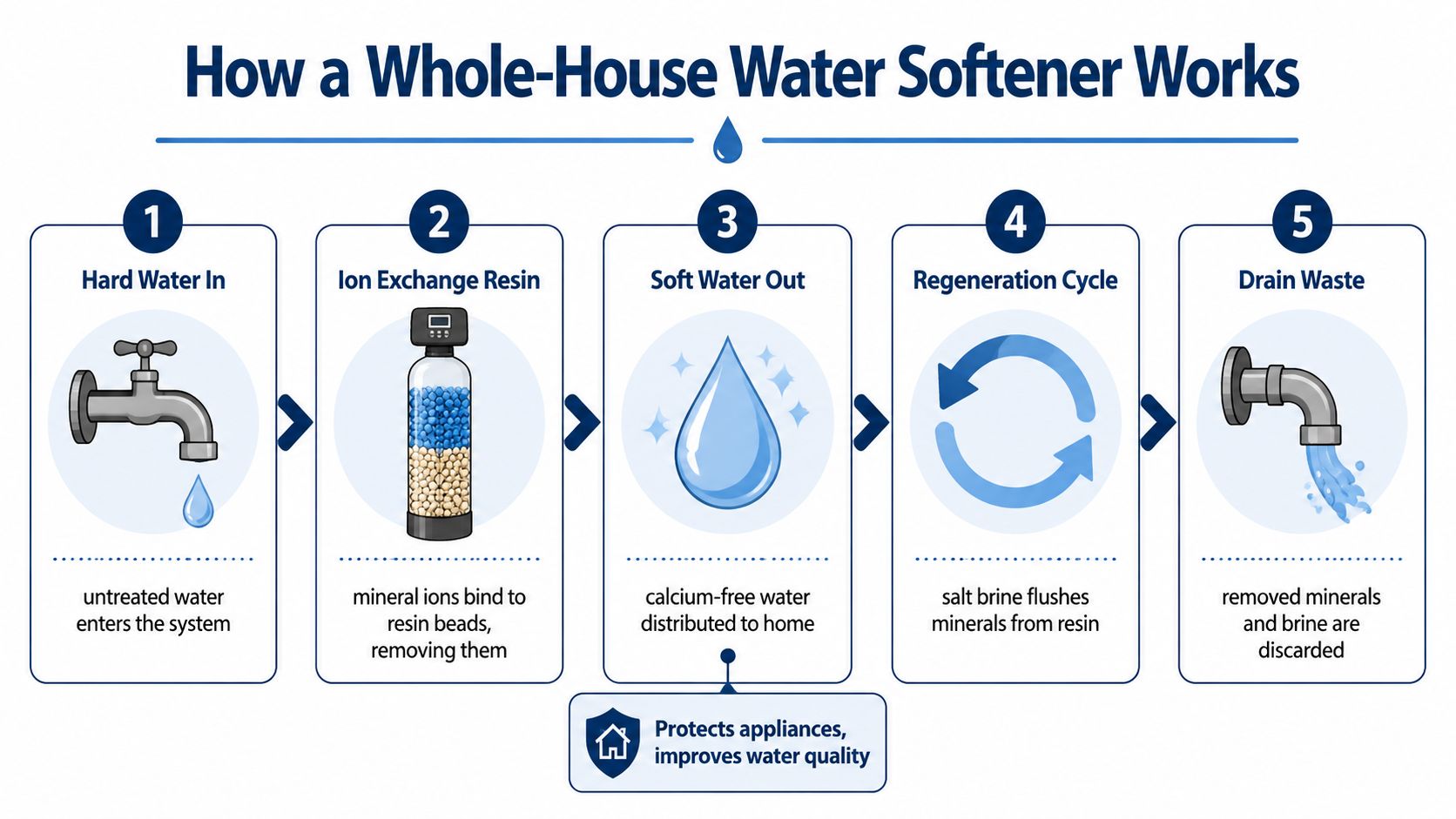
How ion exchange actually works
An ion-exchange softener removes the calcium and magnesium ions that create hard-water scale. In plain language, the system intercepts the water before it spreads through the house and swaps out the hardness minerals that cause buildup.
The Water Quality Association identifies ion-exchange water softeners as the primary and most effective method for addressing the root cause of scale formation in building plumbing systems, as explained in the WQA guidance on scale deposits and softening.
That matters because many homeowners get sold on devices that promise easier maintenance without removing the hardness minerals.
What works and what only sounds good
Here's the trade-off in plain terms:
| Option | What it does | Best use |
|---|---|---|
| Ion-exchange softener | Removes calcium and magnesium from the water | Whole-house scale prevention |
| Reverse osmosis | Purifies drinking water at a point of use | Drinking and cooking water |
| Antiscaling or conditioning devices | May reduce or limit some deposits | Partial mitigation, not full hard-water removal |
A lot of confusion comes from mixing up water quality for drinking with scale protection for plumbing. They are not the same job.
To see the process visually, this short video gives a helpful overview of system operation:
Why prevention beats repeated cleanup
A proper softener protects the whole path of the water. Not just the kitchen sink. Not just one shower. The entire home downstream of the install point.
That changes the maintenance picture in practical ways:
- Fixtures stay cleaner longer: Less mineral crust forms on visible surfaces.
- Hot-water equipment gets a break: Scale doesn't keep building up where heat drives deposition.
- Appliances avoid constant mineral exposure: Dishwashers, washing machines, and valves aren't fighting the same level of buildup.
- Plumbing parts last more predictably: Aerators, cartridges, and lines aren't being narrowed by scale as quickly.
This is why I tell homeowners to think of a softener as an infrastructure decision, not a luxury add-on. If hard water is attacking every fixture in the house, the right answer usually isn't better cleaning supplies. It's a better water strategy.
When to Call a Professional Plumber
You don't need a plumber for every white spot on a faucet. You do need one when the pattern stops looking cosmetic and starts affecting the system.
A good rule is simple. If you clean the visible buildup and the same issues keep returning, especially on the hot-water side, stop treating it like a surface problem.
Red flags that deserve a professional diagnosis
Call a plumber when you notice any of the following:
- Whole-house pressure changes: If multiple fixtures feel restricted, the issue may be beyond a clogged aerator.
- Hot water performs worse than cold: That often points to scale buildup where heating is involved.
- Water heater noise or uneven recovery: Mineral accumulation inside the heater can trigger both.
- Recurring fixture failures: Replacing cartridges, valves, or appliance hoses without solving the water condition gets expensive fast.
One of the most important parts of diagnosis is confirming what the residue is. Guidance on this point is clear: distinguishing limescale from corrosion, soap scum, or sediment is critical, and repeated scale in fixtures can signal a broader hot-water-system issue requiring professional review, as noted in this discussion of diagnosing scale versus other residue problems.
The wrong diagnosis leads to the wrong repair. A white deposit is not automatically a water-softener decision, and it's not automatically a cleaning problem either.
When RO is useful and when it isn't
Homeowners often ask whether reverse osmosis will solve calcium buildup. It depends on what you're trying to fix. If your priority is drinking-water quality at a tap, learning how RO water purification works is worthwhile. But RO is typically a point-of-use solution. It doesn't protect the full plumbing system the way whole-house softening does.
That's where professional guidance matters. A plumber can help separate these questions:
- Is the residue limescale?
- Is the problem limited to one fixture, or is it system-wide?
- Does the house need cleaning, repair, treatment, or all three?
If you've reached the point where you want a real diagnosis instead of repeated guesswork, it makes sense to contact a reliable local plumber for whole-home plumbing issues.
Los Angeles Hard Water and EZ Plumbing Solutions
Los Angeles homeowners deal with hard water conditions often enough that the pattern is familiar. You see residue on shower glass, faucets, and sink edges. Then the hot-water complaints start. Flow drops off. Fixtures need more maintenance. Water heaters lose performance. In multi-unit buildings, the problem gets multiplied across apartments, common areas, and service calls.
That's why calcium buildup in water needs to be treated as a property-protection issue, not just a housekeeping annoyance.
Why this matters in LA homes
Calcium itself isn't the enemy in every context. The World Health Organization has recommended drinking water with calcium levels of approximately 20 to 80 mg/L, but concentrations above 200 mg/L as CaCO3 are known to cause plumbing staining and scale, turning a useful mineral into a mechanical problem for infrastructure, as summarized in this calcium and water-quality overview.
That trade-off is what homeowners miss. The same mineral that can be normal in water becomes a plumbing problem once it starts depositing in the system.

What a proper plumbing response looks like
A skilled plumbing response usually includes more than one step. The right work depends on whether the house has a surface-scale nuisance, a hot-water-system problem, or both.
A practical service approach includes:
- Targeted diagnosis: Confirm whether the white residue is scale and identify whether the issue is localized or building-wide.
- Water heater assessment: Check whether the heater is already showing efficiency loss or mineral accumulation. Homeowners who want to understand upkeep better can review this guide on how to maintain a water heater.
- Fixture and flow evaluation: Inspect aerators, showerheads, shutoffs, and hot-side restrictions where scale often shows up first.
- Treatment planning: Decide whether the property needs whole-house softening, equipment maintenance, or a combination.
Why delaying the fix costs more
Ignoring scale usually creates a false economy. Homeowners save money today by postponing treatment, then spend more later on labor, replacement parts, appliance wear, and heater problems.
The visible residue is the cheapest part of the issue. The hidden mineral layer inside heated equipment is where the expensive trouble starts.
For Los Angeles property owners, that matters whether you live in a single-family home, manage a rental, or oversee an HOA. A recurring scale problem doesn't stay small for long. It spreads through the same plumbing network your home depends on every day.
If the same white residue keeps coming back, if hot water performance has changed, or if you're tired of replacing fixture parts that should be lasting longer, the smart move is to treat the cause instead of cleaning the symptom again.
EZ Plumbing has served Los Angeles since 1989 with licensed, insured plumbing service for homes, HOAs, property managers, and commercial properties. If hard water and calcium scale are affecting your fixtures, water heater, or whole-home plumbing performance, contact EZ Plumbing for professional diagnosis, reliable repairs, and practical long-term solutions.