
How to Hire a Licensed Gas Plumber in Los Angeles
You're replacing a water heater, managing a rental turnover, or responding to a tenant who noticed a faint gas odor. The tempting move is to call the first plumber who answers and ask for a quick connection or repair. In Los Angeles, that shortcut can leave you with unsafe work, missing permits, weak documentation, and a problem that surfaces when the property is inspected, sold, or occupied.
Gas work needs more than general plumbing ability. You need a professional whose license, insurance, testing process, and paperwork match the job and the local authority having jurisdiction. A licensed gas plumber should be able to explain exactly who is authorized to perform the work, how the completed section will be tested, which permits apply, and what records you'll receive when the job is closed.
Table of Contents
- Why Gas Work Is Not a Job for Any Plumber
- What a Gas Plumber License Actually Represents
- Verifying a California Gas Plumber License in Minutes
- Core Gas Services and When You Actually Need Them
- The Case for Preventive Gas Safety Checks
- What to Do Right Now If You Suspect a Gas Leak
- The Hiring Checklist You Use Before Signing
- Common Questions About Hiring a Gas Plumber
Why Gas Work Is Not a Job for Any Plumber
A standard plumbing call usually involves water, drainage, fixtures, or a clogged line. Gas piping introduces a different failure profile. A loose fitting, incorrect connection, damaged pipe, or improperly connected appliance can create a leak, ignition hazard, or combustion problem. The work also affects permitting, inspections, insurance, tenant safety, and your ability to prove that the system was serviced correctly.
That's why a general plumber isn't automatically the right gas contractor. Licensing rules vary by jurisdiction, and the credential that allows someone to perform general plumbing may not cover every gas-piping, appliance, or diagnostic task. In California, a contractor should be able to identify the license classification under which the proposed work will be performed, rather than relying on a vague statement that they “do gas.”
Practical rule: If the contractor won't provide a license number and explain how it covers your specific gas job, don't let that person modify the system.
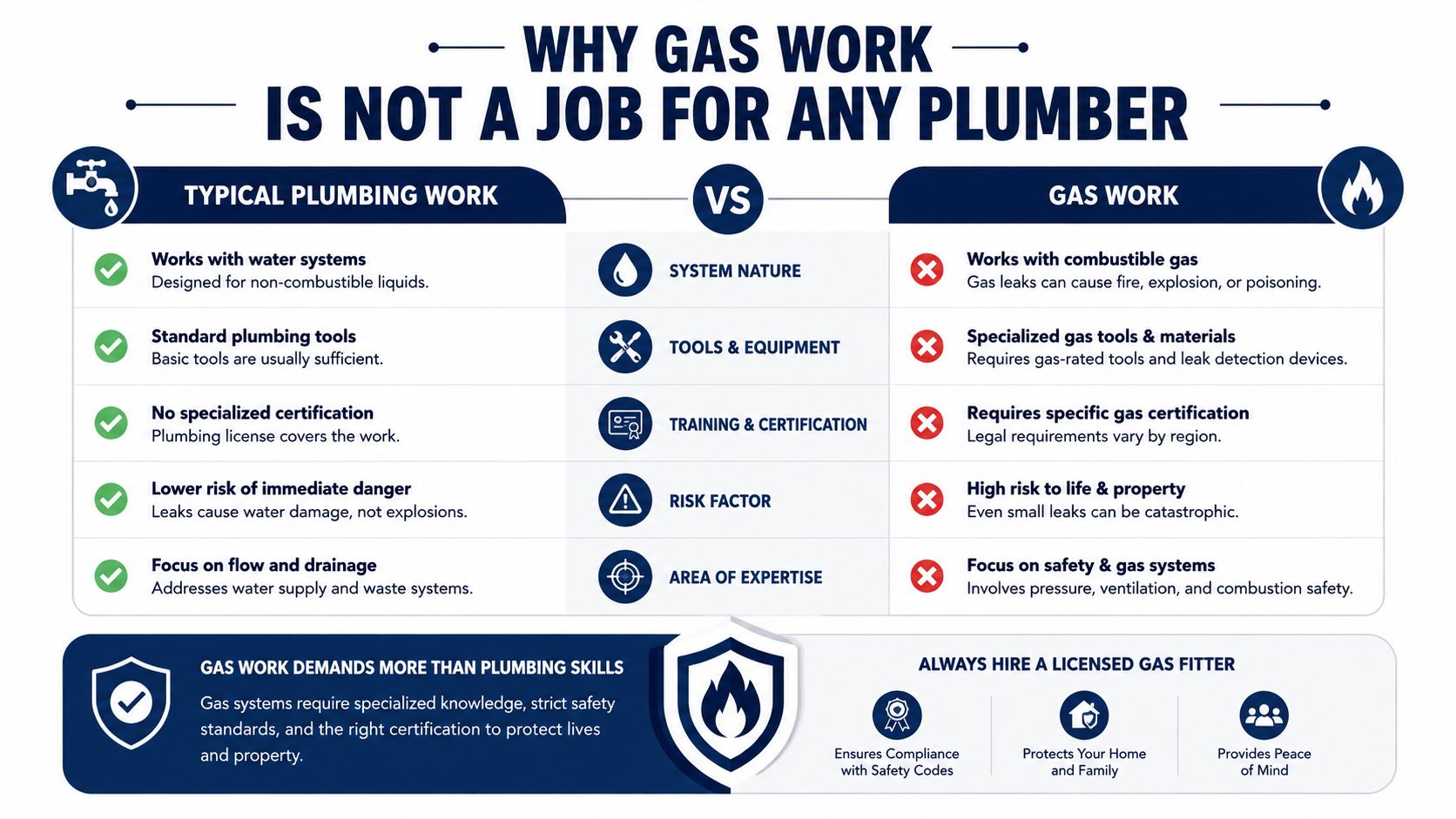
| Capability | General Plumber | Licensed Gas Plumber |
|---|---|---|
| Water and drainage repairs | Common scope | Common scope |
| Gas-piping authorization | Must be confirmed for the job | Confirmed through the applicable credential |
| Leak diagnosis | May not be authorized or equipped for every gas task | Uses gas-specific procedures and calibrated tools |
| Pressure testing | Ask whether it's included | Should be part of the documented gas-work process |
| Permits and inspection closeout | May be outside the contractor's scope | Can explain responsibility for permits and records |
| Appliance connection | Depends on license and job type | Matched to the authorized gas-work scope |
For a homeowner, the distinction protects the building and the people inside it. For a property manager or HOA, it also protects the paper trail. A completed gas job should leave you with a clear scope, applicable permit information, test results, invoice, and warranty terms. The cheapest person with a wrench is not necessarily the lowest-risk choice.
What a Gas Plumber License Actually Represents
A gas credential represents a training pathway, not a weekend add-on. Major U.S. markets commonly use supervised apprenticeships, tiered licenses, formal study, and examinations to establish competence.
Maryland provides a useful example. A journey gas fitter must complete 3,750 working hours as an apprentice natural gas fitter over at least two years under supervision, while a master plumber/gas fitter applicant must have held a journey license for at least two years and completed 3,750 hours of training under a licensed master plumber. Those requirements are documented by the Maryland plumber licensing requirements.
Massachusetts uses a staged route as well. A journeyman gas fitter must complete at least two years as an apprentice, finish 150 hours of gas-fitting theory study, and pass the journeyman examination. A master gas fitter must first hold a journeyman license for at least one year and then pass the master exam.

The license tiers have different meanings
| Tier | Experience Required | Exam | Scope of Authority |
|---|---|---|---|
| Apprentice | Supervised field training | Typically works toward later examinations | Performs permitted work under supervision |
| Journeyman | Documented apprenticeship and field experience | Required in markets such as Maryland and Massachusetts | Performs work within the jurisdiction's authorized scope |
| Master | Additional experience beyond journeyman status | Master examination may be required | May qualify for broader responsibility and supervision |
Alabama's board also requires at least two years as an apprentice, or an approved training program plus equivalent apprentice time, before a journeyman plumber certification can be earned. The state added licensing oversight for gas fitters in 1987, showing how jurisdictions have gradually formalized control over gas work.
New York City established another important benchmark. Beginning January 1, 2020, no person may perform gas work unless they're a licensed master plumber or hold a gas-work qualification under the direct and continuing supervision of a licensed master plumber, as stated in the New York City gas-work rule. The point isn't that Los Angeles uses the same structure. The point is that serious jurisdictions treat gas fitting as a regulated specialty with traceable supervision.
Verifying a California Gas Plumber License in Minutes
Don't wait until the crew arrives to verify credentials. Ask for the contractor's legal business name, license number, license classification, and the name of the individual responsible for the work. Then use the California Contractors State License Board lookup before approving the estimate.
Check the record, not just the truck
Search the CSLB record and compare the information with the proposal. The business name should match, the license should be active for the work period, and the classification should make sense for the scope. Review the listed bond, insurance information where available, workers' compensation details, and disciplinary history.
A contractor who says, “My partner has the license,” needs to explain the relationship and who will supervise the work. Don't accept a license number that belongs to an unrelated company, and don't assume a contractor's online advertisement proves authorization.
Use the licensed plumbing contractor near me resource as another starting point for evaluating a local provider, but still verify the contractor through the official California record. The same principle applies when you're comparing unrelated home-service providers. A Mesa AC repair company comparison can help illustrate how service comparisons work, but it isn't a substitute for checking the license authority that governs your own project.
Ask three direct questions
- Which license classification covers this gas work?
- Who will pull the permit, if one is required?
- What documents will I receive after pressure testing and inspection?
If the answers are evasive, keep calling. A legitimate contractor understands that verification protects both sides.
Core Gas Services and When You Actually Need Them
A licensed gas plumber isn't just an emergency leak specialist. The right contractor handles the connection between the gas supply, piping, shutoff components, appliances, testing process, and required documentation.
A new gas stove, dryer, water heater, outdoor appliance, or other fuel-burning fixture may need a properly sized connection, approved shutoff, and inspection-ready installation. A remodel or ADU conversion can involve new piping routes, wall access, trenching, appliance demand, and coordination with the permit office. Don't treat those as casual extensions of a water line.
For a broader explanation of residential gas piping, review this homeowner's guide to gas line plumbing. Use it to prepare questions, not to replace a site evaluation.
Match the service to the situation
- Gas leak detection: Call when you smell gas, hear hissing, see suspicious damage, or need a professional test after the utility shuts service off.
- Gas line repair: Use a licensed professional when a fitting, valve, connector, or section of pipe is damaged or fails testing.
- Appliance hookup: A stove, dryer, water heater, furnace, or outdoor appliance needs a connection that matches the appliance instructions and local requirements.
- New piping: Remodels, additions, ADUs, and fuel-switching projects should be designed around load, routing, access, and inspection requirements.
- Permit work: Ask who applies for the permit and who schedules the inspection. A permit creates an independent inspection opportunity that can catch installation errors.
Pressure testing is the dividing line
A proper test isolates the gas supply and evaluates the completed section with a manometer or another calibrated pressure device before appliances are connected. In a New York City code example, the gauge range must not exceed twice the test pressure, which helps prevent a small pressure loss from being hidden by an unsuitable instrument. The applicable New York City pressure-testing code shows why the equipment and method matter, even when another jurisdiction uses different details.
Ask for the test method, test result, and whether the completed work passed inspection. “We sprayed it with leak detector” isn't a substitute for the required procedure.
The Case for Preventive Gas Safety Checks
Waiting for a strong odor is a poor maintenance plan. Gas-related danger can involve combustion and indoor air, not just a visible break in a pipe.
British Columbia's 2025 gas safety reporting identified carbon monoxide exposure as the top gas-related safety risk and recorded 79 gas incidents, 36 injuries, and one fatal carbon monoxide exposure. Those figures appear in the Technical Safety BC gas safety data. UK national safety reporting also notes around 30 carbon monoxide-poisoning deaths annually and hundreds of dangerous gas-fitting reports, as summarized in the verified safety data provided for this guide.
The practical lesson is simple. The highest-value gas service may be preventive inspection, not emergency repair.
What a preventive visit should examine
A competent inspection can include the visible gas piping, appliance connections, shutoff access, regulators, venting, and combustion performance. For combustion appliances, ask whether the technician will perform a combustion analysis with a calibrated analyzer and document the readings. That check helps identify unsafe operation that a smell test won't reveal.
A gas-pressure check at the meter or appliance can also reveal supply problems, regulator issues, or conditions that affect appliance performance. The technician should explain what was tested and what was outside normal operating expectations.
A clean inspection report is more useful than verbal reassurance. It gives the owner, tenant, HOA, and future service contractor a shared record.
Property managers should schedule inspections around turnovers, major appliance replacement, remodels, and recurring maintenance plans. Homeowners should treat gas appliances like smoke detectors and fire extinguishers. You don't wait for a fire before checking whether those systems work.
What to Do Right Now If You Suspect a Gas Leak
If you smell gas now, stop reading and leave. Don't try to identify the exact source, don't turn lights on or off, don't use a phone inside, and don't start a vehicle near the suspected area. Get everyone and all pets outside first.
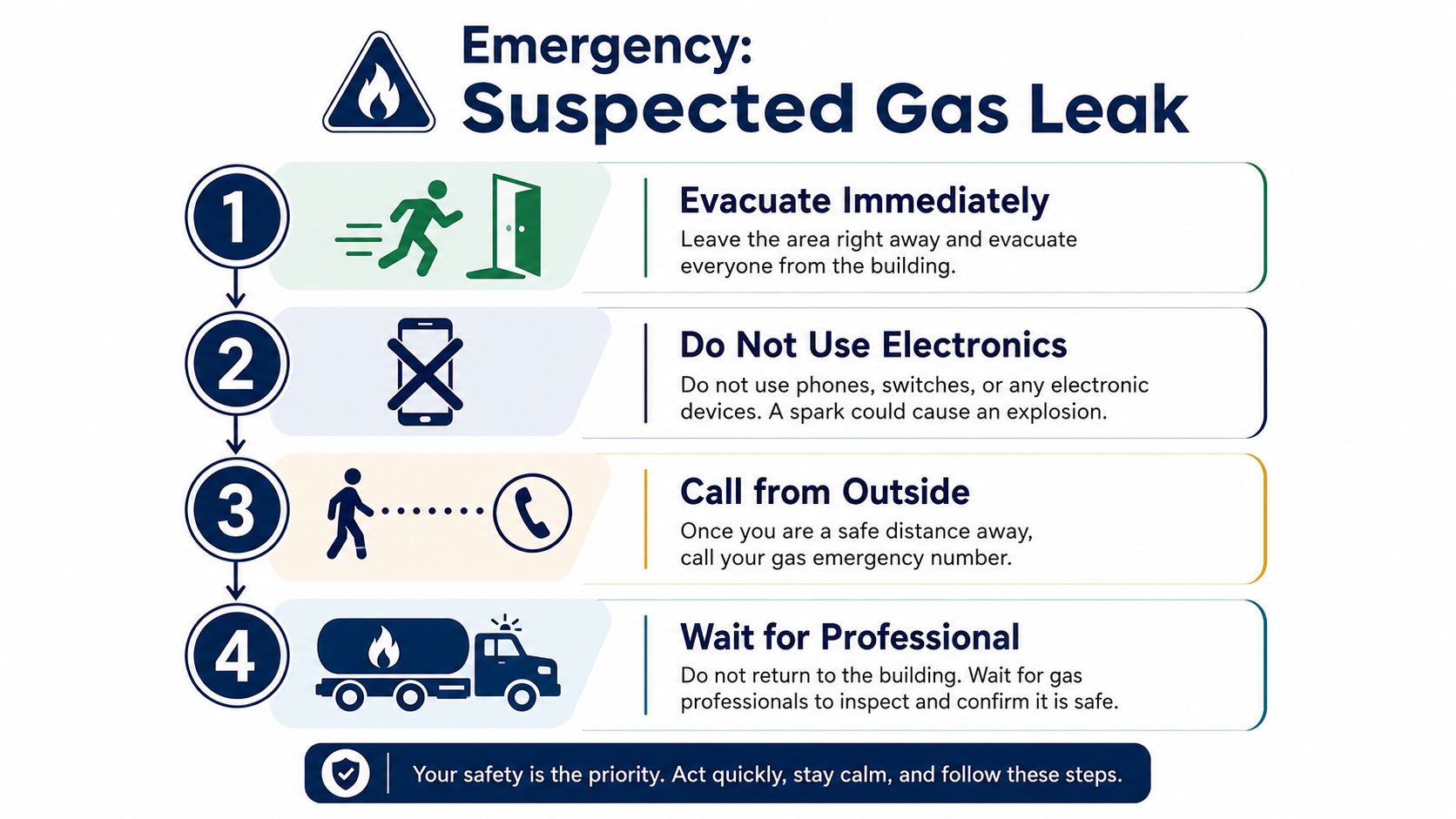
Follow this order
- Evacuate immediately. Leave through the safest available route. Don't stop to collect belongings.
- Avoid ignition sources. Don't operate switches, thermostats, garage-door controls, appliances, matches, or lighters.
- Call from outside. Contact the gas utility's emergency line and, if there's immediate danger, emergency services. Tell them the address and what you noticed.
- Wait for professionals. Don't re-enter until the utility or emergency personnel say it's safe. After the utility response, a licensed gas plumber can perform detection, isolation, repair, and required testing.
For additional warning signs and household response guidance, use this guide to detecting a gas leak in your home. Other signs can include a hissing sound near an appliance or line, dead vegetation above a buried gas route, or an unexplained increase in gas use. The absence of an odor doesn't prove the system is safe.
A utility worker may shut off service as an emergency measure. That doesn't automatically complete the repair or provide the documentation a property owner needs. The licensed contractor should identify the failed section, explain whether repair or replacement is appropriate, test the completed work, and clarify what must happen before service is restored.
Watch the following visual guide only from a safe location and never use it as a reason to delay evacuation.
Understand what drives the price
Gas work doesn't have one honest universal price. The cost depends on whether the pipe is exposed or concealed, how much access and demolition are required, whether a section must be replaced, whether permits and inspection apply, and whether an appliance conversion is involved. Emergency response, after-hours access, multi-unit coordination, and restoration work can also change the estimate.
Reject quotes that omit pressure testing, permits, appliance commissioning, or documentation. For an HOA or multi-unit property, ask whether planned inspections and grouped repairs can reduce repeated mobilization and improve recordkeeping. A low bid that leaves compliance unresolved isn't a saving. It's an unfinished risk.
The Hiring Checklist You Use Before Signing
Save this list on your phone and use it during the first call. A qualified contractor won't treat these questions as an inconvenience.
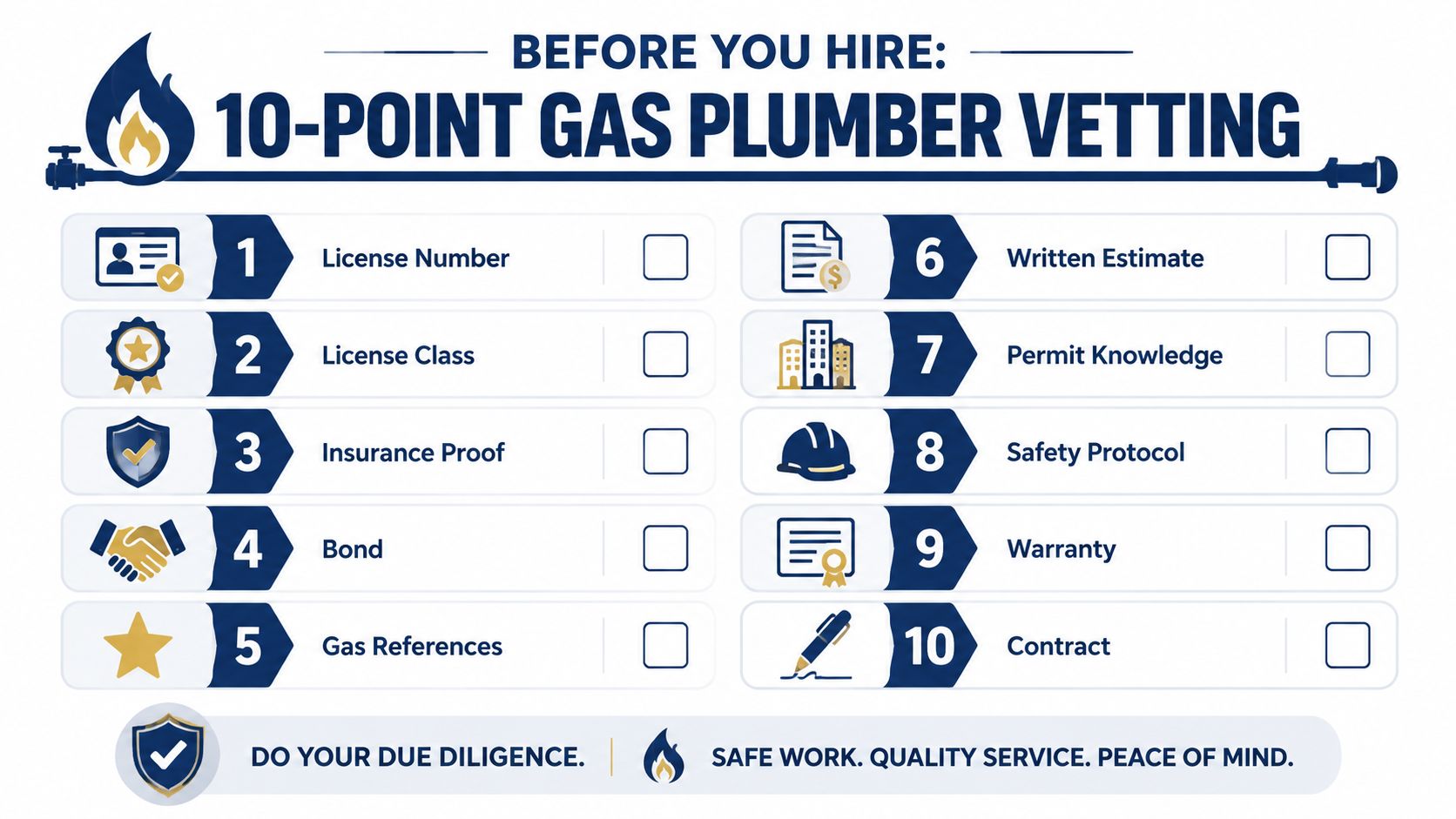
- License number: Get it before scheduling.
- License class: Ask how the classification covers your exact gas task.
- Insurance proof: Request current liability coverage and workers' compensation information where applicable.
- Bond information: Confirm the required bond and the legal business name attached to it.
- Gas references: Ask for comparable work, such as water-heater connections, leak repairs, remodel piping, or multi-unit service.
- Written scope: Require a description of pipe, fittings, valves, appliances, access work, restoration, and exclusions.
- Permit responsibility: Put in writing who applies, pays, schedules, and closes out the permit.
- Testing commitment: Ask what pressure-testing method and calibrated instrument will be used.
- Completion documents: Request test results, inspection records, photos where useful, invoices, and equipment information.
- Warranty and contact: Get warranty terms and one accountable contact from dispatch through completion.
The written estimate should separate labor, materials, permit charges, access work, and possible change orders. A professional can explain what remains unknown before opening a wall or trench, instead of hiding uncertainty inside a vague “miscellaneous” line.
Don't sign a gas-work proposal that promises only “repair leak.” The document should identify what will be tested, what will be replaced, and what proves the system is ready for service.
Compare proposals by scope and evidence, not by the final number alone. Two estimates can look different because one includes inspection coordination and the other stops after installing a fitting.
Common Questions About Hiring a Gas Plumber
Can I do minor gas work myself?
Don't disconnect, extend, repair, reroute, or reconnect gas piping as a DIY project. Even a small fitting can create a leak or fail a required test. The legal scope varies by location, so ask the local building authority or hire a properly credentialed contractor rather than relying on online instructions.
How often should a gas system be inspected?
There isn't one universal interval that fits every Los Angeles property. Arrange an inspection when you buy a home, before a rental turnover, after a remodel, when replacing a major appliance, or whenever performance, odor, venting, or piping condition raises a concern. Property managers should set a written maintenance policy based on appliance age, occupancy, access, and site history.
What should a tenant do after smelling gas?
The tenant should leave immediately, avoid switches and phones inside, and call the utility or emergency services from outside. The property manager should not instruct the tenant to investigate, relight appliances, or wait for a routine appointment. After the utility response, send a licensed gas plumber to diagnose the system, complete authorized repairs, test the work, and document the result.
Will homeowners insurance cover a gas-related incident?
Don't assume coverage. Policies differ, and exclusions may apply to unpermitted work, neglect, intentional acts, or specific property conditions. Notify the insurer when appropriate, preserve permits and contractor records, and ask the carrier how it handles gas-related damage before an incident occurs.
What should a Los Angeles property owner keep after the job?
Keep the proposal, license details, insurance information, permit and inspection records, pressure-test results, appliance documentation, invoices, photos, and warranty terms. For an HOA or rental portfolio, store those records by address and unit so the next manager or technician can verify what changed.
The hiring decision comes down to three requirements: verify the license, demand documentation, and treat preventive checks as the baseline. A contractor who can detect and repair a leak but won't explain testing, permits, or closeout records isn't giving you complete gas service.
EZ Plumbing provides licensed gas leak detection, gas line repair, and permit-related gas plumbing support for Los Angeles homes, HOAs, property managers, and commercial properties, with 24/7 emergency response and same-day scheduling for planned work. Visit EZ Plumbing to request service across Beverly Hills, Santa Monica, West Hollywood, Pasadena, Glendale, Burbank, and the San Fernando Valley, or call (818) 908-2710.