
Find a Licensed Plumbing Contractor Near Me in 2026
You're standing in a hallway with water on the floor, a maintenance tenant calling twice, and a vendor voicemail that sounds unsure about their own arrival time. That's the moment when “licensed plumbing contractor near me” stops being a search phrase and becomes a risk decision. If you manage property in Los Angeles, you don't need the first person who answers, you need the one who can show proof, move fast, and leave the building safer than they found it.
Table of Contents
- When the Phone Call Cannot Wait
- Verifying the License, Bond, and Insurance
- Matching Response Speed to the Problem
- Choosing the Right Specialty for Your Issue
- Reading Reviews and Asking About Guarantees
- Getting Clean Estimates and a Written Scope
- A Reusable Hiring Playbook for Next Time
When the Phone Call Cannot Wait
At 2 a.m., a slab leak in a 1960s Valley bungalow doesn't feel like a service request. It feels like a bad night getting worse by the minute. A water heater dying before an open house in Pasadena or a gas smell in a restaurant before service does the same thing, it compresses every decision into a few tense seconds.
That pressure is exactly why speed without verification causes repeat visits, warranty fights, and insurance headaches. A property manager can't afford a contractor who improvises a fix, disappears, then sends a second crew to “finish” the first crew's work. An HOA board can't defend a bad hire with “they were available first.” Availability is useful only when it comes with legal standing, coverage, and a scope that matches the problem.
Practical rule: treat every urgent plumbing call like a risk check, not a race.
The best way to think about a licensed plumbing contractor near me search is simple. First, confirm the contractor is allowed to do the work. Then confirm the company is covered if something goes wrong on site. Only after that should you care about arrival time, because a fast unverified crew can cost more than waiting an hour for the right one.
Los Angeles buyers feel this more than most. Buildings here mix older pipes, dense occupancy, tenant pressure, and expensive finish materials. That means a sloppy repair can create damage far beyond the original leak. A calm workflow protects the property, the budget, and the people who live or work there.
Verifying the License, Bond, and Insurance
Start with the license number, not the sales pitch. If a contractor cannot give it to you immediately, stop the call and move on. The right sequence is simple. Capture the license number, check it in the California board lookup, confirm that it is active, and make sure the classification covers plumbing work, which in California is C-36.
The next two checks are where weak directory listings fall apart. California applicants typically need a $25,000 contractor bond at licensure, as reflected in the California Contractors State License Board process, and you still need to verify that the company carries general liability and workers' compensation insurance. The bond matters because it backs incomplete or defective work. Liability insurance matters because it helps protect the property if a technician causes damage. Workers' comp matters because it keeps an injury on site from turning into your problem.
For a buyer, this is not paperwork theater. It separates a legitimate contractor from someone renting a truck with a logo on the door. If the paperwork does not match the work being requested, the contractor should not start.
If you want a quick model for this kind of verification, the Jackson landscape design company checklist is useful because it treats hiring as a screening process. The same thinking applies here. A real contractor should pass credential review before they ever touch a building system.
For a closer look at why licensed help matters in the home, see why a licensed plumber is worth the call. The point is not to admire credentials. The point is to reduce the chance that a simple leak turns into a dispute, a delay, or a coverage problem.
Most of this check should take only a few minutes if the contractor is legitimate and organized.
Matching Response Speed to the Problem
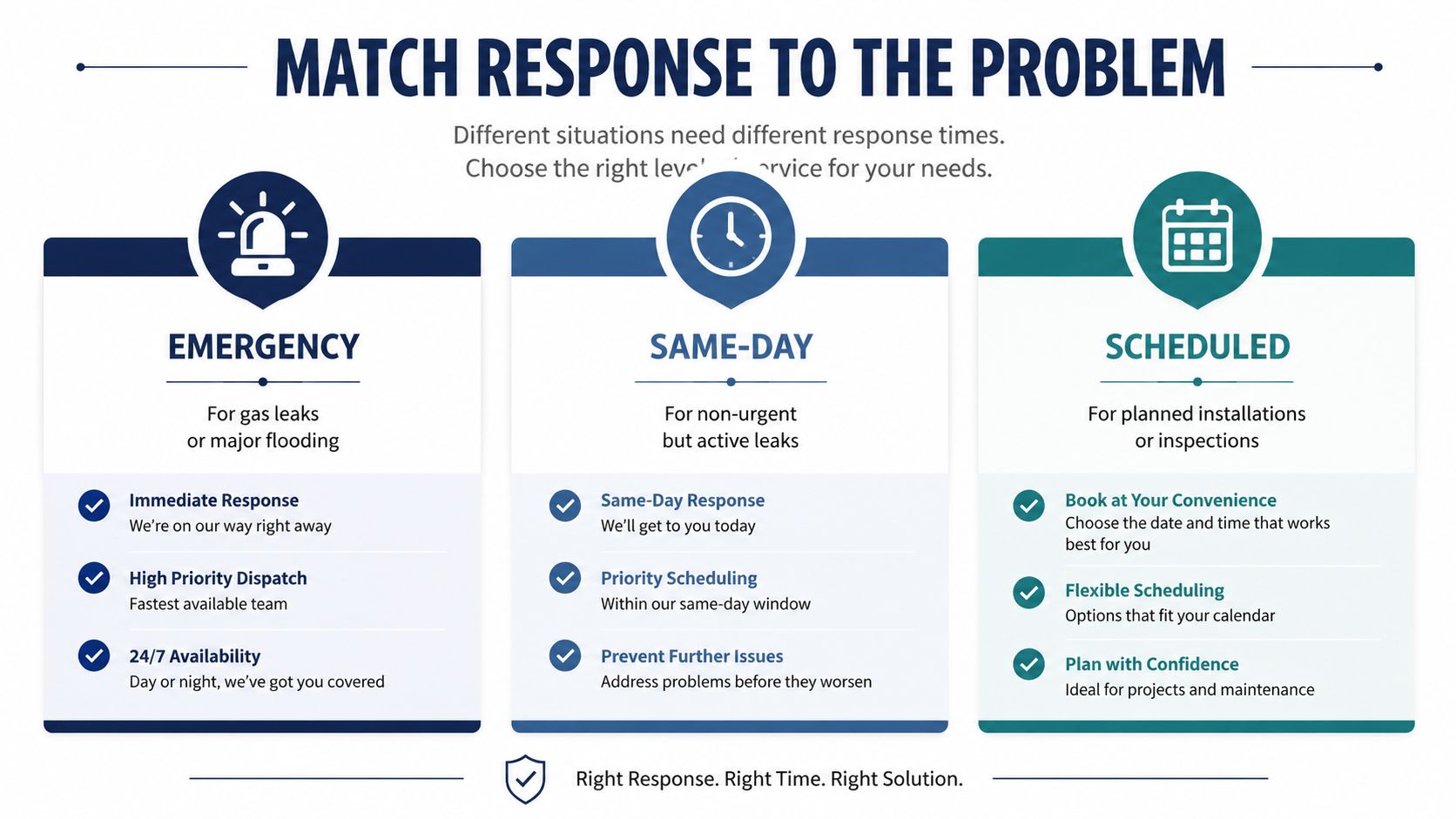
A 2 a.m. truck is the wrong answer for a problem that can wait. Dispatch should follow risk, not panic. A slow drain before a tenant walkthrough is a scheduling issue. Active flooding, a sewer backup in occupied space, or a suspected gas leak belongs in emergency status.
Use this rule of thumb.
| Situation | Best response |
|---|---|
| Active flooding, sewer backup affecting multiple units, suspected gas leak | Emergency |
| Failed water heater with one functional bathroom, slow drain before a tenant meeting | Same-day |
| Full re-pipe, tankless conversion, planned hydro jetting, inspection work | Scheduled |
The cost premium is real. In the Westland market data, average plumber rates are about $100/hour, with a range of $45 to $200/hour. Emergency rates average $150/hour plus a $100 to $350 trip fee. That pricing gap is why response speed should match the actual risk on site. If water is still moving through the property, paying for speed can be cheaper than paying for repairs, tenant claims, or shutdown time. If the issue is stable, rush pricing is wasted spend. For the source on those Westland rates, see the Westland market data.
HOAs, property managers, and commercial buyers need a tighter standard than a single-family homeowner. A backed-up line in an occupied building is a disruption issue that reaches beyond the plumbing itself. A planned repair window gives the contractor time to bring the right equipment, notify occupants, and document the work. Emergency dispatch is for work that cannot wait. Same-day service is for active but contained failures. Scheduled work is for known jobs that need coordination, access planning, and tenant communication.
Pay for speed when delay creates damage, safety exposure, or tenant fallout. Otherwise, book the right window and protect the budget.
Choosing the Right Specialty for Your Issue
Not every plumber is the right plumber for every job. A contractor who clears kitchen drains all day may still be the wrong call for a sewer line under a driveway. Gas leak work needs a different level of caution, and water heater work has its own set of failure points.
The cleanest way to frame it is by problem type, not by company slogan. If you're describing a restaurant backup on Ventura Boulevard, say that grease buildup is part of the picture. If you're scoping a Craftsman before purchase, say you need sewer diagnostics, not just “a plumber.” The cleaner the problem statement, the better the dispatch.
- Drain cleaning: Use this for slow sinks, branch line clogs, and recurring backups in kitchens or restrooms.
- Hydro jetting: Use this for heavy grease, scale, and buildup that a basic cable can't fully clear.
- Sewer line repair or diagnostics: Use this when backups keep returning, multiple fixtures are affected, or you need a camera inspection before a purchase.
- Water heater repair or tuning: Use this for no-hot-water calls, inconsistent heat, or performance issues in tank and tankless units.
- Gas leak detection and remediation: Use this any time there's a smell, alarm, or suspected line issue. That's a safety call, not a convenience call.
The tool choice matters just as much as the title. A smart dispatcher won't send a drain specialist to do gas work or a water heater tech to diagnose a collapsed sewer. For a multifamily building in Glendale, for example, tankless tuning should be routed to a crew that understands capacity, venting, and ongoing service access. For a commercial kitchen, hydro jetting is often the more honest first move because it attacks the buildup rather than just poking a hole through it.
The phrase licensed plumbing contractor near me should lead to capability, not just proximity. Ask what equipment they're bringing, and ask what the first diagnostic step will be. That question usually tells you whether you're speaking to a real operator or a phone-answering middleman.

Reading Reviews and Asking About Guarantees
Star ratings are blunt instruments. They can tell you a contractor has volume, but not whether they handle your type of job well. I care more about patterns than praise. If three different reviews mention clean work, clear communication, and follow-through on a return visit, that's worth more than a pile of generic five-star fluff.
Read for job similarity first. A landlord review about a multi-unit emergency is more useful to a property manager than a single-family faucet review. A commercial note about tenant coordination matters more than a comment about “nice guys.” Ignore reviews that only praise speed without describing the actual repair, and discount any testimonial that sounds like an ad.
A warranty only matters if it's written down and specific. Ask what the workmanship guarantee covers, how long it applies, and what happens if the same issue returns. If the answer stays vague, the guarantee is weak. For buildings with boards or management systems, ask for before-and-after photos, invoice line items that match the estimate, and the license number on the paperwork.
For a useful reference on how warranty language should be handled, review the done-right guarantee. Good contractors do not act offended by documentation requests. They expect them.
A contractor who's serious about standing behind the work won't dodge the paperwork.
If the company sounds like a lead-gen operation, you'll notice it. The call center can't answer basic questions, the job description changes every time you ask, and nobody can explain who shows up. Reliable firms talk in specifics. Who is coming, what they're checking, and what happens if the issue reappears.
Getting Clean Estimates and a Written Scope
The cheapest quote is often the most expensive quote after the work starts. That happens when a contractor gives a vague number, then fills in the gaps with extras, change orders, and sudden “discoveries.” A clean estimate protects you from that game.
A proper scope should spell out labor, parts, diagnostics, permit-related items if needed, warranty terms, and the expected start and finish window. If you're comparing two bids, compare the same scope on both sides. Don't compare a shortcut estimate to a real one and call the shortcut “cheaper.”
| Estimate Item | Why It Matters |
|---|---|
| Labor line items | Shows what work is actually being billed |
| Parts and materials | Prevents vague markups and missing details |
| Diagnostic fee | Clarifies the cost of finding the problem |
| Permit-related costs | Keeps compliance from becoming a surprise |
| Warranty terms | Tells you what is covered after the job |
| Start and finish window | Helps with tenant notice and access planning |
| License number on the document | Ties the estimate to the right contractor |
For broader budgeting context, the internal guide on how plumbing estimates help Los Angeles homeowners make smart choices is a good companion piece, especially if you're comparing multiple bids for the same repair. The same logic applies to HOAs and commercial properties, just with more people affected.
Change orders deserve special attention. If the contractor finds additional damage, they should stop, explain it, and get written approval before starting extra work. No written approval means no extra work. That rule protects the board, the manager, and the owner from scope creep that nobody signed off on.
A verbal-only quote is a red flag. A demand for full payment up front is another. So is a document with no license number, no timeline, and no clear finish point. You want paperwork that would still make sense if a board member, insurer, or tenant read it six weeks later.
A Reusable Hiring Playbook for Next Time
The next time something goes wrong, use the same sequence every time. Verify the CSLB license, confirm insurance and bond, match the response speed to the actual urgency, match the specialty to the problem, read reviews for patterns instead of stars, and get the scope in writing before the crew starts. That's the whole playbook.
Los Angeles buyers should also think in coverage zones, not just city names. A contractor that can move across Beverly Hills, Santa Monica, Pasadena, Glendale, Burbank, and the San Fernando Valley is easier to keep on standby because the response path is already built. That matters most when you're juggling after-hours emergencies and planned maintenance in the same portfolio.
The right contractor should be able to handle emergency dispatch and same-day scheduling without making the process feel chaotic. A dispatcher who gives a real ETA, a tech who shows up prepared, and paperwork that matches the job are not extras. They're the baseline.
The easiest way to avoid future panic is to keep one vetted contact ready before the next failure hits. If you're managing buildings, save the license details, the after-hours number, and the warranty terms now. Don't wait until water is coming through the ceiling.
If you're also managing a remodel or property refresh, the DC luxury remodeling tips are a useful reminder that vendor selection should always start with credentials, scope, and documentation, not sales language. The same discipline applies here.
If you need a licensed team that handles urgent plumbing, same-day repairs, drain cleaning, sewer diagnostics, water heater work, and gas leak response across Los Angeles, EZ Plumbing can help you verify the issue, dispatch the right crew, and keep the paperwork tight. Call them when you need a real ETA, clear recommendations, and work that fits HOA, property management, or commercial standards.