
Finding a Reliable Plumber Near Me: A Los Angeles Guide
Looking for a reliable plumber near me in Los Angeles usually means something has already gone sideways. Maybe a kitchen line started leaking under the sink. Maybe a tenant called about a toilet backing up on a Sunday night. Maybe you smelled gas and now you're standing in the driveway trying to decide whether this is a plumbing call, a utility issue, or both.
In LA, plumbing problems get expensive fast. Water moves through drywall, flooring, cabinets, and neighboring units long before anyone agrees on whose fault it is. That's why the right move isn't just “find a plumber.” It's to slow the situation down, protect the property first, and then vet the company like someone who's going to live with the result.
I manage properties in Los Angeles, and the pattern is always the same. The owners who avoid the worst outcomes aren't the ones who get lucky. They're the ones who know what to do in the first few minutes, what questions to ask before approving work, and how to tell the difference between a fast answer and a dependable service operation.
Table of Contents
- First Steps During a Plumbing Emergency
- Decoding Reliability What to Look For Before You Call
- The Vetting Process A Step-by-Step Guide for Angelenos
- Asking the Right Questions Beyond the Price Quote
- Understanding Los Angeles Plumbing Costs and Warranties
- Why LA Property Managers and Homeowners Trust EZ Plumbing
First Steps During a Plumbing Emergency
A burst pipe at 2 a.m. scrambles people. The mistake is calling around before you've contained the damage. In Los Angeles homes, condos, and small multifamily buildings, the first 15 minutes often decide whether you're dealing with a repair bill or a repair plus restoration problem.
Start with a three-step triage checklist
Stop the water source first.
Go to the nearest fixture shutoff if the issue is isolated to a sink, toilet, or supply line. If you can't tell where the failure is, shut off the main water supply to the unit or building. In single-family homes, that may be near the perimeter, garage, or where the service line enters the structure. In condos, you may have a unit shutoff plus a building-level valve controlled by management or maintenance.Shut off gas only if the situation points to it.
If you smell gas, hear a hiss near a line, or the plumbing issue involves a water heater or gas appliance connection, leave the area and follow utility safety procedures. Don't start experimenting with tools if you're unsure. Gas work isn't the place for guesswork.Contain and document.
Put down towels, buckets, and pans. Move rugs, boxes, and electronics. Take clear photos before anyone starts opening walls or removing parts. Those photos help with insurance, owner communication, and later disputes over what was already damaged.
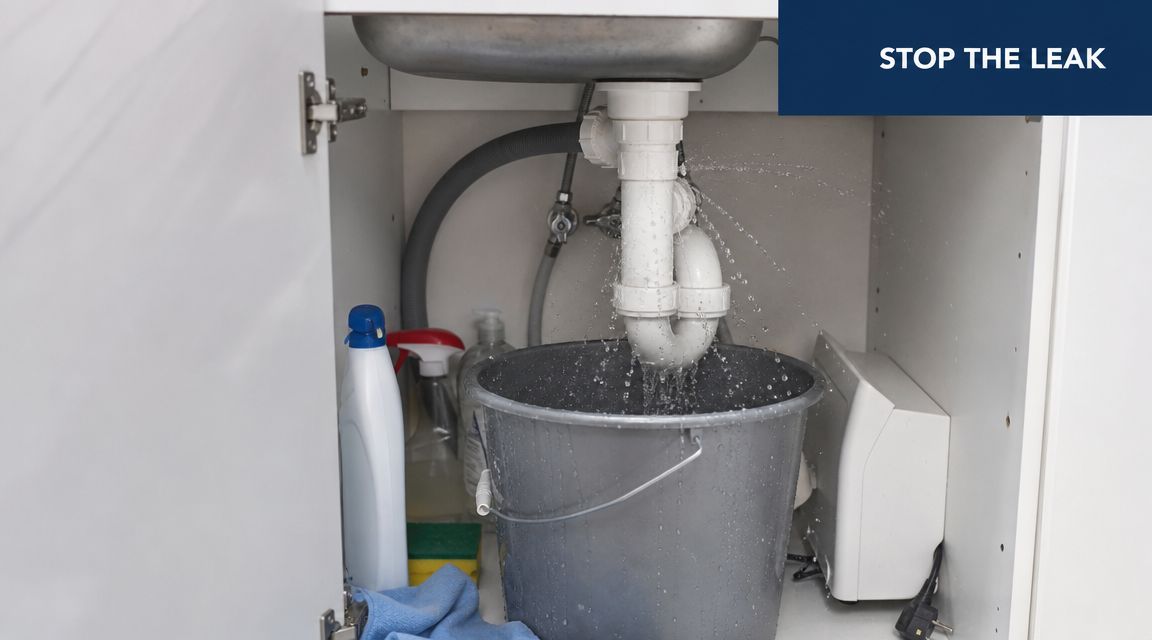
Practical rule: Don't approve invasive work while water is still actively running unless the technician is stopping the source as part of the first response.
Know when the problem may be deeper than the fixture
A lot of owners assume every leak is a simple supply line or drain issue. In older LA housing stock, that's not always true. If water shows up at flooring seams, exterior edges, or multiple rooms, the leak path may be under the slab or traveling farther than it appears. When that happens, it helps to understand what access options exist before a contractor starts breaking finishes. This overview of under slab tunneling services gives useful context on low-disruption access methods that sometimes matter when plumbing problems extend below the structure.
Call with a clear description, not a panicked one
Once the property is stable, call the plumber and give a focused report: what failed, what you shut off, whether there's active leaking, whether multiple fixtures are affected, and whether gas is involved. That gets you a better dispatch decision.
If you want a local emergency checklist written for this market, this guide on handling your Los Angeles plumbing emergency with confidence is worth saving before you need it.
Decoding Reliability What to Look For Before You Call
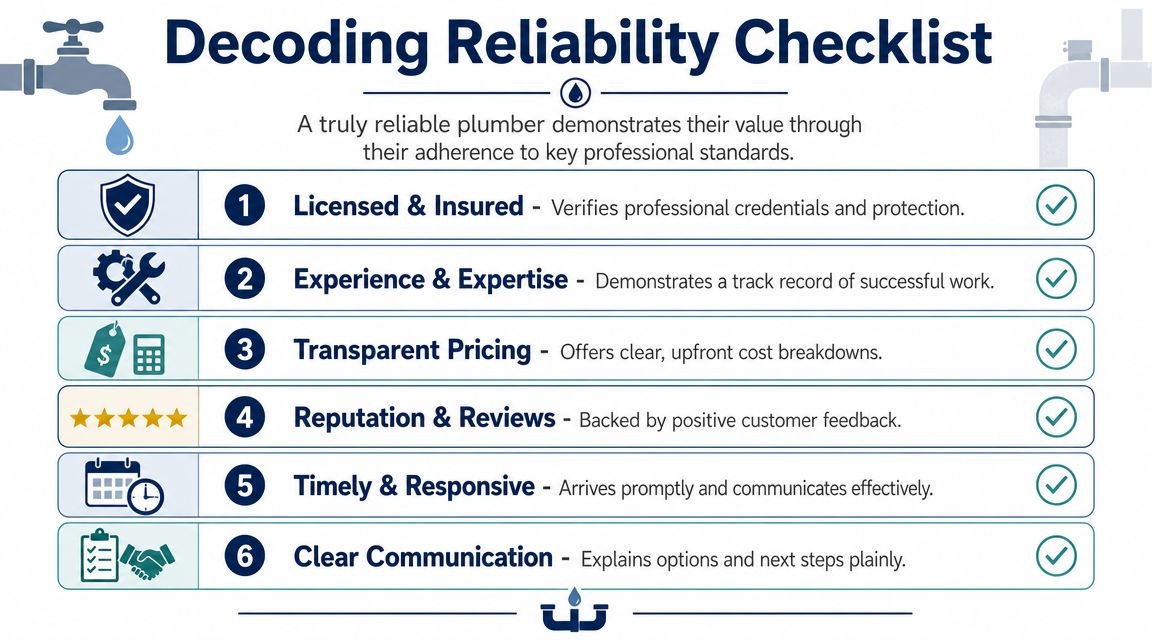
In Los Angeles, “reliable” can't mean “they picked up the phone.” That bar is too low. A reliable plumber near you needs the operational depth to respond across a wide service area, arrive prepared, and finish the work without turning a single repair into three return visits.
Early in the search, I look for evidence of speed plus coverage. Angi notes that local plumbers can handle most repairs the same day because technicians arrive with well-stocked trucks, and many established providers advertise 24/7 emergency service for urgent failures. The same reference also points to cost context from ProMatcher in a major market, where residential plumbing contractors average around $74.49 per hour. That gives homeowners a useful benchmark when a quote looks suspiciously low or inflated (same-day repairs, stocked trucks, 24/7 service, and hourly cost context).
What reliability looks like in Los Angeles
LA isn't one compact service zone. A company may say it serves the city, but that doesn't mean it can respond efficiently from Santa Monica to Pasadena or from West Hollywood into the Valley on the same day. Coverage matters because traffic, dispatch load, and technician routing affect response quality.
Use this short filter before you call:
- Real emergency availability: If the issue is urgent, can they dispatch after normal business hours?
- Wide local coverage: Do they clearly serve your neighborhood, not just “Greater Los Angeles” in vague terms?
- Prepared trucks: A stocked truck often means fewer delays waiting on common parts.
- Service depth: Can they handle drains, sewer diagnostics, water heaters, and gas-related work without subcontracting everything out?
- Clear communication: Do they explain arrival windows, approval steps, and what happens if the scope changes?
A lot of smaller operators do solid work. But for property managers, HOAs, and owners with tenants waiting, the trade-off is capacity. A one-person shop may be excellent until that person is already tied up across town.
Here's a useful contrast. Some plumbing companies earn business because they show up first in search, while others earn repeat business because their operation is built to handle demand. If you're curious how contractors improve visibility online, this look at how to boost local leads for home services explains why some names appear everywhere. Visibility helps you find a company. It does not prove reliability.
Later in the screening process, licensing becomes essential. This article on why hiring a licensed plumber for your home matters is a good reminder that operational strength and legal compliance are not the same thing. You want both.
A quick visual can also help you separate marketing from substance:
The Vetting Process A Step-by-Step Guide for Angelenos
Once you've got a shortlist, don't bounce between reviews, prices, and promises randomly. Vet plumbers in a fixed order. That prevents the most common mistake, which is getting emotionally attached to the cheapest or fastest option before confirming they're even qualified to do the work.
Step one is license and insurance
Start by verifying the plumbing contractor's license and asking for proof of insurance. This is the foundation, not a final detail to check later. If a contractor can't clearly show they're licensed for the work and insured for the risk, stop there.
A practical hiring workflow is to verify licensing and insurance first, then request at least 3 written estimates. The same guidance notes that local building departments can show which plumbers regularly pull permits, which is a strong proxy for code compliance and procedural discipline (licensing, insurance, estimates, and permit history).
In Los Angeles, permit history matters more than many owners realize. A plumber who regularly works through permit-required jobs tends to have cleaner habits around documentation, inspections, and scope control. That doesn't mean every small repair needs a permit. It does mean you should take permit familiarity seriously when the work goes beyond a straightforward fixture swap.
Step two is how they write the estimate
Ask for written estimates, not verbal ranges thrown out over the phone. You're comparing more than labor. You're comparing assumptions.
Read each estimate for:
- Scope clarity: Does it say what they're repairing, replacing, or diagnosing?
- Parts and materials: Are the components identified clearly enough to compare?
- Timeline: Are they promising same-day completion or just arrival?
- Payment terms: Is deposit language clear and reasonable?
- Exclusions: What is not included if the wall opens and the issue is larger?
A vague estimate often becomes an expensive conversation later.
Step three is reading reviews like an operator
Don't just scan the star rating. Read the middle reviews, not only the glowing ones or the angry ones. Patterns tell you more than extremes.
Look for repeated comments about:
- Communication: Did dispatch keep people updated?
- Cleanliness: Did technicians protect floors and clean the work area?
- Problem resolution: Did the company solve the issue or just patch it?
- Follow-through: If the first repair didn't hold, did they come back responsibly?
There's also a modern wrinkle here. Some companies look bigger than they are because they've invested in search visibility. That's not bad in itself, but it means you should separate online presence from operational proof. If you want to understand how that online footprint gets built, this overview of local SEO strategies for plumbers gives helpful context.
For owners juggling vendors and approvals, a local guide on managing plumbing repairs in Los Angeles step by step can help keep the process organized once the shortlist is in front of you.
Asking the Right Questions Beyond the Price Quote
In Los Angeles, a low number on the estimate can hide an expensive second round of work. I look for something more useful than price first. I want to know how the plumber plans to diagnose the problem, what equipment they will use, and how they will confirm the repair solved it.
That standard matters in this market. Older cast iron lines, root intrusion, hillside drainage issues, slab leaks, grease-heavy kitchen lines, and patched-together gas systems change the job fast. A plumber who answers technical questions clearly is showing you how the job will be handled once the easy fix turns into a real diagnosis.
Questions that expose competence
Start with the symptom, then push for method.
If a drain backs up every few months, ask whether they plan to snake the line or whether hydro jetting is a better fit. Snaking can reopen flow and get a unit usable again. Hydro jetting usually makes more sense when grease, scale, or heavy debris is coating the pipe and causing repeat stoppages. In apartment buildings and older LA homes, that distinction matters because a temporary opening is not the same as a cleaned line.
For sewer complaints, ask whether they will run a camera before recommending excavation, liner work, or replacement. If they want to dig first and inspect later, that is a bad sequence. In my experience, camera footage settles arguments fast. It shows whether you are dealing with roots, offsets, bellies, breaks, or a simple blockage.
Gas issues deserve even tighter screening. Ask whether the technician assigned to the call is qualified to perform gas leak detection and repair, what testing method they use, and whether the company handles the repair in-house or hands it off. In Los Angeles, where remodels and additions often leave behind mixed-age gas piping, that answer tells you a lot about the company's depth.
Here is the short list I keep handy:
| Service Needed | Key Question to Ask |
|---|---|
| Recurring drain clog | Do you recommend snaking or hydro jetting for this line, and why? |
| Suspected sewer problem | Will you camera the line before recommending repair or replacement? |
| Water heater issue | Are you diagnosing the unit first, or quoting replacement immediately? |
| Gas line concern | Is the technician assigned to this job qualified to perform gas leak detection and repair? |
| Leak behind wall or slab | How will you confirm the leak location before opening finishes? |
Ask how they document the work
Documentation is not office fluff. It prevents disputes.
Arrivy's guidance on plumbing field operations recommends using service checklists, approval forms, photos, and QC steps so companies can confirm the scope, record the condition before and after, test connections, check for leaks, and close out the work area properly. That matters on occupied rentals, HOA properties, and single-family homes where owners may not be on-site when the work happens.
Good documentation protects everyone involved. Tenants can see what was repaired. Owners have a record for approvals and warranty follow-up. The plumbing company has proof of the agreed scope and final condition.
If a company is casual about records, expect the callback process to be casual too.
Price is one line item, not the whole decision
The better hire is often the company that explains the method, brings the right equipment, and closes the job with clear documentation. That quote can come in higher and still cost less over the life of the repair.
EZ Plumbing is one example of the type of Los Angeles provider owners usually look for when the issue may involve more than one trade skill. The service mix includes hydro jetting, sewer diagnostics, water heater work, and licensed gas leak detection. That breadth matters in LA because the first symptom often is not the full problem. A kitchen backup may be a line condition issue. A water heater complaint may involve venting, gas supply, or shutoff valves. A good vetting question is whether one company can diagnose the whole chain without handing you off halfway through.
Understanding Los Angeles Plumbing Costs and Warranties
Most owners don't mind paying for plumbing. They mind paying for surprises. The easiest way to avoid that is to understand how the quote is structured before the work starts.
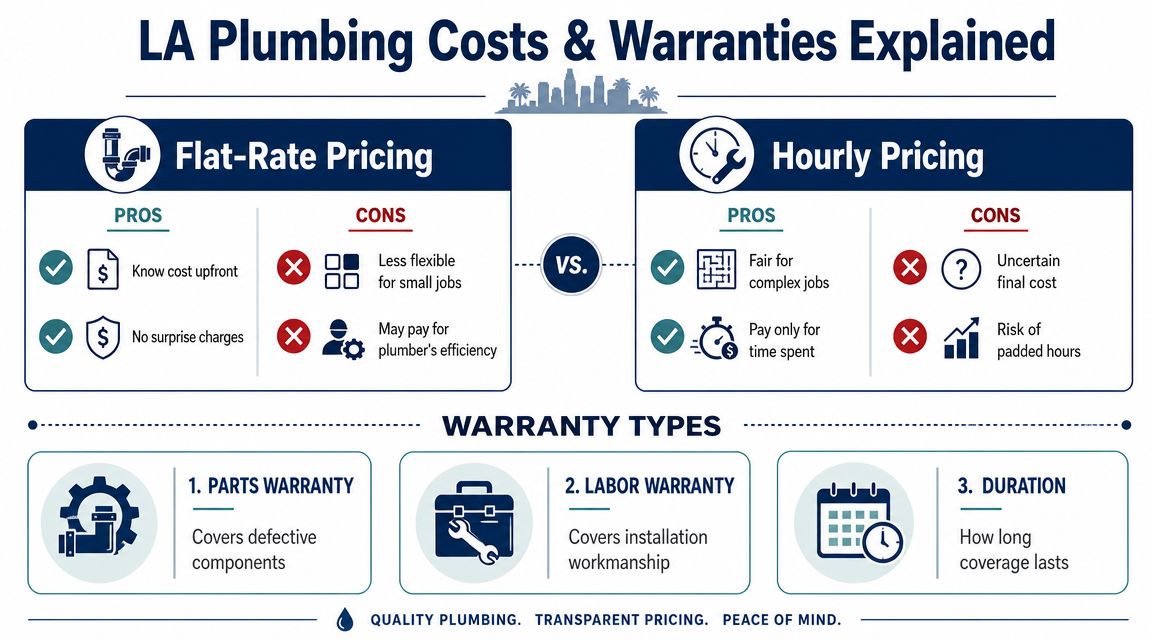
Flat-rate versus hourly pricing
Some plumbers price by the job. Others bill time and materials. Neither model is automatically better. The right choice depends on how defined the problem is.
Flat-rate pricing works well when the task is clear. Replace a disposal. Swap a shutoff valve. Install a standard fixture. You know the cost up front, which helps owners and property managers approve work quickly.
Hourly pricing can make more sense when the job is exploratory or complicated. Leak tracing, intermittent drain problems, and hidden access issues don't always fit neatly into a fixed price before diagnosis.
Read the estimate line by line
Look for these common categories:
- Trip or service call charge: This covers getting a technician to the property and starting diagnosis.
- Labor: Either a flat installed price or billed time.
- Materials and parts: Valves, connectors, fixtures, fittings, disposal units, supply lines, or specialty components.
- Diagnostic work: Camera inspection, leak detection, or testing time.
- Restoration exclusions: Plumbing repair often does not include drywall, paint, tile, or cabinetry repair.
A lower quote can still be the more expensive one if it leaves out likely steps that another contractor already accounted for.
Warranties tell you how the company thinks
Don't settle for a vague promise that they'll “take care of it” if something goes wrong. Ask what's covered on parts, what's covered on labor, and whether the warranty terms are written on the estimate or invoice.
Good warranty language is specific enough that you don't need a second phone call to understand it.
The strongest plumbing relationships in LA are built on clarity. Clear scope. Clear approval. Clear warranty. That's what keeps an urgent repair from becoming a long-running dispute between owner, tenant, and contractor.
Why LA Property Managers and Homeowners Trust EZ Plumbing
At 2 a.m., the question is rarely who had the cheapest estimate last month. It is who answers, shows up prepared, and can solve the full problem without turning one plumbing call into three vendor calls.
That standard is why many Los Angeles homeowners and property managers keep EZ Plumbing on their short list. The company has been serving LA since 1989, carries licensing and insurance, offers 24/7 emergency response, and handles same-day scheduling for planned repairs. Its service area covers the neighborhoods and submarkets that create real volume for managers, including Beverly Hills, Santa Monica, West Hollywood, Pasadena, Glendale, Burbank, and the San Fernando Valley.
Range matters in Los Angeles. An older duplex in Mid-City, a condo in Santa Monica, and a hillside home in the Valley can all present different plumbing risks. A simple drain backup may need hydro jetting instead of a basic snaking. A leak call can expose a larger sewer issue. A water heater complaint can lead to gas line testing. In those cases, a shop that can diagnose and complete advanced work in-house saves time, reduces tenant disruption, and limits the handoff problems that often create repeat visits.
EZ Plumbing handles the mix of services LA owners often need most: emergency plumbing, drain cleaning, hydro jetting, sewer diagnostics and repair, water heater service, and licensed gas leak detection and remediation.
Why it lines up with what careful clients look for
Owners and managers usually trust the plumber who makes the job easier to manage, not harder to track. That comes down to a few habits:
- Fast dispatch: urgent calls are addressed outside normal business hours
- Field-ready technicians: trucks carry common parts and equipment for first-visit repairs when possible
- Advanced capability: hydro jetting, sewer diagnostics, and gas leak work are available without bringing in a second company
- Clear communication: the technician explains findings and options before work is approved
- Respect for occupied property: the crew works cleanly and leaves the space usable
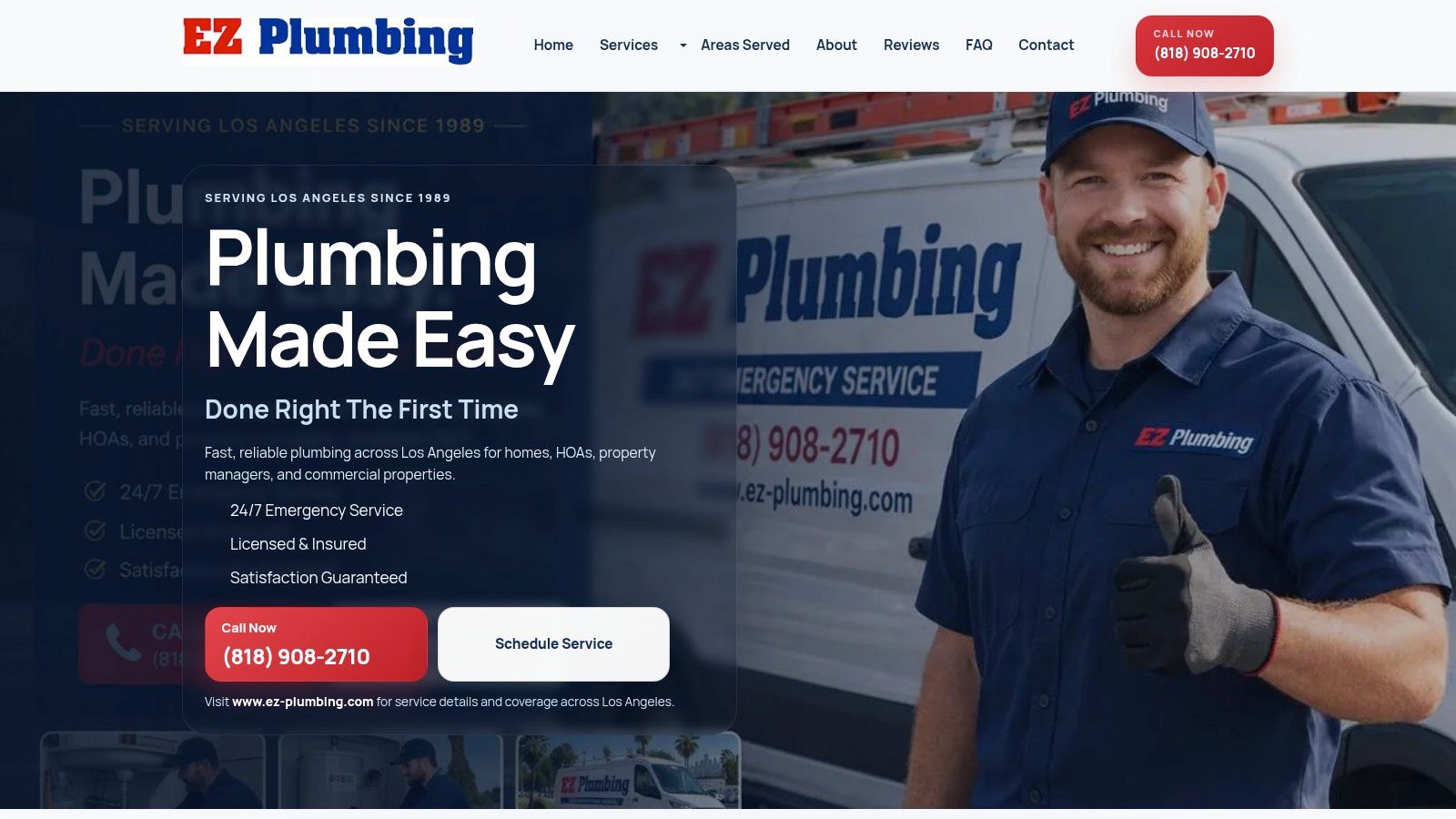
For homeowners, that usually means less panic and fewer loose ends when a drain line backs up or a water heater starts failing.
For property managers and HOAs, it means fewer status-chasing phone calls, fewer gaps between diagnosis and repair, and fewer headaches when a job involves both plumbing skill and documentation.
If you are comparing companies, use the same standard here that you would use anywhere in LA. Confirm licensing and insurance. Ask whether they handle hydro jetting, sewer diagnostics, and gas leak detection with their own team. Check how they communicate approvals and updates. Then choose the plumber that can solve the issue cleanly the first time, especially on properties where delay gets expensive fast.
If you need a licensed Los Angeles plumber for emergency repairs, hydro jetting, sewer diagnostics, water heater service, or gas leak detection, contact EZ Plumbing. You can call (818) 908-2710 or book online for service backed by clear communication, experienced technicians, and support for homes, HOAs, and managed properties.