
What to Do if You Smell Gas: Emergency Steps for Homeowners
You're halfway through dinner when a rotten-egg smell reaches the kitchen. Or you're walking into the lobby of a Los Angeles apartment building and notice it near the mailboxes, the meter room, or the parking structure. Don't start looking for the source. Leave first, warn people only if you can do it without delaying your exit, and call for help from a safe location.
Table of Contents
- Why a Gas Smell Demands Immediate Action
- Your First Moves When You Detect Gas
- When to Shut Off Your Gas Meter and When to Wait
- Navigating Conflicting Advice on Ventilation and Evacuation
- Getting Professional Help After the Immediate Danger Passes
- Common Causes and Practical Prevention Strategies
Why a Gas Smell Demands Immediate Action
Natural gas doesn't have a useful smell on its own. Odorization was suggested as early as 1885, and the first commercial city-gas odorization procedure appeared in 1905, when Pintsch gas condensates were used to odorize water gas. That history matters because the smell is designed to serve as an early public warning, not as an invitation to investigate an appliance, pipe, or meter yourself. PHMSA's historical review of gas odorants%2001-74.pdf) explains how odorization became part of the safety approach used around gas systems.
A smell in your kitchen may come from a stove connection. In a shared Los Angeles building, it may be near a common meter bank, a utility closet, a hallway, or an underground line. You can't determine the source or concentration reliably by standing there longer, and you can't make the situation safer by searching room to room.
The response burden is substantial. U.S. public-sector responders handled about 2.4 million gas-leak-coded incidents from 2003 to 2018, and those incidents nearly quadrupled during that period. In 2018, uncombusted gas leaks cost fire departments an estimated $564 million, based on a median response cost of $2,609 per incident, according to the analysis of natural-gas leak response in the United States.
The rule I give every homeowner and property manager: treat an unexpected gas odor as an emergency until trained responders prove otherwise.
That smell may fade as gas disperses, but fading odor doesn't prove the system is safe. Your first decision isn't whether the odor seems strong enough. Your first decision is whether you can get everyone, including pets, outside without creating an ignition source or passing through a suspected gas-filled area. For more detail on identifying the odor itself, see what methane gas smells like, but don't delay evacuation to confirm what you're smelling.
Your First Moves When You Detect Gas
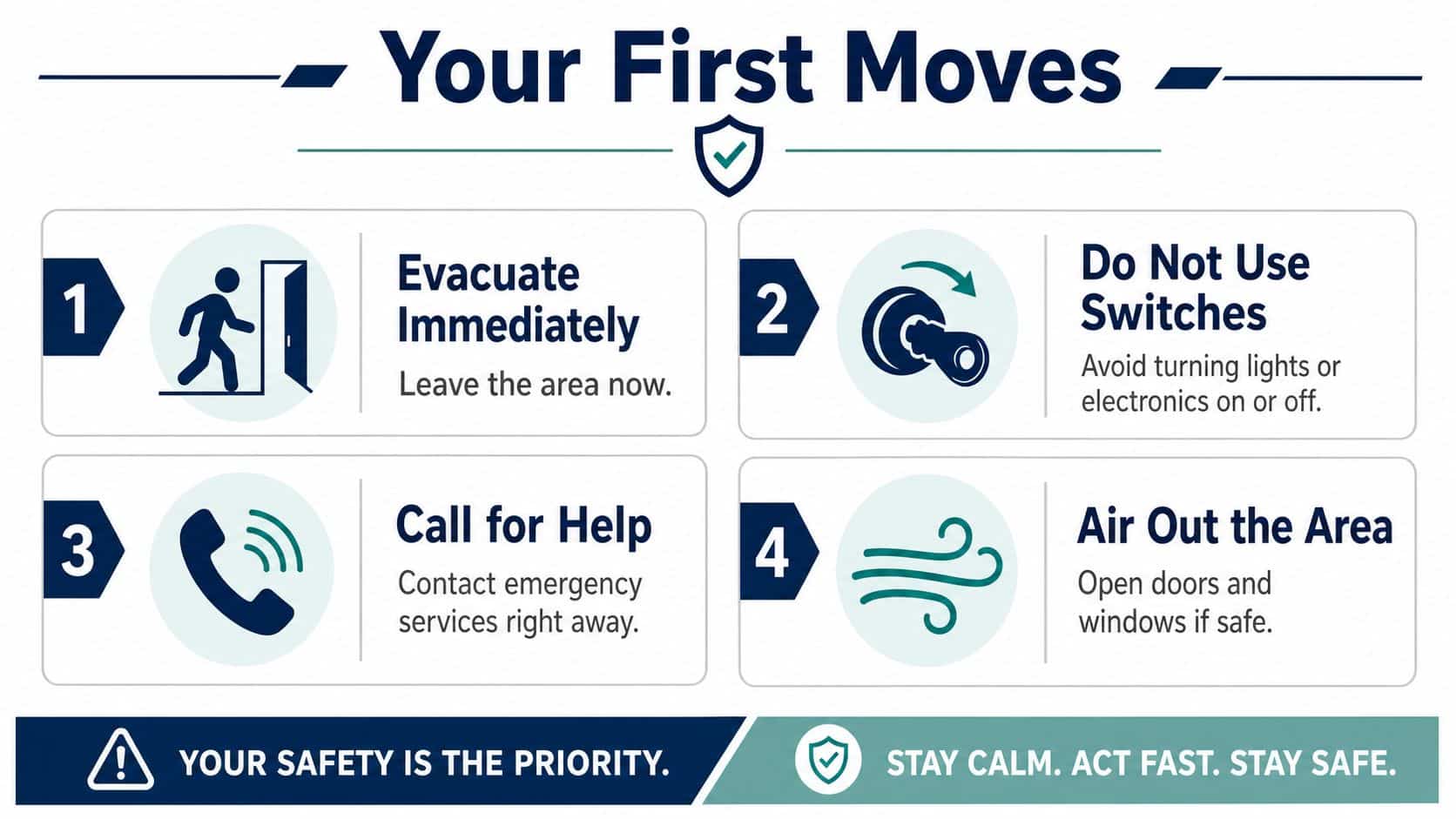
Move decisively. Don't switch on a light, adjust a thermostat, start an appliance, light a candle, smoke, or plug in a phone charger. A small electrical action can create a spark, and an open flame can ignite accumulated gas.
Follow the exit sequence
-
Evacuate immediately. Get everyone out by the nearest safe route. Don't stop to collect belongings, search for the leak, or shut down appliances unless the control is directly in front of you and using it won't delay your exit or expose you to gas.
-
Leave switches and equipment alone. Don't touch light switches, doorbells, garage-door controls, elevators, fans, phones, or electrical panels inside the affected area. In a multi-unit building, don't use the elevator if taking the stairs is practical and safe.
-
Call from outside. Once you're away from the odor, call 911 and the gas utility. Give the address, identify where the odor was strongest, and tell responders whether anyone may still be inside. Don't call from a hallway, lobby, garage, or meter room.
-
Keep people out. Don't re-enter because the smell disappears. Don't restart the furnace, stove, water heater, or other gas equipment. Wait for emergency personnel or the gas utility to assess the property and clear it.
Opening windows deserves caution. Some public instructions recommend ventilating while leaving, while other authorities advise leaving doors and windows as they are. If reaching a window requires walking toward the odor, operating a switch, or remaining indoors, skip it. Evacuation takes priority.
If the smell seems connected to a furnace, don't restart it or inspect the burner compartment. A resource covering signs of a furnace gas leak can help with later awareness, but it isn't a substitute for emergency response.
For a broader explanation of detection methods and warning signs, review how to detect a gas leak in your home.
This short video reinforces the basic response sequence. Watch it later, from a safe location, not while you're standing near an odor.
When to Shut Off Your Gas Meter and When to Wait
Shutting off the meter can stop the flow of gas, but reaching the valve can put you directly in the hazard area. The correct choice depends on access, location, and your ability to operate the valve without delay or exposure.
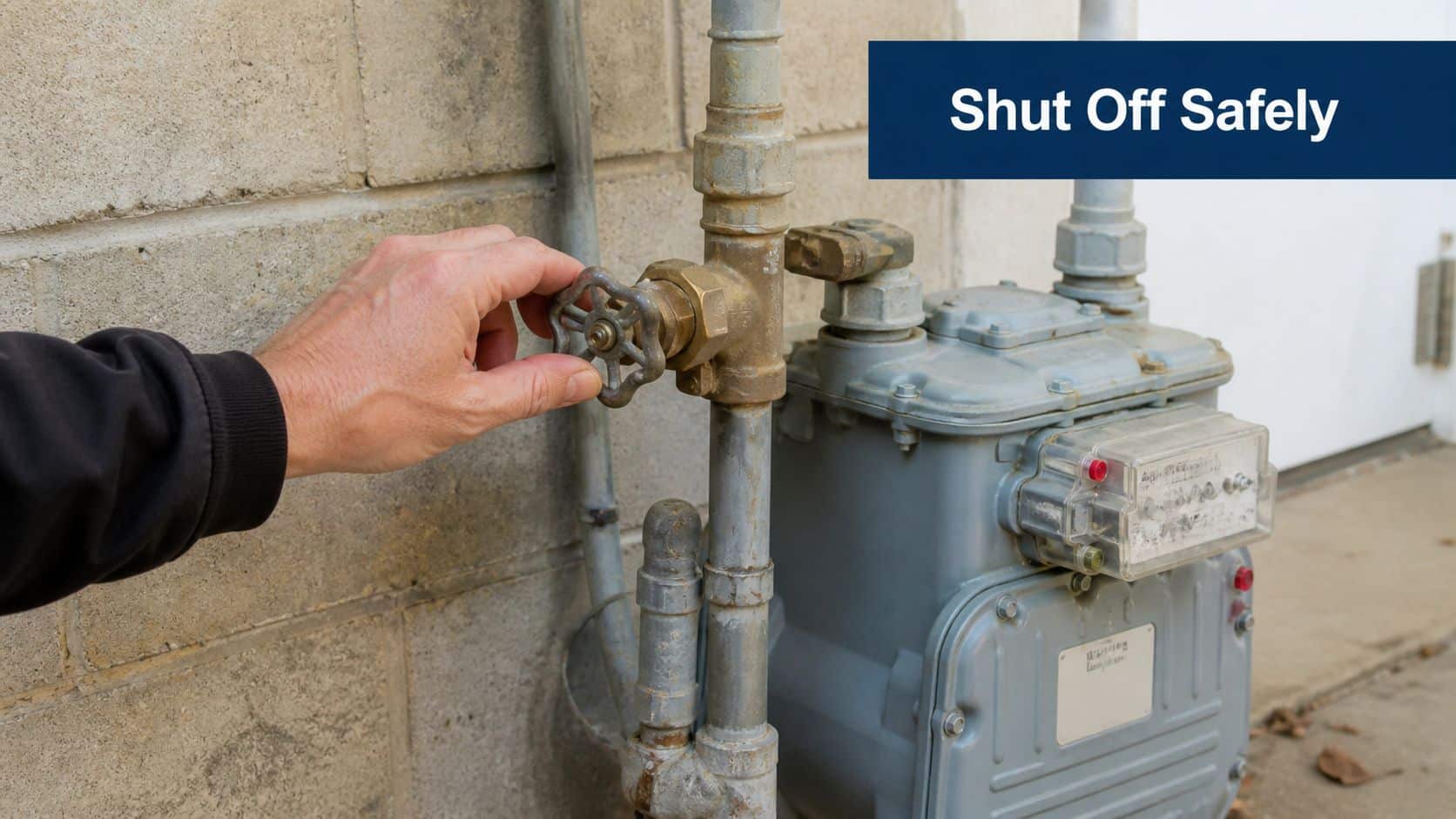
If the meter is outside, clearly accessible, and away from the strongest odor, a person who knows the shutoff procedure may turn the supply off. Technical fire-service guidance recommends shutting off the gas at the meter when the source is unknown or uncontrolled, while also controlling ignition sources and evacuating when accumulation is suspected.
Shutoff is reasonable only when
- The route is safe: You can reach the meter without entering the building, garage, crawlspace, utility room, or any area where gas may have accumulated.
- The valve is familiar: You know which valve controls the property and understand how to operate it. Don't experiment under pressure.
- You won't delay the call: If emergency responders or the utility are already on the way, stay out of their operating area and follow their instructions.
- You can leave immediately afterward: Turning the valve isn't the end of the response. Move away and keep everyone clear.
Leave the meter alone when
The meter is indoors, behind a locked gate, in a basement, near a strong odor, or accessible only by walking through the suspected leak area. Don't enter a parking structure or shared mechanical room to reach it. Property managers should never send a tenant or maintenance worker into a questionable area just because the meter is nearby.
Never turn the gas back on yourself. Reopening the supply can feed an unrepaired leak, and appliances may require inspection before safe operation. Emergency personnel, the gas utility, or a qualified licensed professional must determine when the premises and equipment are ready for service.
Navigating Conflicting Advice on Ventilation and Evacuation
The ventilation question causes unnecessary hesitation. One guide may say to open doors and windows, while another says to leave them alone. That difference usually reflects the layout, the suspected gas location, the authority issuing the advice, and whether opening anything requires touching electrical equipment or moving deeper into the building.
My recommendation for Los Angeles homes and apartments is simple: don't stay inside to ventilate. If a door is already open as you exit, leave it that way. Don't walk back through the home to open windows, don't operate fans, and don't use a phone near the odor. If local responders give a specific ventilation instruction, follow that instruction from a safe position.
Shared buildings need a different exit plan
In a duplex, apartment building, HOA property, or mixed-use building, the odor may not be inside your unit. It could be in a corridor, stairwell, garage, courtyard, alley, or meter enclosure. Leave by the safest route that avoids the strongest odor, and alert neighbors verbally only if you can do so while moving out without entering the affected area.
Don't call each resident from inside the building. Once outside, tell 911 and the gas utility that the property has multiple units and identify the area where you noticed the smell. A property manager should meet responders from a safe location with site access information, meter locations, unit details, and occupant concerns, but shouldn't enter to inspect.
Distance matters more than smell intensity
Responders use combustible gas indicators to measure suspected areas because odor strength doesn't reliably reveal concentration or prove that conditions are safe. Fire-service incident guidance recommends an exclusion zone of at least 100 meters for flammable-gas leak scenes and an approach from upwind and uphill, as described in this fire-service guidance on gas-leak scenes.
You don't need to measure the distance with a tape. Move well away from the building, avoid low areas and enclosed structures, and stay upwind when possible. Let responders decide when the area is safe, even if the odor no longer seems noticeable.
Getting Professional Help After the Immediate Danger Passes
Once you're outside, call 911 when there's an active odor, suspected accumulation, illness, fire risk, or uncertainty about whether people remain inside. Notify the gas utility as well. The utility can isolate the line and verify the premises before re-entry, but utility response doesn't necessarily mean the underlying piping, appliance connection, or damaged fitting has been repaired.
Don't re-enter because a neighbor says the smell is gone. Don't relight pilot lights, reconnect an appliance, or restore service after someone closes the meter valve. Wait for clearance and ask who is responsible for the inspection, repair, and safe return to service.
Know who handles what
- Fire department or 911: Immediate life safety, evacuation, ignition control, atmospheric assessment, and emergency coordination.
- Gas utility: Utility-side isolation, gas-system checks, and decisions about utility service status.
- Licensed plumber or gas professional: Locating the building-side fault, testing accessible piping and appliance connections, repairing or replacing defective components, and coordinating safe restoration.
For a detached home, the source may be a single appliance connection or branch line. For a multi-unit property, the investigation may need to account for common piping, multiple meters, tenant appliances, and areas where gas can migrate.
Choose a contractor who is licensed and insured, offers emergency response, understands gas-leak detection, and can communicate clearly with residents, owners, HOAs, and utility personnel. A company such as a licensed gas plumber is the kind of provider to contact after the immediate emergency has been made safe. Ask for a written description of the suspected source, the repair completed, and any testing or follow-up required before occupancy.
Common Causes and Practical Prevention Strategies
Gas leaks often begin at aging lines, worn appliance connections, damaged fittings, corrosion, or poorly maintained equipment. Older Los Angeles buildings deserve particular attention because decades of alterations, remodels, and appliance replacements can leave owners with mixed materials, abandoned lines, or connections that no longer match current equipment.
Prevention starts with knowing your system instead of waiting for a smell.
- Schedule inspections: Have a qualified professional inspect gas piping and appliances on a regular maintenance schedule appropriate for the property.
- Check connections: Watch for loose, damaged, or deteriorated appliance connections, and never install or modify gas equipment without qualified help.
- Maintain older piping: Ask for a focused assessment when renovating, replacing appliances, or managing a building with aging infrastructure.
- Recognize warning signs: Treat an unexpected odor, hissing, unusual appliance behavior, or concern around a meter as a reason to stop using the equipment and seek help.
Property managers should document shutoff locations, keep emergency contacts current, and give tenants a clear rule: evacuate, avoid ignition sources, call from outside, and never re-enter without clearance. Gas detectors can provide another warning layer, but they don't replace odor awareness, professional inspections, or emergency response. For broader household planning, review practical guidance on fire hazards in your home.
If you smell gas in Los Angeles, EZ Plumbing provides licensed gas leak detection and repair after the area has been made safe, with emergency response for homes, HOAs, property managers, and commercial properties. Visit EZ Plumbing to arrange professional help and protect your property from an unresolved gas-line problem.