
What Does Methane Gas Smell Like? Identify Leaks
Pure methane is odorless. If you smell rotten eggs, that smell is usually mercaptan, a sulfur-based warning additive that people can detect at concentrations as low as 1 part per billion, and it's added so leaks can be noticed before methane reaches its flammable range of 5.4% to 17% in air.
If you're searching this because your house, apartment, or building suddenly smells off, treat that smell seriously. In Los Angeles, I've seen people lose time trying to decide whether it's “just plumbing” or “just the stove,” when the safest move is to assume the odor matters first and sort out the source second.
The confusing part is that the smell people associate with gas often isn't methane at all. It can point to a utility-side natural gas issue, a problem on the house side of the gas system, or sewer gas coming from drains or venting. Those are very different problems, and the right response depends on where the issue is coming from.
That's what matters most here. You need to know what the smell means, what signs to check besides odor, and in Los Angeles, whether the first call should go to SoCalGas or to a licensed plumber.
Table of Contents
- That Rotten Egg Smell Could Be a Gas Leak
- The Science Behind the Smell Pure Methane Is Odorless
- Is It a Gas Leak or Just a Sewer Smell
- How to Spot a Gas Leak Without Your Nose
- What to Do Immediately If You Suspect a Gas Leak
- Who to Call in Los Angeles SoCalGas vs a Plumber
That Rotten Egg Smell Could Be a Gas Leak
A common version of this starts late at night. Someone walks into the kitchen, laundry room, garage, or a side yard and catches that sharp sulfur smell. They open a window, sniff around the stove, maybe run some water, and start wondering if they're overreacting.
They're usually not.
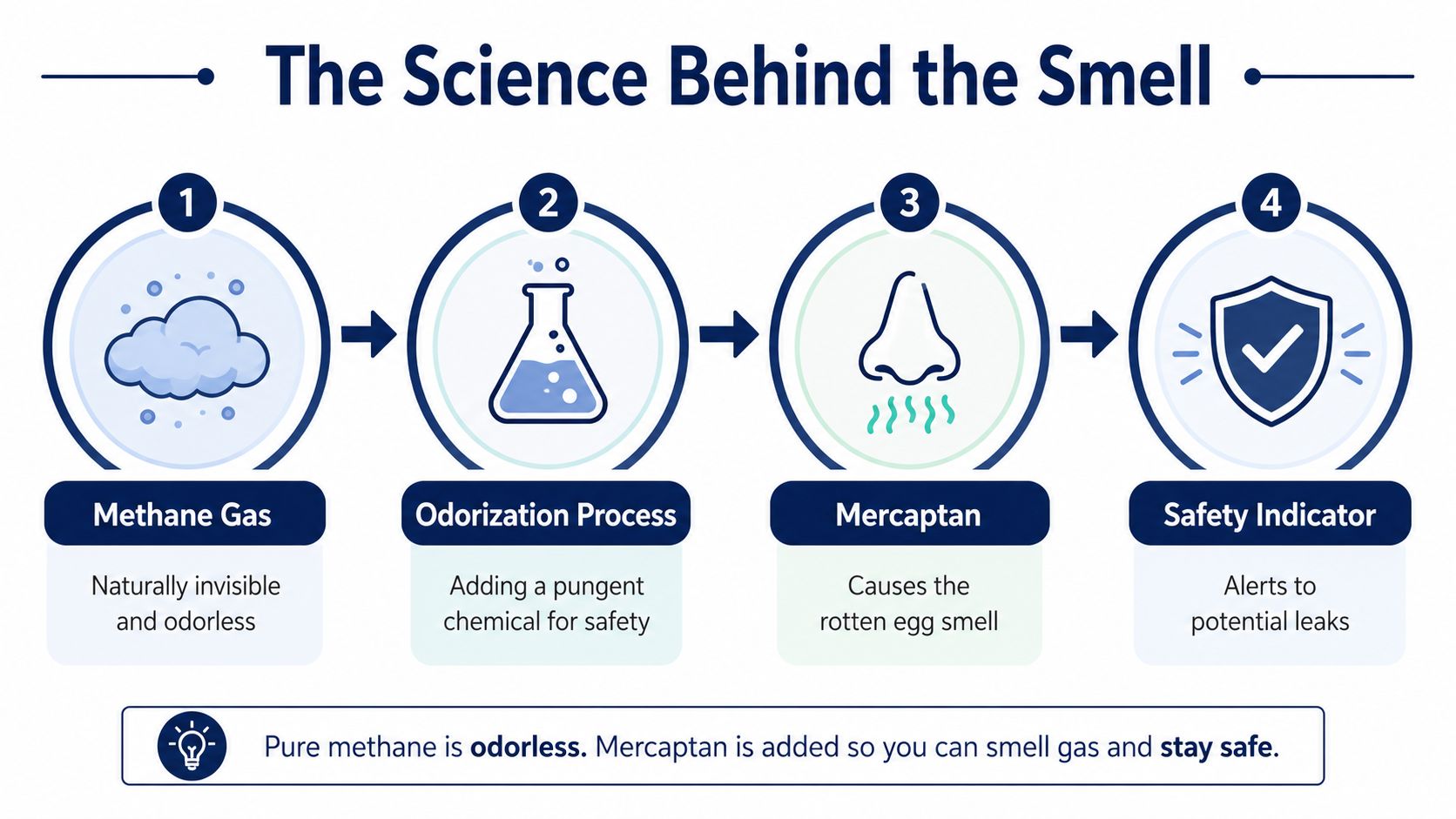
Methane gas, by itself, is completely odorless and has no smell, color, or taste. The rotten egg smell people connect with “gas” comes from mercaptan, a sulfur-based additive intentionally put into natural gas so leaks can be detected by smell, as explained in this gas leak odor guide.
That detail matters because it changes how you think about the smell. You're not smelling methane itself. You're smelling a built-in warning signal designed to get your attention fast.
Practical rule: If a rotten egg smell appears suddenly and you can't explain it immediately, don't try to “monitor it for a while.” Treat it like a safety issue first.
In homes and multi-unit properties, hesitation is what causes trouble. People wait because the smell comes and goes, or because one room smells stronger than another, or because they've had drain odors before. But a gas problem doesn't need to be constant to be dangerous.
Los Angeles properties add another layer of confusion because many buildings have aging appliances, tight side yards, enclosed laundry areas, converted garages, and older drain systems. A sulfur odor can seem like it's coming from everywhere. The safest approach is simple. Respect the smell, notice where it's strongest, and don't assume you already know the source.
The Science Behind the Smell Pure Methane Is Odorless
Natural gas in a home is primarily methane. On its own, methane is odorless, colorless, and transparent, which means your senses won't warn you if it escapes. That's why utilities don't leave it in that natural state for distribution.
Instead, they add an odorant, effectively attaching a loud alarm to a silent hazard. The danger doesn't become safer because it smells. It becomes easier for people to notice before conditions get worse.
Why mercaptan works
The added odorant is typically tert-butylthiol, and the human nose can detect it at concentrations as low as 1 part per billion, far below methane's flammable range of 5.4% to 17% in air, according to the methane reference. That's the entire point of odorization. You're supposed to smell the warning before the escaped gas reaches a dangerous level.
People describe that odor in slightly different ways. Rotten eggs is the usual phrase, but some call it sulfur, skunk-like, or cooked cabbage. In the field, the exact description matters less than the fact that it's sudden, unpleasant, and out of place.
What works and what doesn't
What works is recognizing the smell as a deliberate safety feature.
What doesn't work is trying to decide whether it smells “enough like gas” to count. Real homes have cooking smells, laundry products, old cabinets, pet odors, and drain issues. The nose isn't a precision instrument. It's an alarm bell.
When that sulfur odor shows up near an appliance, meter area, wall cavity, or outside line path, treat the situation as real until a qualified party proves otherwise.
Another important trade-off is that smell can tell you something is wrong, but it can't tell you exactly where the leak is. That's why homeowners shouldn't rely on sniff testing or trial and error. The right next step depends on the source and location, not just the odor itself.
Is It a Gas Leak or Just a Sewer Smell
A common point of confusion arises because a sewer-related odor can smell almost identical to a natural gas leak because both are often described as rotten eggs. One comes from gas system odorants. The other is commonly tied to hydrogen sulfide in sewer gas.
That overlap causes bad decisions. Homeowners sometimes call it a plumbing smell and ignore a gas issue. Others evacuate for what turns out to be a dry drain or failed trap seal. As noted in this discussion of sewer gas versus natural gas confusion, many homeowners mix the two up, and gas authorities now stress using auditory and visual signs when smell alone is ambiguous.
Where the smell shows up matters
Location gives you the first useful clue.
If the odor is strongest near a floor drain, shower drain, unused bathroom, utility sink, or laundry standpipe, sewer gas moves higher on the list. If it gets worse after a fixture sits unused, that often points to a trap issue. If you want a plain-language refresher on how drain seals stop sewer gas from entering a home, this guide to the purpose of a P-trap is worth reviewing.
If the smell is strongest near a stove connection, water heater, furnace area, meter, exterior gas riser, or along a gas appliance line, take the natural gas possibility seriously right away.
A sulfur smell near a drain suggests a plumbing problem. A sulfur smell near a gas appliance or meter suggests a gas problem. If you can't tell, default to the safer assumption.
Moisture can complicate the picture too. Basements, crawlspaces, and slab-adjacent utility areas can trap odors and make them seem stronger or farther from the actual source. In properties with chronic dampness, these solutions for damp basements can help people understand why odors linger and spread in enclosed spaces.
Natural gas leak vs. sewer gas smell
| Indicator | Natural Gas Leak (Mercaptan) | Sewer Gas (Hydrogen Sulfide) |
|---|---|---|
| Most common location | Near meter, gas appliance, exposed gas line, side yard line path | Near drains, toilets, cleanouts, utility sinks, venting points |
| Smell behavior | May appear suddenly and stay concentrated around line or appliance areas | Often worse near drain openings or in rarely used rooms |
| What you may hear | Hissing or faint gas escape sound | Gurgling drains or air movement through plumbing |
| What changes it | Smell may remain even if you run water | Running water into a dry fixture may reduce the smell if a trap was the cause |
| Outside clues | Dead vegetation, blowing dirt, bubbling in wet ground | Usually no dead vegetation pattern tied to a buried gas line |
| Best first assumption | Emergency until ruled out | Plumbing issue, unless other gas-leak signs are present |
A table like this helps, but it doesn't replace judgment. If the smell is strong, unusual, or tied to appliance areas, don't waste time doing detective work inside the home.
How to Spot a Gas Leak Without Your Nose
Smell gets the most attention, but it shouldn't be your only trigger. In some situations, the better clues are what you hear and what you see around the building.
A quick field check often starts with the surroundings, not the air.
Listen first
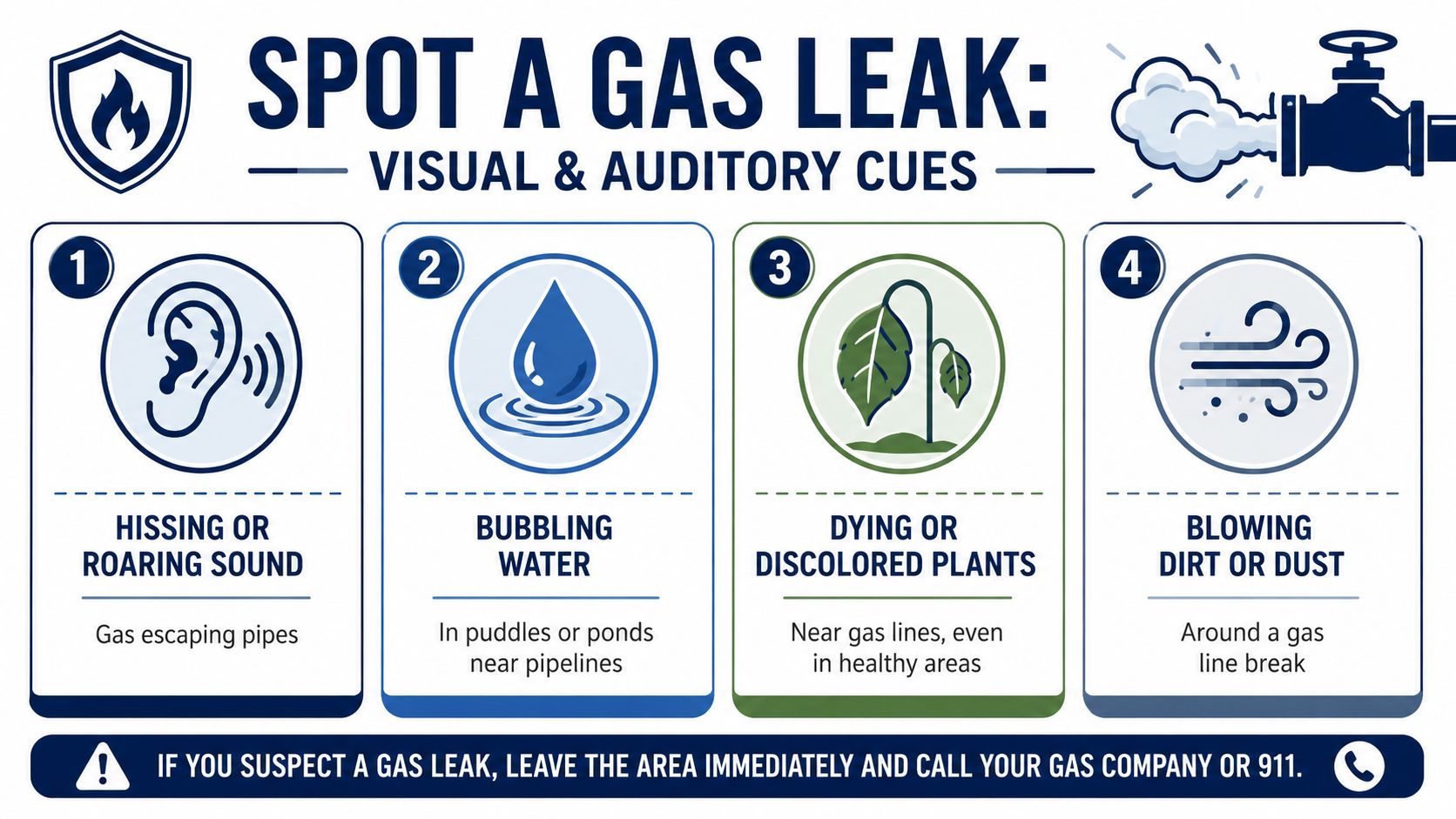
A leak may create a hissing or whistling sound near a line, fitting, regulator, or appliance connection. Outside, that sound can be easy to miss if there's traffic or wind. Indoors, people often hear it in quiet utility rooms, garages, or near water heater closets.
If you're not sure what else to look for, this practical page on how to detect a gas leak in your home covers the kinds of signs property owners should recognize before a small issue becomes a dangerous one.
Look around the property
Gas authorities increasingly remind people to use visual signs when odor is unclear. Watch for:
- Blowing dirt: Dust or soil moving from a fixed point outdoors can suggest a buried line leak.
- Dead or discolored plants: A patch of struggling vegetation near a gas line route can be a warning sign, especially if surrounding plants look healthy.
- Bubbling in wet ground or puddles: Escaping gas can disturb standing water.
- Appliance flame changes: If a gas appliance flame looks abnormal, have it evaluated. Don't test further yourself.
These signs don't prove every issue is a gas leak, but they do tell you not to brush it off. In real properties, the strongest clue is often the combination of signs, not one perfect symptom.
What to Do Immediately If You Suspect a Gas Leak
If you smell a strong rotten egg odor, move fast. The smell of hydrogen sulfide or mercaptan can be detected at concentrations as low as 0.0005 parts per million, and if you smell a strong rotten egg odor, you should leave immediately and call 911 from a safe distance, as stated in InterNACHI's guidance on sewer gases and gas odors.
Start with getting people out.
What to do right away
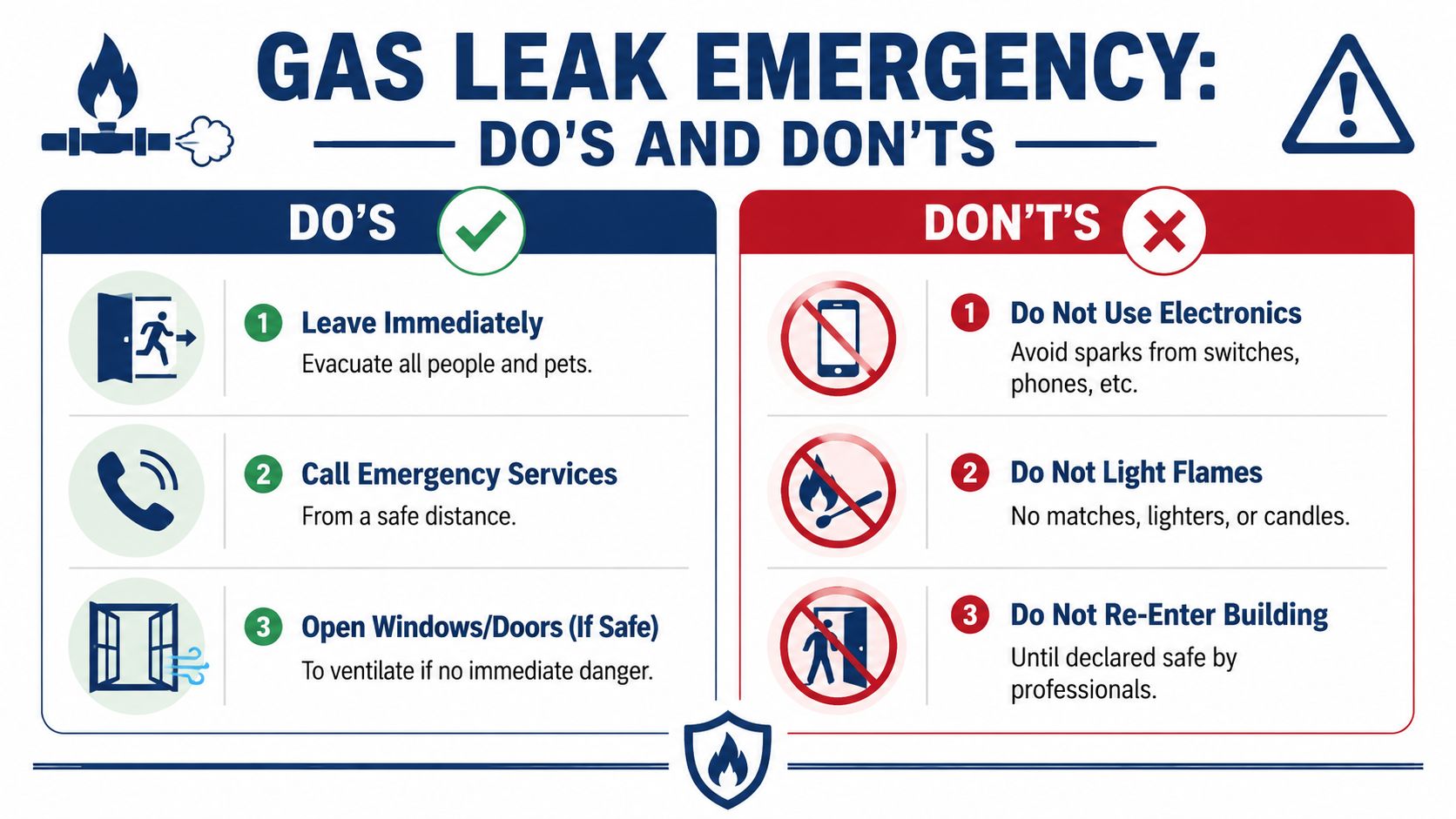
- Leave the building: Get everyone out, including pets.
- Move to a safe distance: Go far enough away that you're no longer near the structure or meter area.
- Call emergency services: Use a phone only after you're safely outside and away from the suspected leak area.
- Wait for clearance: Don't go back in until the property has been declared safe by the appropriate professionals.
Here's a short visual overview of emergency response steps:
What not to do
- Don't flip switches: That includes lights, fans, garage door controls, and anything else electrical.
- Don't light anything: No candles, lighters, matches, or cigarettes.
- Don't hunt for the leak: Leave diagnosis to the utility or a licensed professional after the area is secured.
- Don't assume it will fade: A disappearing smell doesn't mean the hazard is gone.
If the odor is strong enough to make you stop and wonder, that is enough reason to get out first and make calls second.
Who to Call in Los Angeles SoCalGas vs a Plumber
For Los Angeles residents, the most useful rule is this. If you suspect a gas leak, start with SoCalGas or 911 from a safe distance. Don't begin with a routine service call. The immediate priority is securing the gas supply and making sure the property is safe to approach.
The meter is the practical dividing line
In day-to-day practice, the meter is the easiest way to think about responsibility.
If the issue is at the meter, before the meter, or on the utility side, SoCalGas is the right first call. That includes suspected problems involving the street supply, service connection, or the meter assembly area. Utility crews handle their side of the system and can shut down service when needed.
If the leak is confirmed after the meter, that usually falls on the property owner's side. That means house piping, appliance connectors, shutoff valves serving appliances, and branch gas lines within the building or site.
When a plumber comes in
Once the area is safe and the gas has been shut off if necessary, a licensed plumber steps in to locate and repair the problem on the customer side. That may involve appliance connections, exposed gas piping, concealed branch lines, or damaged fittings. If you need to understand that scope of work, this overview of gas line repair shows the kinds of house-side issues a plumbing contractor handles.
This distinction saves time in Los Angeles. Calling the utility first protects life and property when the source is uncertain. Calling a plumber after utility response gets the actual repair moving if the leak is inside the property boundary.
For homeowners, HOAs, and property managers, that sequence works better than guessing. Utility first for immediate hazard control. Licensed plumbing repair for everything on the building side after the system is made safe.
If you're in Los Angeles and need help after SoCalGas has secured the property, EZ Plumbing handles licensed gas leak detection and gas line repair for homes, HOAs, property managers, and commercial buildings. They've served Los Angeles since 1989, offer 24/7 emergency response, and can help restore safe service with clear communication and professional repair work.