
What Is Drain Venting? A Homeowner’s Clear Guide
Drain venting is defined as the system of pipes that introduces atmospheric air into your home’s drain-waste-vent (DWV) network to maintain neutral air pressure and ensure wastewater flows freely. Without this system, negative pressure builds inside drain pipes, siphoning water out of P-traps and allowing sewer gases to enter your living space. Understanding what is drain venting, how it works, and what can go wrong gives you the knowledge to catch problems early and protect your home. The International Plumbing Code and Uniform Plumbing Code both require proper venting in every residential drain system.
What is drain venting and why does your home need it?
Drain venting is the “V” in the DWV system, and it is the most misunderstood component in residential plumbing. Most homeowners know about drains and water supply lines, but vents operate invisibly behind walls and through the roof, doing critical work that most people never think about until something goes wrong.
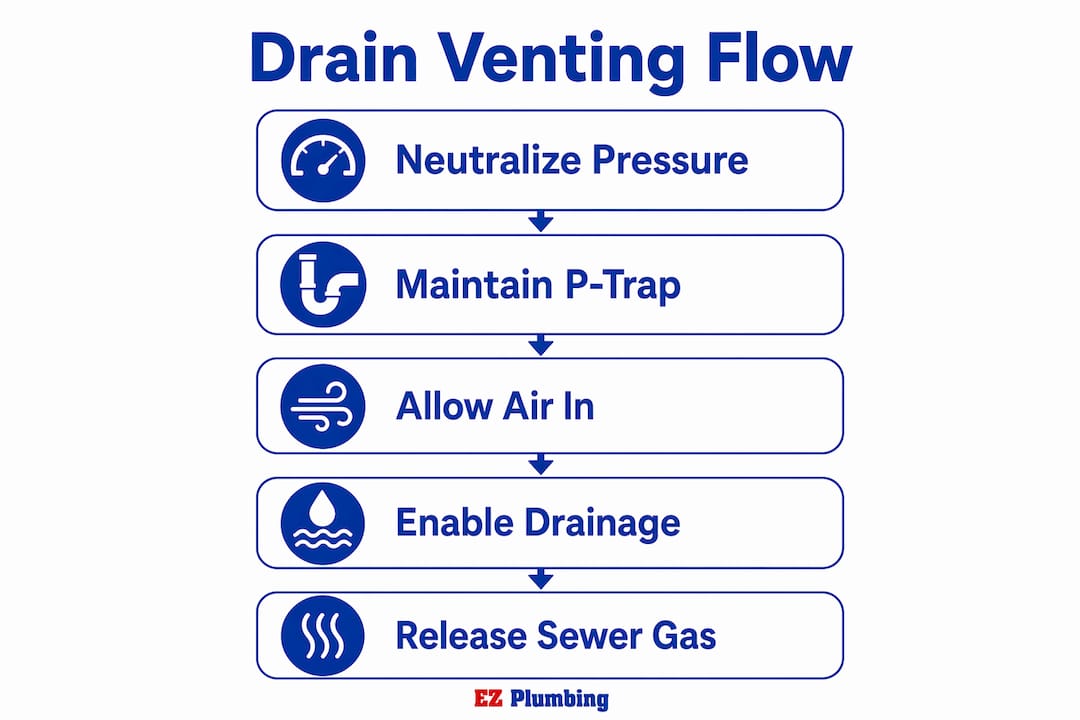
The core job of a vent pipe is straightforward. When wastewater rushes down a drain, it displaces air inside the pipe. Without a way to replace that air, the moving water creates a vacuum. That vacuum pulls the water out of the P-trap, the curved section of pipe beneath every sink, toilet, and tub that holds a small amount of water as a seal against sewer gases.
Atmospheric pressure in the DWV system keeps that P-trap seal intact. When the vent pipe admits outside air, the pressure inside the drain pipe stays neutral, water flows freely, and the trap stays full. This is why venting is not optional. It is a code requirement and a health safeguard in every home.
Vents also serve a second function: they give sewer gases a safe exit. Methane, hydrogen sulfide, and other gases produced by decomposing waste need somewhere to go. Vent pipes route those gases up through the roof and out of the home, away from living areas.
How does drain venting work to maintain air pressure and drainage flow?
The mechanics of drain venting become clear with a simple analogy. Think about placing your thumb over the top of a straw filled with liquid. The liquid stays in the straw because atmospheric pressure cannot act on it from above. Lift your thumb, and the liquid drops freely. Vent pipes work the same way: they keep the “thumb” off the drain system by continuously admitting air.
When you flush a toilet or run a sink, wastewater accelerates through the drain pipe. That fast-moving water acts like a piston, pushing air ahead of it and pulling a partial vacuum behind it. The vent pipe, connected to the drain line and open to the atmosphere at the roof, fills that vacuum instantly. Drainage stays smooth, and the P-trap water seal stays in place.
Without a functioning vent, the consequences are predictable and unpleasant. Negative pressure siphons P-trap water, leaving the trap dry. A dry trap has no barrier between your home and the sewer. Sewer gases enter freely, producing odors and, in high concentrations, health risks.
The symptoms of a venting failure are distinct from a simple clog. A clog slows one drain. A vent problem often affects multiple fixtures at once, produces gurgling sounds as air is pulled through the trap water, and creates odors that persist even after the drain appears clear.
Pro Tip: If you hear a gurgling sound from your toilet after running the bathroom sink, that is a classic sign of a venting problem, not a clog. The two fixtures share a vent path, and the gurgle is air being pulled through the toilet trap.
Common symptoms of a failing vent system include:
- Gurgling or bubbling sounds from drains after water runs nearby
- Persistent slow drainage that does not improve after snaking or cleaning
- Foul sewer odors near sinks, tubs, or floor drains
- Multiple fixtures slowing down at the same time
- Drain water that seems to “hesitate” before flowing
What are the common types of drain venting systems used in homes?
Residential plumbing uses several vent configurations, each suited to different layouts and code requirements. Knowing which type your home uses helps you understand where to look when problems arise.
True vent pipes and roof stacks
A true vent is a dedicated pipe that runs vertically from the drain line up through the roof. It carries no water. Its only job is to admit air and allow sewer gases to escape. Most homes built before 1980 rely almost entirely on true vents connected to a central roof stack. The stack is the large vertical pipe, typically 3 or 4 inches in diameter, that you see protruding from the roof.
Wet vents
A wet vent carries both wastewater and venting air in the same pipe. It serves multiple fixtures simultaneously, which makes it efficient in bathrooms where a sink, toilet, and tub are grouped closely together. Wet venting is code-permitted in most jurisdictions when the pipe is sized correctly for the combined load.
Air Admittance Valves
Air Admittance Valves, or AAVs, are mechanical one-way valves that open to admit air when negative pressure develops in the drain line, then close to prevent sewer gas from escaping into the room. They are installed inside the wall or under the cabinet near the fixture they serve. AAVs are code-approved in most states for individual fixtures and wet-vented branches, though they cannot replace the main roof vent stack entirely.
Island vents
An island vent, sometimes called a cheater vent, serves kitchen sinks installed in countertop islands where running a vent pipe through the roof is not practical. The vent loops up beneath the countertop before connecting back down to the drain, creating enough air circulation to prevent siphoning. Island vents require careful sizing and slope to function correctly.
| Vent type | Primary function | Typical location | Code notes |
|---|---|---|---|
| True vent | Admits air only, no wastewater | Inside walls, exits through roof | Required in all systems |
| Wet vent | Carries air and wastewater | Bathroom fixture groups | Must be correctly sized |
| Air Admittance Valve | Mechanical air inlet, no roof penetration | Under sink, inside wall cavity | Cannot replace main stack |
| Island vent | Vents countertop island sinks | Kitchen islands | Requires specific slope and sizing |
When planning a bathroom renovation, vent type selection is one of the first decisions a licensed plumber makes. Getting it wrong at the rough-in stage creates expensive corrections later.
What common problems indicate drain venting issues?
A blocked vent stack creates negative pressure that mimics a pipe clog but requires completely different remediation. This is the most common misdiagnosis in residential plumbing. Homeowners snake a drain, find no blockage, and assume the problem is resolved. Days later, the gurgling and odors return because the vent was never addressed.
Roof vents block for several predictable reasons. Bird nests are common in spring and fall. Leaves and debris accumulate after storms. In colder climates, ice dams can seal a vent opening entirely during winter months. In Los Angeles, dried palm fronds and debris from Santa Ana wind events frequently clog roof stacks.
Four primary symptoms signal a failing vent system: gurgling sounds from drains, persistent slow drainage, foul sewer odors near fixtures, and multiple fixtures slowing simultaneously. Each symptom points to the same root cause: air is not moving freely through the vent system.
Recognizing these warning signs of plumbing problems early prevents a minor vent blockage from becoming a full system failure. A dry P-trap, left unaddressed, allows continuous sewer gas exposure in your home.
Pro Tip: If drain odors appear only after heavy rain, a blocked roof vent is the likely cause. Rainwater can temporarily seal a partially blocked vent opening, intensifying negative pressure and odors until the vent dries out.
Modifying or capping a vent stack yourself violates plumbing codes and causes system failure. No homeowner should reduce, cap, or reroute a vent pipe without a licensed plumber and a permit. The consequences include code violations, failed inspections, and drainage problems that worsen over time.
How can homeowners maintain drain venting safely?
Proactive maintenance keeps vent systems functioning without expensive repairs. Most of what a homeowner can safely do involves inspection and cleaning at the roof level, not modifications to the pipe system itself.
-
Inspect the roof vent opening twice a year. Check in spring after nesting season and in fall after leaves drop. Look for debris, nests, or visible blockages at the vent cap. Clear loose debris by hand or with a garden hose from above.
-
Run water in infrequently used fixtures monthly. Floor drains, guest bathroom sinks, and utility sinks can lose their P-trap seal through evaporation if not used regularly. Running water for 30 seconds refills the trap and restores the gas barrier.
-
Do not pour grease or heavy solids down drains. Grease buildup inside drain pipes narrows the pipe diameter and disrupts airflow through connected vent branches. This is a common contributor to slow drainage in Los Angeles kitchens.
-
Schedule a camera inspection if symptoms persist. A professional camera inspection lets a licensed plumber see inside the vent stack and drain lines without opening walls. It confirms whether the problem is a blockage, a pipe defect, or a venting configuration issue.
-
Consider AAVs for problem fixtures. If a specific fixture repeatedly loses its trap seal and a roof vent is not practical, Air Admittance Valves are a code-compliant alternative that a licensed plumber can install without major structural work.
Proper vent pipe sizing and placement are not guesswork. The Uniform Plumbing Code specifies minimum pipe diameters, maximum distances between fixtures and vent connections, and required slopes. Any modification to a vent system requires a permit in Los Angeles and must be inspected before walls are closed.
Pro Tip: Never use a chemical drain cleaner to address gurgling or odor problems. These products address clogs, not venting failures. Using them on a vent-related issue wastes money and can damage pipe interiors.
Understanding how plumbing traps work alongside your vent system gives you a complete picture of how your drain system protects your home from sewer gases.
Key Takeaways
Drain venting is the pressure-balancing system that keeps wastewater flowing freely, P-trap seals intact, and sewer gases out of your home.
| Point | Details |
|---|---|
| Core function | Vent pipes admit atmospheric air to prevent vacuum buildup in drain lines. |
| P-trap protection | Venting keeps trap water seals full, blocking sewer gas from entering living spaces. |
| Symptom recognition | Gurgling drains, persistent odors, and multiple slow fixtures all point to venting failure, not clogs. |
| Vent types | True vents, wet vents, AAVs, and island vents each serve specific layouts and code requirements. |
| Safe maintenance | Inspect roof vents twice yearly and call a licensed plumber for any pipe modifications. |
Venting is the part of plumbing most homeowners ignore until it fails
After years of diagnosing plumbing problems across Los Angeles, the pattern is consistent: homeowners call about a slow drain or a bad smell, and the first assumption is always a clog. Nine times out of ten, the drain is clear. The vent is the problem.
Vents act as the breathing apparatus of your plumbing system. That description is accurate, and it carries a practical implication: a system that cannot breathe cannot drain properly, no matter how clean the pipes are. Homeowners who understand this stop chasing the wrong fix.
The other misconception I see regularly is that vent problems are rare or exotic. They are not. A single bird nest in a roof stack, a crushed vent pipe inside a wall, or an AAV that has worn out after years of use can bring an entire drain system to its knees. These are ordinary failures with ordinary solutions, provided the diagnosis is correct.
My honest advice: if you have recurring slow drains or odors that come and go, stop treating the symptom and find the cause. A camera inspection takes less than an hour and gives you a definitive answer. That is a far better investment than repeated drain cleaning that addresses nothing.
— EZ
Ez-plumbing can diagnose and fix your venting problems

Venting failures are one of the most misdiagnosed plumbing problems in Los Angeles homes, and Ez-plumbing has the tools and experience to get the diagnosis right the first time. As a licensed plumbing company (C-36 License #583868) serving the greater Los Angeles area, Ez-plumbing uses camera inspection and pressure testing to identify vent blockages, damaged stacks, and trap failures without unnecessary wall openings.
If your drains are gurgling, your home smells like sewer gas, or multiple fixtures are slowing down at once, the problem is likely in your vent system. Ez-plumbing’s drain cleaning services cover full diagnostic evaluation alongside clearing and repair. Contact Ez-plumbing to schedule an inspection and get a clear answer about what is happening inside your plumbing system.
FAQ
What is drain venting in simple terms?
Drain venting is a system of pipes that admits outside air into your home’s drain lines to maintain neutral pressure, keep wastewater flowing freely, and prevent sewer gases from entering your home through P-traps.
How do I know if my vent pipe is blocked?
The clearest signs are gurgling sounds from drains, persistent slow drainage that does not respond to snaking, foul sewer odors near fixtures, and multiple fixtures slowing down at the same time.
Can I cap or modify a vent pipe myself?
No. Capping or modifying a vent stack violates plumbing codes, causes drainage failures, and requires a licensed plumber and permit to correct legally.
What is an Air Admittance Valve and when is it used?
An Air Admittance Valve is a mechanical one-way valve that replaces a traditional roof vent for individual fixtures or fixture groups. It is code-permitted in most jurisdictions when a roof vent is not practical, but it cannot replace the main vent stack.
How often should I inspect my roof vent?
Inspect your roof vent opening at least twice a year, in spring and fall, to clear debris, bird nests, or other blockages before they restrict airflow and cause drainage problems inside the home.