
Water Heater Service Explained for Los Angeles Homes
You turn the shower handle on a Los Angeles morning and get water that's barely warm. The unit may still be running, but that doesn't mean it's heating efficiently or safely. A technician has to separate a simple control problem from scale buildup, a failed component, a leaking tank, or a venting issue before recommending a repair.
That distinction matters in LA homes, HOAs, rentals, and commercial buildings. Conventional tank units generally last 8 to 12 years, while tankless models often reach 15 to 20 years with proper care, according to independent water-heater failure and replacement data. Hard water, installation quality, demand, and maintenance history can move the outcome in either direction.
Table of Contents
- What Water Heater Service Actually Covers
- Tank Versus Tankless Systems and How Service Differs
- Routine Maintenance Checklist for Los Angeles Homes
- How Hard Water Shapes Service Frequency and Performance
- Common Repairs and What the Warning Signs Mean
- Repair Versus Replacement and What It Really Costs
- When to Call a Professional and What to Expect
- Quick Answers for Los Angeles Homeowners
What Water Heater Service Actually Covers
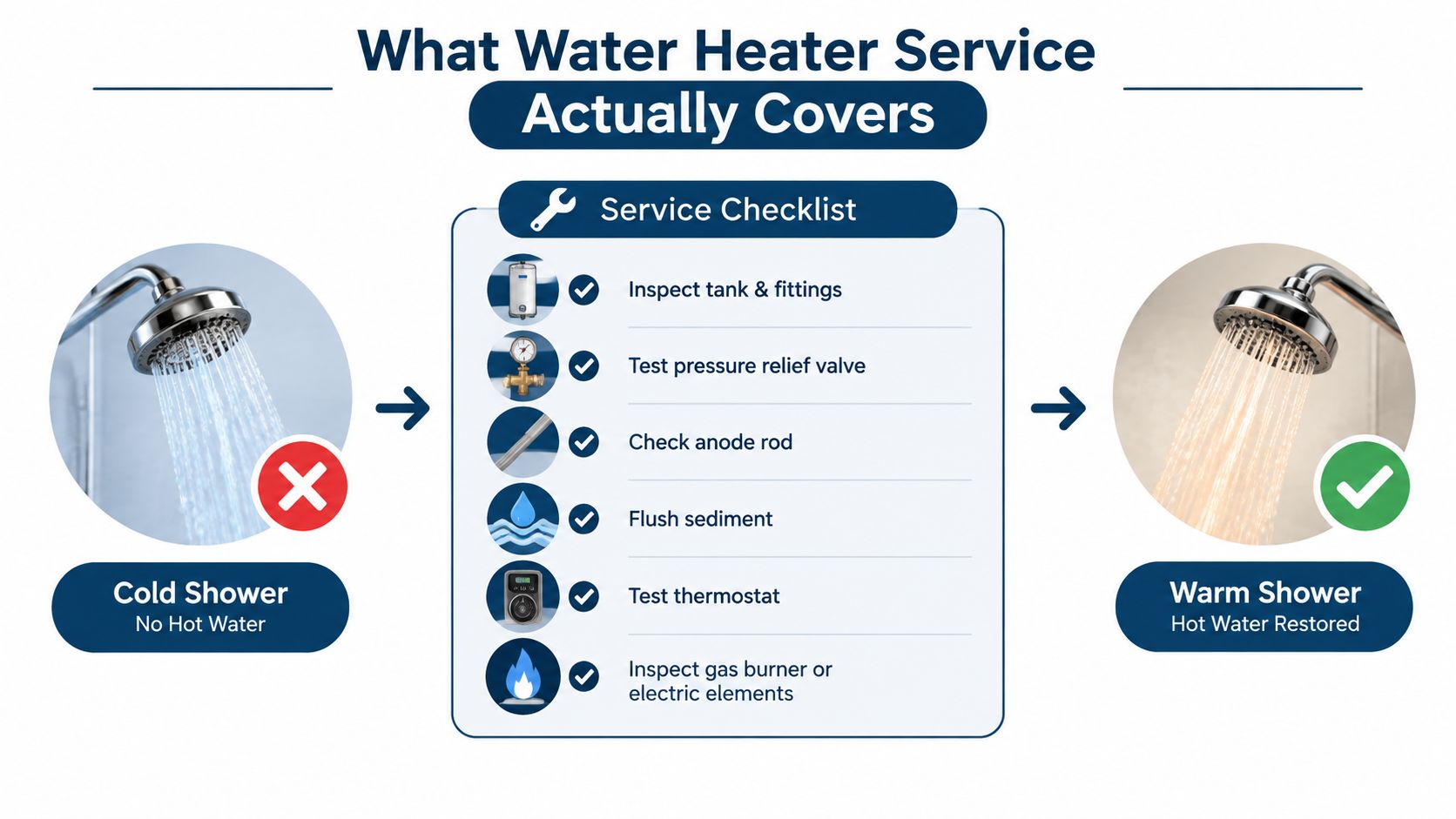
A proper water heater service call starts before the technician removes a cover or opens a drain valve. The first job is to understand what the system is doing. That usually means checking inlet and outlet temperatures, gas pressure or electrical draw, ignition behavior, control settings, water connections, and any displayed fault codes.
The inspection then moves through the safety and operating components. On a gas unit, that includes combustion air, burner condition, ignition, flue and venting, and the heat exchanger or tank body. On an electric tank, the technician checks elements, thermostats, wiring, bonding, and signs of overheating. Both types require attention to the Temperature and Pressure relief valve, discharge piping, shutoffs, and visible corrosion.
Maintenance and repair aren't the same visit
A maintenance appointment is planned. The technician cleans, tests, measures, and records conditions before a failure forces the issue. A repair call is reactive and usually focuses on a specific symptom, such as no ignition, lukewarm water, a leaking fitting, or a relief valve that won't hold.
For a storage tank, service commonly includes draining or flushing sediment, inspecting the burner or elements, checking the flue, examining the anode rod, and testing the safety valve. For a tankless unit, the work shifts toward descaling the heat exchanger, cleaning the inlet filter, inspecting the fan and flame sensor, and checking condensate lines where applicable.
Practical rule: A technician should explain what the tests found before proposing a part replacement.
Homeowners also benefit from a broader plumbing reference, especially when a water-heater problem involves shutoff valves, supply piping, or fixture flow. The Modern Bathrooms plumbing guide offers useful background on how those connected systems work.
The most reliable approach is layered. Schedule professional maintenance, then perform simple visual checks between visits. A service call can restore hot water, but recurring inspections are what reveal deteriorating components before they damage the property.
Tank Versus Tankless Systems and How Service Differs
Tank and tankless heaters don't fail in the same way, so a technician shouldn't service them with the same checklist. A storage tank heats and holds water, which creates standby losses and gives sediment a place to settle. A tankless unit heats water as it moves through a heat exchanger, so flow restriction and mineral scale become immediate performance concerns.
Tank systems are usually simpler to diagnose. The inspection focuses on the tank shell, anode rod, burner or elements, thermostats, relief valve, sediment, and vent type. Older gas tanks may use a standing pilot. Newer models may use electronic ignition or direct spark. Ignition problems are common reasons for a service call, but the failed part could be the thermocouple, gas valve, igniter, or control rather than the burner itself.
Tankless service takes a different path. A technician checks the cold-water inlet filter, flow sensor, flame sensor, igniter, fan, condensate drain, vent terminations, and heat exchanger. Scale can restrict the exchanger and cause fault codes even when the gas supply and electronics are functional.
Service trade-offs at a glance
| Service Aspect | Tank Water Heater | Tankless Water Heater |
|---|---|---|
| Main concern | Sediment, corrosion, burner or element failure | Heat-exchanger scale, restricted flow, sensors |
| Typical service work | Flush, anode inspection, burner or element checks | Descaling, inlet-filter cleaning, sensor and fan inspection |
| Ignition and venting | Standing pilot, electronic ignition, or power vent may apply | Electronic ignition, fan, condensate, and sealed venting often matter |
| Failure pattern | Leaks and gradual recovery loss | Error codes, inconsistent temperature, and flow-related shutdowns |
| Service planning | More frequent basic checks, especially as the tank ages | Fewer visits when maintained, but each visit can involve specialized cleaning |
Venting deserves attention on either system. Atmospheric, direct-vent, and power-vent configurations have different airflow and termination requirements. A clean burner won't make an unsafe or obstructed vent acceptable.
For a more detailed equipment comparison, see this guide to the difference between tank and tankless water heaters. The practical trade-off is straightforward. Tankless service can cost more per visit because the work is specialized, while a well-maintained unit may need fewer visits. Tank systems generally offer simpler component access, but their stored water and internal corrosion make replacement planning important.
Routine Maintenance Checklist for Los Angeles Homes
A useful maintenance plan should be specific enough for a homeowner to follow and clear enough to hand to a plumber. Start with observation, not disassembly. Look for changes in sound, temperature, water color, pressure, and moisture around the unit.
Checks between professional visits
- Monthly leak check: Look around the tank base, top connections, drain valve, shutoffs, and the relief-valve discharge pipe. A dry floor doesn't prove the tank is healthy, but new moisture deserves attention.
- Quarterly safety check: Briefly lift the Temperature and Pressure relief-valve lever only if the discharge pipe terminates safely and you can avoid contact with hot water. The valve should release water and stop afterward. If it continues dripping, call a professional.
- Quarterly temperature check: Compare the thermostat setting with the outlet temperature using a thermometer. A large difference, fluctuating temperature, or slow recovery indicates that testing is needed.
- Annual tank service: Flush the tank until the discharge runs clear, inspect the flue and combustion air on gas models, clean the burner area, and examine the anode rod.
- Tankless cleaning: Descale the heat exchanger with a circulating pump and an approved solution, clean the cold-water inlet screen, inspect the fan, and check the condensate neutralizer if the unit uses one.
Adjust the schedule for the property
Los Angeles water can be hard enough to make a generic annual schedule inadequate, especially in homes with older piping or well water. Scale and sediment build faster when mineral-heavy water enters the heater, so the right interval depends on water quality, household demand, and the unit's symptoms.
The anode rod protects the tank lining by corroding in the tank's place. Inspect it through the hex head on top of the unit. Replace it when less than half an inch of core wire remains or when heavy calcium coating has consumed the active material. Powered anode rods can be a useful upgrade in homes where odor or rapid anode wear keeps returning.
Before a DIY flush, shut off the gas or electrical supply and close the cold-water inlet. Hot water, pressurized connections, and an incorrectly opened drain can cause burns or flooding. The water-heater maintenance guide provides a helpful task overview, but gas, electrical, burner, and difficult valve work should be left to a qualified technician.
A written service record helps identify recurring faults, supports warranty conversations, and gives future owners a clearer maintenance history.
How Hard Water Shapes Service Frequency and Performance
Hard water is one of the biggest variables in LA water heater service. Calcium and magnesium leave deposits on heating surfaces, inside valves, at inlet screens, and within tankless heat exchangers. A storage tank can hide that damage because the sediment collects below the water, while a tankless exchanger exposes the restriction through reduced flow, temperature swings, or fault codes.
The performance penalty can appear sooner than a homeowner expects. A U.S. Department of Energy-linked PNNL report documented a gas tankless unit dropping from 80% efficiency to 72% after 1.6 years on unsoftened water, then recovering to about 77% after deliming. That result shows why cleaning helps without necessarily restoring the system completely to its original condition.
The same research associates severe scale and sediment conditions with efficiency reductions of up to 10% and service-life reductions of 25% to 40%. Those figures apply to the referenced research conditions, not to every LA installation, but they explain the field symptoms: longer recovery, higher fuel use, restricted flow, burner stress, and premature component wear.
Match service to water conditions
A tankless unit in a hard-water home may need descaling more often than the owner's manual's general schedule suggests. A tank may need more frequent flushing when the discharge contains heavy sediment or the burner produces popping and rumbling sounds. Water treatment can reduce the load, but it doesn't replace inspection, because filters, softeners, and bypass valves can fail or be poorly adjusted.
Homeowners dealing with mineral film on faucets and shower glass can review this practical guide to DIY hard water stain removal. That surface evidence doesn't measure heater scale directly, but it can signal that water quality deserves a closer look. For system-level calcium concerns, this resource on calcium buildup in water adds useful context.
A technician should use water condition and symptom history to set the interval. A fixed calendar is convenient, but hardness-aware service protects performance more effectively.
Common Repairs and What the Warning Signs Mean
The symptom homeowners notice is often only the first clue. A good technician doesn't replace the most obvious part without testing the rest of the system.
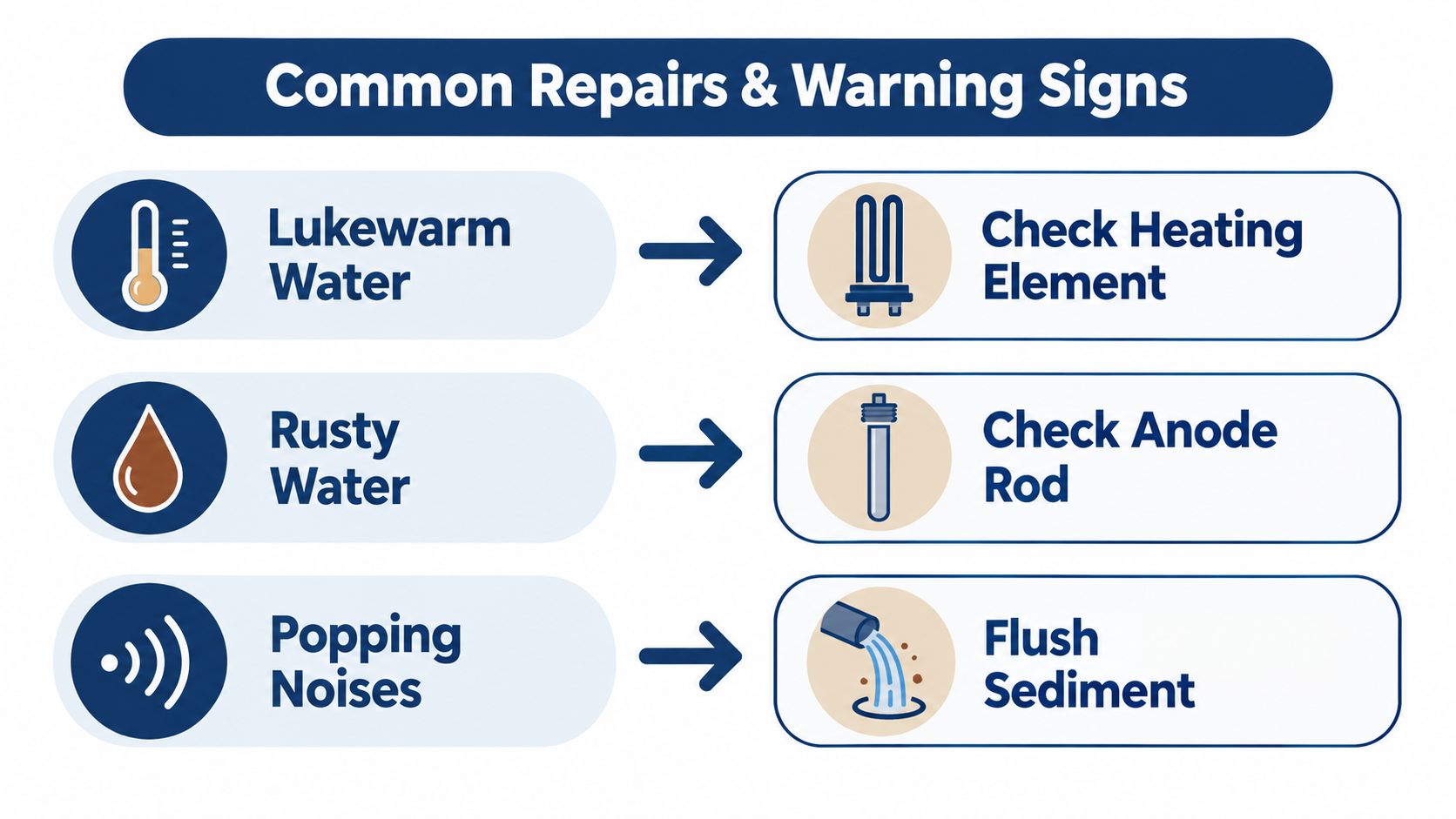
Lukewarm or inconsistent water can point to a failed electric heating element, a thermostat problem, restricted tankless flow, or scale on the heat exchanger. On a gas tank, the technician also checks burner operation, gas pressure, venting, and recovery performance. The repair might be an element or thermostat replacement, but it could instead require cleaning or correcting a combustion problem.
Popping, cracking, or rumbling usually deserves a sediment inspection on a storage tank. Water trapped beneath hardened deposits flashes into steam against the burner-heated base, producing noise and uneven heat transfer. Flushing can help when the tank is structurally sound. If the tank has already corroded, cleaning won't reverse the damage.
Read the location of the problem
Water near the base of a tank often indicates internal corrosion and a failed tank shell. Moisture at the top may come from a loose inlet, outlet, drain connection, or relief valve. A leaking relief valve requires testing, because replacing it without addressing pressure or temperature conditions can leave the underlying problem in place.
Pilot or ignition failure can involve a thermocouple, gas valve, flame sensor, igniter, wiring, or control board. A technician checks flame quality and ignition sequence rather than repeatedly resetting the appliance. Gas odor is a safety issue, not a routine troubleshooting step.
Tankless displays can narrow the search, but error codes still need interpretation. Codes 11, 12, and 14 can correspond to different ignition, flame, or sensor faults depending on the manufacturer and model. Record the exact code and model number before shutting the unit down.
Don't judge a repair by the part name alone. The diagnosis matters more than the replacement part.
The symptom-to-repair logic also applies outside California. A concise guide on how to fix a cold shower in Brisbane illustrates the same basic principle, identify the operating symptom first, then test the component that could produce it.
Repair Versus Replacement and What It Really Costs
Repair decisions should account for age, condition, water quality, access, and the likelihood of another failure. A cheap repair isn't economical if the tank is already corroded or a neglected tankless exchanger is near the end of its useful life.
The cost ranges below come from the planning data supplied for Los Angeles service work. Actual estimates depend on equipment, labor access, permits, venting, code corrections, and whether the replacement requires changes to gas, water, electrical, or condensate connections.
| Service or Repair | Typical Cost Range (LA) | Replacement Alternative |
|---|---|---|
| Tankless descaling | $150 to $300, independent maintenance guidance | Continue maintenance when the exchanger and controls remain sound |
| Tankless heat-exchanger rebuild | Can exceed $1,200, independent maintenance guidance | Compare with a replacement unit and installation changes |
| Anode-rod replacement | $150 to $250, independent maintenance guidance | Replace the tank if corrosion has reached the shell |
| Gas-valve replacement | $250 to $450, independent maintenance guidance | Consider replacement when multiple major components are aging |
| Full tank replacement | $1,400 to $3,500 installed, independent maintenance guidance | Select a properly sized, code-compliant new system |
A useful decision rule is the 50% test. If one repair approaches half the cost of a new system and the heater is already old, replacement often offers better reliability. The relevant age depends on the equipment. Conventional tanks typically last 8 to 12 years, while tankless models often last 15 to 20 years with proper care, as summarized by water-heater failure and lifespan data.
Proactive service isn't automatically worthwhile for every unit. It makes more sense when cleaning can restore operation, protect an otherwise healthy tank, or prevent a scale-related shutdown. Waiting becomes expensive when a leak, failed exchanger, or repeated control fault leaves no practical repair path.
When to Call a Professional and What to Expect
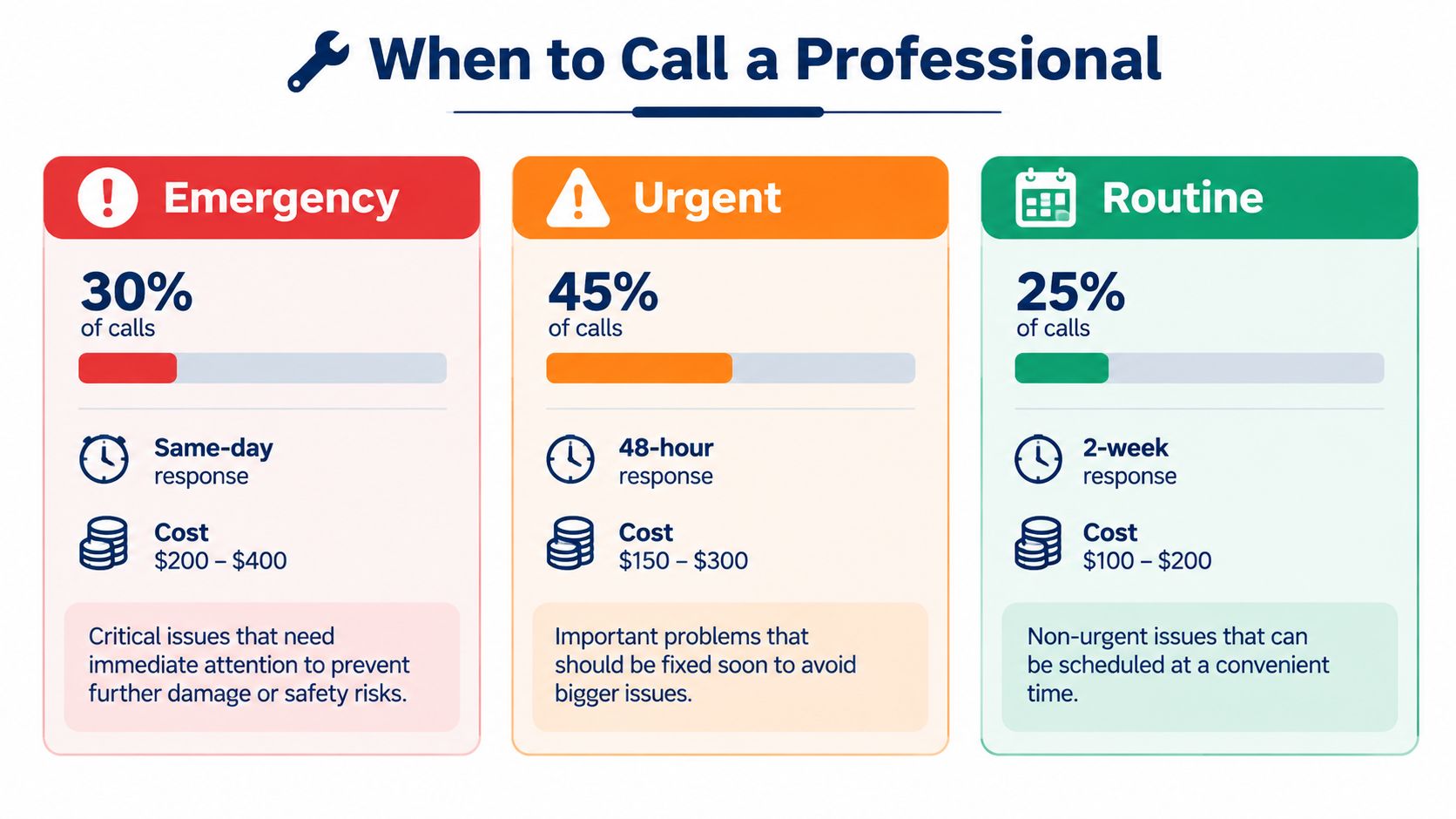
Water heater service is a triage decision. Active leaking, flooding, a gas smell, electrical arcing, or complete loss of hot water during freezing conditions deserves immediate attention. A noisy tank, mildly lukewarm water, or a due maintenance visit can generally wait for a standard appointment if there is no leak or safety hazard.
Choose the right response
- Same-day emergency: Shut off the water supply if safe, isolate gas or power when appropriate, and keep clear of electrical components exposed to water. If you smell gas, leave the area and contact the gas company or emergency services before arranging plumbing work.
- Routine appointment: Schedule intermittent temperature problems, slow recovery, overdue flushing, scale-related performance loss, and anode inspection before the unit stops operating.
- Full-system evaluation: Ask for a broader assessment when the tank shows base corrosion, the unit has repeated error codes, or the system is approaching the end of its expected service window.
Independent emergency guidance recommends reserving true after-hours dispatch for safety hazards and total loss of service, while less urgent symptoms can wait for a normal appointment. Seasonal demand can also tighten availability. A service-industry trend report recorded January installation volumes in 2024 and 2025 running 18% to 24% above average, which is consistent with winter replacement pressure, though it doesn't determine the urgency of an individual call.
On arrival, a technician should isolate leaks, test valves, inspect scale, check combustion on gas equipment, and explain the findings before work begins. Ask whether replacement work requires permits or code updates in your jurisdiction, and have the model, serial number, installation date, warranty paperwork, and error codes ready.
For Los Angeles homeowners, EZ Plumbing offers water-heater repair and performance tuning for tank and tankless systems, including emergency response and planned scheduling. The practical decision rule is simple: address hazards immediately, schedule performance problems promptly, and evaluate the whole system when age and repeated repairs make another failure likely.
Quick Answers for Los Angeles Homeowners
How soon can routine service be scheduled? Availability changes with season and workload. Routine maintenance should be booked before a failure, while active leaks, gas odors, electrical hazards, flooding, or total loss of hot water may justify same-day dispatch.
What should I send the dispatcher? Provide the manufacturer, model and serial numbers, installation date if known, fuel type, error codes, and a short description of the symptom. A photo of the unit and surrounding connections can also help identify access and venting conditions.
Can I get same-day replacement? A straightforward replacement may be possible when the correct equipment is available, but permitting, venting, gas, electrical, drain, or code changes can affect timing. Ask for the requirements before approving removal.
What can I do before the technician arrives? Clear access, locate the water shutoff, keep children away from the unit, and avoid resetting a gas appliance repeatedly. If water reaches electrical components, don't touch the equipment.
What about warranties? Keep invoices and maintenance records. Coverage for thermostats, gas valves, anode rods, and other parts depends on the manufacturer and warranty terms, so the technician needs the model and installation details to verify eligibility.
EZ Plumbing provides Los Angeles homeowners, landlords, HOAs, and commercial property managers with water heater repair, maintenance, replacement, and tankless performance tuning. Visit EZ Plumbing to review service options or request help before a small scale, valve, or temperature problem becomes a failed heater.