
Water Heater Broken? Your 2026 LA Emergency Action Guide
Your shower goes cold. Then you notice a puddle near the tank, or a low popping sound, or a tenant texting that there's no hot water in only one unit. In Los Angeles, a broken water heater isn't just an annoyance. In a house, it can turn into floor and drywall damage fast. In a condo building or apartment property, it can become a coordination problem with multiple residents, access issues, and real liability if someone ignores warning signs too long.
The first job is simple. Stop the damage. Then figure out whether you're dealing with a whole-system failure, a localized plumbing issue, or a tank that's no longer safe to leave in service. For property owners and managers in LA, that distinction matters. A cold shower can wait a little. Active leakage, tank deformation, or suspected gas problems can't.
Table of Contents
- Immediate Safety Steps for a Broken Water Heater
- Troubleshooting Your Water Heater No Hot Water vs Leaks
- Quick Fixes and Temporary Solutions You Can Try
- Repair or Replace Making the Right Financial Decision
- Typical Water Heater Repair Timelines and Costs in Los Angeles
- When to Call a Pro Get 24/7 Emergency Service from EZ Plumbing
Immediate Safety Steps for a Broken Water Heater
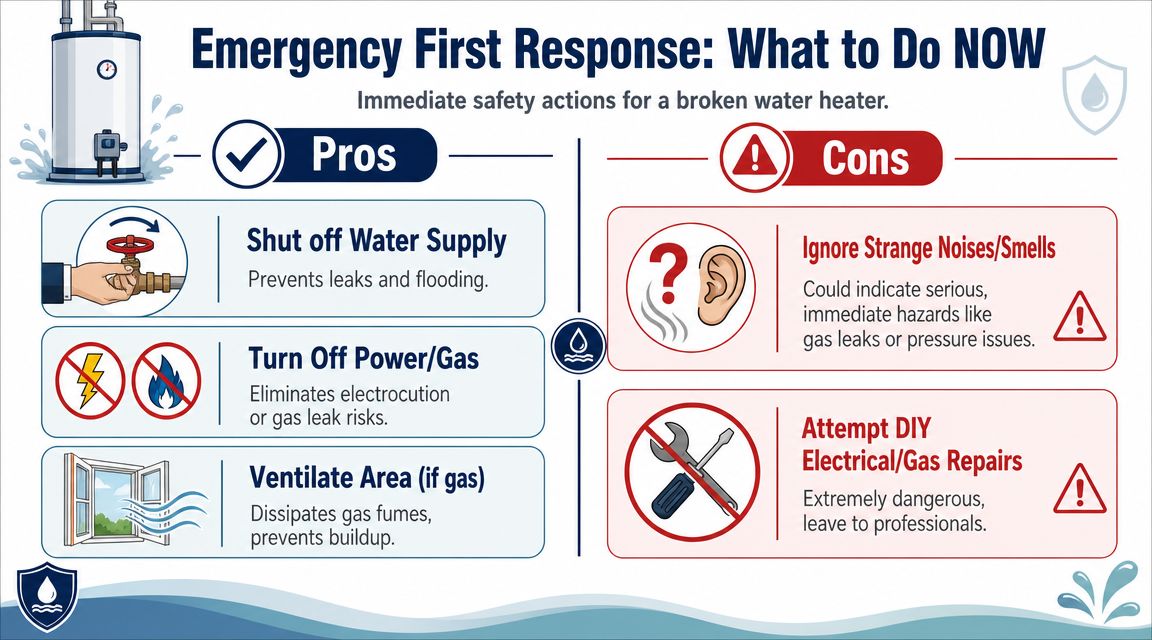
When a water heater breaks, the two biggest immediate risks are water damage and fuel-related danger. Water spreads farther than expected, especially in garages, closets, and utility rooms with shared walls. If the unit is gas-fired, a suspected leak changes the situation from maintenance to emergency.
The red flags that point to imminent failure or safety risk include bulging sides, rust-related tank deformation, water in the drain pan, and active leakage, and if you suspect gas, the emergency step is to shut off the gas and leave the area, as noted in this water heater safety guidance.
Stop the water first
If there's any leaking, go straight to the cold-water shutoff valve on the pipe feeding the heater. On many installations, that valve sits just above the unit. Turn it clockwise until it stops. If the local shutoff is stuck or missing, shut off water to the building at the main.
Use towels, a wet vac, or a bucket only after the supply is off. Don't waste time mopping while the heater is still feeding the leak.
For LA property managers, this matters even more in multi-unit buildings. Water often travels before you can see where it ends up. A small utility-room leak can show up as staining in a neighboring unit, common wall, or downstairs ceiling.
Practical rule: If water is already on the floor, act like secondary damage has started. Don't wait to “see if it slows down.”
Shut down the energy source
After the water is off, isolate the heater from power or gas.
For an electric water heater:
- Go to the breaker panel: Turn off the breaker labeled for the water heater.
- Leave the access panels alone: Don't remove element covers or touch wiring unless you know how to verify de-energization safely.
- Keep the area dry: Standing water and energized equipment are a bad combination.
For a gas water heater:
- Turn off the gas supply valve: Shut the valve serving the heater.
- If you smell gas: Leave the area immediately and don't try to diagnose the appliance in place.
- Ventilate only if it's safe to do so: Open windows or doors on the way out if you can do it without lingering.
Don't try to “bleed off” a dangerous tank
Homeowners sometimes see water around the discharge pipe and assume the fix is to mess with the relief valve. Don't do that casually. If you're trying to understand what that valve does and why it matters, this overview of the water heater pressure relief valve is useful. But if the tank is distorted, rusting through, or leaking actively, the issue may be beyond the valve itself.
A broken water heater can move from nuisance to emergency fast. Secure the area, isolate the utilities, and keep people away from the unit until you know what failed.
Troubleshooting Your Water Heater No Hot Water vs Leaks
Once the area is safe, the next question is basic but important. Do you have a heating problem, a leak problem, or a supply problem that only looks like a failed heater? Plenty of unnecessary replacements happen because nobody slows down and separates symptoms.
A reliable workflow starts by isolating the energy source, then inspecting likely failure points such as the thermostat, heating elements, pressure relief valve, leaks, and sediment. That same guidance also notes that sediment buildup can cause noisy operation and mimic other failures in ways that confuse homeowners during first inspection, as explained in this water heater diagnostic overview.
If there's no hot water anywhere
Start at the building level. Is every hot tap cold, or only one bathroom, one apartment, or one side of the house? A true whole-property hot water loss points toward the heater, its power source, or its fuel supply. A single affected fixture often points somewhere else.
Check these basics:
- Breaker or disconnect issue: On electric models, verify the breaker hasn't tripped.
- Pilot or ignition issue: On gas units, confirm the burner system is operating if you can inspect it safely.
- Thermostat setting: Make sure it hasn't been turned down by accident.
- Fixture pattern: If the kitchen has hot water but one shower doesn't, you may be dealing with a fixture-specific blockage or valve issue, not a dead heater.
That last point gets missed all the time in HOAs and apartment buildings. One resident reports “the water heater is broken,” but the actual problem is isolated to that branch line or fixture.
If the water is lukewarm or runs out too fast
Lukewarm water usually means the heater is still doing something, but not enough. That can come from a thermostat setting problem, sediment interfering with heat transfer, or a failing component that hasn't quit completely.
Look for patterns:
- Morning only: Heavy demand may be exposing a heater that's limping along.
- All day, every day: More likely a control or heating issue.
- Only one side of a duplex or one stack of units: Check the distribution side before condemning the tank.
If you manage rental property, routine inspection habits matter here. The same mindset used in broader effective equipment care applies to water heaters too. Small signs like unusual cycling, inconsistent output, or recurring tenant complaints usually appear before a total outage.
No hot water doesn't always mean the tank failed. A smart first check is whether the problem is building-wide or only showing up at certain taps.
If you hear banging, popping, or rumbling
Noise changes the diagnosis. Popping and banging often point to sediment buildup. The unit may still heat water, but it does it poorly and noisily because scale interferes with normal heat transfer.
That doesn't automatically mean replacement. It does mean the heater needs attention, because sediment can make a workable unit look worse than it is.
If there's a puddle on the floor
A puddle needs a closer look before anyone labels the tank itself as failed.
Check where the water appears to start:
- At a fitting or connector: Sometimes it's a connection issue.
- At the valve or discharge area: Could involve the relief side.
- Along the body of the tank or underneath it: More serious, especially with visible rust, deformation, or seepage.
For LA condos and apartment buildings, document exactly where you found the water and which units may be affected. That helps contractors, insurers, and boards move faster.
Quick Fixes and Temporary Solutions You Can Try
Some water heater broken calls turn out to be simple resets or supply issues. That's good news, but only if you stay inside safe limits. If you need to open gas controls, expose electrical terminals, or disassemble components, it's no longer a basic homeowner task.
Power Pro Plumbing's consumer guidance notes that a no-hot-water complaint can come from a tripped breaker, an extinguished pilot light, incorrect thermostat settings, or even a fixture-specific blockage, and recommends checking whether the problem affects all taps or only some of them in this hot water loss troubleshooting guide.
Reset the obvious electrical issue
If you have an electric unit and the breaker has tripped, reset it once. If it holds and hot water returns later, keep watching the heater. If it trips again, stop there. Repeated trips usually mean there's a fault worth diagnosing properly.
A second easy check is the high-limit reset on the heater, but only if you can access the manufacturer-provided reset point without getting into wiring. Press it once. Don't keep cycling it.
Relight the pilot only if the manufacturer instructions are clear
For gas models, an extinguished pilot can be a simple cause of no hot water. Follow the label on the unit or the manufacturer instructions exactly. If the pilot won't stay lit, don't keep trying. That points to a deeper issue, and repeated attempts can waste time while the property still has no service.
Rule out a localized plumbing problem
If one sink has hot water and another doesn't, the heater isn't your first suspect. Check whether:
- Only one fixture is affected
- One tenant is reporting the issue while adjacent units are normal
- A mixing valve or fixture control may be the problem
That distinction saves money and avoids unnecessary heater replacement.
What not to do
Don't try these without proper training:
- Replacing heating elements
- Replacing thermostats
- Testing live electrical terminals
- Working on gas valves or burner controls
- Forcing open valves because “maybe it's stuck”
Those repairs can be manageable for trained techs, but they're where homeowners often turn a moderate repair into a dangerous one.
If you want a broader homeowner-level reference on low-risk checks versus higher-risk repair steps, this DIY water heater repair guide for LA homes is a practical place to start.
If a quick fix doesn't restore normal operation cleanly, stop. Repeated resets and repeated relighting attempts usually waste time and muddy the diagnosis.
Repair or Replace Making the Right Financial Decision
Most owners don't need a lecture here. They want to know one thing. Is this worth repairing, or am I about to throw money at a dying tank?
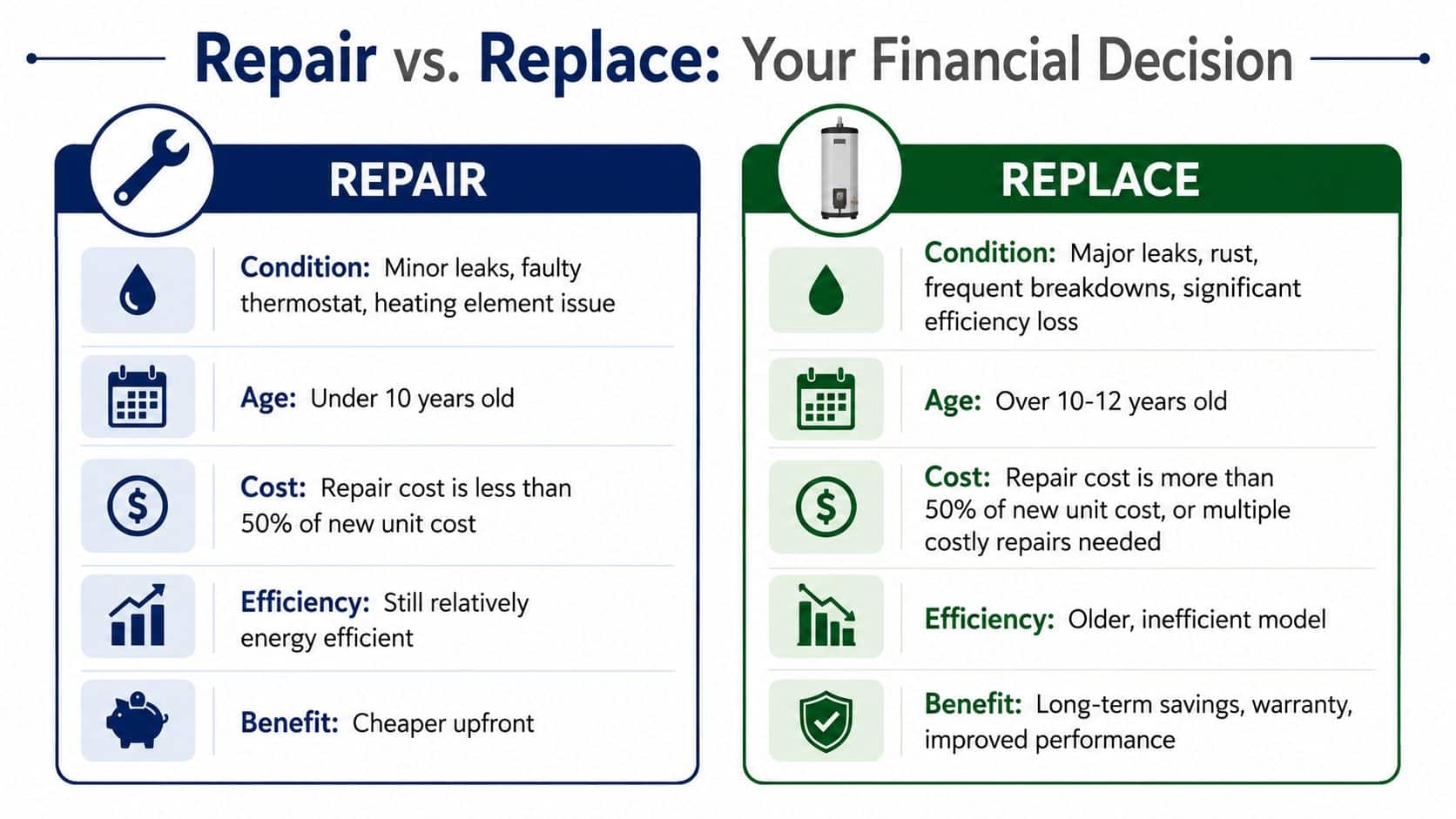
There's a useful cost frame for that decision. The average water heater repair is estimated at $501 to $615, with typical ranges of $228 to $1,016, while replacement commonly falls around $850 to $1,800 for a new unit, according to this water heater repair and replacement cost breakdown.
When repair usually makes sense
A repair is easier to justify when the problem is limited and the tank itself is still structurally sound.
A good repair candidate often looks like this:
| Situation | Lean |
|---|---|
| No visible tank deformation or body leak | Repair is more reasonable |
| Single failed control or heating component | Repair is more reasonable |
| Problem appeared suddenly, not repeatedly | Repair is more reasonable |
| Building needs a fast restore without broader system changes | Repair may be the practical move |
For landlords and property managers, there's also an operations angle. If you're responsible for habitability, clear documentation matters as much as the repair decision. This overview of Prophaven on landlord expectations is useful context for thinking through response obligations and maintenance follow-through.
When replacement is the smarter call
Replacement becomes easier to defend when the tank itself is the risk. Active leakage from the body of the unit, rust-related deterioration, or visible deformation usually means you're beyond a small-parts solution.
Other situations push the answer toward replacement:
- Recurring failures: You fix one thing, then another shows up.
- Property-risk exposure: The heater sits above finished space, near stored contents, or in a multi-unit setting where leaks can spread.
- Bad economics: The repair estimate lands too close to replacement cost.
For LA owners trying to compare bids clearly, a structured estimate helps. This guide on how plumbing estimates help LA homeowners make smart choices does a good job showing what should be spelled out before you approve the work.
The decision filter I'd use on site
Ask these questions in order:
- Is the tank itself leaking or deforming? If yes, lean hard toward replacement.
- Is the problem isolated to a serviceable component? If yes, repair stays on the table.
- Will delay increase building damage risk? If yes, speed matters more than squeezing a little more life out of the unit.
- Does the repair estimate feel too close to a new-unit cost? If yes, replacement often gives the cleaner long-term answer.
For HOAs and multi-unit buildings, replacement decisions also have a communication benefit. One complete, documented fix is often easier to manage than repeated tenant complaints and repeat access appointments.
Typical Water Heater Repair Timelines and Costs in Los Angeles
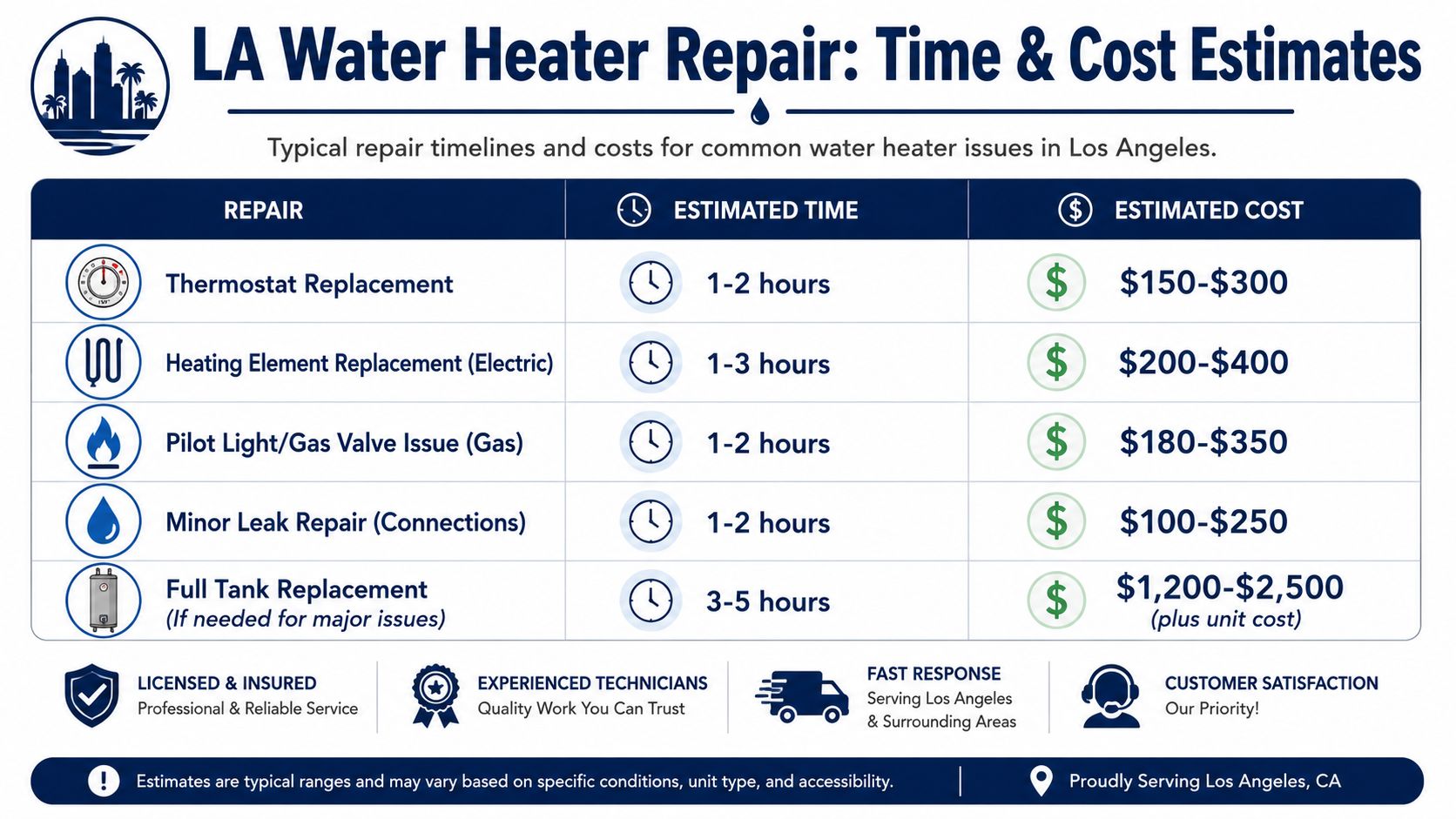
In the field, simple water heater repairs are often faster than owners expect once the actual fault is identified. The catch is that diagnosis can take longer when symptoms overlap. A no-hot-water complaint may involve supply issues, control problems, or sediment effects that look similar at first.
A practical benchmark is that straightforward repairs such as replacing a failed heating element or thermostat usually fall in the 1 to 3 hour range once the problem is correctly identified, while hidden leaks, control issues, and difficult access make the work take longer, based on this water heater repair timeline reference.
What affects how long the visit takes
Los Angeles properties add their own complications. Utility closets can be tight. Parking and access can slow things down. In apartment and condo buildings, a technician may also need unit access, HOA coordination, or time to verify whether the complaint is local to one residence or tied to central equipment.
Common reasons a job stretches out include:
- Access limitations: Tight closets, stacked laundry areas, or restricted service areas
- Leak tracing: Water doesn't always originate where it shows up
- Control diagnosis: Symptoms can overlap between thermostat, reset, element, or supply issues
- Parts availability: Older models sometimes require extra sourcing time
What owners should expect on a service call
A competent service visit usually follows a pretty disciplined sequence.
| Service stage | What happens |
|---|---|
| Initial safety check | Confirm the area is safe and utilities are correctly isolated if needed |
| System inspection | Check supply, controls, leak points, and visible condition |
| Diagnosis | Narrow the fault instead of replacing parts blindly |
| Repair or recommendation | Complete the repair if practical, or recommend replacement if not |
| Final verification | Confirm heating recovery and check for leaks after service |
That last step matters. A heater that powers on isn't necessarily fixed. It should be checked under normal operation, with attention to recovery and leakage.
A short repair window is realistic only after the right diagnosis. The longest jobs I see often start with a wrong assumption, not with a hard repair.
For LA owners and managers, the smart move is to ask two things when booking service: what access will the technician need, and whether the reported symptom sounds like a building-wide heater problem or a unit-specific plumbing issue. That alone can save hours of confusion.
When to Call a Pro Get 24/7 Emergency Service from EZ Plumbing
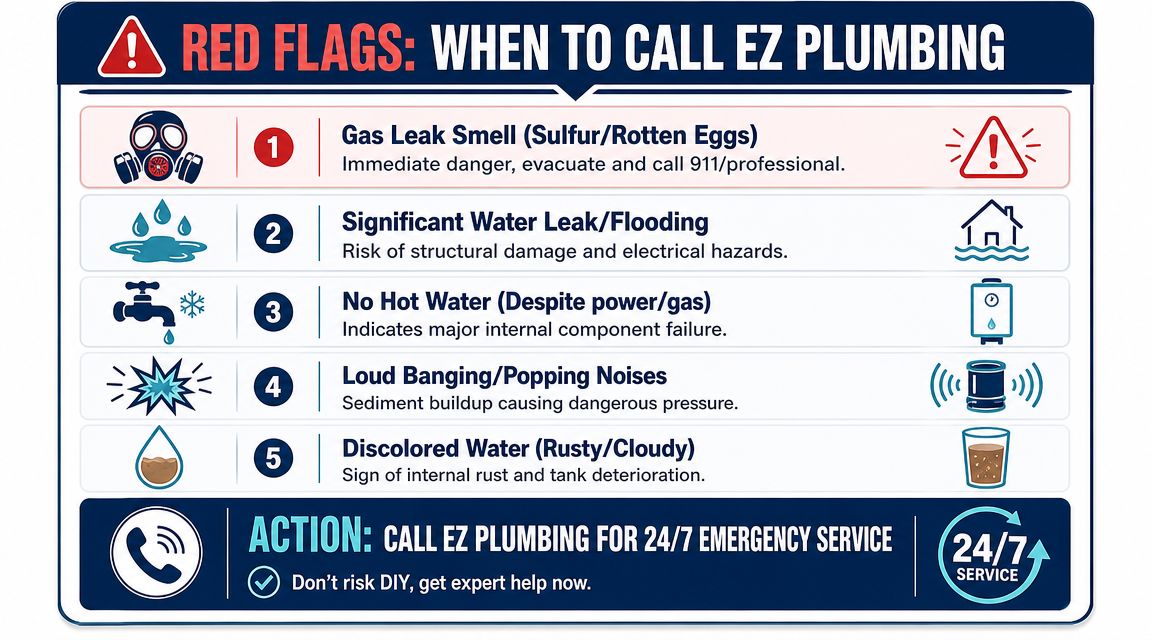
Some calls should never turn into a DIY project. If you smell gas, see active water spreading, notice rust deformation or bulging on the tank, or keep losing power to the heater, the right move is to stop troubleshooting and get a licensed plumber involved.
That's especially true in Los Angeles multi-unit buildings. One bad decision in a utility room can affect neighboring units, shared walls, finished ceilings, and tenant safety. In those situations, the actual cost isn't just the appliance. It's water intrusion, documentation, access coordination, and restoring service without making the property damage worse.
Red flags that mean stop and call
Use a professional when any of these are true:
- You suspect gas: Leave the area after shutting off gas if safe to do so.
- Water is actively leaking from the tank body: That's different from a minor external drip at a fitting.
- The heater shows visible distortion or rust seepage: Those are failure signs, not maintenance reminders.
- The same issue keeps coming back: Repeated resets and recurring outages usually mean the first diagnosis didn't solve the root problem.
- The property is occupied by tenants or part of an HOA: Documentation and fast containment matter as much as the repair itself.
If you're comparing service providers or trying to understand how another contractor approaches this type of work, resources like Platinum Heating for water heater repair can help you frame the right questions about inspection, repair scope, and replacement planning.
A practical LA service standard
For local owners, managers, and boards, the service standard should be simple. You need a licensed, insured plumbing contractor who can respond to emergencies, handle gas-related concerns appropriately, work cleanly in occupied properties, and communicate clearly from dispatch through completion.
That's where EZ Plumbing fits as a local option. The company serves Los Angeles homeowners, HOAs, property managers, and commercial properties, offers 24/7 emergency response and same-day scheduling for planned repairs, and handles water heater repair, diagnostics, and related plumbing work across areas including Beverly Hills, Santa Monica, West Hollywood, Pasadena, Glendale, Burbank, and the San Fernando Valley.
If the water heater broken call involves safety, spreading water, or multiple residents, speed and clarity matter more than squeezing in one more DIY attempt.
If you're standing in front of a leaking tank right now, keep it simple. Shut off the water. Shut off the power or gas. Keep people clear of the area. Then get a qualified plumber on site who can tell you whether this is a repairable component failure or a replacement situation.
If you need help with a broken water heater in Los Angeles, contact EZ Plumbing for professional service. They've served LA since 1989, provide 24/7 emergency response and same-day scheduling, and work with homeowners, landlords, HOAs, and property managers across the region. For urgent service, call (818) 908-2710.