
How plumbing estimates help LA homeowners make smart choices
Most Los Angeles homeowners treat a plumbing estimate like a restaurant menu price, a simple number before the bill arrives. That assumption leads to budget overruns, project delays, and disputes with contractors. A proper estimate is a structured document that breaks down materials, labor, and potential risks so you can budget accurately, compare bids, and avoid financial surprises. In a city where aging infrastructure, strict building codes, and hillside terrain routinely complicate even routine repairs, understanding what goes into your estimate is one of the most practical things you can do before any plumbing project begins.
Table of Contents
- What is a plumbing estimate and why does it matter?
- How plumbers create accurate estimates: Step-by-step process
- Typical plumbing estimate costs in Los Angeles: What to expect
- Edge cases and cost drivers: What can impact your plumbing estimate
- How to use plumbing estimates to make confident decisions
- The uncomfortable truth: Most plumbing estimates skip these critical details
- Connect with LA’s most trusted plumbers for reliable estimates
- Frequently asked questions
Key Takeaways
| Point | Details |
|---|---|
| Estimates prevent surprises | Detailed breakdowns in plumbing estimates help you avoid unexpected costs and stay on budget. |
| LA pricing factors | Local permit fees, emergencies, and property age all affect estimate totals in Los Angeles. |
| Always get itemized bids | Request an itemized estimate and review inclusions, exclusions, and contingencies for clarity. |
| On-site analysis is vital | In-person inspections uncover hidden risks that affect final plumbing costs. |
What is a plumbing estimate and why does it matter?
A plumbing estimate is a formal, itemized projection of the total cost to complete a specific plumbing scope of work. It is not a rough guess. A professional estimate accounts for materials, labor hours, permit fees, overhead, exclusions, and a contingency buffer for unexpected conditions discovered during the job.
The practical benefits for you as a homeowner or property manager are significant. Accurate budgeting prevents you from committing to a project you cannot afford to finish. Side-by-side bid comparison becomes possible only when each estimate uses the same line items. Transparent cost breakdowns reveal whether a contractor is padding margins or cutting corners on materials. And clearly stated exclusions protect you from scope creep, where the job quietly expands beyond what you originally approved.
In Los Angeles specifically, the role of plumbers during home upgrades is more complex than in many other cities. Properties built before 1970 often contain galvanized steel pipes prone to corrosion, clay sewer laterals susceptible to root intrusion, and cast iron drain stacks that require specialized handling. The Los Angeles Department of Building and Safety (LADBS) enforces permit requirements that add cost and timeline to nearly every significant repair. Without a proper estimate that accounts for these local realities, you are essentially approving work with your eyes closed.
What goes wrong without a thorough estimate? Contractors may quote a low number verbally, begin work, and then present change orders for conditions they claim were “unforeseen.” A well-structured estimate with a plumbing pricing breakdown eliminates that ambiguity by documenting what is included and what is not before a single pipe is touched.
A proper plumbing estimate is not a formality. It is your primary financial protection before any work begins.
Now that we know why estimates are more than numbers, let’s break down how they’re created.
How plumbers create accurate estimates: Step-by-step process
Professional plumbers follow a structured process to produce estimates that hold up under real job conditions. Skipping any step increases the risk that the final invoice will differ significantly from what you were quoted.
The process typically unfolds in this sequence. First, a licensed plumber conducts an on-site walkthrough to assess existing conditions, pipe materials, access points, and any visible damage. Second, the plumber reviews blueprints or as-built drawings when available, particularly for commercial properties or major residential remodels. Third, digital takeoff software such as Planswift or FastPIPE is used to calculate pipe lengths, fixture counts, and material quantities with precision. Fourth, labor hours are estimated based on task complexity, crew size, and local wage rates. Fifth, material costs are applied using current supplier pricing, with markups that typically range from 15% to 300% depending on material type and availability. Sixth, overhead recovery, often calculated at a fixed hourly rate such as $33 per hour, is added to cover business operating costs. Finally, a contingency of 10% to 15% is built in for remodel work where hidden conditions are likely.

Pro Tip: Ask your plumber which estimating software or pricing database they use. Contractors referencing RS Means or similar industry-standard tools are more likely to produce estimates that reflect actual market conditions rather than gut instinct.
The line items you should expect to see on a professional quote include materials by type and quantity, labor broken out by task, permit fees, equipment rental if applicable, and a clearly labeled exclusions section. The plumbing estimating tools used by reputable contractors make this level of detail achievable and standard, not optional.
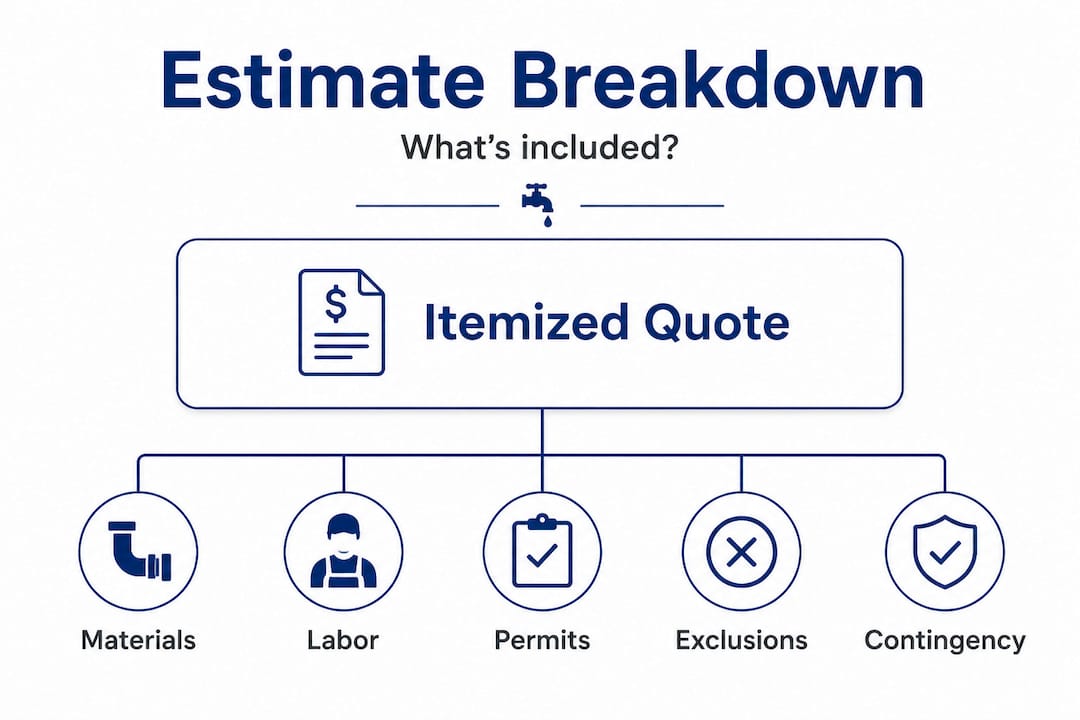
| Estimate component | What it covers |
|---|---|
| Materials | Pipe, fittings, fixtures, valves, sealants |
| Labor | Hours per task, crew size, skill level |
| Permits | LADBS filing fees, inspection scheduling |
| Overhead | Insurance, vehicle, administrative costs |
| Contingency | Buffer for unforeseen conditions (10-15%) |
| Exclusions | Work explicitly not included in scope |
Knowing how detailed estimates are built, we can look at what typical LA plumbing projects should cost.
Typical plumbing estimate costs in Los Angeles: What to expect
Los Angeles plumbing costs run higher than national averages due to local labor rates, permit requirements, and the complexity of older building stock. Understanding the benchmarks for common services helps you recognize fair pricing and flag bids that seem too low or unreasonably high.
Current LA-specific cost ranges for frequent services are as follows: drain cleaning runs $125 to $600 depending on method, with hydro-jetting at the higher end; toilet installation falls between $300 and $950 including the fixture; water heater replacement ranges from $900 to $3,500 based on tank size and fuel type; slab leak repair costs $1,500 to $6,000 depending on access difficulty; and whole-house repiping spans $5,000 to $20,000 for most residential properties. Standard service call fees run $75 to $150, and emergency or after-hours calls carry a multiplier of 1.5x to 2x the standard rate.
| Service | Low estimate | High estimate |
|---|---|---|
| Drain cleaning | $125 | $600 |
| Toilet installation | $300 | $950 |
| Water heater replacement | $900 | $3,500 |
| Slab leak repair | $1,500 | $6,000 |
| Whole-house repipe | $5,000 | $20,000 |
| Emergency service call | $112 | $300+ |
When reviewing a bid from LA plumbers, check whether permit fees are included or listed separately. In Los Angeles, permit costs for water heater replacements alone can run $150 to $400 depending on the jurisdiction. A bid that appears low may simply be excluding permits, leaving you to cover that cost later.
For residential plumbing services, the most common red flags in estimates include no mention of permits, no contingency line, and a single lump-sum total with no itemization. Any of those gaps signals that you are not getting a professional estimate, you are getting a number someone invented to win the job.
Once you know what standard projects cost, it’s crucial to understand the complex scenarios that affect your estimate.
Edge cases and cost drivers: What can impact your plumbing estimate
Certain job conditions in Los Angeles routinely push estimates beyond standard ranges. Knowing these scenarios in advance allows you to ask the right questions and ensure your estimate includes the appropriate allowances.
Slab leak repairs require concrete coring to access pipes beneath the foundation, and that coring premium can add $500 to $1,500 to the base repair cost. Properties on hillsides in areas like Laurel Canyon, Silver Lake, or Bel Air carry a 15% to 30% upcharge for access difficulty, extended pipe runs, and specialized equipment needs. Homes built before 1978 may contain asbestos insulation around pipes, requiring abatement before any plumbing work can proceed. Water pressure exceeding 80 PSI requires a pressure-reducing valve installation as a code upgrade, adding cost that a phone quote would never anticipate. Multi-story commercial buildings with vertical drain stacks present significantly more labor complexity than single-family homes.
For commercial plumbing estimates, discovery clauses are especially important. A discovery clause gives the contractor authority to proceed with additional work up to a defined dollar amount if hidden damage is found, without requiring a full stop and new contract. Paired with a not-to-exceed cap, this clause protects both parties from runaway costs.
LA plumbing emergencies carry their own cost structure. After-hours calls, weekend repairs, and holiday service can cost 1.5x to 3x the standard rate, and those multipliers should be stated explicitly in your estimate if there is any possibility the work will extend beyond business hours. Unexpected emergency plumbing costs catch many property owners off guard precisely because no one discussed the after-hours rate upfront.
Pro Tip: Always request a physical inspection before approving any job involving slab access, old galvanized pipe, or suspected hidden damage. A phone quote for these scenarios is not an estimate, it is a guess.
Understanding edge cases and estimate details sets you up to take action and safeguard your investment.
How to use plumbing estimates to make confident decisions
Receiving an estimate is only the beginning. How you read, compare, and act on that document determines whether your project stays on budget and on schedule.
Start by verifying that the estimate is itemized. A single lump-sum number gives you nothing to evaluate. Itemized estimates let you compare labor rates, material choices, and contingency amounts across multiple bids. When planning major plumbing work, this comparison process is the single most effective way to identify the best value, not just the lowest price.
Ask these questions before signing any estimate. Is a permit required, and is the filing fee included? Is the contractor licensed with a valid C-36 license, verifiable through CSLB? What is the warranty on parts and labor? What specific conditions are excluded from the scope? What is the timeline, and what happens if hidden damage extends the job?
Follow this sequence to evaluate competing bids effectively. First, confirm each estimate covers identical scope. Second, check that permit costs appear on every bid. Third, compare contingency percentages. Fourth, verify C-36 license and permits through LADBS or CSLB before awarding any contract. Fifth, request clarification in writing for any line item that is vague or missing.
Walk away from any estimate that uses vague language like “plumbing repairs as needed” without defining scope, omits exclusions entirely, or pressures you to sign before you have time to review. Lowball bids that skip permits or contingencies are not savings, they are deferred costs that will surface mid-project.
The uncomfortable truth: Most plumbing estimates skip these critical details
After years of working on Los Angeles properties, we have seen a consistent pattern. Homeowners and property managers who accepted phone quotes or drive-by estimates without on-site inspections almost always end up paying more than the original number. Not because contractors are dishonest, but because a phone quote cannot account for what is behind the wall, under the slab, or inside a corroded pipe.
The most common missing elements we see in incomplete estimates are discovery clauses, not-to-exceed caps, and explicit exclusions. Without a discovery clause, a contractor who finds unexpected damage mid-job has no contractual framework for proceeding efficiently. Without a not-to-exceed cap, you have no ceiling on what you can be charged. Without listed exclusions, every item not mentioned becomes a potential add-on.
Post-2020, experienced LA property managers have started demanding all three of these controls as standard. They have learned, often at significant cost, that the estimate document is where financial protection is either built in or left out entirely. When plumbing goes wrong mid-project due to hidden damage or scope creep, the homeowners who fare best are the ones who had a properly structured estimate from the start.
The uncomfortable reality is that a thorough estimate takes time and requires an in-person visit. Contractors who offer instant quotes over the phone are not saving you time, they are shifting the financial risk onto you.
Connect with LA’s most trusted plumbers for reliable estimates
EZ Plumbing (C-36 License #583868) provides fully itemized, transparent estimates for homeowners and property managers across greater Los Angeles. Every estimate we produce includes materials, labor, permit fees, exclusions, and a contingency allowance, so you know exactly what you are approving before any work begins.
Whether you need sewer line repairs on an aging lateral, drain cleaning solutions for a chronically slow building, or water heater installations that meet current LA code requirements, our team conducts on-site diagnostics before quoting a single dollar. We are fully licensed, insured, and familiar with LADBS permit requirements across all LA jurisdictions. Contact EZ Plumbing to schedule your professional estimate and get the clarity your project deserves.
Frequently asked questions
What should a plumbing estimate include?
Every estimate should list materials, labor, permit fees, exclusions, and a contingency for surprises, giving you a detailed breakdown that supports accurate budgeting and bid comparison.
How accurate are plumbing estimates in Los Angeles?
A detailed local estimate should be within 10% to 15% of final costs when all site conditions are checked, since reputable contractors build in a 10% to 15% contingency for remodel work and difficult-access locations.
Why do LA plumbing estimates vary so much?
Estimates differ based on building age, access difficulty, emergency needs, and required permits, with LA service costs spanning wide ranges even for standard jobs like drain cleaning or water heater replacement.
Should I ever accept a plumbing bid without an on-site estimate?
No. Complex jobs require in-person diagnostics because on-site inspections uncover edge cases that phone quotes consistently miss, often leading to costly mid-project change orders.