
Stuck Shut Off Valve? Here’s How to Fix It
The worst version of a plumbing problem isn't the leak, it's the moment you reach for the shutoff and it won't move. You're standing there with water spreading under a sink or behind a toilet, and the valve that should save the room has turned into a stuck shut off valve that feels welded in place. In older Los Angeles homes, that's not a rare surprise, it's a maintenance failure that finally showed itself at the worst time.
A valve can look fine from the outside and still be functionally useless. Industry guidance says shut-off valves should be exercised at least every two years, and typical service life is about 10 to 25 years, with an average of 20 years (Everlasting Valve USA). In a city with a lot of older housing, that matters because many valves have sat too long, collecting corrosion, mineral buildup, and neglect until the handle no longer tells the truth about what's happening inside.
One detail that catches people off guard is that valve failure is often a problem of inactivity, not just age. A shutoff can be physically present, but the stem can seize, the packing can bind, or the handle can strip, so the next emergency turns into a scramble instead of a shutdown.
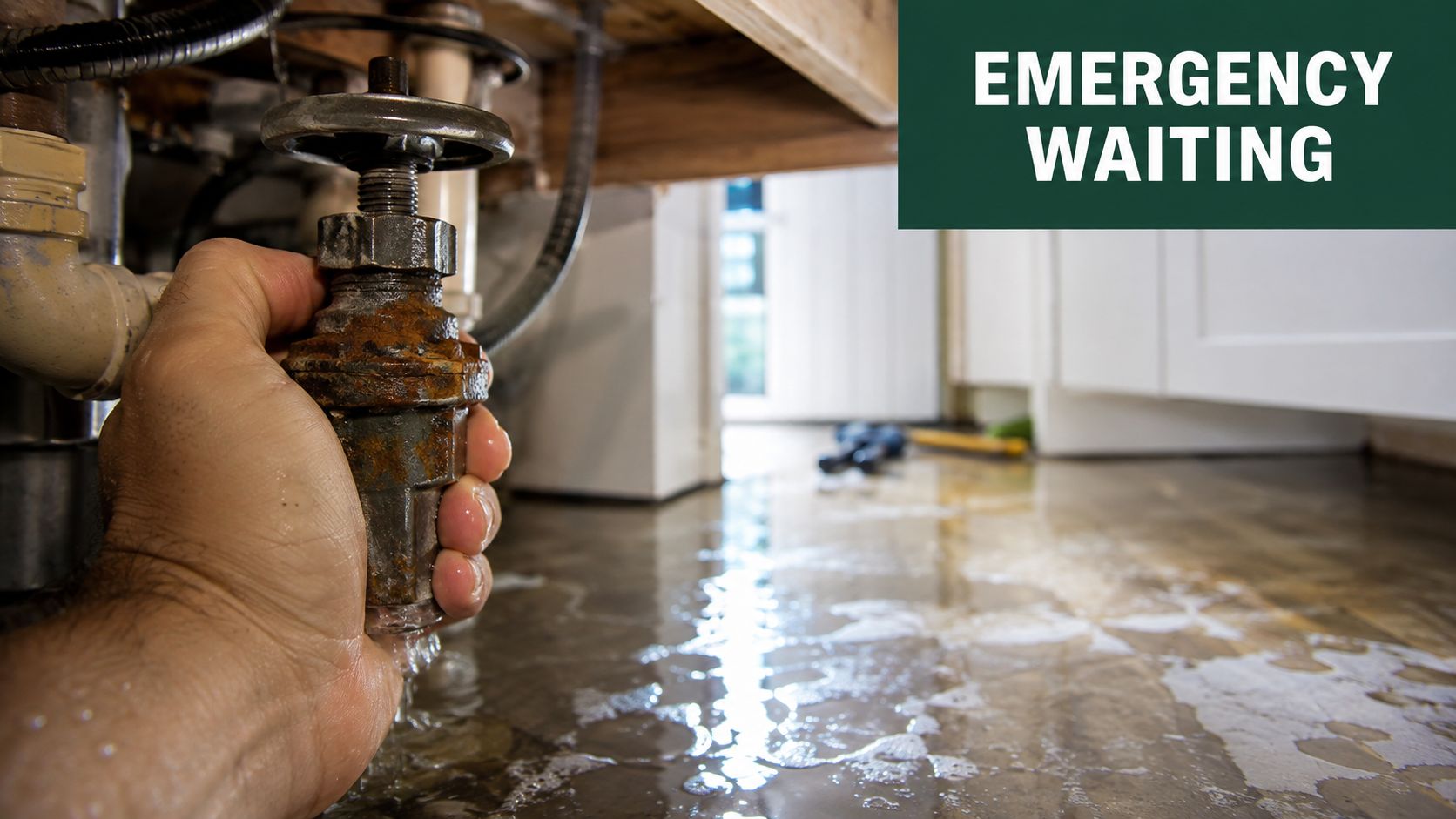
Table of Contents
- Why a Stuck Shut Off Valve Is an Emergency Waiting to Happen
- Identifying Your Valve Type and Where It Is Stuck
- Step-by-Step Methods to Free a Stuck Shut Off Valve
- Repair vs Replace When a Stuck Valve Needs a Professional
- Emergency Fallbacks When You Cannot Shut Off the Water Immediately
- When to Call EZ Plumbing Trusted LA Plumbers for Shut Off Valve Service
Why a Stuck Shut Off Valve Is an Emergency Waiting to Happen
A pipe splits under a sink, or a water heater starts dripping hard enough to soak the floor. The instinct is automatic, get to the nearest valve, turn it off, stop the damage. Then the handle won't budge, and the whole room becomes a countdown.
That failure is often predictable. In a 7-year offshore safety review, researchers found 179 emergency shutdown-valve failure cases, and more than three-quarters were failures to close. The same review identified corrosion, seizure or sticking from salt accumulation and debris, and equipment age as the main immediate causes (IChemE study). The setting was industrial, not residential, but the mechanism is the same. Valves usually don't fail randomly, they degrade along a path that maintenance was supposed to interrupt.
LA homes make this more than a theory
In Los Angeles, aging housing stock raises the odds that the valve you need has been sitting untouched for years. That doesn't mean every older valve is doomed, but it does mean the risk is not abstract. A valve may be present, labeled, and easy to see, yet still refuse to turn when a leak starts.
Practical rule: if a shutoff hasn't been exercised in years, assume it may not work until you've tested it gently.
The primary hazard is not just leakage. It's losing the one control that should let you stop water fast enough to save flooring, cabinets, drywall, and sometimes electrical equipment. That's why a stuck shut off valve should be treated as a warning sign, not just an inconvenience.
The good news is that most stuck valves give clues before they fail completely. Handle feel, visible corrosion, and leak patterns usually point to what's wrong, and the next step is figuring out whether the valve is jammed, stripped, or just stiff enough to justify careful freeing attempts.
Identifying Your Valve Type and Where It Is Stuck
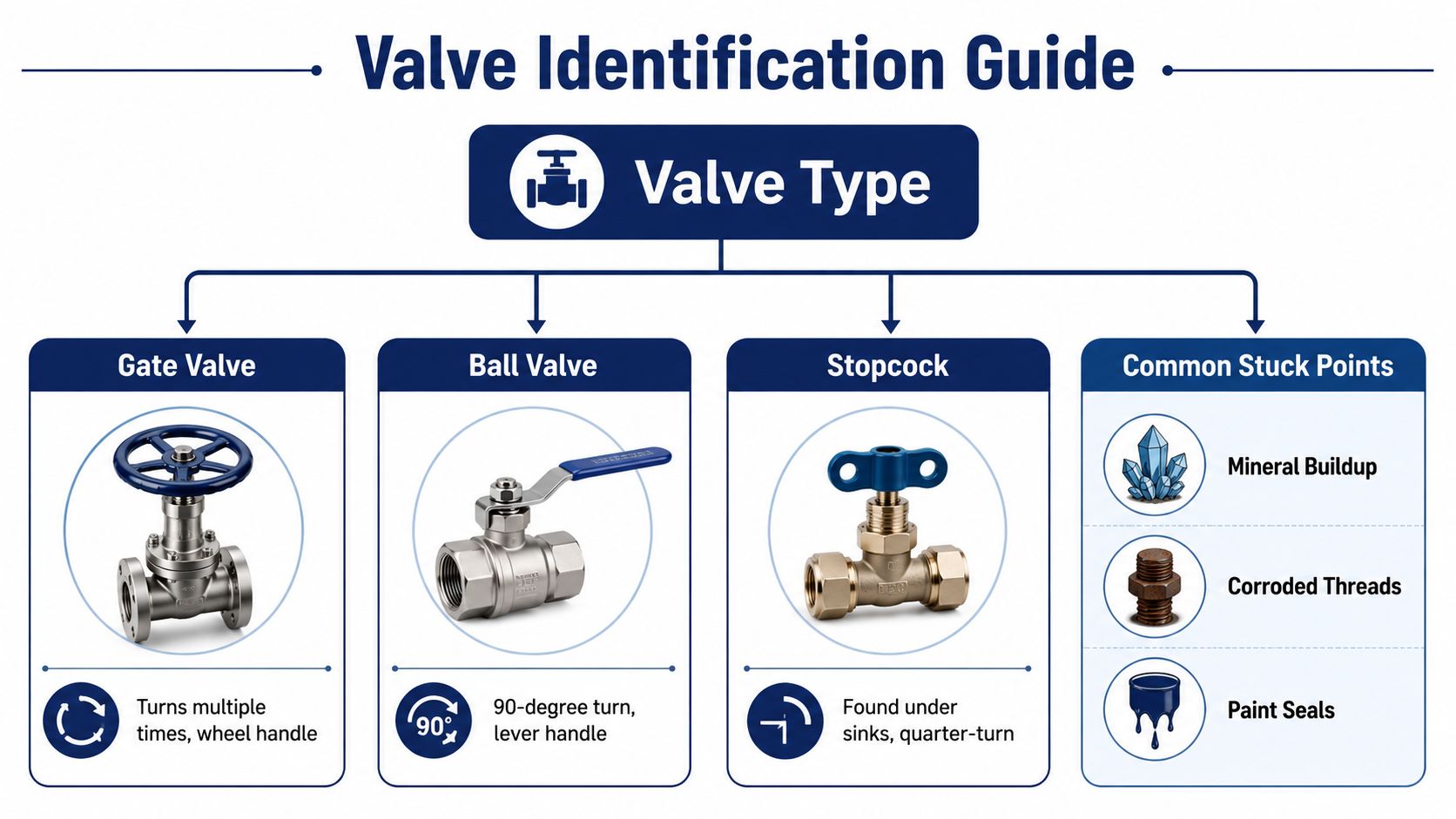
Before touching a wrench, identify the valve. A ball valve usually has a lever handle and turns a quarter rotation. A gate valve has a round wheel and takes multiple turns. A stop valve or compression-style shutoff, often found under sinks and toilets, sits somewhere between the two in feel and failure pattern.
Read the handle before you read the body
If the handle moves but the water doesn't shut off, the problem may be in the stem or internal mechanism. If the handle won't move at all, the stem may be bound by buildup or corrosion. If you can turn it and water leaks from around the handle, the packing or gland area may be the weak point.
A useful resource for locating the shutoff before you need it is find your home's shut off valve. Knowing where the valve sits, and which fixture it serves, saves a lot of guesswork when the room is already wet.
A quick diagnostic sequence
Start simple and work outward.
- Check handle travel: a lever that stops hard after a short move suggests seizure or an internal obstruction.
- Watch for stem leaks: moisture around the handle often points to packing failure rather than a fully seized body.
- Look for corrosion or paint: rust, mineral crust, or old paint lines can lock moving parts together.
- Test for false movement: if the handle spins but the valve doesn't react, the handle-to-stem connection may be stripped.
If a valve changes flow with tiny adjustments, the stem may still be moving and the seat may be scaled. If nothing changes, the binding is probably deeper.
That distinction matters because the wrong fix can destroy a repairable valve. Forcing a corroded gate valve with a long wrench can snap the stem. Treating a stripped handle like a simple stiffness problem wastes time and can make the failure worse.
Step-by-Step Methods to Free a Stuck Shut Off Valve
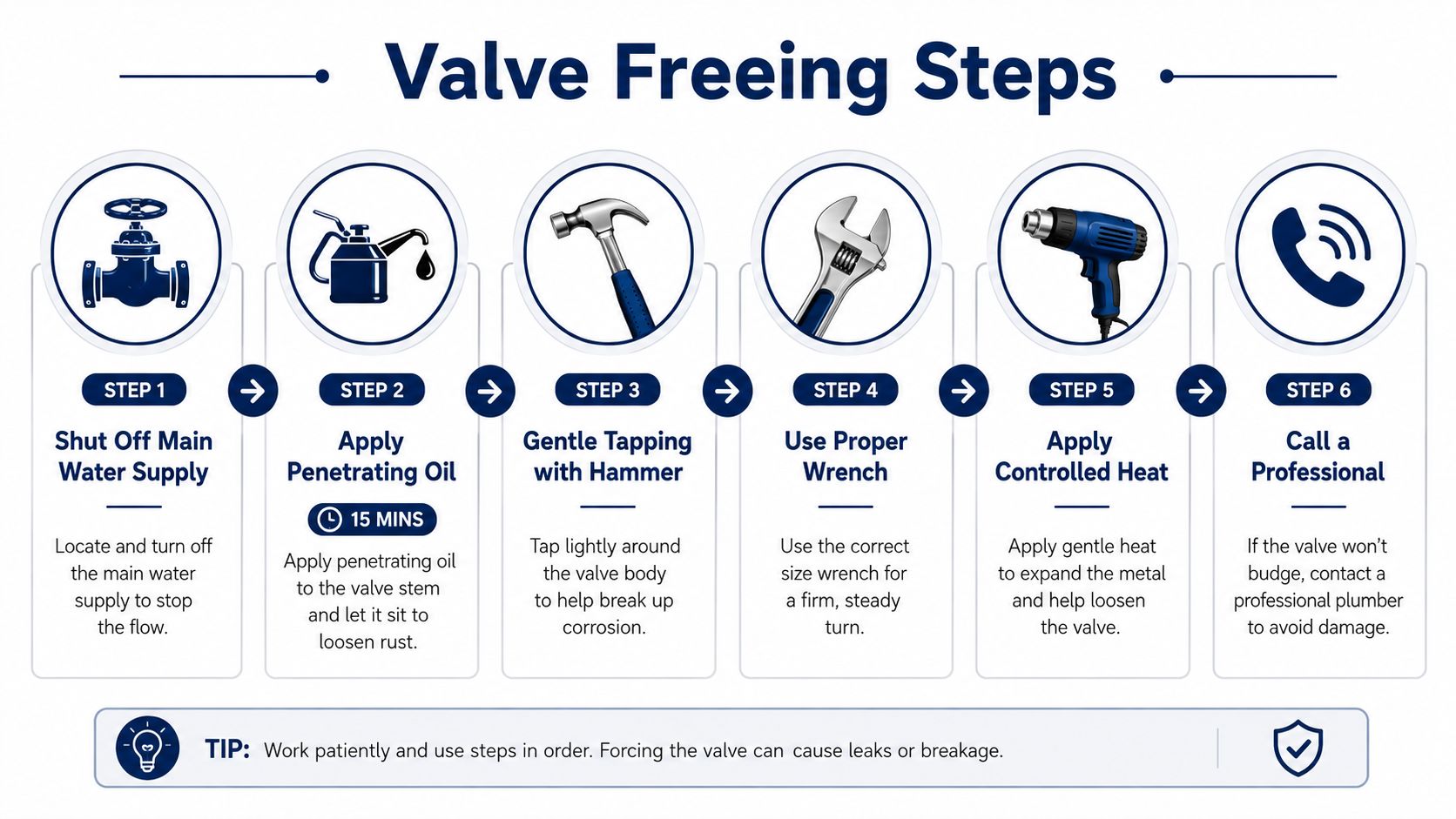
The safest way to free a stuck shut off valve is to start with the least aggressive move that can still work. Technical guidance on shutoff assemblies shows these valves are built around defined operating limits, so the point isn't to overpower them, it's to stay inside what the hardware can tolerate (A2T technical documentation). Once resistance feels extreme, stop.
Start by removing pressure
If there's an upstream shutoff or a meter stop you can use, turn that off first. Taking pressure out of the line reduces the load on the stuck valve and lowers the chance that a sudden turn will shear something. After the line is isolated, try the local valve again with a calm grip and short, deliberate movement.
Use penetrating oil the right way
Apply a penetrating lubricant to the exposed stem threads and packing area, not all over the body. Give it time to work, because rushing this step is one of the most common mistakes. Fifteen to thirty minutes is a reasonable soak window for a normal attempt, and the point is to let capillary action do the work before force enters the picture.
Move it in small increments
Use a proper adjustable wrench on a square or hex stem nut, or the correct valve tool for the handle style. Turn with steady pressure, then back off slightly, then try again. On quarter-turn ball valves, a few degrees of back-and-forth motion can help break mineral deposits without stressing the body.
Don't confuse stiffness with progress
A valve that suddenly gets easier after tiny movement may still be recoverable. A valve that feels like it's grinding metal or twisting the piping is warning you to stop.
- Use the right contact point: grip the stem nut or intended flat, not the pipe body.
- Avoid impact force: hammering can crack brass or loosen adjacent fittings.
- Lightly snug the packing nut only if accessible: a small adjustment can compress packing and reduce binding.
- Stop at abnormal resistance: if your hand starts trying to lean body weight into the tool, the valve may be beyond safe DIY.
For homeowners dealing with repeated leaks, this shut-off valve leaking guide is a practical companion because a valve that leaks and sticks usually needs a different response than one that only feels stiff.
Important boundary: if the valve still won't move after a gentle attempt and lubrication, don't escalate into brute force. That's how a manageable valve issue becomes a flooded cabinet.
Repair vs Replace When a Stuck Valve Needs a Professional
Not every stuck valve deserves the same answer. Some can be repacked or cleaned. Others are already at the point where replacement is the safer choice, especially if the body is old, the stem is damaged, or the valve has already shown signs of leakage.
What usually earns a repair
A gate valve with a solid body and a stem that only needs repacking can often be restored without replacing the whole assembly. In practice, that means removing the handle, cleaning the exposed parts, replacing worn stem components, and testing for leaks after reassembly. Manufacturer repair guidance for shutoff assemblies follows that basic pattern, with retesting after service to confirm the valve still seals properly (VDS Asia standard guidance).
What usually earns replacement
A quarter-turn ball valve with a cracked body, severe internal corrosion, or a fractured handle assembly usually isn't worth nursing back to life. Ball valves are far better at quick isolation than at piecemeal rebuilding. If the body is compromised, replacement is the cleaner answer.
| Decision factor | More repair-friendly | More replacement-friendly |
|---|---|---|
| Visible body condition | Solid body, minor corrosion | Cracks, heavy pitting, leaks |
| Valve behavior | Stiff but still responsive | Stuck hard, sheared, or spinning free |
| Location | Accessible branch line | Main shutoff or critical isolation point |
| Age and service history | Recent or maintained | Long-neglected, older, uncertain |
Why old valves often lose the argument
A valve that has already made it into the upper end of its service life is telling you something. Industry guidance puts typical lifespan around 10 to 25 years and recommends exercising shutoff valves at least every two years (Everlasting Valve USA). If the valve has been neglected for years and still resists after careful freeing attempts, replacement usually costs less in risk than another round of forcing.
For broader home repair planning, find repair solutions for homes can help frame the issue, but the decision here is straightforward. If the valve body is cracked, the stem shears, or the torque feels wrong after service, replacement is the safer long-term move.
Emergency Fallbacks When You Cannot Shut Off the Water Immediately
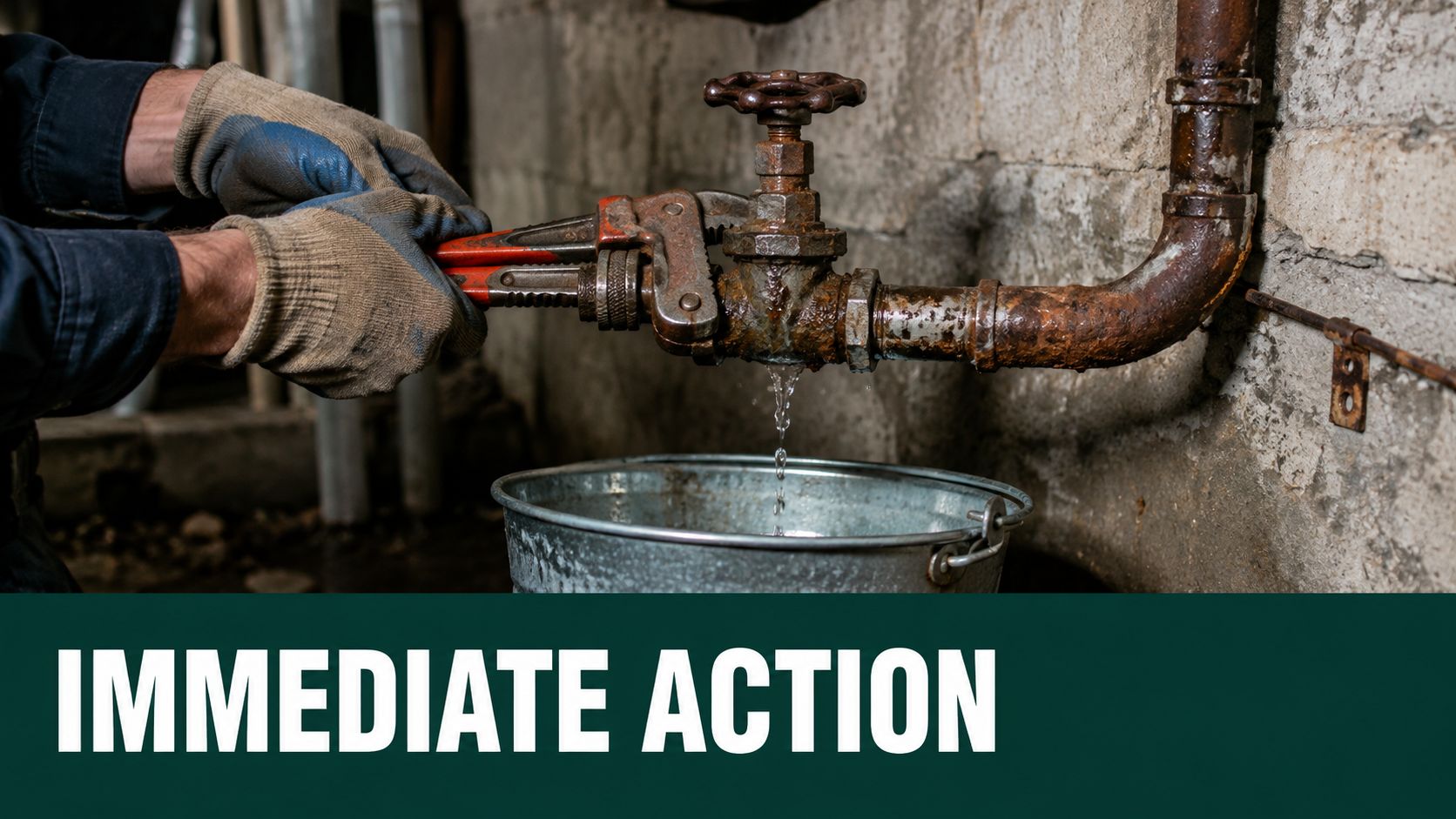
When the local valve won't free and water is already moving, the priority shifts from repair to isolation. If the line is active, speed matters more than elegance.
Use the next upstream shutoff
The next best option is whatever shuts water off farther upstream, such as a building-level valve or a curb stop. In Los Angeles neighborhoods, the curb stop is often near the sidewalk or property line in a utility box, but accessing it can require the proper key and should be handled carefully to avoid damage to city-side infrastructure.
If you need a practical walkthrough for whole-house isolation, how to shut off main water supply is the right reference to keep nearby. After any shutdown attempt, open a downstream faucet to confirm the water is off.
Know the difference in multi-unit properties
In apartment buildings, HOAs, and commercial spaces, one seized valve should not block the whole property if the system is mapped correctly. Each unit or zone needs its own documented shutoff, and staff should know which valve isolates which area. That planning matters because a stuck shut off valve in one unit can otherwise become a property-wide disruption.
A documented valve map is boring until water is running. Then it becomes the fastest way to restore control.
Use the emergency mindset, not the repair mindset
If the water is already escaping and the valve is resisting, don't keep trying to prove it can be saved. Close the nearest valid upstream valve, contain the leak, and move to service. A delayed response usually creates more damage than the original failure.
When to Call EZ Plumbing Trusted LA Plumbers for Shut Off Valve Service
Some valves are worth another careful attempt. Others have already crossed the line where DIY stops being economical. If the valve won't move after lubrication and gentle pressure, if the body is cracked or leaking, or if the main shutoff is seized on a property where water control matters, it's time to bring in a licensed plumber.
EZ Plumbing has served Los Angeles since 1989 as a licensed and insured plumbing contractor, with 24/7 emergency response and same-day scheduling for planned repairs. That matters on a stuck shut off valve because the value of the visit is not just turning hardware, it's restoring control before the leak spreads into cabinets, floors, or shared building space.
They work across Beverly Hills, Santa Monica, West Hollywood, Pasadena, Glendale, Burbank, and the San Fernando Valley, which makes them a practical option for homeowners, landlords, HOAs, and facility managers who need a fast valve replacement or emergency shutoff handled by professionals who do this every day.
For a valve that refuses to move, the decision isn't really about whether you can keep trying. It's about whether the next turn is more likely to free it or break it. When the risk has shifted toward flooding, the right move is to stop forcing it and get qualified help.
If you're dealing with a stuck shut off valve in Los Angeles, EZ Plumbing can help locate the shutoff, isolate the water, and replace the valve before the problem turns into property damage. Visit EZ Plumbing to schedule service or request emergency help from a local team that handles these failures every day.