
Hiring a Sewer Line Repair Company: An LA Owner’s Guide
A sewer issue usually starts with something small enough to dismiss. A downstairs toilet burps when the upstairs shower runs. A tenant reports a laundry drain backing up, then says it “went away.” Outside, one strip of soil stays damp longer than the rest of the yard. In Los Angeles, where many properties sit on older clay or cast iron lines, those early signs matter. Waiting can turn a manageable repair into flooring damage, tenant complaints, emergency cleanup, and a much bigger restoration bill.
If you're hiring a sewer line repair company for a home, duplex, HOA, or mixed-use property in LA, the job isn't just fixing pipe. It's protecting hardscape, landscaping, access, schedules, and compliance. Small lots, tight side yards, alley access, slab foundations, and city permitting all affect the right repair plan. A good decision starts with knowing what the symptoms mean, what a competent contractor should do, and where owners get trapped by vague bids and rushed recommendations.
Table of Contents
- Recognizing the Telltale Signs of a Sewer Line Problem
- The Professional Diagnostic Process Explained
- Decoding Your Repair Options Trenchless vs Traditional
- Your Vetting Checklist for LA Sewer Contractors
- How to Compare Bids and Avoid Red Flags
- Managing Emergency Repairs and Project Sign-Off
Recognizing the Telltale Signs of a Sewer Line Problem
The first question is simple. Are you dealing with one fixture, or the whole building's drainage system? A slow bathroom sink by itself often points to a local stoppage. A tub, toilet, and floor drain acting up together usually means the problem is farther downstream in the main line.
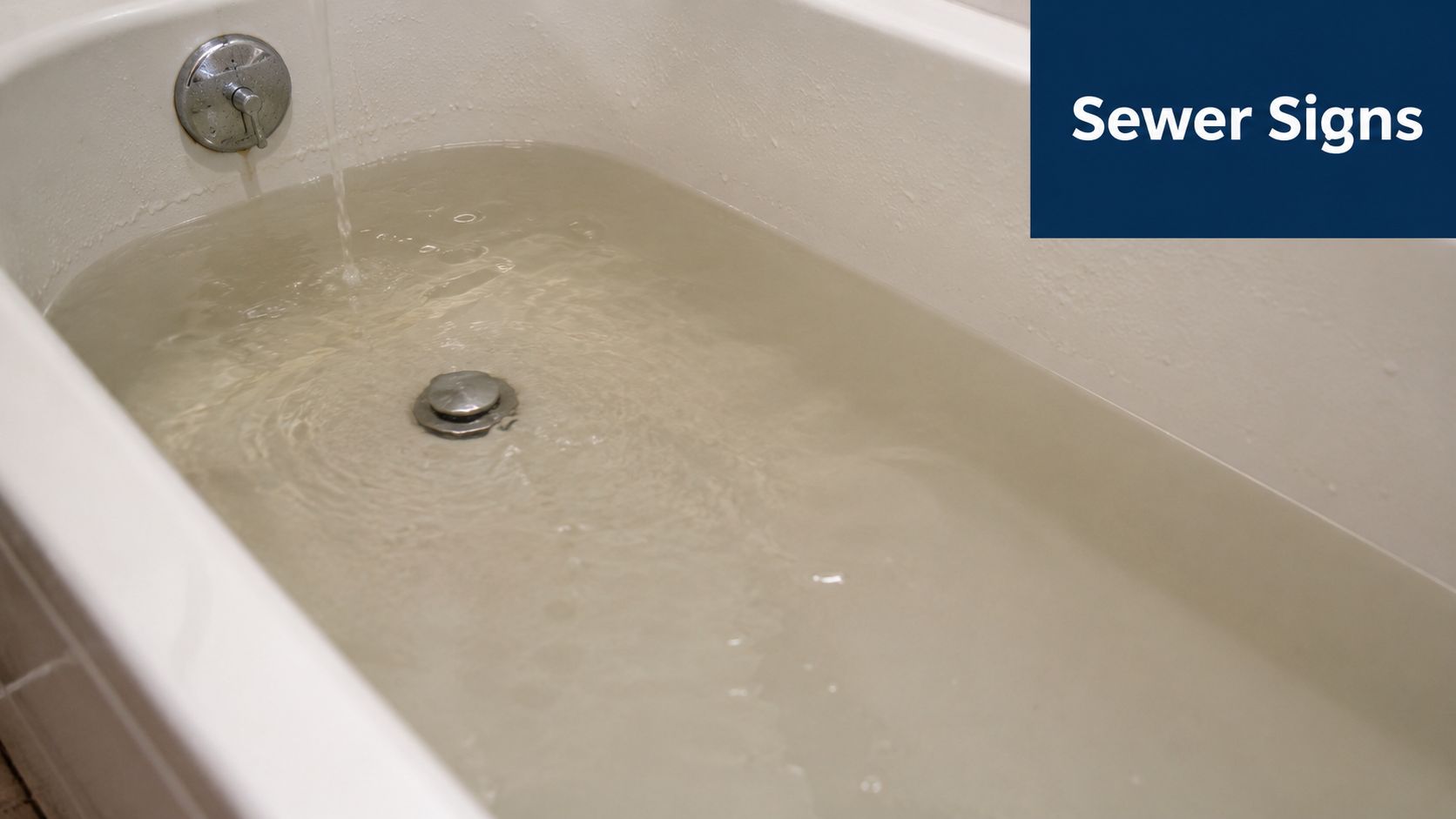
Gurgling matters more than most owners realize. When a toilet bubbles after a nearby fixture drains, the line may be struggling to move air and wastewater properly. That's a pressure warning. In a multi-unit LA property, tenants often describe it as “the toilet talks back” or “the shower backs up when the washer drains.”
Subtle signs that usually show up first
Start with patterns, not isolated complaints.
- Multiple slow drains at once: If the kitchen, tub, and toilet all drain sluggishly, the blockage is rarely inside one fixture trap.
- Recurring stoppages in the same stack: Repeated cabling that only buys a little time often means roots, scale, a belly, or a break in the line.
- Odors near cleanouts or in a side yard: Sewer gas outside can indicate a compromised line or a bad seal point.
- Intermittent backups: A line can pass water one day and fail the next, especially when debris catches on roots or a shifted joint.
Practical rule: One bad drain is a service call. Several bad drains are a sewer investigation.
LA properties create their own clues. Older homes in neighborhoods with mature trees often develop root intrusion. Hillside lots can deal with movement and joint separation. On narrow parcels, a sewer line may run under walkways, patios, or driveway approaches, so exterior symptoms can be harder to spot until the issue is advanced.
Clear red flags that need immediate action
Once sewage appears where it shouldn't, the wait-and-see phase is over. A backup at a tub or shower is common because those openings sit lower than sinks. Ground-level units and first-floor bathrooms usually show the problem first.
Watch for these signs outside the structure too:
- Foul odor in one area of the yard: That can point to wastewater leaking into soil.
- A strangely lush patch of grass: Extra moisture and waste can feed growth over the damaged section.
- Soft ground near the suspected line path: Saturated soil often shows up before standing wastewater.
- Cracking or settlement near hardscape: When soil conditions change around a break, patios, walks, or adjacent surfaces can shift.
A serious main line problem doesn't always start with dramatic flooding. It often starts with tenants adapting around it. They stop using one shower, flush less often, or avoid doing laundry at the same time. That's the point to call a sewer line repair company, before emergency cleanup and tenant displacement become part of the job.
The Professional Diagnostic Process Explained
On an LA property, the repair decision can go wrong before any pipe is touched. A tenant reports repeated backups, one contractor says “roots,” another says “broken clay,” and a third starts talking about lining the whole run before anyone has shown you where the defect is. Good diagnostics stop that kind of expensive guessing.
A proper sewer repair starts with proof of four things. What failed, where it failed, what the pipe is made of, and what access the property allows. On a small Los Angeles lot, that last part matters as much as the defect itself. A line under a driveway, narrow side yard, or mature landscaping calls for a different plan than a line with open access along a side setback.
A camera inspection gives owners something concrete to evaluate.
What a camera inspection should show you
During a CCTV inspection, the technician runs a camera through the line and reviews the interior in real time. The useful part is not the video by itself. It is the explanation that goes with it, plus location data that ties the defect to a spot on the property.
A useful inspection should identify:
- Pipe material and size
- The location of roots, cracks, scale, or collapse
- Whether joints are offset or separated
- How far the problem is from a cleanout or access point
- Whether the line has bends that affect repair approach
For owners who want a stronger baseline before approving work, this LA homeowner sewer inspection guide shows what a documented inspection process should include.
Video is only part of the diagnosis. In older Los Angeles systems, I also want to know how the cable traveled, whether the line holds water, whether access is limited to a roof vent or remote cleanout, and whether the pipe appears round enough for lining. A camera can show an offset joint, but it does not always tell you how unstable that section is. On hillside properties and older slab-on-grade buildings, those details affect whether a spot repair will hold or whether the line needs a broader fix.
The full repair path on a professional job
Once the defect is confirmed, the next step is matching the repair to the line condition and the site conditions. A serious sewer line repair company should explain the whole job path before work starts, including permit handling, inspection requirements, and restoration exposure.
On a professional job, the sequence usually looks like this:
- CCTV inspection to confirm the defect and map the run.
- Electronic locating and depth marking so the defect is tied to a real point on the lot.
- Cleaning, if needed, for an accurate second look when roots, grease, or debris block the view.
- Method selection based on pipe condition, length of damage, bends, and site access.
- Permit review and application when the scope requires city approval.
- Public area coordination if the work affects a sidewalk, parkway, street access, or shared drive.
- Physical repair by excavation, sectional repair, pipe bursting, lining, or another approved method.
- Post-repair verification with testing and a final camera pass.
- Inspection sign-off and documentation for your records.
That paperwork matters in Los Angeles. If the line runs toward the street, crosses hardscape near the public way, or serves a multi-unit building where shutdown timing affects tenants, permit timing can drive the whole schedule. Property managers should ask about that before authorizing work, not after a crew has opened concrete.
There is also a structural piece some contractors gloss over. If the damaged run sits beneath the slab, excavation may involve access choices that affect flooring, foundations, and restoration costs. In those cases, it helps to review foundation tunneling options alongside the plumbing scope so the repair method fits the building, not just the pipe.
A short diagnosis usually leads to a short estimate. That is where expensive mistakes start.
Decoding Your Repair Options Trenchless vs Traditional
A Los Angeles property manager usually hits this decision after the camera inspection confirms the bad news. The line needs work, tenants want a timeline, and the question is no longer whether to repair it. The question is whether to protect the property with the least destructive method that still fixes the problem for the long haul.
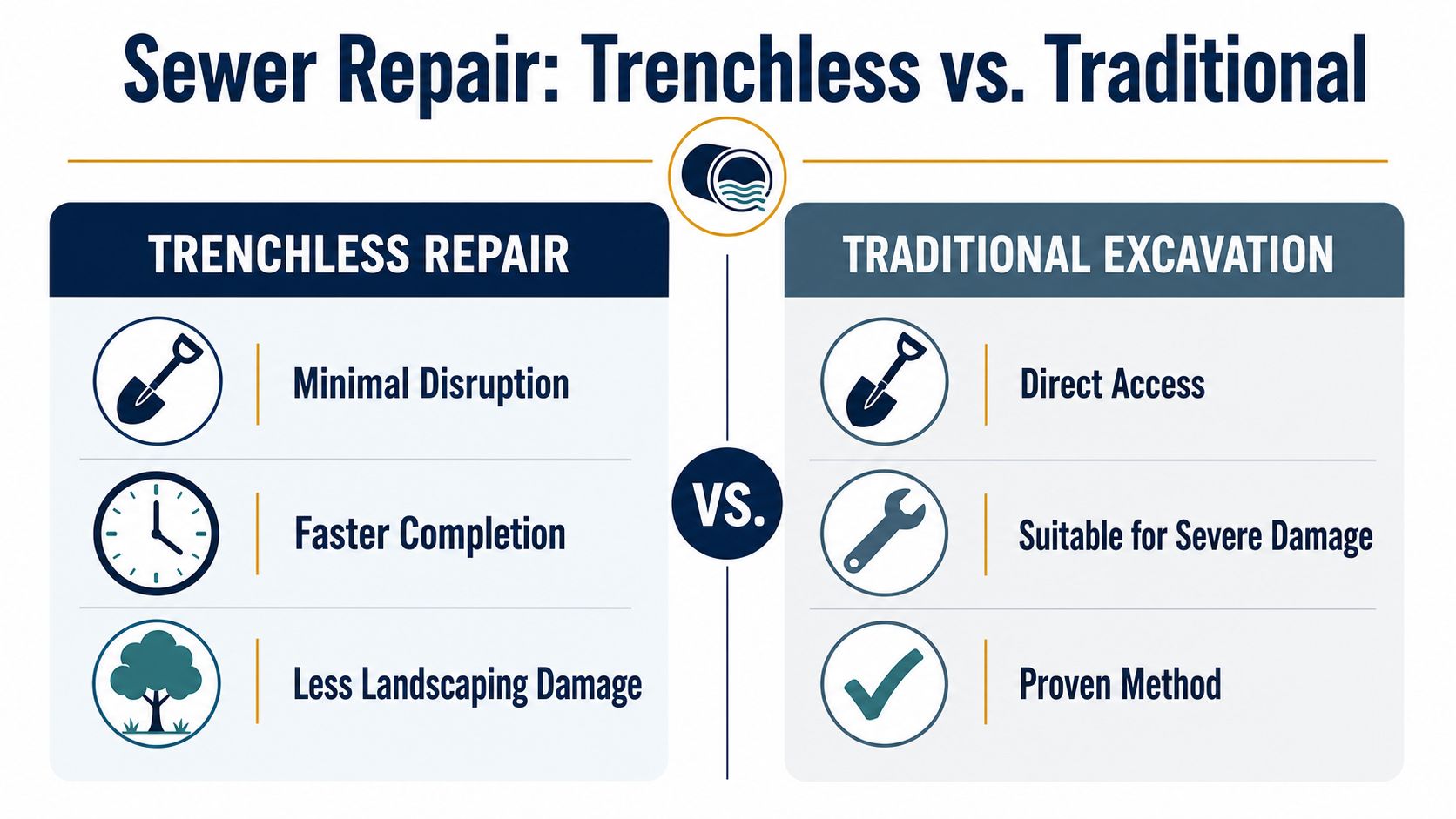
On LA lots, that choice matters more than it does in places with wide side yards and easy access. Many properties here have old clay or cast-iron lines, narrow setbacks, mature trees, expensive hardscape, shared driveways, and very little room for error. A method that looks cheaper on paper can become the expensive option once you add concrete replacement, yard restoration, tenant disruption, and permit delays.
When trenchless is the smarter fit
Trenchless repair makes sense when the pipe is damaged but still suitable for rehabilitation, and when surface restoration would be costly or disruptive. I see this on duplexes with decorative walkways, small apartment buildings with tight courtyards, and hillside homes where excavation creates access and stability concerns that go well beyond plumbing.
CIPP lining is often a good fit for lines with cracks, root intrusion, scale, and some joint separation. It can also work through certain bends if the inspection shows the line can be cleaned, measured, and lined correctly, as explained in this overview of trenchless lining through bends and elbows. That matters in Los Angeles, where sewer runs are rarely simple, straight shots from the building to the city connection.
Pipe bursting is a different trenchless option. It replaces the old pipe instead of lining it, which can be useful when the existing material is too deteriorated for a liner but the route still allows a bursting head to pass. On a tight lot, that can preserve patios, planting beds, and access paths that would be expensive to rebuild.
Speed is part of the appeal, but it should not be the deciding factor by itself. A trenchless job can move quickly once the line is cleaned, measured, and approved, but only if the prep work is done right. If a contractor skips heavy descaling, fails to document the wet-out and cure, or treats a partially collapsed line like a lining candidate, the savings disappear fast.
Before approving trenchless work, ask direct questions. Is the host pipe structurally suitable? Are cleaning and reinstatement included? Will you get a post-install camera and cure documentation? A short explainer on what trenchless sewer repair involves can help owners frame those questions before signing.
Later in the decision process, many owners want to see the method in action.
When excavation is still the right call
Excavation remains the right repair on plenty of LA jobs. If the line has a full collapse, a bad belly, severe offset joints, wrong grade, or a route that has to be reconfigured, lining will not correct the underlying problem. The only honest answer is to expose the pipe and rebuild that section, or replace the run.
That comes up often on older properties where decades of settlement have changed the pipe slope, or where old repairs left the line patched together with mixed materials. In those cases, direct access gives the contractor control over grade, fittings, bedding, and tie-ins. It also lets the owner fix the actual defect once instead of paying for a liner that only masks part of it.
Access method matters too. If the sewer runs under the slab, under finished flooring, or close to structural elements, cutting from above is not always the least damaging route. Owners dealing with under-slab access issues sometimes review foundation tunneling options to understand how contractors can approach buried lines while limiting damage to interior floors or structural areas.
A practical comparison looks like this:
| Method | Best fit | Main advantage | Main drawback |
|---|---|---|---|
| Trenchless lining | Pipe with enough structural integrity to rehabilitate from existing access points | Preserves yard, hardscape, and site layout | Will not correct major collapse, bad grade, or severe deformation |
| Pipe bursting | Full replacement where the pipe path and site conditions allow bursting | Replaces the line with less surface disruption than open trenching | Requires access pits and is not suitable on every property |
| Excavation | Collapse, misalignment, grade correction, or route changes | Full access to rebuild the line correctly | Highest impact to concrete, landscaping, and restoration budget |
What determines long term performance
Long-term results come down to fit and workmanship. A well-installed liner in the right pipe can serve a property very well. A liner installed in a pipe that should have been excavated is a problem delayed, not a problem solved.
The same standard applies to excavation. Open-trench work is not automatically better just because the pipe is exposed. Poor bedding, rushed backfill, weak compaction, or bad transitions at the repair ends can create the next failure point, especially on lots with movement, roots, or heavy surface loads.
Property owners and managers should judge the method by the defect it solves, the site damage it avoids, and the quality controls the contractor can prove. On an LA property with mature landscaping, limited access, and a line that still qualifies for rehabilitation, trenchless can protect both the pipe and the site. On a settled or collapsed run, excavation is often the cheaper decision in the long term because it fixes the geometry instead of working around it.
Your Vetting Checklist for LA Sewer Contractors
A property manager in Los Feliz gets a backup on a Friday afternoon. One contractor says he can line the pipe tomorrow if the deposit is paid today. Another says the line needs excavation but cannot explain where the grade fails or how much of the courtyard will be opened. That is how expensive mistakes start in Los Angeles. Tight lots, older clay lines, tenant access, and city inspections leave very little room for guessing.
What to verify before anyone starts work
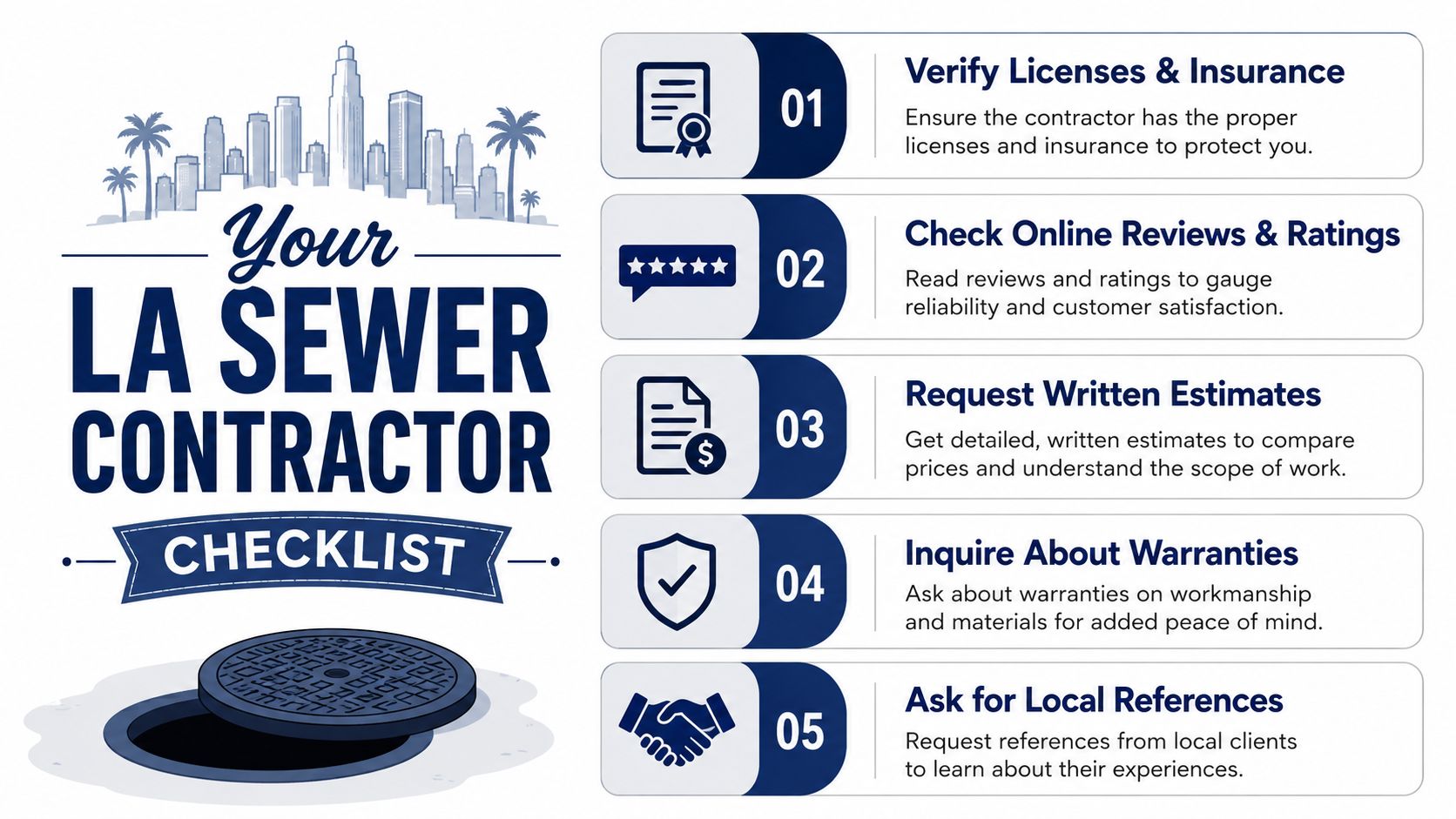
Start with legal and operational basics. The company should hold the right California plumbing license, carry general liability and workers' compensation coverage, and be willing to put the scope in writing. On LA sewer work, the written scope should also identify who pulls permits, who schedules inspection, and who provides final closeout records.
Then check whether the contractor works in conditions like yours. A crew that does clean, efficient work on a single-family lot in the Valley may struggle on a Koreatown apartment property with restricted access, parked cars, and tenants using the building during repairs. Ask for recent jobs that match your property type, not just five-star reviews.
Use this checklist:
- Active California license: Confirm the classification and status through the CSLB.
- Insurance documents: Ask for current certificates, not verbal assurances.
- Clear written scope: The proposal should state the defect location, repair method, access plan, and site restoration terms.
- Permit handling: Confirm who pulls permits and who meets the inspector on site.
- Traffic and access planning: On small LA lots, staging and entry points matter as much as the repair itself.
- Warranty in writing: Read what is covered, what voids coverage, and whether post-repair maintenance is required.
- Closeout documentation: Require post-repair camera footage and any test results the job calls for.
Reviews still matter, but read them like an owner protecting an asset. Complaints about late arrivals are annoying. Complaints about unfinished restoration, surprise change orders, or recurring backups after "completed" sewer work are much more serious. If you want context on why some companies show up everywhere online while others do not, this overview of local SEO strategies for plumbers explains part of that visibility gap.
Questions that separate sewer contractors from sewer sales teams
Ask the contractor to explain the problem in plain language. If they inspected the line, they should be able to describe the defect, the location, the depth, and why their proposed method fits that specific section of pipe.
These questions do the job:
- What exactly did the camera inspection show, and at what distance?
- Can this section be rehabilitated, or does it need full replacement? Why?
- What site conditions on my property affect your recommendation?
- What cleaning, prep, and verification steps do you perform before sign-off?
- Will I get post-repair video and a marked repair location?
- Who is supervising the work on site?
- What restoration is excluded from your price?
For trenchless work, ask about quality control without getting lost in jargon. A serious contractor should be able to explain how the pipe is cleaned, how the host pipe is evaluated before lining, how the installation is monitored, and what happens if the existing line condition is worse than expected once the work begins. If those answers are vague, the risk shifts to your property.
One sentence is enough here. Sales pressure is a warning sign.
If the conversation keeps returning to discounts, same-day signatures, or "we do this all the time" instead of permits, prep, curing, testing, and documentation, keep looking.
Ask for local references from owners with similar constraints. In Los Angeles, that might mean a duplex with limited side-yard access, a hillside home with mature landscaping, or a multi-unit building where shutting down sewer service requires tenant coordination. If you want a general benchmark for what responsive service and communication should look like, review a page like reliable plumber near me while you compare contractors.
How to Compare Bids and Avoid Red Flags
The cheapest sewer bid is often the most expensive decision on the property. Not because high price always means quality. It doesn't. The problem is that low bids often leave out the exact things owners assume are included: permit handling, proper cleanup, testing, finish restoration, disposal, traffic access coordination, or post-repair documentation.
You need to compare bids on identical scope. If one contractor inspected with a camera and another just looked at a backup and guessed, those proposals are not comparable.
What an estimate must include
A real sewer estimate should tie directly to diagnosis. If you don't see the defect, the location, and the chosen method spelled out, the number by itself doesn't mean much.
Look for these items:
- Defined repair area: Which section of line is being repaired or replaced.
- Method description: CIPP lining, pipe bursting, spot repair, or excavation.
- Access plan: Cleanout use, pit locations, trench route, or equipment staging.
- Permit and inspection language: Who handles approvals and closeout.
- Restoration terms: Concrete, soil, planting, pavers, or patching.
- Warranty details: Coverage period and exclusions.
- Post-repair verification: Camera footage and any required testing.
A useful cost baseline exists, but it's only a baseline. The average U.S. sewer line project ranges from $1,426 to $5,758, and the total can run higher depending on length, depth, and whether excavation is needed, according to these plumbing industry cost figures. In Los Angeles, access difficulty and property restoration often drive as much discussion as the pipe work itself.
Red flags that usually cost more later
Some warning signs are obvious. Others are easy to miss when the property is under pressure.
Watch for these:
- One-line estimates: “Sewer repair” with a lump sum and no scope.
- No camera documentation: If they won't show you what they're fixing, you can't judge the recommendation.
- Heavy pressure to sign immediately: Good contractors don't need urgency as a sales tool.
- Vague warranty wording: “We'll stand by it” isn't a warranty.
- Missing exclusions: If restoration isn't addressed, expect a later argument.
- Different scopes at different prices: One bid may cover a partial repair while another covers the full failing run.
A practical move is getting at least two bids on the same documented scope. That doesn't mean picking the middle number by default. It means checking whether both contractors are solving the same problem, with the same assumptions, and with clear responsibility for permits, testing, and final closeout. That's how owners avoid buying a “repair” that only lasts until the next heavy use day.
Managing Emergency Repairs and Project Sign-Off
Emergency sewer calls usually come in after hours, on weekends, or when a tenant says wastewater is coming up somewhere it shouldn't. In that moment, the first goal isn't designing the permanent repair. It's stopping damage, protecting the building, and figuring out whether the line can be stabilized safely until full work begins.
What happens on the first emergency visit
Have the basics ready when you call. Which fixtures are backing up, whether multiple units are affected, whether sewage has entered living space, and whether there's an exterior cleanout the technician can access. That saves time before the truck even arrives.
On site, the technician typically starts by isolating the severity of the stoppage, checking the cleanout, and determining whether the immediate issue is a blockage, a break, or a likely offset. In emergency conditions, experience matters. As noted in this explanation of offset joint diagnosis, video inspection is essential but isn't always enough by itself to confirm an offset joint. Skilled plumbers also rely on physical cues felt while cabling the line.
That distinction matters because the first visit may involve clearing enough obstruction to stop the backup, then returning for a complete repair plan once the line can be fully inspected.
What you should collect before calling the job finished
The end of the project should be as disciplined as the start. Owners get into trouble when they assume “flowing again” means “finished correctly.”
Before sign-off, make sure you receive:
- Post-repair video evidence showing the repaired section
- Testing results if applicable to the method used
- Permit and inspection closeout documents
- Written warranty paperwork
- A clear record of what was repaired and where
For property managers, this paperwork isn't clerical. It protects you when a tenant reports a later issue, when an owner asks what was done, or when a future contractor needs to understand the line history. A professional sewer line repair company leaves a property with a functioning system and a complete paper trail.
If you need a licensed Los Angeles plumbing team for sewer diagnosis, emergency response, or a second opinion on a repair plan, EZ Plumbing serves homeowners, property managers, HOAs, and commercial properties across LA. They offer 24/7 emergency service, same-day scheduling for planned work, and experienced technicians who focus on clear communication, minimal disruption, and doing the job right the first time.