
5 Immediate Steps to Stop a Rain Sewer Backup in LA and Who Pays
If sewage is backing up into your home during heavy rain, evacuate the affected area, shut off electricity to flooded zones, and stop using water in every fixture. Call a licensed emergency plumber and your insurance carrier immediately, and document everything with timestamped photos. If manholes are overflowing on your street, report it to LA Sanitation, since that points to a municipal mainline failure, not a private problem.
TL;DR:
- The key to preventing sewage backups during heavy rain is to conduct a professional camera inspection of your lateral line before storms arrive.
- Municipal systems are overwhelmed mainly due to illegal stormwater connections and aging infrastructure, which cannot be fixed quickly.
- Homeowners are responsible for maintaining and repairing their lateral pipes, with private repairs requiring licensed plumbers and permits from the Bureau of Engineering.
- Insurance coverage for sewer backups usually needs a specific water-backup endorsement, and detailed documentation speeds up claims processing.
- Immediate response steps include evacuating affected areas, shutting off power, stopping water use, and calling licensed plumbers and insurers before attempting cleanup.
Table of Contents
- First Steps When Rain Causes a Sewer Backup in Los Angeles
- Why Heavy Rain Triggers Sewer Backups in LA
- Who’s Responsible: Homeowner vs. City Duties
- What Professional Sewage Cleanup Involves
- How to Prevent the Next Sewer Backup
- Does Homeowners Insurance Cover Sewer Backups?
- How Los Angeles’s Rainy Season Strains Sewer Systems
- What the City Is Doing to Fix Aging Sewer Infrastructure
- Where Affected Residents Can Find Help and Support
- Our Take: The Advice Most Guides Get Backwards
- Get Emergency Sewer Help From Ez-plumbing Now
- Sources
First Steps When Rain Causes a Sewer Backup in Los Angeles
A rain sewer backup in Los Angeles moves fast, and the order you respond in affects both your safety and your insurance claim. Work through these steps in sequence.
- Evacuate the room if sewage is visibly entering through drains, toilets, or floor cracks. Raw sewage carries bacteria and viruses that spread quickly through standing water.
- Cut power to any outlets, switches, or circuits in flooded areas at the breaker box, not at the fixture itself.
- Stop all water use in the home, including laundry, dishwashers, and showers, since added flow can push more sewage back into fixtures.
- Move family members and pets away from contaminated water and avoid direct contact with it.
- Call a licensed emergency plumber and your insurance company before touching cleanup.
While you wait for help, document the damage:
- Photograph and video every affected room, including water lines on walls and furniture.
- Timestamp each photo (most phone cameras do this automatically).
- Keep damaged items in place rather than discarding them until an adjuster or plumber has documented them.
When you call, tell the plumber the water source (toilet, floor drain, multiple fixtures) and roughly how much water is involved. Never attempt DIY sewage cleanup without gloves, boots, and a respirator. If you see overflow in the street or multiple neighboring homes affected, that’s a different call entirely, covered next.
Why Heavy Rain Triggers Sewer Backups in LA
Most rain-related backups trace to one of two sources: the public system choking on stormwater, or a private lateral failing under added pressure. Telling the difference early saves you time and money.
Municipal overload happens when stormwater enters the sanitary sewer through illegal connections, cracked pipes, or unauthorized downspout taps. LA County sanitation officials have documented extreme rain events pushing unusually high volumes of water into sewer lines through these unintended connections, overwhelming pipeline capacity built for dry-weather flow. During a 2024 storm cycle, raw sewage escaped through manholes into streets and coastal waters across LA County when the system simply couldn’t move water fast enough.
Private-side failures get worse under the same rain, independent of the public system:
- Root intrusion from mature trees cracking clay laterals
- Collapsed or bellied pipe sections that trap debris
- Grease buildup that narrows pipe diameter over years
A single backup in your home usually points to a private issue. Multiple homes on your block backing up at once points to the main.
Who’s Responsible: Homeowner vs. City Duties
Los Angeles draws a clear line here, and it surprises a lot of homeowners the first time they hear it. Property owners are responsible for maintaining and repairing their sewer lateral, including the lower portion that runs under the street to the city main, and the City provides no financial assistance for that repair. That holds true even when a city-planted street tree is the one whose roots caused the damage.
Signs you’re dealing with a public mainline problem instead:
- Overflow visible at a street manhole
- Multiple addresses on the same block affected simultaneously
- Backup happens even though your own fixtures haven’t been used
For public overflows, LA County Sanitation Districts publish contact tables by city so you know exactly who to reach. For private repairs, only a plumber holding a C-36 contractor license and an LA business license can legally perform lateral work, and any work touching the public right-of-way needs a Class A permit from the Bureau of Engineering.
What Professional Sewage Cleanup Involves
Raw sewage isn’t just unpleasant, it’s a genuine health hazard. Contact with floodwater contaminated by sewage can expose you to bacteria, parasites, and viruses, which is why containment comes before anything else.
Professional cleanup typically follows this sequence:
- Extraction of standing water and sewage
- Removal of porous materials that can’t be sanitized (carpet, drywall, insulation)
- Antimicrobial treatment of affected surfaces
- Structural drying with commercial-grade equipment
- Clearance testing before the space is cleared for re-occupancy
Timing matters more than most homeowners realize. Mold can begin colonizing wet porous materials within 24 to 48 hours, which is why waiting even a day to start extraction can turn a plumbing problem into a mold remediation problem.
Pro Tip: Ask your cleanup crew for a written scope of work with before-and-after photos and itemized invoices. A documented service report showing cause, remediation steps, and materials removed materially improves insurance claim outcomes.
How to Prevent the Next Sewer Backup
Rain sewer backups in Los Angeles rarely happen just once. If your lateral has failed during a storm, it’s telling you something about its condition, and prevention is cheaper than the next flood.
Backwater valves stop sewage from flowing backward into your home when the main surcharges, but they only protect against backups from downstream, not internal clogs above the valve.
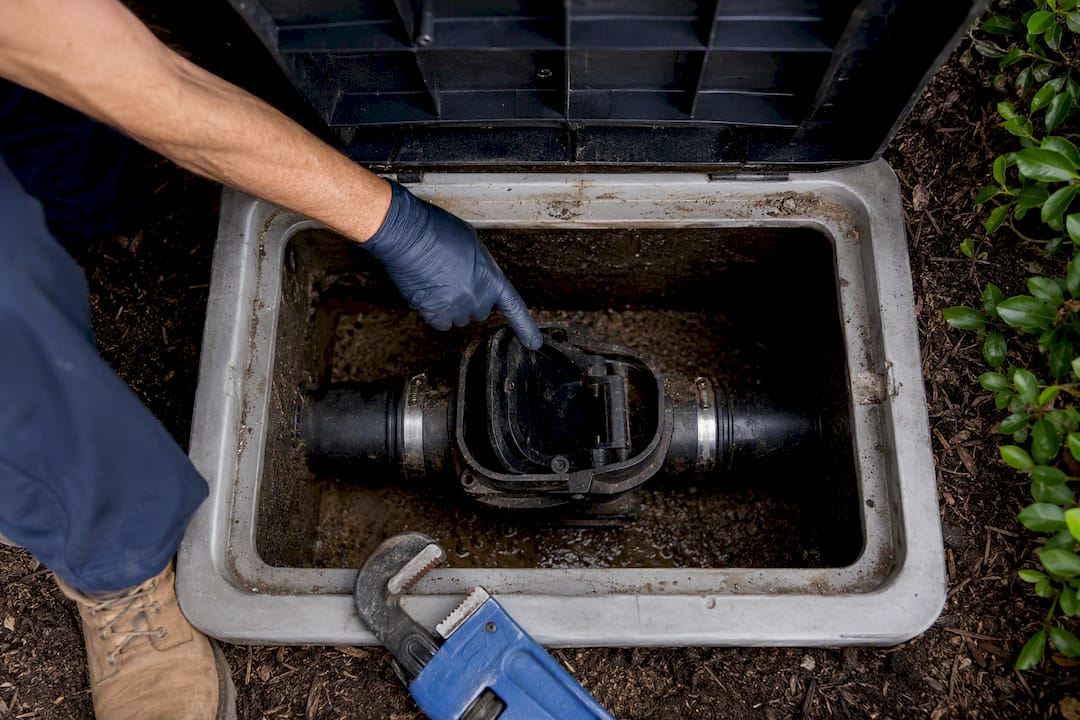
Sump pumps with battery backup help in low-lying properties where groundwater or surface flooding is the bigger risk, though they do nothing for sewage backing up through a lateral.
Longer-term maintenance keeps small problems from becoming rain-triggered emergencies:
- Routine hydro-jetting clears grease and root intrusion before they narrow pipe diameter
- Sewer camera inspection catches bellied pipe and cracks before a storm finds them
- Root control treatments slow regrowth between cleanings
When a lateral is too damaged to save, you have options short of full excavation. Trenchless methods like pipe-bursting and pipe-lining repair the line with minimal digging, while a full sewer line repair or replacement makes sense for severely collapsed sections. Any work in the public right-of-way still needs that Bureau of Engineering permit.
Pro Tip: If your home has flooded from backups more than once, get a professional inspection before the next rainy season rather than after the next storm. Design choices around drainage and grading also matter, as Kevin Francis Design’s guide to water damage prevention points out.
Does Homeowners Insurance Cover Sewer Backups?
Standard homeowners policies in California typically don’t cover sewer backup damage automatically. Coverage usually requires a specific water-backup endorsement, and without it, you may be paying out of pocket for a problem the city’s own infrastructure contributed to.
A few things affect how a claim plays out:
- Source of loss matters. A public mainline overflow is treated differently than a private lateral failure caused by neglected maintenance.
- Maintenance history gets scrutinized. Insurers may ask whether you’d had prior inspections or ignored known root intrusion.
- Cost components vary widely. Extraction, demolition of damaged materials, structural drying, and lateral repair each get billed separately, and lateral replacement alone can run into thousands of dollars depending on length and access.
Keep every invoice, photo, and written scope of work. Adjusters move faster when your documentation already answers their questions.
How Los Angeles’s Rainy Season Strains Sewer Systems
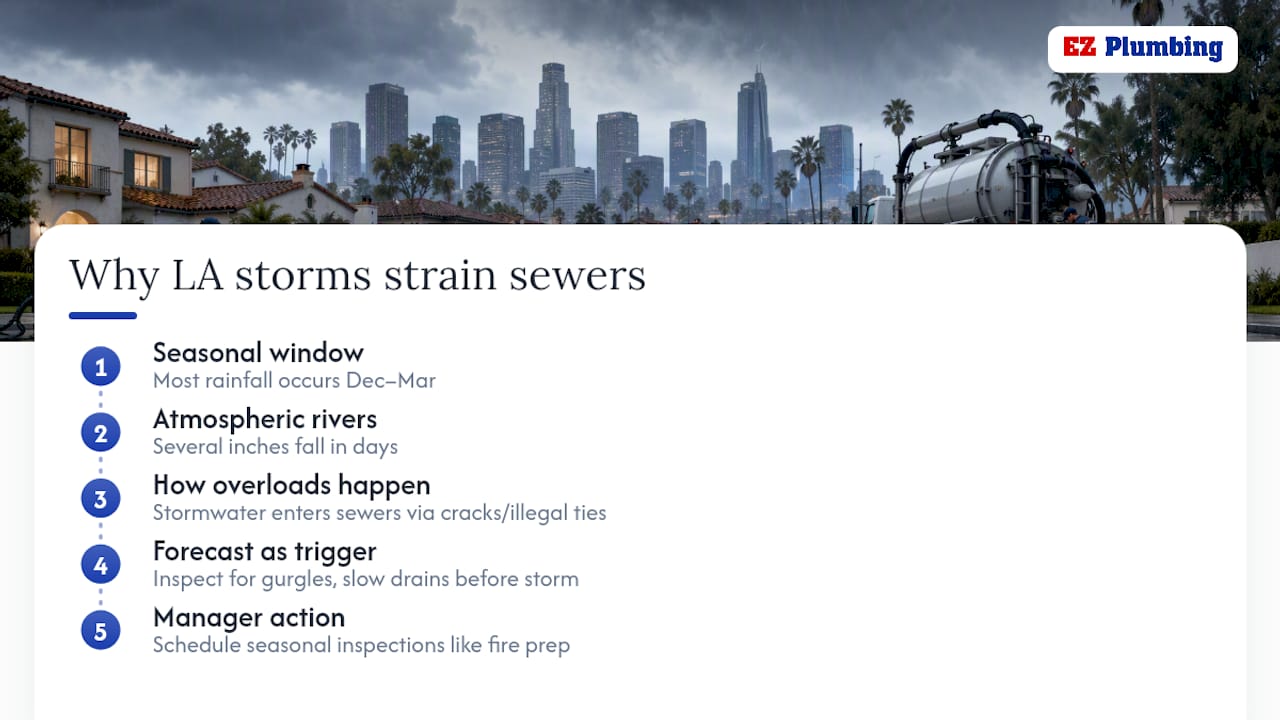
Los Angeles gets most of its annual rainfall between December and March, and that seasonal concentration is exactly what stresses sewer infrastructure built for a mostly dry climate. Unlike cities that see steady rain year round, LA’s system handles long dry stretches punctuated by intense storm cycles, which means pipes, pump stations, and treatment capacity aren’t exercised at volume for months at a time.
Atmospheric river events hit especially hard because they dump rainfall over a short window rather than spreading it out. When several inches fall in a day or two, stormwater finds its way into sanitary sewer lines through illegal connections and aging infrastructure faster than the system can move it out. That’s the mechanism behind the overflow reports LA County has documented during recent winter storm seasons.
Forecasting has become part of how the city and individual property owners prepare. When forecasters flag an incoming atmospheric river, that’s the window to check your own property for early warning signs, slow drains, gurgling toilets, or damp spots near your lateral line, before the storm arrives, not after water is already backing up. Property managers overseeing multiple units should treat seasonal forecasts the same way they treat fire season prep: a scheduled reason to inspect, not a surprise to react to.
Climate patterns suggest these intense, compressed rain events aren’t going away. That makes seasonal readiness, not just emergency response, the smarter long-term posture for LA property owners.
What the City Is Doing to Fix Aging Sewer Infrastructure
Los Angeles isn’t ignoring the problem, though the pace of infrastructure work rarely matches the urgency homeowners feel during a storm. City reports from 2025 detail storm and wildfire damage to sewer pump stations and stormwater pipes, with LASAN engaging outside contractors and estimating infrastructure recovery costs in the millions.
That kind of damage compounds an already aging system. Much of LA’s sewer network was built decades ago, and pump stations designed for a different rainfall pattern now face storms that arrive more concentrated and more intense. The city’s response includes pump station repairs, expanded monitoring of overflow-prone areas, and contractor-led emergency fixes following major storm damage.
Here’s the part homeowners need to internalize: this work takes time and funding, and it proceeds on a municipal timeline, not a property owner’s timeline. Fixing your own lateral doesn’t stop a mainline from surcharging during the next atmospheric river, but relying on city upgrades alone leaves your own property exposed in the meantime. The two tracks, municipal resilience projects and private lateral maintenance, run in parallel, and homeowners who wait for one to finish before addressing the other are taking on unnecessary risk.
If you want to gauge whether infrastructure near you has a history of problems, the reporting contacts in the next section can tell you whether your street has had prior overflow incidents.
Where Affected Residents Can Find Help and Support
A sewer backup during a storm often hits at the worst possible time, financially and logistically, and Los Angeles residents aren’t left entirely on their own to sort it out.
Start with the agencies that track and respond to the problem directly. LA Sanitation handles reporting for issues tied to the municipal system, while LA County Sanitation Districts maintain city-by-city contact tables specifically for sewage overflow reports. Both exist so residents aren’t guessing which department to call when sewage is in the street rather than confined to one property.
For financial strain after a backup, your insurance carrier is the first stop, particularly if you carry a water-backup endorsement. Renters and homeowners without that endorsement should still file a claim and ask directly what portion of cleanup, if any, is covered under liability provisions, since policy language varies enough that assuming “no coverage” without asking can cost you a legitimate payout.
Property managers dealing with multi-unit buildings face a different set of pressures: multiple displaced tenants, habitability questions, and faster documentation needs. Keeping a standing relationship with a licensed emergency plumber before a storm hits, rather than searching for one mid-crisis, is the single most useful step a property manager can take. The same applies to homeowners in flood-prone or older neighborhoods where backups have happened before.
Our Take: The Advice Most Guides Get Backwards
Most guidance on this topic treats prevention and emergency response as separate problems. They’re not. The homeowners who handle a rain sewer backup well are the ones who already knew, before the storm, whether their lateral was public or private responsibility, and who to call for each.
Here’s where conventional advice falls short: it tells you to “call a plumber” without explaining that a backwater valve won’t help you if the failure is your own root-damaged lateral, and that a sump pump won’t touch a sewage backup at all. Matching the fix to the actual cause matters more than buying whichever device sounds protective.
The single highest-leverage move for most LA property owners is a camera inspection before the next storm season, not after a backup. It’s the only way to know if you’re sitting on a ticking clay lateral or a healthy line that just got unlucky with a citywide overload. Everything else, valves, pumps, jetting schedules, should follow from what that inspection shows, not precede it.
Prioritize documentation like it’s part of the emergency response, not paperwork for later. The homeowners who come out of a backup financially whole are usually the ones who photographed everything before the cleanup crew touched a thing.
— EZ
Get Emergency Sewer Help From Ez-plumbing Now
When a rain sewer backup hits, the fastest licensed response beats any guide you’re reading. Ez-plumbing runs 24/7 emergency service across the greater Los Angeles area, holds an active C-36 license (#583868), and carries full insurance, so the crew that shows up can legally perform lateral work and pull permits when the repair touches the public right-of-way.
Call and tell the dispatcher what you’re seeing: which fixtures are backing up, whether water is entering from one source or several, and whether you’ve noticed overflow outside the home. That information routes you to the right response, whether that’s emergency extraction, CCTV camera inspection to confirm the cause, hydro-jetting to clear a blockage, or a full sewer line repair if the lateral has failed. Every job comes with a documented service report, useful the moment you file an insurance claim. If your line has backed up more than once, ask about backwater valve installation while the crew is already on-site.
Sources
- Sewer System FAQs — Los Angeles Bureau of Sanitation
- Storms overwhelm sewage system causing overflows — CBS Los Angeles
- Pounding rains trigger flood of raw sewage in L.A. County — Los Angeles Times
Recommended
- Who Is Responsible for Sewer Line Repair in Los Angeles
- Emergency plumbing response steps: A complete guide for LA homes
- Hiring a Sewer Line Repair Company: An LA Owner’s Guide
- Top sewer line repair tips for Los Angeles homeowners
Recent EZ Plumbing Jobs in Los Angeles
Real, recent work from our crews — updated automatically as jobs complete.