
Avoid Permit Rework: 5 Steps to Comply with Los Angeles Gas Line Code
Any installation, alteration, or replacement of gas piping, fixtures, or appliances in Los Angeles requires a permit from the Los Angeles Department of Building and Safety, and the work must be done by a properly licensed contractor. Before any piping gets covered or buried, it has to pass a pressure test and staged inspections. Many projects also trigger a requirement for seismic or excess-flow shutoff valves, particularly during alterations, additions, or a property sale.
TL;DR:
- Gas piping must be inspected and pressure tested before covering or backfilling to avoid costly rework or delays.
- The minimum burial depth is generally 18 inches, with heavier piping required for higher pressure or deeper installations.
- Installing seismic or excess-flow shutoff valves is mandatory for alterations, additions, or property sales involving gas systems.
- Permits must be secured before starting work, with licensed contractors handling the process and maintaining proper documentation on-site for inspections.
- Failing to follow the correct inspection sequence, particularly covering pipes before pressure testing, accounts for most rework and permit issues.
Table of Contents
- Quick compliance checklist for homeowners and property managers
- Which laws set the gas piping rules in Los Angeles
- How LADBS permits and inspections actually work
- Installation thresholds: depth, materials, and pressure testing
- When Los Angeles requires seismic and excess-flow shutoff valves
- What we see cause the most permit rework
- What strict Los Angeles gas codes actually protect
- How EZ Plumbing handles gas line compliance for you
- Sources
- FAQ
Quick compliance checklist for homeowners and property managers
Gas line work in Los Angeles follows a predictable sequence, and skipping a step almost always costs more time than following it would have. Before a contractor touches a single fitting, confirm the paperwork and inspection plan are lined up.
- Pull the LADBS permit before any work begins, not after.
- Hire a contractor holding the proper state license, typically a C-36 classification for gas and plumbing work.
- Schedule the pressure-test inspection before covering or backfilling any piping.
- Install seismic or excess-flow shutoff valves if the project is an alteration, addition, or tied to a property sale.
- Keep the permit card and approved job copy on-site for every inspection visit.
Pro Tip: Take a photo of the approved plan and permit card on your phone the day the permit is issued. Inspectors ask for it more often than property managers expect, and a missing copy can push an inspection to the next available slot.
Which laws set the gas piping rules in Los Angeles
Fuel gas piping in Los Angeles sits at the intersection of city and state law, and knowing which document governs which detail saves time during plan review. The Los Angeles Plumbing and Mechanical Code adopts the California Plumbing Code and layers on local amendments covering plan submittal, riser and isometric diagram requirements, and system classification specific to the city’s housing stock. The state code beneath it, the California Plumbing Code, sets the baseline for material standards, sizing, and testing that Los Angeles then builds on.
- The Los Angeles Municipal Code contains the city’s fuel gas piping and mechanical/plumbing code chapters.
- The California Plumbing Code supplies the statewide baseline that LA’s local code amends and extends.
- California Code of Regulations, Title 8, Section 536 sets piping material standards, safety factors, and minimum underground piping specifications that apply regardless of jurisdiction.
Because code language changes with each adoption cycle, always check the current published text during plan review rather than relying on a previous project’s approved drawings.
How LADBS permits and inspections actually work
Permitting in Los Angeles follows a defined path, and understanding where delays typically happen makes the process considerably less frustrating.
- Submit for plan review. LADBS reviews gas piping plans, riser diagrams, and system layout before issuing a permit.
- Confirm who can pull the permit. A licensed contractor handles most permits, though an owner-occupant may sometimes act as their own applicant; rental properties generally require a licensed contractor to pull the permit for liability and insurance reasons.
- Schedule the pressure-test inspection. This must happen before any piping is concealed behind drywall, buried, or otherwise hidden from view.
- Complete the final inspection. Once the pressure test passes and any remaining work is finished, LADBS signs off on the job.
- Verify Deputy Inspector certification when required. LADBS inspection services explain that when continuous inspection is needed and the department cannot provide it directly, a certified Deputy Inspector steps in, and property managers should confirm that certification before work proceeds.
Covering piping before the pressure-test inspection is one of the most common and expensive mistakes on gas line jobs, since it typically means opening the wall or trench back up.
Installation thresholds: depth, materials, and pressure testing
Los Angeles code sets measurable targets rather than vague guidance, which is useful because it gives both contractors and inspectors a clear pass or fail line.
Underground gas piping generally needs a minimum of 18 inches of cover for service lines, with 24 inches required for some mains or separate-trench conditions, depending on the specific routing and load. Material selection matters too: standard steel or approved plastic piping covers most residential runs, but heavier Schedule 80 piping is called for where pressure or depth conditions demand the added wall thickness. Title 8, Section 536 lays out the material design and safety-factor requirements behind these choices.
10 psi for 15 minutes is the pressure-test benchmark contractors work to on nearly every Los Angeles gas line job. Specifically, pressure testing guidance drawn from California Plumbing Code requirements calls for a minimum test pressure of 10 psi held for at least 15 minutes with no perceptible drop, using air, nitrogen, carbon dioxide, or another inert gas as the test medium. Oxygen is never an acceptable test medium.
Before testing begins:
- Disconnect all gas appliances from the system.
- Visually inspect every joint and fitting for defects before pressurizing the line.
- Confirm the gauge holds steady for the full 15 minutes with zero visible drop.
- Have riser or isometric diagrams and the approved job copy ready for the inspector.
A test that shows any drop in pressure fails, and the piping stays uncovered until the leak is found and corrected. For appliance-specific connection details, our natural gas water heater installation guide covers the disconnection and reconnection sequence in more depth.
When Los Angeles requires seismic and excess-flow shutoff valves
Los Angeles requires seismic or excess-flow shutoff valves downstream of the gas utility meter for a wide set of triggers, including many alterations, additions, and property sales in buildings with fuel gas piping. The Los Angeles Municipal Code sets the scope, mounting rules, and referenced standards for these valves.
- Valves install downstream of the meter but upstream of any appliance connection.
- Mounting must be rigid, typically to an exterior wall or another approved location per the manufacturer’s instructions.
- The valve itself must meet the California referenced standards named in the code, not a generic equivalent.
- Once installed, the valve must be maintained or replaced as needed to stay code-compliant for the life of the building.
Pro Tip: If you’re selling a property with fuel gas piping, confirm the shutoff valve requirement early. Escrow companies increasingly flag missing valves, and retrofitting one during closing week is far more stressful than handling it ahead of time.
What we see cause the most permit rework
Most rework on gas line jobs traces back to one of two mistakes: covering piping before the pressure-test inspection, or showing up to an inspection without the approved drawings and permit card in hand. Riser and isometric diagrams should be prepared before the crew ever picks up a pipe wrench, not scrambled together the morning of inspection.
Scheduling the pressure test before any backfill or wall closure is the single habit that prevents the most expensive redo on a gas line project.
When a job requires a Deputy Inspector because LADBS cannot provide continuous coverage, ask for identification and certification details before work resumes. As a licensed contractor, EZ Plumbing prepares that documentation as a standard part of gas leak detection and gas appliance installation work, so inspections tend to move through on the first visit.
What strict Los Angeles gas codes actually protect
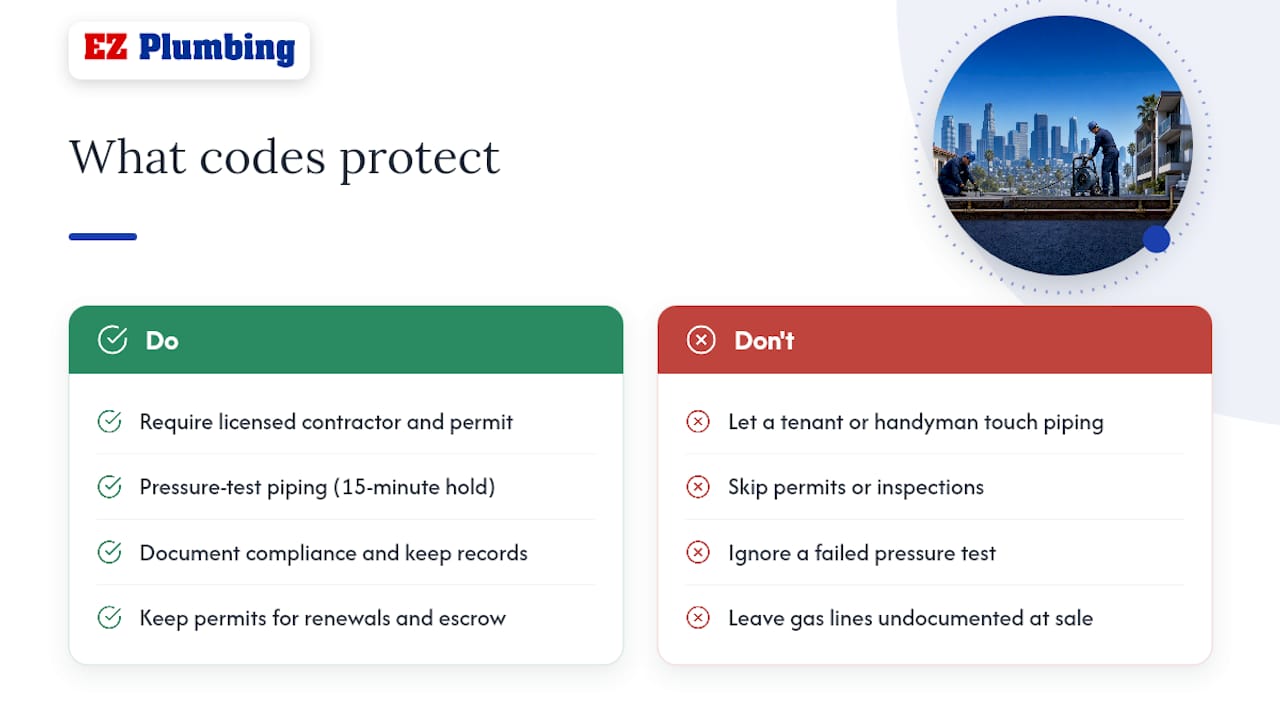
Los Angeles treats gas piping with more procedural weight than most other trades, and property managers sometimes read that as bureaucratic excess. It isn’t. A pressure test that fails to hold for 15 minutes is catching a leak that would otherwise sit behind a wall or under a slab for years. The permitting and inspection sequence exists because gas failures are rarely gradual, they’re sudden, and the cost of a missed step is measured in more than money.
Our practical recommendation for property managers is simple: never let a tenant or handyman touch gas piping without a licensed contractor and a permit on file. Documented compliance also matters at renewal time, since insurers and buyers alike ask for it, and an undocumented gas line has stalled more than one escrow.
— EZ
How EZ Plumbing handles gas line compliance for you
Getting a gas line project through LADBS on the first attempt takes more than knowing the code, it takes daily familiarity with how local inspectors read plans and what they flag. EZ Plumbing has worked under the C-36 license (#583868) across the greater Los Angeles area, and permit-ready documentation is part of how every gas job gets scoped from the start.
- Gas line installation and repair with pressure testing built into the schedule, not treated as an afterthought.
- Seismic shutoff valve installation sized and mounted to the referenced California standards.
- Gas leak detection to catch problems before they reach the pressure-test stage.
- Riser diagrams and approved job copies prepared ahead of the inspection date, not the morning of.
If you need a permit-ready estimate or same-day inspection support, reach out through our rate calculator to get a project quote or contact us directly at Ez-plumbing for emergency gas line support.
This article is general information, not a substitute for advice from a qualified lawyer. Consult a qualified legal professional about your own circumstances before acting on anything here.
Sources
- LADBS permit information
- California Code of Regulations, Title 8, §536 Piping Standards
- Milpitas gas-line guidance (testing and inspections extract)
- LAMC — Seismic gas shutoff valves
FAQ
How deep does a gas line need to be buried?
Underground gas service lines in California generally need a minimum of 18 inches of cover, while some mains or separate-trench conditions call for 24 inches depending on routing and load. Always confirm the specific depth against the current California Code of Regulations, Title 8, Section 536 requirements for your exact scenario.
What does California Plumbing Code 701.2 require?
This section of the California Plumbing Code addresses fuel gas piping systems and their installation, and the exact requirements depend on the specific piping configuration and materials used. For the precise regulatory text, consult the current adopted Los Angeles Plumbing Code or ask a licensed contractor to walk through it for your project.
Is there a gas pipeline running through California?
California has an extensive network of natural gas transmission and distribution pipelines operated by utility companies across the state, separate from the interior gas piping that Los Angeles code regulates inside buildings. Homeowners and property managers deal with the latter, the piping and appliance connections inside their own property lines.
What are the sizing guidelines for gas pipes under the California Plumbing Code?
Gas pipe sizing depends on the total appliance load, pipe length, and the number of fittings in the run, calculated using sizing tables in the California Plumbing Code. A licensed contractor performs this calculation during plan review, since undersized piping causes pressure drop at the appliance and oversized piping wastes material without adding benefit.
Do I need a permit to replace a single gas valve?
Yes, even minor gas-related work such as replacing a valve technically requires a permit from LADBS in Los Angeles. Property managers and landlords often underestimate this requirement, which can create enforcement issues or gaps in insurance coverage if the work is ever questioned.
Recommended
- Avoid Permit Rework for Earthquake Gas Shutoff Valve Installs in LA
- Avoid Permit Rework in Los Angeles: Which Agency Issues Yours
- Natural Gas Leak Repair Guide for Los Angeles Homes
- Natural Gas Water Heater Installation: A Los Angeles Guide
Recent EZ Plumbing Jobs in Los Angeles
Real, recent work from our crews — updated automatically as jobs complete.