
Commercial Property Maintenance Guide for Los Angeles
You're reviewing a Los Angeles office building when a tenant reports a damp ceiling tile near a restroom. The leak looks minor, so the work order waits. A few days later, the ceiling is stained, the restroom is closed, the tenant is calling again, and your maintenance budget now carries water damage, disruption, and a difficult conversation about reliability.
That's the practical meaning of commercial property maintenance. It isn't just a list of repairs. It's the operating system that protects tenant experience, building value, compliance, and predictable spending. In Los Angeles, plumbing deserves special attention because a hidden leak can affect water bills, finishes, neighboring suites, and sustainability reporting before anyone sees the source.
Table of Contents
- Why Commercial Property Maintenance Protects Value
- What Commercial Property Maintenance Really Covers
- Routine Schedules and Seasonal Checklists That Prevent Failures
- Budgeting and Lifecycle Planning for Los Angeles Properties
- How to Choose Vendors and Set SLAs That Actually Work
- Emergency Response Planning and Real ROI From Preventive Care
- Putting Your Maintenance Plan Into Action
Why Commercial Property Maintenance Protects Value
A Los Angeles property manager may first notice a running toilet, slow drain, failed water heater, or ceiling stain. Those visible symptoms are only the dashboard warning. The work that prevents larger failures happens earlier, through inspections, valve exercises, drain cleaning, leak monitoring, and clear service records.
Deferred maintenance means work that was not completed when scheduled, including preventive tasks, component replacement, and repairs needed to keep an asset in acceptable condition. Federal facilities guidance and lifecycle data distinguishes planned preventive work from unplanned and deferred maintenance, giving managers a practical way to see whether a budget is protecting the building or merely reacting to it.
A small leak has a large operating footprint
A supply connection beneath a sink can drip for days. The janitorial team may see moisture without knowing whether a work order exists. If access must wait for a tenant window, the leak can damage cabinetry, raise water use, and become a service complaint instead of a logged plumbing repair.
The same chain can begin above a ceiling, in a mechanical room, at a water heater, or around a roof penetration. A professional commercial roofing company can help inspect roof surfaces, flashing, and drainage paths before intrusion reaches occupied space. For plumbing inspections, documentation, and repairs, managers can review commercial plumbing services that match the property's access rules and operating schedule.
Manager's rule: Treat every recurring symptom as information about a system, not as an isolated nuisance.
This system view also improves budgeting. A 2024 Trepp analysis summarized in facility-maintenance benchmarking data reported that repair and maintenance costs across the 50 largest U.S. office markets increased 12.3% on average from 2021 to 2022. For an LA portfolio, changes in labor, materials, or service frequency can spread across multiple buildings, while an ignored water issue can add restoration work, tenant disruption, and compliance concerns.
A maintenance plan therefore protects more than the structure. It gives ownership a defensible budget, helps managers track water-risk controls and ESG-related resource use, supports tenant confidence, and creates records for vendor accountability and compliance readiness. Plumbing-focused preventive care works like checking a building's pressure points before they fail. The result is better control of both operating risk and long-term property value.
What Commercial Property Maintenance Really Covers
A commercial building behaves less like a collection of separate rooms and more like a living body. Plumbing is circulation, moving clean water in and wastewater out. HVAC is the lungs, managing air movement and temperature. Electrical systems are the nervous system, carrying power and signals to every operation. The roof and exterior act like skin, while fire and life-safety systems work like an immune response that detects danger and limits harm.
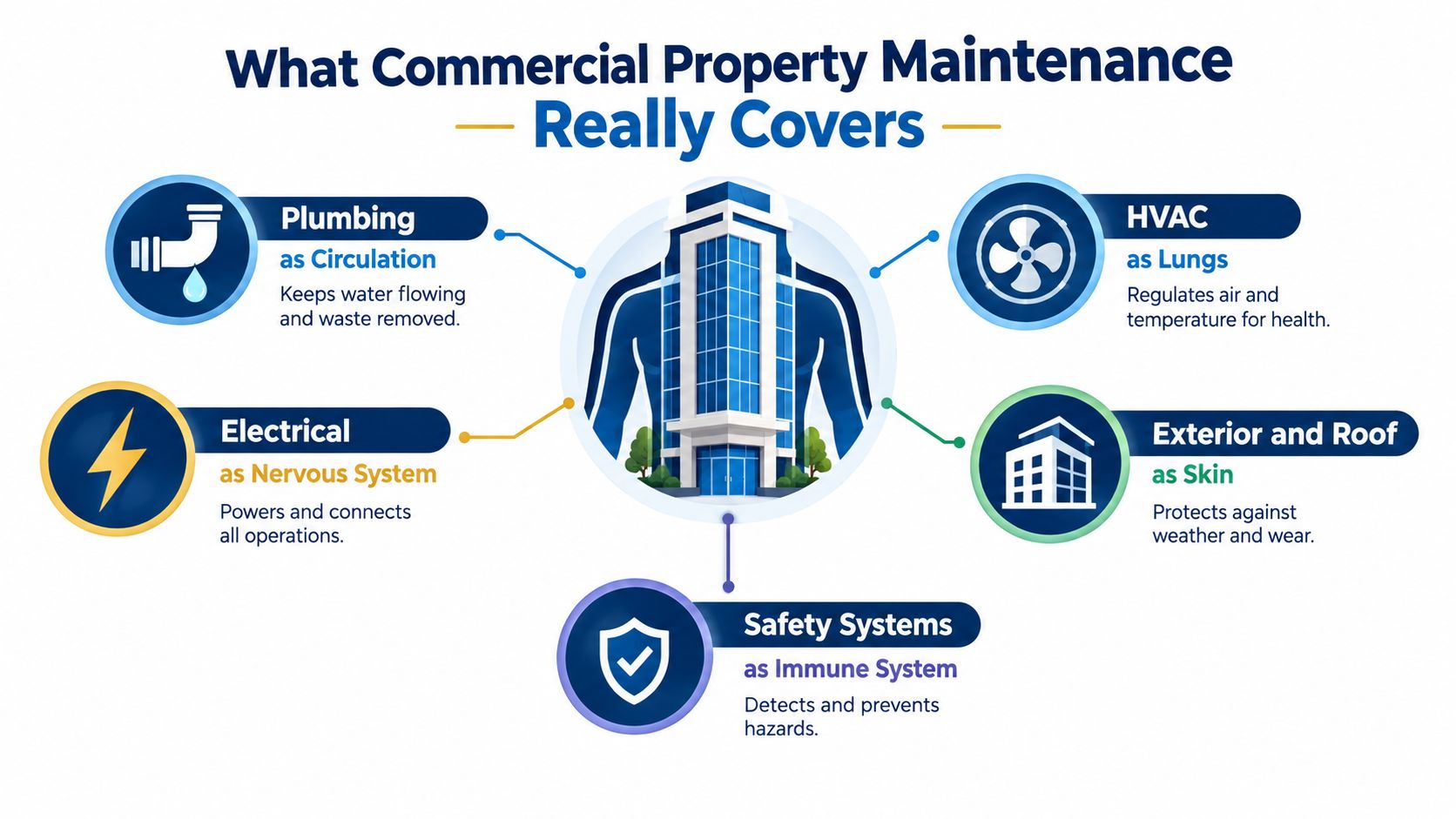
That analogy helps new managers avoid a common mistake. A plumbing issue can become an interior-finish issue, an air-quality concern, an electrical hazard, or a tenant-relations problem. A roof drain blockage can send water toward walls and mechanical equipment. An HVAC condensate problem can look like a roof leak. Maintenance teams need to investigate connections rather than repair only the first visible mark.
Three maintenance modes
Preventive maintenance happens on a planned schedule. Examples include checking restroom fixtures, exercising shutoff valves, inspecting exposed piping, cleaning drains, tuning water heaters, servicing HVAC filters, and clearing roof drainage paths. The purpose is to find wear while the repair remains manageable.
Corrective maintenance addresses a known defect. A failed flush valve, broken pipe support, or leaking water heater requires a work order, a defined scope, and a completion record. Corrective work isn't a failure of management when it follows a documented inspection. It becomes a management weakness when the same defect keeps returning without root-cause review.
Predictive maintenance uses trends and condition data. Water-meter anomalies, repeated drain backups, pressure changes, equipment alarms, and service histories can reveal deterioration before a complete failure. This approach doesn't require every building to install advanced sensors. A consistent log can provide useful early warning when staff record the same observations in the same way.
The full scope usually includes:
- Building envelope: Roofs, walls, doors, windows, sealants, drainage, and exterior finishes.
- Mechanical systems: HVAC, boilers, pumps, domestic hot water, and controls.
- Water systems: Supply piping, fixtures, drains, sewer connections, backflow devices, sump pumps, and leak detection.
- Electrical and vertical transport: Panels, lighting, emergency power, elevators, and access systems.
- Safety and compliance: Fire alarms, sprinklers, emergency lighting, egress routes, and required inspections.
- Site operations: Pavement, landscaping, irrigation, waste areas, exterior lighting, and cleanliness.
Exterior conditions affect maintenance too. A planned program may include exterior cleaning for commercial properties when dirt, biological growth, or buildup obscures defects and accelerates surface wear.
Routine Schedules and Seasonal Checklists That Prevent Failures
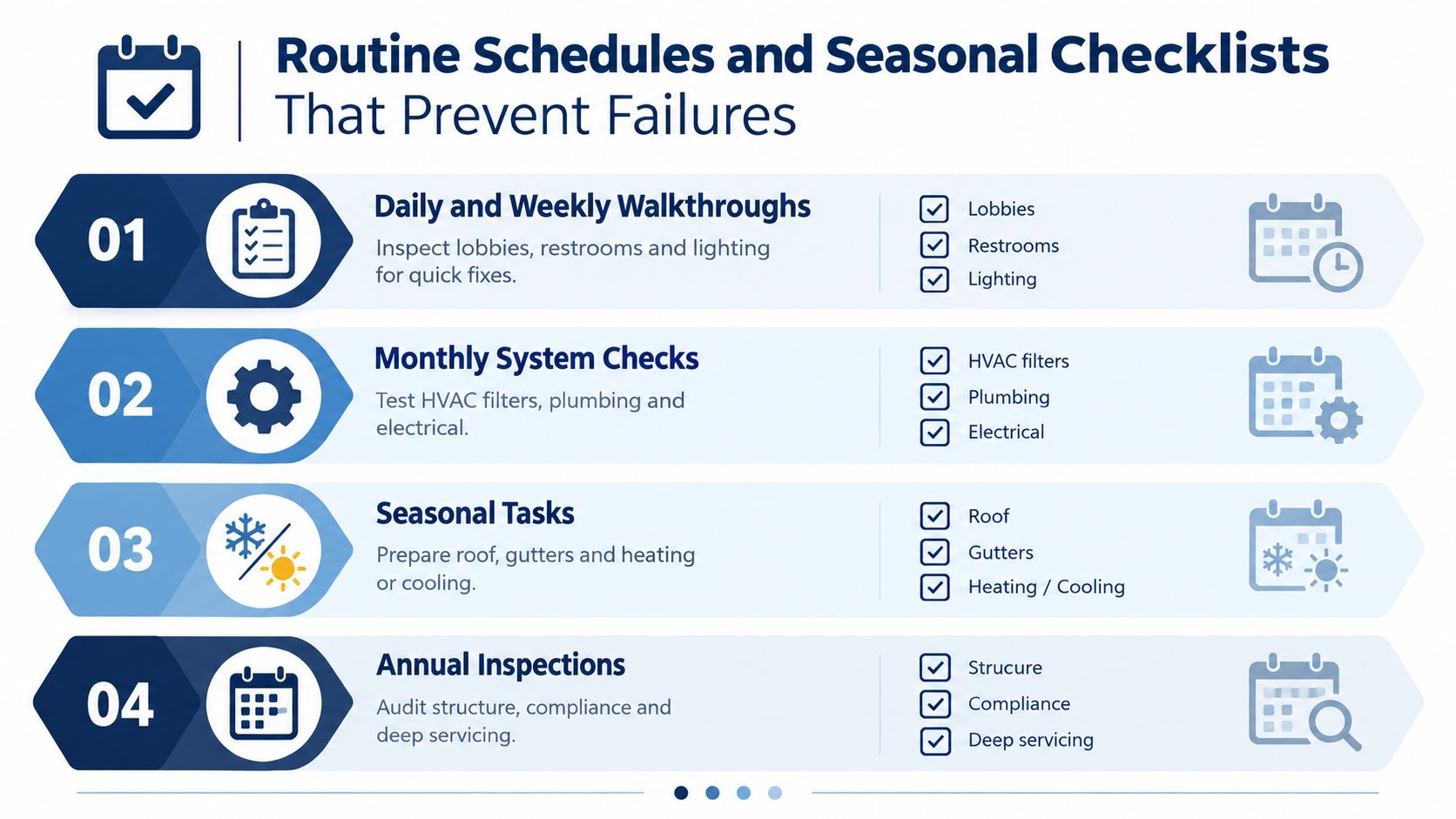
A useful schedule follows the building's rhythm. Daily work catches tenant-facing problems, monthly work checks system condition, quarterly work prepares equipment for changing demand, and annual work verifies deeper condition and compliance. The schedule must be realistic enough for a small facilities team to complete and specific enough that “inspected” means something.
Build the calendar around observable results
Daily and weekly walkthroughs should focus on restrooms, visible piping, mechanical rooms, common-area fixtures, standing water, unusual odors, and tenant reports. Don't write “check plumbing.” Write “inspect exposed supply lines for active moisture, test representative fixtures, confirm floor drains are clear, and photograph any exception.” That wording creates an acceptance standard.
Monthly checks can examine water-meter readings, water-heater condition, shutoff access, drain performance, and recurring work orders. If a meter shows unusual use without a change in occupancy or operating hours, investigate before assuming the bill is higher. A simple trend log can connect water consumption with leaks, irrigation problems, fixture failure, or billing questions.
Quarterly inspections should go deeper. Review drain performance, use appropriate drain cleaning or hydro jetting where the system history supports it, inspect sewer access points, examine roof drains before rain, and confirm that emergency shutoffs are labeled and accessible. Coordinate work during low-occupancy periods whenever possible.
Practical rule: Every inspection should produce one of three outcomes, pass, work order, or specialist review.
Use Los Angeles seasons as planning prompts
Los Angeles doesn't follow a harsh winter pattern, but that doesn't eliminate seasonal preparation. Before the rainy season, clear roof drains, inspect scuppers, check downspout discharge, and review known roof and exterior vulnerabilities. Before hot weather, prepare cooling systems and confirm that plumbing rooms and water heaters won't create avoidable heat or access problems.
Annual tasks should combine condition assessment with documentation. Review recurring failures, vendor reports, water-use trends, backflow records, life-safety documentation, and open corrective work. Keep photographs, readings, invoices, and completion notes in one property record rather than scattered email threads.
A schedule also needs an owner. Assign each task to an employee, vendor, or supervisor, set a due date, and define what happens when the inspection finds a defect. A mobile work-order platform can help technicians attach photographs and timestamps, but a well-designed paper process can still work if someone reviews completion and closes the loop.
A short visual guide can reinforce the calendar for onsite teams.
Budgeting and Lifecycle Planning for Los Angeles Properties
A maintenance budget can look lean on paper while a building accumulates risk. A recurring drain backup, rising water bill, or aging water heater may each seem manageable as a repair line. Together, they can signal a system that needs lifecycle planning. For Los Angeles managers, the budget should connect cost per square foot, asset value, condition, water risk, ESG goals, and compliance duties.
Use benchmarks as starting points, not fixed prices. Local labor, building age, system complexity, occupancy, and service expectations shape the appropriate budget. A low current spend may reflect good preventive work, or it may reflect deferred maintenance. Inspection records, open work orders, equipment condition, and critical-system reliability help distinguish the two.
Commercial Maintenance Cost Benchmarks at a Glance
| Planning measure | How to use it |
|---|---|
| Repair and maintenance costs across major U.S. office markets | Recheck labor, materials, and service-frequency assumptions rather than carrying last year's budget forward |
| Water consumption and meter-reading history | Separate a utility variance from a leak, irrigation issue, or failing plumbing component |
| Sewer lateral condition and replacement scope | Compare continued repairs with rehabilitation or replacement before repeated failures consume the operating budget |
| Deferred-maintenance remediation exposure | Identify backlog work before it becomes a larger capital request |
| Building-system age and remaining service life | Schedule funding before an emergency replacement disrupts tenants |
| Compliance and ESG documentation needs | Include testing, records, water efficiency, and corrective work in the operating plan |
The table works as a screening tool. It does not replace a site assessment, current bids, or a review of the property's repair history.
Plumbing deserves its own lifecycle line because failures often arrive in stages. A sewer lateral, aging water heater, or recurring drain problem can consume several repair cycles before ownership approves replacement. Compare continued repair, targeted rehabilitation, and replacement while accounting for disruption, water loss, tenant access, regulatory requirements, and documentation. Managers reviewing a project can use these sewer lateral replacement cost factors as context, not as a substitute for inspecting the property.
Turn water data into a financial control
Water-risk management belongs in routine budget reviews. Track bills, meter readings, irrigation activity, leak alerts, repair history, and unusual consumption. This record supports utility forecasting and gives finance teams a clearer way to identify a physical defect behind an operating variance.
Water data also supports ESG reporting. A documented reduction in avoidable loss is easier to explain than a general claim about efficiency. Backflow testing, corrective-work records, and inspection documentation can support compliance reviews while showing whether planned maintenance is protecting the asset.
Deferred maintenance creates future financial pressure. An industry analysis reports that each $1 of deferred maintenance can create $4 to $8 in future repair cost, along with replacement, liability, and downtime impacts, as summarized by Oxmaint's deferred-maintenance analysis. The same source reports preventive-maintenance savings of more than $13 per square foot over 10 years and more than $25 per square foot over 20 years, while deferred-maintenance remediation is estimated at roughly $30 to $65 per square foot.
Treat these figures as planning lenses, not promises. A strong budget request identifies the observed condition, the consequence of delay, the proposed intervention, and the evidence connecting the work to water efficiency, ESG reporting, compliance, or tenant continuity. That turns maintenance from a yearly expense debate into a documented plan for protecting the property.
How to Choose Vendors and Set SLAs That Actually Work
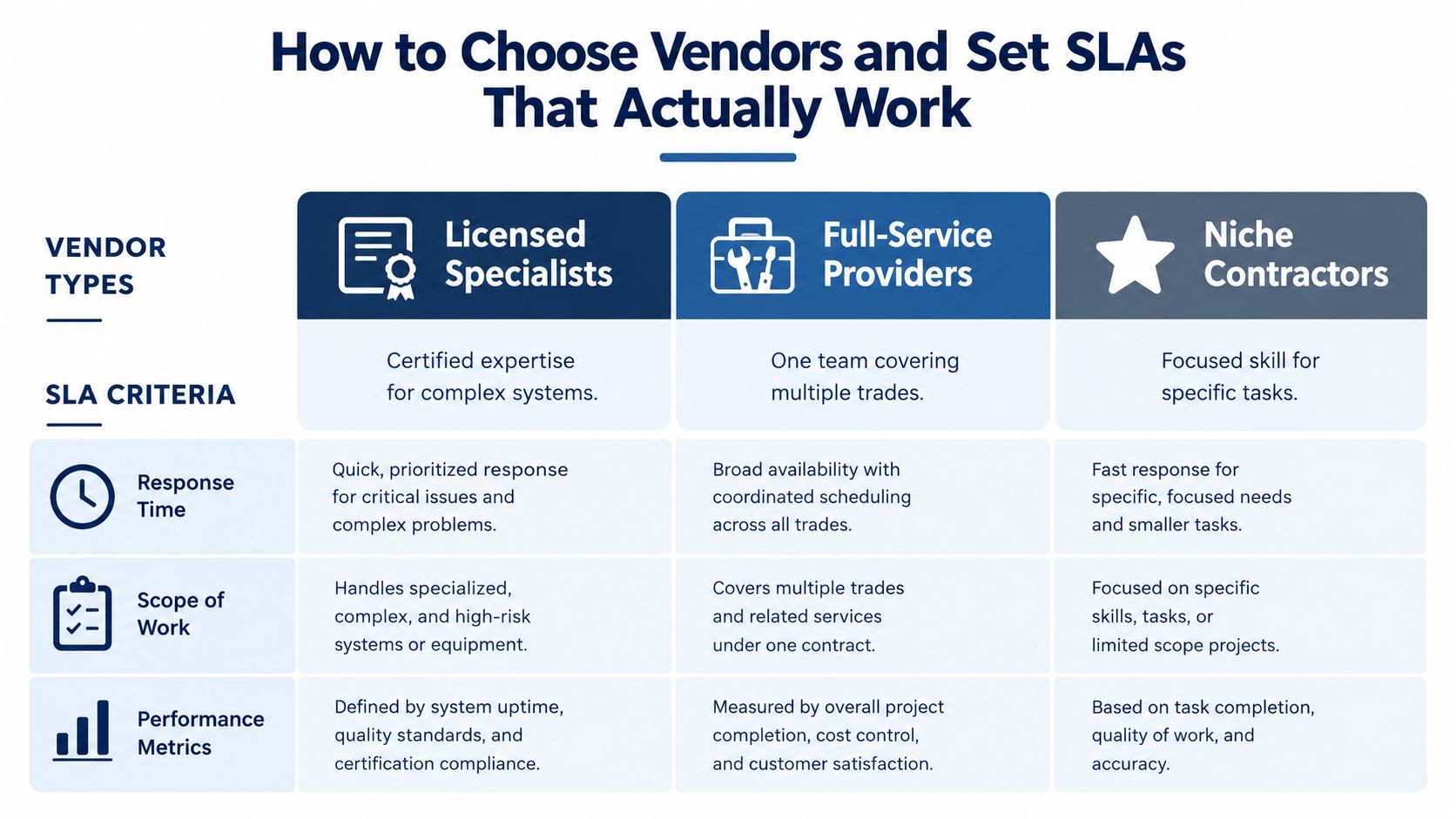
A vendor can be technically capable and still fail your property if dispatch is slow, documentation is incomplete, or technicians can't work around tenant schedules. Choose partners by matching the service model to the risk. A licensed specialist may be necessary for complex plumbing, gas, backflow, or sewer work. A full-service provider may simplify coordination across several trades. A niche contractor can be efficient for a tightly defined task.
Compare vendors by operating fit
| Vendor approach | Strength | Watch for |
|---|---|---|
| Licensed specialist | Deep expertise for regulated or technically complex work | You may need separate vendors for unrelated systems |
| Full-service provider | One coordination point for multiple maintenance categories | Confirm actual in-house capability rather than assuming coverage |
| Niche contractor | Focused skill and clear task ownership | Response coverage may be narrower across LA submarkets |
Ask every bidder for license and insurance documentation, after-hours coverage, geographic service area, escalation contacts, dispatch process, and sample completion reports. For plumbing, request examples of how the vendor records findings, photographs access points, identifies root causes, and separates urgent work from recommended improvements.
A service-level agreement should describe behavior, not just availability. Define response windows by severity, access and tenant-notice requirements, communication milestones, approval limits, documentation standards, and closeout expectations. “Prompt service” is difficult to enforce. “Acknowledge the dispatch, provide an arrival estimate, secure the affected area, and send a written finding after diagnosis” gives both sides a workable standard.
Put accountability into the contract
Use a simple scorecard after each visit:
- Response: Was the first communication timely and clear?
- Diagnosis: Did the technician identify the likely source rather than only the symptom?
- Execution: Was the approved scope completed safely and cleanly?
- Documentation: Did the report include findings, photographs, parts, recommendations, and unresolved risks?
- Tenant impact: Did the vendor protect occupied areas and restore access as promised?
Labor pressure makes this structure more important. A North American commercial facility-maintenance market report states that 56% of facilities managers reported higher workloads and 43% said their teams were understaffed. Those figures support a hybrid approach, with onsite staff handling observations and coordination while qualified specialists perform work requiring particular training, tools, or authorization.
For plumbing coverage, a manager can compare a local licensed plumbing contractor against broader providers using the same scorecard. The decision should rest on documented performance and risk fit, not on the lowest invoice alone.
Emergency Response Planning and Real ROI From Preventive Care
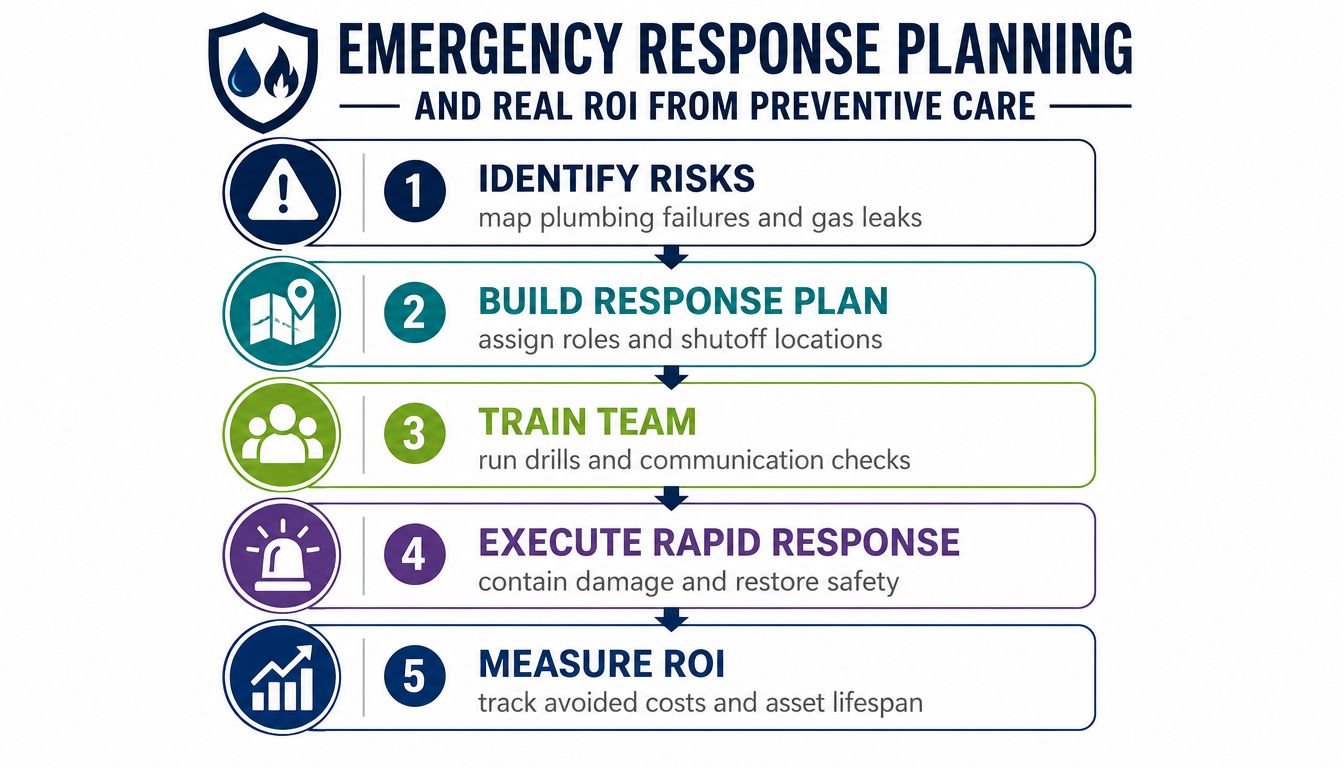
A pipe breaks above an occupied suite during business hours. The first minutes determine whether the event stays near one valve or spreads through ceilings, flooring, tenant space, and records. Preventive maintenance lowers the chance of that failure, while an emergency plan limits its reach when prevention falls short. Treat both as one operating system for the property.
Write the response before the incident
Create a one-page response map for each building. Mark domestic-water shutoffs, equipment isolation points, gas shutoffs, electrical disconnects, roof access, sewer cleanouts, fire risers, elevator machine rooms, and areas where water can migrate. Keep it current, then give it to onsite staff, security, janitorial teams, and emergency vendors.
Assign each role before a call arrives:
- The first observer reports the condition, protects people from immediate hazards, and avoids unsafe intervention.
- The onsite lead isolates the affected area when authorized and confirms the correct shutoff.
- The property manager contacts ownership, vendors, insurers, and affected tenants.
- The vendor diagnoses the source, stabilizes the system, records conditions, and recommends permanent correction.
- The follow-up owner tracks drying, restoration, repairs, and the post-incident review.
Prepare communication templates in advance. Tenants should receive the known facts, the restricted area, the action underway, and the time of the next update. Do not guess about the cause or restoration time before the technician inspects the system.
Explain the return on prevention
Preventive care creates value by avoiding consequences that are harder to budget and manage. A planned valve replacement can be scheduled around occupancy. An emergency pipe failure can affect several suites, require cleanup, interrupt business operations, and create a liability record. An ROI report should show the planned work, the defect found, the consequence avoided, and the risk that remains.
Water records make the business case clearer. Utility monitoring may reveal a leak before a tenant complaint, while inspection records show that the property team acted deliberately rather than reacting only to a high bill. A documented leak-response record can also support water intensity per square foot tracking, ESG reporting, operating-budget decisions, and compliance evidence.
The record works like a maintenance receipt. It shows what was observed, what was done, and why the expense protected the property.
After every emergency, ask: Which inspection, sensor, service interval, or training change would make this failure less likely next time?
Facilities teams can compare planned preventive maintenance, unplanned maintenance, and deferred-maintenance costs over time. The practical lesson is straightforward: portfolios become easier to budget when managers measure lifecycle work, corrective actions, and remaining exposure instead of counting emergencies alone.
Putting Your Maintenance Plan Into Action
A workable plan doesn't need to launch as a massive software project. Start with the building's highest-consequence systems and create a reliable record for each one. For plumbing, list fixtures, valves, water heaters, pumps, drains, sewer access points, backflow devices, and known leak locations. Add the responsible person, inspection frequency, condition, next action, and supporting photograph or report.
Your first 30 days
- Inventory the assets: Walk the property and label critical plumbing, HVAC, roof, electrical, elevator, and life-safety equipment.
- Map the risks: Mark shutoffs, access restrictions, vulnerable tenant areas, and recurring trouble spots.
- Create the calendar: Assign daily, monthly, quarterly, seasonal, and annual tasks to named owners.
- Set the baseline: Collect recent maintenance invoices, open work orders, water bills, meter information, vendor reports, and compliance records.
- Fix the communication gap: Give staff and vendors one escalation process, one reporting format, and one location for completed documentation.
- Review the budget: Separate routine maintenance, deferred work, and planned capital replacements so ownership can see the lifecycle choice.
Los Angeles managers should treat water-risk information as an operating metric, not a side note. A documented leak response, consistent meter review, and clear service history can support financial planning, tenant communication, ESG reporting, and compliance conversations at the same time.
Choose one property, complete the inventory, and schedule the first plumbing condition review this month. EZ Plumbing provides commercial plumbing maintenance, drain cleaning, hydro jetting, water-heater service, sewer diagnostics, and emergency response for managed properties, so managers can connect planned work with documented findings and urgent support when conditions change.
Visit EZ Plumbing to discuss a documented commercial plumbing maintenance plan for your Los Angeles property, including preventive inspections and emergency response. Ask the team to review your building's recurring plumbing risks, access requirements, and water-management priorities.