
Causes of Low Hot Water Pressure and How to Fix Them
You step into the shower in your Los Angeles place, turn the handle, and the hot side comes out thin, weak, and disappointing while the cold tap still feels normal. That's the moment the water heater starts to seem like the suspect, but in my experience the better first question is simpler, is this one fixture, or the whole house?
That one decision saves a lot of money. A hot-only problem can come from a clogged showerhead, a half-closed valve, sediment in the heater, or a bad mixing valve, while a whole-house pressure drop points you somewhere else entirely. If you want a practical starting point, use the same kind of triage homeowners rely on in a sudden drop in water pressure checkup from EZ Plumbing, then work from the fixture back toward the heater.
Table of Contents
- Why Your Hot Water Pressure Suddenly Feels Weak
- How Hot Water Pressure Works in Your Home
- The Most Common Causes of Low Hot Water Pressure
- Diagnosing a Single Low-Pressure Fixture
- Control Devices That Quietly Cut Your Hot Pressure
- Tank Versus Tankless Failure Modes
- Safe DIY Fixes and When to Call a Plumber
- Preventing Low Hot Water Pressure in Los Angeles Homes
Why Your Hot Water Pressure Suddenly Feels Weak
A homeowner usually notices this problem in the most ordinary way possible. You're rinsing dishes at the kitchen sink, or you're halfway through a shower, and the hot stream feels like it lost its backbone while the cold side still looks fine. That pattern matters more than the annoyance itself, because it points to a plumbing branch, not necessarily to the city supply.
Start with the simplest split, one fixture or the whole house
If only one tap is weak, I don't start at the water heater. I start at the aerator, showerhead, stop valve, or cartridge closest to that fixture, because localized restrictions are common and cheap to fix. If every hot fixture is weak, the issue shifts toward the heater outlet, hot branch piping, or a shared control device.
Practical rule: if cold water is normal and only hot water is weak, the problem is usually downstream of the main cold-water supply.
That rule lines up with utility and plumbing guidance that treats a hot-only drop as a diagnostic clue, not a mystery. Portland's water-pressure guidance notes that when only hot water has lower flow and cold water is normal, homeowners should inspect the water heater for leaks or other failures, and it also notes that water-system events can cause temporary pressure changes, which helps separate building-specific faults from broader supply issues Portland Water Pressure and Flow guidance. In plain terms, don't let one weak shower trick you into assuming the street main is failing.
What the problem usually feels like
A sudden change often means a valve moved, debris shifted, or a fixture clogged up. A slow decline usually means scale, sediment, or corrosion has been narrowing the path for a while. That's why the timing matters, because a weak hot stream that appeared after maintenance is a different case from one that has been getting worse for months.
The homeowner's job here is not to solve everything at once. It's to sort the problem into the right bucket before spending money on parts, labor, or a heater replacement that doesn't address the underlying cause.
How Hot Water Pressure Works in Your Home
Hot water does not have its own separate pressure source. It uses the same incoming supply pressure as cold water, then moves through the heater, out through the hot branch, and on to the fixture. That means pressure is a system property, not a heater-only property, even though the heater is often where the bottleneck shows up.
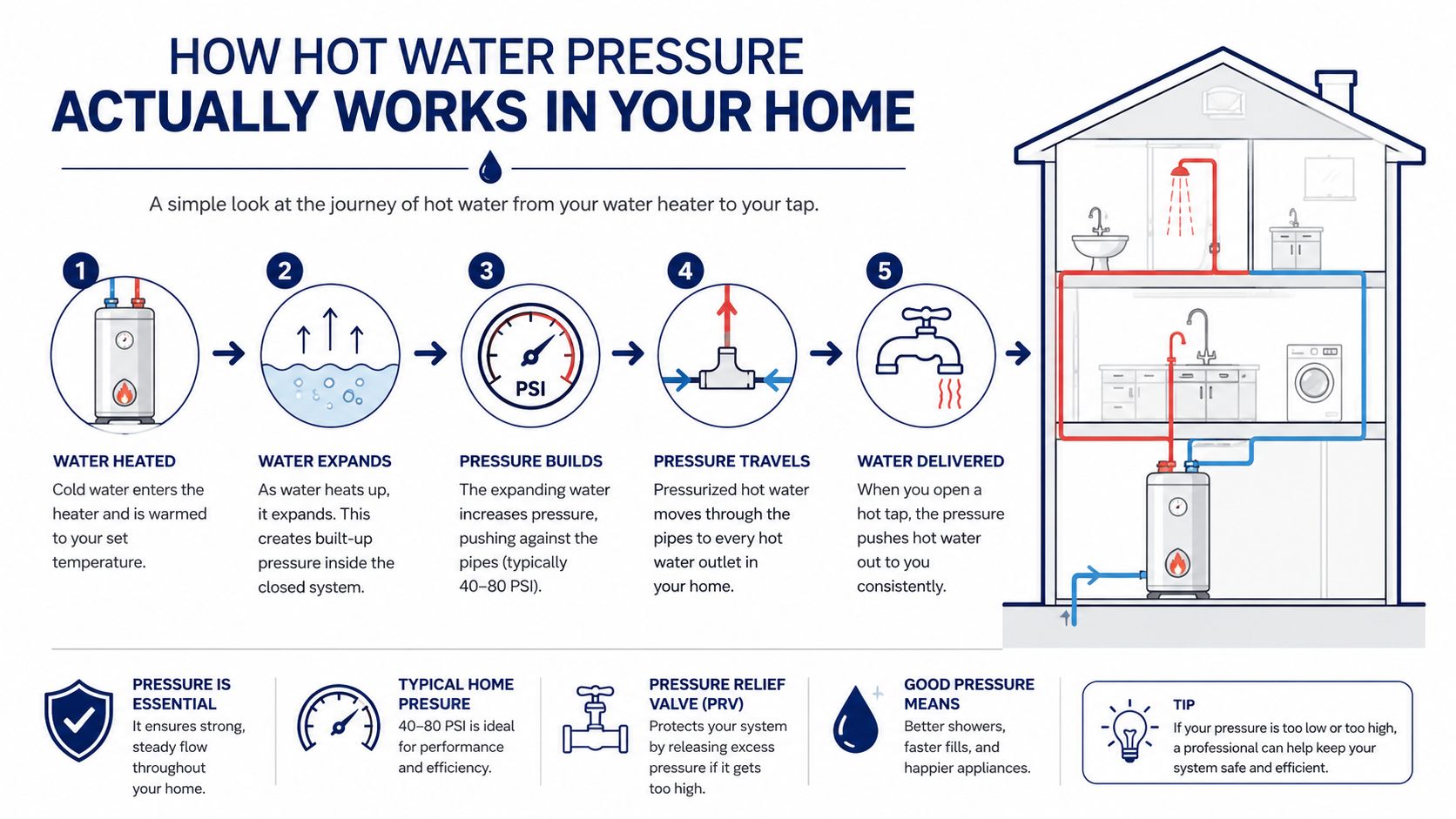
Use the kitchen sink as your first test
Run hot and cold separately at the kitchen sink. If cold comes out strong and hot comes out weak, you have already ruled out a lot of whole-house supply problems. That points the search toward the heater outlet, the hot branch, or the fixture itself.
If both hot and cold are weak, you are in a different conversation. That pattern points more toward the main line, a pressure-reducing valve, or a broader supply issue than to the water heater.
Pressure and flow are not the same thing
Homeowners often say “low pressure” when they are really seeing low flow at the faucet. The difference sounds technical, but it changes the diagnosis. A fixture can have decent system pressure and still deliver a miserable stream because the aerator is packed with debris, the showerhead is scaled up, or the cartridge is clogged.
Low hot water “pressure” at one tap is often a restriction before it is a true supply problem.
That distinction is why I ask what changed, and where. If one faucet acts up while the rest of the house works, the repair is probably local. If several hot fixtures weaken together, the problem is shared upstream in the heater, branch line, or a control device.
What the hot-only pattern tells you
The most useful clue is the one you already have. Cold normal, hot weak usually means the issue sits in the hot side of the plumbing, not in the municipal main. That can be a valve, sediment, scale, or pipe corrosion, but it usually is not the city cutting pressure to one tap only.
Once you understand that split, the rest of the diagnosis becomes much less random. You stop guessing and start tracing the water path the way a plumber does on service calls.
The Most Common Causes of Low Hot Water Pressure
Most hot-water complaints come back to a short list of restrictions. The order matters, because the likely culprit changes depending on whether the problem affects one fixture, several fixtures, or the whole house. In Los Angeles, hard water makes sediment and scale the most persistent suspect, because mineral deposits build up over time inside heaters and supply lines and narrow the effective pipe diameter.
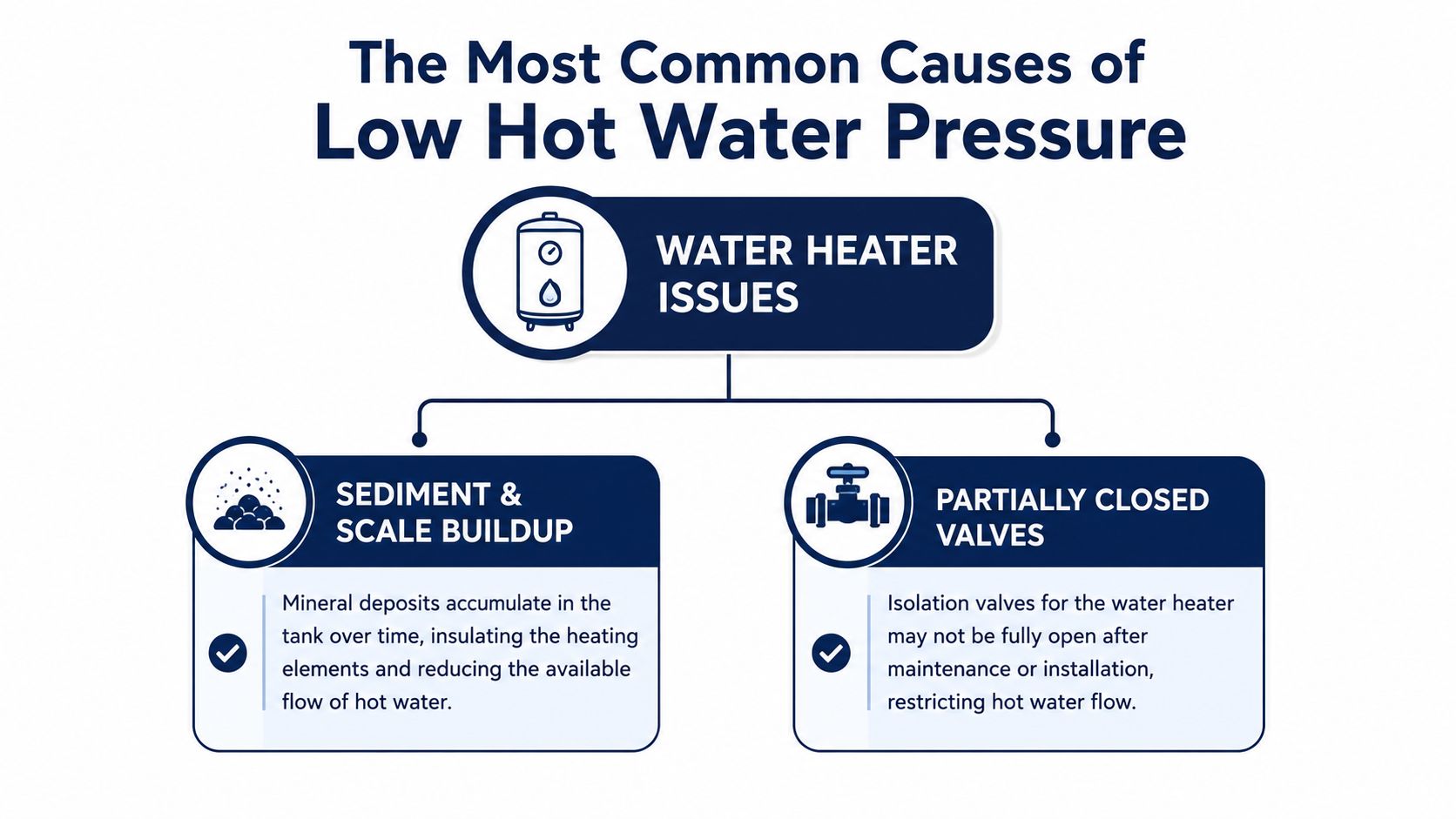
The heater and hot branch come first
Sediment in the tank and scale in the hot-water circuit are the most common recurring causes I'd put near the top of the list. Mineral buildup reduces flow area, and once it starts shedding loose particles, those particles can end up in aerators and showerheads too. That's how a heater problem turns into a fixture problem downstream.
Partially closed isolation valves are the next easy thing to find. A valve that isn't fully open after maintenance can choke the hot side without making a dramatic noise or leak, which is why it slips past homeowners so often. A hot-only issue that affects multiple fixtures often ends up here or in the heater itself, not in the city line.
Corrosion changes the picture
Corroded pipes are a slower, uglier problem. They don't usually fail all at once, they narrow over time as rust and mineral deposits collect on the inside walls. Older galvanized piping is especially suspect when hot flow has been fading gradually instead of dropping in one sudden step.
Good diagnostic habit: sudden changes usually suggest a valve, local blockage, or fixture issue. Gradual changes usually suggest scale or corrosion.
That habit keeps you from chasing the wrong repair. If the problem appeared after a water heater service call, I'd inspect valves first. If the house has old piping and the hot side has been getting weaker year by year, the pipe itself may be the restriction.
The quick ranking I use
- One fixture only, look at the aerator, showerhead, supply line, and shutoff valve.
- Several hot fixtures, think heater sediment, hot branch restriction, or a partially closed heater valve.
- Hot and cold both weak, move upstream to the PRV, main line, or municipal supply.
- Old galvanized system, expect internal corrosion to be part of the answer.
That ranking isn't theory, it's field triage. It keeps a $4 showerhead from turning into a $4,000 unnecessary replacement.
Diagnosing a Single Low-Pressure Fixture
When only one faucet or shower is weak, the heater is usually not the culprit. That's where a lot of broad hot-water articles miss the mark, because they jump straight to tank sediment even though the bottleneck is often sitting right at the fixture. In apartments, condos, and rentals, this is the first place to check before anyone calls for a water heater service.
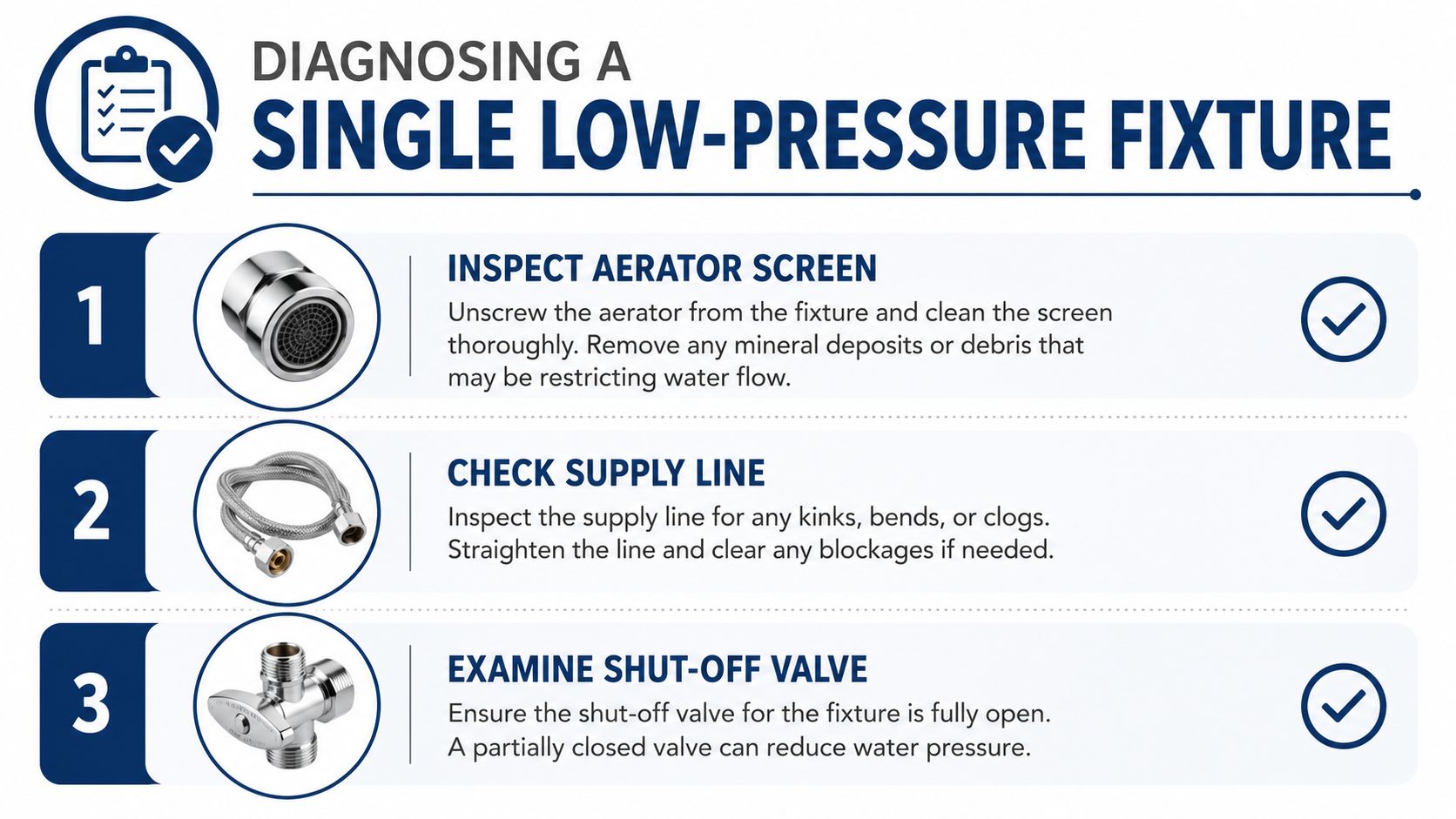
The cheap parts that clog first
Unscrew the aerator at the faucet tip and look for white mineral flakes, rust-colored grit, or tiny bits of pipe debris. If it's packed, clean it and run the tap again. On a shower, remove the showerhead and soak it in white vinegar if you see scale on the face or inside the nozzles.
Flexible supply lines deserve the same attention under the sink. A kink, partial collapse, or debris trap in the line can mimic a broader pressure issue even when the main system is fine. Then check the angle stop behind the fixture and make sure it's fully open, because a valve left half-closed after a repair can choke the hot side fast.
The cartridge can fool you
If the fixture still feels weak after the easy checks, the cartridge may be the bottleneck. Faucet cartridges wear, stick, or clog, and some brands are more failure-prone than others in real-world use. When the cold side is fine at the same fixture but the hot side is weak, a cartridge issue is worth considering before touching the heater.
If one shower is weak and the one next to it is fine, stop blaming the house and start looking at that shower.
That advice saves property managers a lot of unnecessary service calls. A tenant complaint can sound like a building-wide problem, but one clogged fixture often hides in plain sight.
How this plays out in rentals and HOAs
For shared buildings, train tenants to check the fixture first. It's the fastest way to separate a local restriction from a system issue, and it avoids sending someone up a ladder or into a mechanical room for a problem that lives in a showerhead. Community troubleshooting often points to exactly these small parts, not the water heater, when only one tap is affected community fixture troubleshooting discussion.
The trade-off here is time versus certainty. If cleaning the aerator restores flow, you've solved it in minutes. If it doesn't, you've still narrowed the problem enough to make the next repair more targeted.
Control Devices That Quietly Cut Your Hot Pressure
Some of the hardest problems to spot live in the control devices, not the obvious hot-water path. Pressure-reducing valves, tempering valves, water softeners, and recirculation setups can all make hot flow feel weak, and in mixed Los Angeles properties they're often part of the story. The mistake is treating these parts as background equipment when they may be the actual bottleneck.
When both sides are weak, think upstream
If hot and cold are both low, a failing pressure-reducing valve is high on the list. A PRV that isn't regulating correctly can make the whole house feel starved, and homeowners sometimes assume the city is to blame because the symptoms look broad. That's why the hot-only versus whole-house question keeps paying off.
Tempering and mixing valves deserve a close look too. They blend hot and cold to control delivery temperature, and when scale collects inside them, they can restrict flow on the hot side. In homes with recirculation or more complicated plumbing, that restriction can be easy to miss because the system still makes hot water, just not with much force.
Softeners and recirculation loops are easy to overlook
Water softeners can create their own pressure complaints if they're not maintained properly. A softener that's loaded up, poorly serviced, or stuck in regeneration can reduce pressure across the home, which makes the problem feel bigger than it is. Recirculation systems add another layer, because a bad check valve or pump can short-circuit hot water back toward the heater or leave air in the line.
That's why I ask whether the house has any of those devices before I start opening heater panels. The answer changes the map. A plain single-family home with no softener is a different diagnosis from a larger LA property with a tankless recirc loop and a tempering valve in the mix.
Practical insight: if your plumbing has a softener, a PRV, or a recirculation loop, don't stop at the heater. One of those devices may be restricting the whole system.
If you're trying to sort out what you're looking at, a licensed plumber's water pressure repair visit or low-water-pressure diagnostic service can test the control layer before anyone replaces major equipment. EZ Plumbing handles that kind of work in Los Angeles, but the same rule applies no matter who you call, identify the device first, then repair the right one.
Tank Versus Tankless Failure Modes
Not every hot water system fails the same way. Tanks and tankless units can both cause weak hot flow, but the failure patterns differ enough that you should know which machine you own before you start worrying about parts. A tank can lose pressure through sediment, corrosion, or a bad dip tube, while a tankless unit usually gets pinched by scale or an inlet restriction.
| Failure Mode | Tank System Symptom | Tankless System Symptom |
|---|---|---|
| Sediment or scale | Hot flow drops gradually as the tank and outlet area collect mineral buildup | Flow can feel restricted as scale forms in the heat exchanger and small passages |
| Dip tube damage | Cold water mixes too early, hot water gets weak or inconsistent | Not a typical tankless issue |
| Inlet restriction | Less common at the unit itself, more often found in valves or piping | Cold-water inlet filter can clog and reduce hot-side performance |
| Internal corrosion | Tank performance degrades as age and corrosion advance | Not a tank corrosion issue in the same way |
| Recirculation or control problem | Can affect delivery if valves or mixing controls misbehave | Throttle behavior and loop issues can make hot flow feel inconsistent |
What changes on a tank
A tank system gives you a storage vessel, so sediment can settle at the bottom and build gradually. When the tank is old enough, internal corrosion joins the picture, and that's when pressure complaints start to overlap with water-quality complaints and temperature inconsistency. A broken dip tube can also make hot water seem weak because incoming cold water mixes too soon.
What changes on a tankless
Tankless units have no storage tank to clog in the same way, but they're more sensitive to scale in the heat exchanger and filters. A restricted inlet filter or a scaled passage can throttle flow, which makes the hot side feel starved even though the unit is technically producing hot water. That's why tankless maintenance matters so much, and why a proper cleaning is not the same as a tank flush.
For homeowners who want the deeper maintenance version, EZ Plumbing's cleaning tankless hot water heater guide is a useful reference point, because tankless systems often need a different service approach than storage tanks.
How to read the symptom pattern
If the issue is gradual and tied to an older tank, think sediment and corrosion. If the issue shows up on a tankless unit with weaker hot delivery but normal cold supply, think scale, filter blockage, or a control problem. If the symptom changes after someone serviced the heater, check the valves and connections before assuming a major part failed.
Safe DIY Fixes and When to Call a Plumber
The safe fixes are usually the boring ones, and that's a good thing. Fully open the relevant valves, clean the aerators and showerheads, flush a tank heater if you know how to drain it safely, and reset a water softener if the unit is clearly out of its normal cycle. Most of those jobs cost little more than basic supplies and a little time.
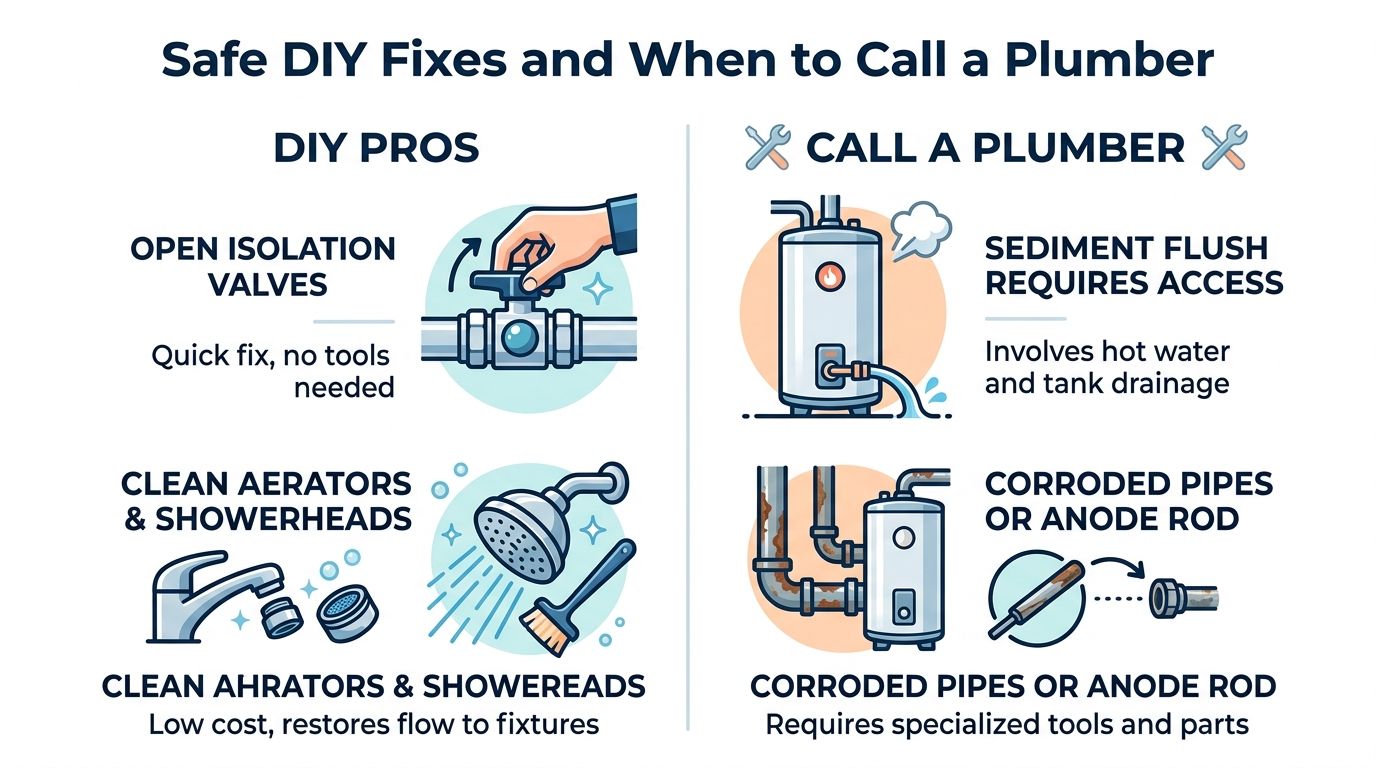
The repairs a careful homeowner can handle
Open isolation valves fully if someone left one partly shut after a repair. Clean faucet aerators and showerheads when the restriction is local and visible. If your water heater is a standard tank and you're comfortable with the process, a flush can clear sediment from the bottom of the unit. None of those should require a major parts order.
A home maintenance checklist for short-term rentals is useful here too, because hosts often catch fixture buildup before it turns into a guest complaint. A property care checklist for Airbnb hosts can be a smart reminder to keep aerators, showerheads, and visible valves on a regular inspection cycle.
The line where a plumber makes more sense
PRV replacement is not a casual DIY move. Tempering valve service also belongs with a licensed plumber, especially when the valve is tied into a safety-critical hot-water setup. Tankless descaling with circulation equipment, dip tube replacement, and any work involving the gas line or electrical connections should go to a professional.
Los Angeles homeowners should also be careful about heater replacement planning, because local permitting and code compliance matter when a water heater is swapped out. If the diagnosis points to a repair that crosses into gas, venting, electrical, or pressure-control work, it's smarter to stop there and bring in someone who does this every day.
Rule of thumb: if you need to shut off gas, open electrical panels, or reconfigure a control valve, the repair has moved out of DIY territory.
If you're trying to restore shower flow without opening the whole system, EZ Plumbing also has a shower pressure improvement guide, which is helpful when the issue stays local to one bathroom.
What professional repairs usually buy you
A plumber can isolate whether the restriction is in the heater, the branch line, a valve, or the fixture itself, then repair only the part that's failing. That matters because the wrong replacement can leave the restriction untouched. The value of the visit is precision, not just a wrench on a pipe.
Preventing Low Hot Water Pressure in Los Angeles Homes
Los Angeles plumbing has a few repeat offenders, hard water, older galvanized piping in some homes, newer copper or PEX in others, and a lot of tankless retrofits layered onto older systems. That mix means prevention is less about one miracle fix and more about staying ahead of scale and control-device drift.
A simple maintenance rhythm works
Flush a tank heater or descale a tankless on schedule, clean fixture aerators every so often, test the PRV, and service the softener if you have one. If you've got a recirculation loop, inspect the check valve and make sure the pump is behaving normally. That kind of routine is cheaper than waiting for a heater outlet, tempering valve, or pipe interior to choke off flow.
Hard water makes the habit more important, not less. Mineral deposits don't need drama to cause trouble, they just need time. In older galvanized systems, the inside of the pipe narrows, and by the time the shower feels weak, the restriction has usually been there for a while.
Four questions homeowners always ask
Is it the city's pressure or mine? If cold water is normal and only hot water is weak, it's usually your side of the plumbing, not the municipal main.
Does a booster pump make sense? Only after you confirm the issue is whole-house low pressure, not a local hot-side restriction.
How long should a flushed tank stay clear? It depends on water quality and maintenance habits, but recurring sediment means the source problem still exists.
Should I replace a failing PRV first? If both hot and cold are weak, yes, that device may be the choke point before you touch the heater or piping.
If your checks point beyond a basic cleaning, EZ Plumbing can trace low or inconsistent water pressure through the heater, control valves, fixtures, and hidden piping, then fix the part that's limiting flow. Visit EZ Plumbing to schedule service when you want the diagnosis done right and the repair handled by a licensed Los Angeles plumber.