
Sudden Drop in Water Pressure? a 2026 Diagnostic Guide
You turn on the shower and the spray drops to a weak stream. Then the kitchen faucet does the same thing. At that point, homeowners don't care about plumbing theory. They want to know one thing. Is this a quick fix, or is something failing behind the walls?
A sudden drop in water pressure usually gives you useful clues if you check the right things in the right order. The biggest mistake I see is people jumping straight to the worst-case scenario, or doing the opposite and ignoring a real warning sign. Both can cost you time. One can also cost you a lot of property damage.
A calm diagnostic sequence works better. Start with the fixtures you can see. Compare hot and cold. Check whether the problem is at one tap, one area, or the whole property. Normal home water pressure is typically 40 to 60 psi, and a sharp drop below that range is a strong sign that something real has changed in the system, not just normal variation, according to Tameson's water pressure overview.
Table of Contents
- That Frustrating Moment Your Water Flow Stops
- Common Causes for a Sudden Drop in Water Pressure
- Your Immediate Diagnostic Checklist
- Temporary Measures and Safety Precautions
- When to Call a Professional Plumber in Los Angeles
- Frequently Asked Questions About Water Pressure
That Frustrating Moment Your Water Flow Stops
A sudden drop in water pressure almost always shows up at the worst time. You're rinsing shampoo out of your hair, trying to fill a stockpot, or getting tenants ready for the morning in a multi-unit building. What feels like a random annoyance is often one of the most useful plumbing warning signs you can get.
The reason is simple. Where the pressure dropped tells you where to start looking. If one faucet is weak, the problem is often right there at the fixture. If one side of the house is struggling, the issue is often in that branch of piping. If the whole property loses pressure at once, the trouble is more likely at the main supply, the pressure control side, or upstream of the building.
The first thing pressure loss tells you
This isn't just about comfort. It's about narrowing the search fast.
Practical rule: Don't ask only “How bad is it?” Ask “Where is it bad?”
That question changes everything. A single bad lavatory faucet points you toward an aerator, cartridge, or local shutoff. Weak flow at every fixture points you away from sink parts and toward bigger causes. That's how plumbers keep a pressure complaint from turning into a guessing game.
Why homeowners lose time on this problem
One often tests the single annoying fixture and stops there. That's understandable, but it leads to bad decisions. Replacing a showerhead won't fix a main-line restriction. Calling for a slab leak check because one faucet is weak is the other extreme.
A better response is to slow down for five minutes and map the symptoms. Compare rooms. Compare temperatures. Notice whether the pressure fell instantly or has been getting worse. Those observations usually tell you whether you're dealing with a simple cleanup, a water heater issue, or a whole-property problem that needs professional equipment.
If the pressure change was sudden and obvious, treat it like a message from the system, not just a nuisance.
Common Causes for a Sudden Drop in Water Pressure
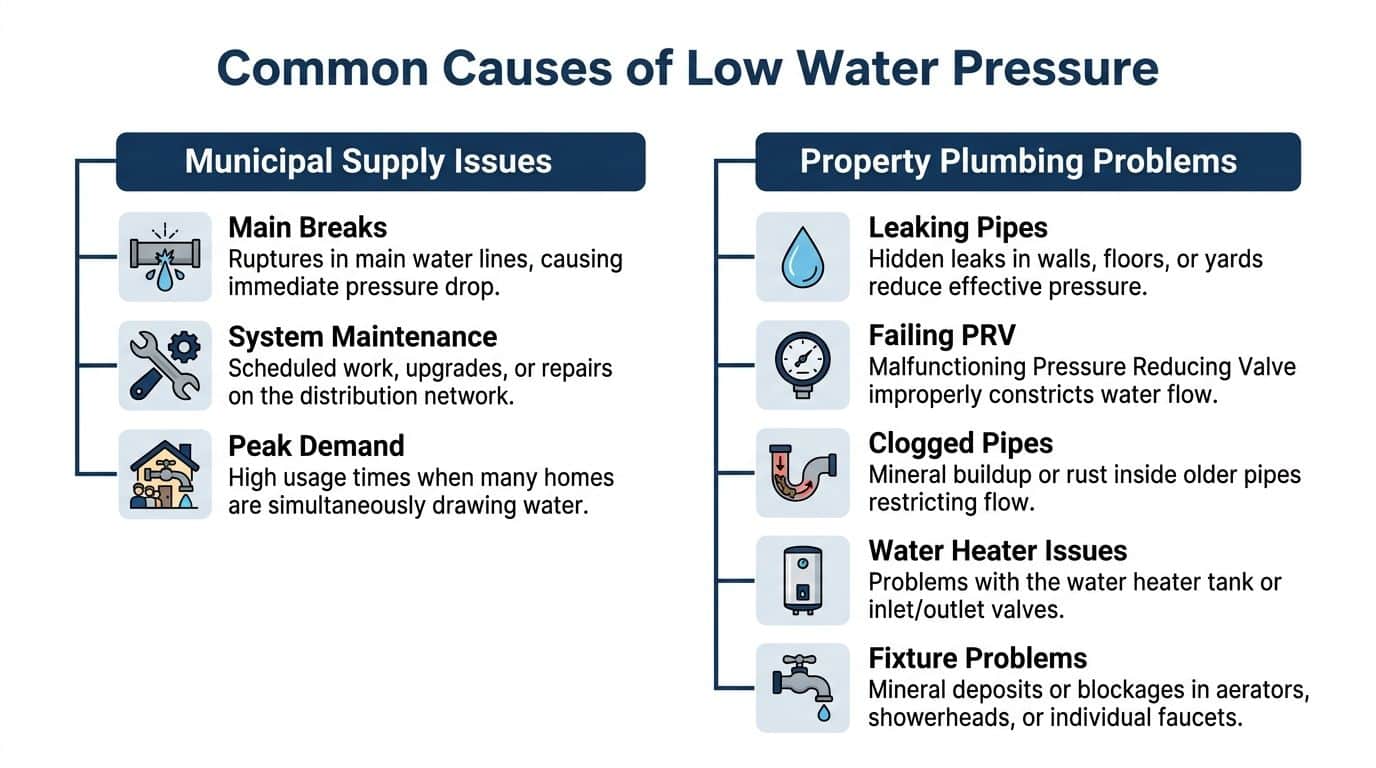
Most pressure problems fall into two buckets. The issue is either outside the property or inside the property. That distinction matters because it changes who you call, what you test, and what you should leave alone.
Problems outside your property line
Sometimes the plumbing inside your home is fine. The trouble is upstream. Municipal maintenance, a water main break, or a temporary supply issue can cause low pressure across multiple homes at once. When several properties are affected together, that's a strong clue that the issue didn't start in your kitchen or bathroom.
This is why asking a neighbor can save you a lot of wasted effort. If they're seeing the same thing, don't start tearing apart faucets. Check for utility notices first and keep your own inspections simple until the public side stabilizes.
Problems inside the property
When the problem is yours alone, the cause can still range from minor to serious.
Some are simple:
- Clogged aerators or showerheads can choke off one outlet.
- Partially closed shutoff valves can reduce flow to a fixture or section.
- Fixture cartridges with debris can act like a blockage inside the faucet body.
Some are larger:
- Leaks can steal flow before water reaches fixtures.
- Pressure-reducing valve trouble can affect the whole house.
- Corroded or restricted piping can reduce flow through older systems.
In buildings with older galvanized plumbing, corrosion can restrict flow over time. A useful clue is when only hot water pressure drops while cold water stays normal. That often points toward the water heater or its dedicated piping, as discussed in this plumbing note on sudden pressure loss.
If you're already troubleshooting water quality and fixture performance together, it can also help to review residential water filtration options so you can separate filtration-related flow issues from broader plumbing restrictions.
One part can mimic another
A tricky part of diagnosis is that different failures can feel the same at the faucet. A bad pressure-reducing valve can make the whole home feel weak. A hidden leak can do that too. So can a supply issue from the street.
That's why random part-swapping usually doesn't work. Plumbing responds better to isolation. Test one fixture. Then several. Then hot versus cold. Then the service entry components.
If you notice moisture around a valve assembly or signs of seepage, a leaking shutoff can be part of the story. This guide on a shut off valve leaking issue is worth reviewing, especially if pressure loss came with dampness near the supply connections.
Your Immediate Diagnostic Checklist
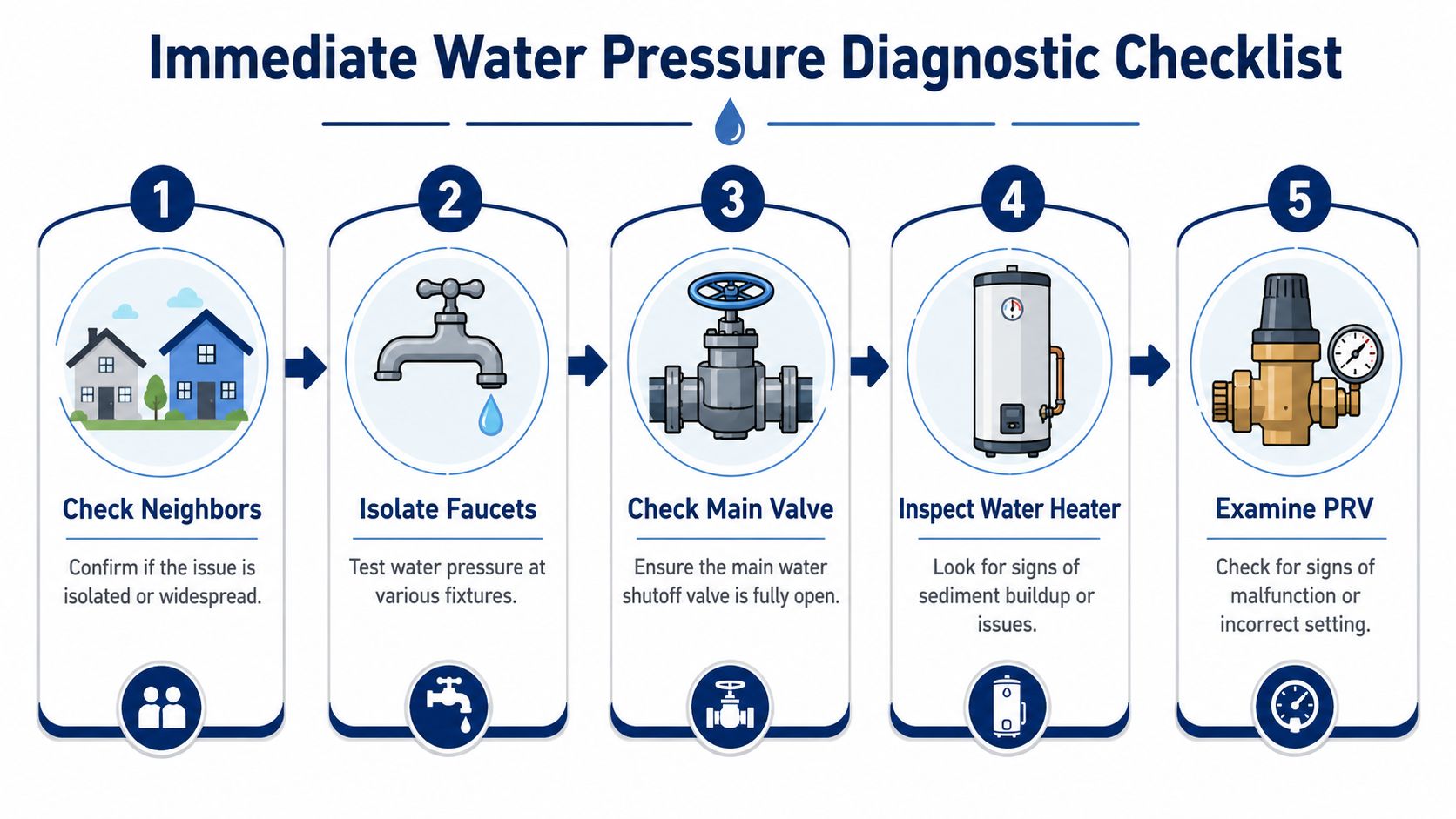
When pressure drops suddenly, don't start with tools. Start with pattern recognition. The fastest path to the right answer is a short checklist that moves from broad clues to narrow ones.
Start with the broadest clue
-
Check with neighbors
If nearby homes or units lost pressure too, your issue may be upstream. That doesn't fix your water, but it keeps you from wasting time disassembling fixtures when the cause is outside your property. -
Test more than one faucet
Open a bathroom sink, kitchen sink, tub spout, and an outside hose bib if you have one. Utility guidance recommends comparing hot and cold, testing multiple faucets, and checking outside hose bibs because it helps separate building plumbing problems from public supply issues. Portland Water Bureau explains that if all fixtures lose pressure, the issue is likely upstream in the public supply, while an isolated problem points to your own plumbing in their home water pressure troubleshooting guidance.
A whole-house symptom changes the job. A one-fixture symptom changes the fixture.
Check what changes between fixtures
-
Compare hot and cold at the same location
If cold pressure feels normal and hot is weak, stop blaming the city. That pattern usually points inward. The water heater, hot-side valves, or hot-side piping become much more likely than a neighborhood supply problem. -
See if the problem is one fixture, one section, or all fixtures
This is one of the most reliable field shortcuts:- One fixture only usually means a localized issue.
- One section of the property often suggests branch-line restriction or a partially closed valve.
- Every fixture means you should think about the main supply path, pressure regulation, or a significant leak.
Look for leak and valve clues
-
Inspect the main shutoff valve
Make sure it's fully open. Sometimes a valve gets bumped during unrelated work, after a recent repair, or even during cleaning in utility areas. A partially open main can make the whole house feel weak without producing any obvious leak. -
Check the fixture shutoffs under sinks and behind toilets
These smaller stops can also be left half-open. If only one sink or toilet area is weak, look there before assuming something is buried in the wall. -
Read the water meter when everything is off
If no one is using water and the meter is still moving, you may have a leak somewhere in the system. This is one of the best homeowner checks because it doesn't require opening walls or guessing. If you haven't done it before, this walkthrough on how to read a water meter for leaks makes the process straightforward. -
Remove and inspect the aerator if only one faucet is weak
Sediment and debris collect there first. It's a small part, but it causes a lot of false alarms. Clean it, flush briefly, and retest.
Field note: The simplest fix is often at the end of the faucet, not deep in the system.
- Pause before adjusting a PRV
Homeowners often want to turn screws when pressure feels wrong. That's risky without confirming the actual system condition first. If the issue is a leak, corrosion, or utility-side event, changing the regulator won't solve the cause and can make diagnosis harder later.
Temporary Measures and Safety Precautions
If your checklist points to a leak or a major whole-house pressure problem, the next goal is simple. Protect the property while you wait for a proper diagnosis.
What to do first if you suspect a leak
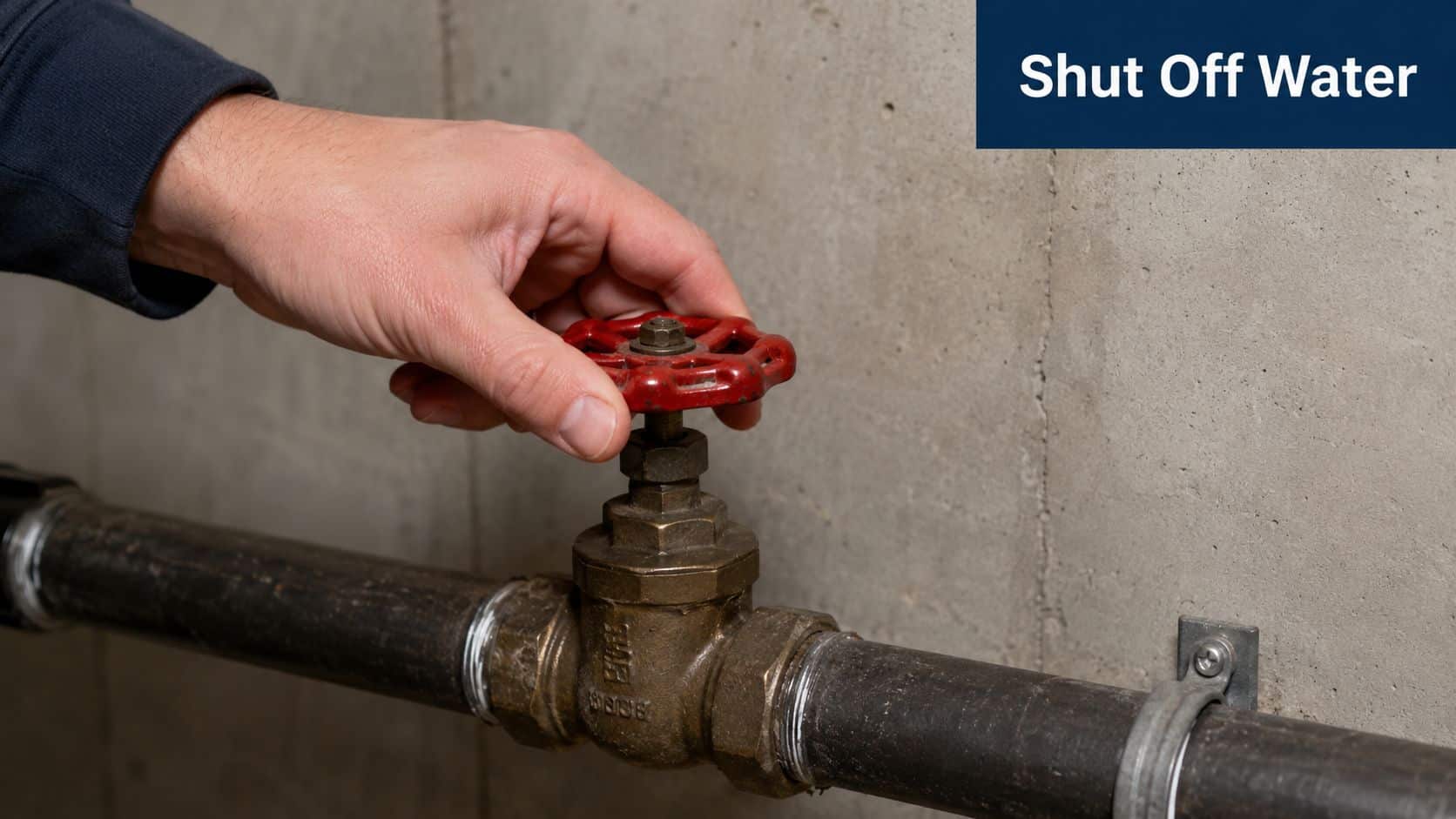
Find the main water shutoff valve and be ready to use it. If you see active leaking, hear water running when nothing is on, or notice water where it shouldn't be, shut the water off completely. That step matters more than any temporary bucket, towel, or guess about where the failure is.
Then limit water use throughout the property. Don't keep testing every fixture once you suspect a real leak. Repeated use can feed the problem, especially if the break is hidden in a wall, ceiling, crawlspace, or underground line.
A practical short list looks like this:
- Shut off the main if you suspect active leakage or a failed supply component.
- Protect nearby finishes with towels or containers only after water flow is stopped.
- Avoid appliances that call for water, including dishwashers, ice makers, and washing machines.
- Check local utility notices if the pressure issue appears neighborhood-wide.
If severe weather is in the forecast and water service feels unstable, it also helps to review essential hurricane preparedness tips, especially the practical advice about storing water safely before service interruptions.
What not to touch
Don't start disassembling main-line parts, pressure regulators, or water heater controls because pressure is low. Those are not good trial-and-error repairs. The risk isn't just doing the repair wrong. It's losing the original clues and making the eventual diagnosis slower.
This video gives a useful visual refresher on shutoff basics and emergency response around household plumbing problems:
If the city is doing work in the area, keep an eye on local alerts before drinking tap water after pressure returns. Sudden pressure events sometimes come with public instructions that matter for safety.
When to Call a Professional Plumber in Los Angeles
There's a point where more DIY checking stops being useful. Once you've ruled out a clogged aerator, a simple valve position issue, and an obvious fixture problem, the next steps usually require pressure testing, leak detection, or line inspection.
The stop DIY triggers
Call a plumber if any of these are true:
- Pressure is low across multiple fixtures and you've already checked the obvious valves.
- The meter suggests a leak when no water is being used.
- Only the hot side is failing and the water heater area shows signs of trouble.
- Pressure swings sharply instead of staying consistently low.
- You hear rushing water in walls, slab areas, or ceilings.
- The property has older piping and the problem appeared abruptly after a period of decline.
A pressure gauge is often the turning point in diagnosis. Residential pressure is commonly around 40 to 80 psi, and if the reading is materially lower than that, or if it swings widely, that's highly consistent with a failing pressure-reducing valve or an upstream supply problem, according to All Plumbing's guide on sudden pressure drops.
What a plumber should test on site
A proper service call shouldn't start with guessing. It should start with isolation and measurement.
Here's what skilled plumbers typically do:
- Gauge the pressure at the service entry or hose bib to see the actual system condition.
- Separate fixture-level symptoms from whole-system symptoms by testing multiple points.
- Inspect the PRV and shutoffs for failure, blockage, or poor response.
- Check for hidden leaks using meter behavior, acoustic clues, and targeted diagnostics.
- Evaluate whether deeper line inspection is needed when the symptoms suggest internal restriction or underground failure.
Low pressure that affects the whole property is rarely solved by replacing random faucet parts.
In Los Angeles, that matters because housing stock varies so much from older homes with aging pipe materials to multi-unit buildings with shared service conditions. A one-bathroom bungalow, a hillside home, and a small apartment building can all show the same symptom at the faucet while requiring completely different repairs.
If pressure loss is sudden, building-wide, or tied to suspected leakage, the safest move is to stop troubleshooting by feel and arrange professional service through a Los Angeles emergency plumber. Quick response matters most when low pressure is really a symptom of water escaping where you can't see it.
Frequently Asked Questions About Water Pressure
What does it typically cost to fix low water pressure
The cost depends entirely on the cause. Cleaning an aerator may cost nothing but a few minutes. Replacing a failed pressure-reducing valve is a different level of repair. Hidden leaks, main-line problems, and major pipe replacement are larger jobs. The only reliable estimate comes after the cause is isolated.
Can I just live with low water pressure
You shouldn't ignore a sudden drop in water pressure. If it's only a dirty aerator, ignoring it is harmless but annoying. If it's a leak, failing regulator, or major restriction, waiting can lead to water damage, fixture problems, or service interruption. Pressure loss is a symptom. The risk depends on what's causing it.
How long does a typical repair take
Simple fixture-level fixes are usually much faster than system-level repairs. A localized clog or straightforward valve issue may be handled the same day. A hidden leak or main supply problem takes longer because diagnosis comes first, then access, then repair.
What if pressure dropped only on the hot side
That usually points away from the municipal supply and toward the water heater side of the system. Sediment, heater-side valves, or hot-side piping restrictions are all possibilities. That's one of the clearest symptom patterns in pressure diagnosis.
For Los Angeles homeowners, landlords, HOAs, and property managers, the fastest way to get from “something's wrong” to a real answer is a professional inspection that starts with pressure testing and leak isolation, not guesswork.
If you need a fast diagnosis for a sudden drop in water pressure, EZ Plumbing serves Los Angeles with emergency response, same-day scheduling for many repairs, and experienced technicians who can isolate fixture problems, pressure regulator issues, hidden leaks, and deeper line restrictions. Call (818) 908-2710 or schedule service online to get the problem identified and repaired before it turns into property damage.