
Cast Iron Offset Closet Flange: A Complete Guide
You've pulled the old toilet, set the replacement in place, and found the problem: the bowl's mounting holes don't line up with the existing flange. The pipe may be sound, but it sits too close to a wall, joist, or finished surface. Moving the drain can mean opening the floor, damaging tile, and turning a contained toilet replacement into a larger plumbing repair.
A cast iron offset closet flange can correct that alignment without rebuilding the entire drain connection. It isn't a magic part, though. The right offset can save time and demolition, while the wrong flange installed on deteriorated cast iron can create leaks, loose closet bolts, and repeat service calls.
Table of Contents
- When the Toilet Does Not Line Up
- What Is a Cast Iron Offset Closet Flange
- Sizes, Offsets, and Connection Types
- How to Install an Offset Closet Flange
- Cast Iron Offset vs Other Solutions
- When to Hire a Licensed Plumber
When the Toilet Does Not Line Up
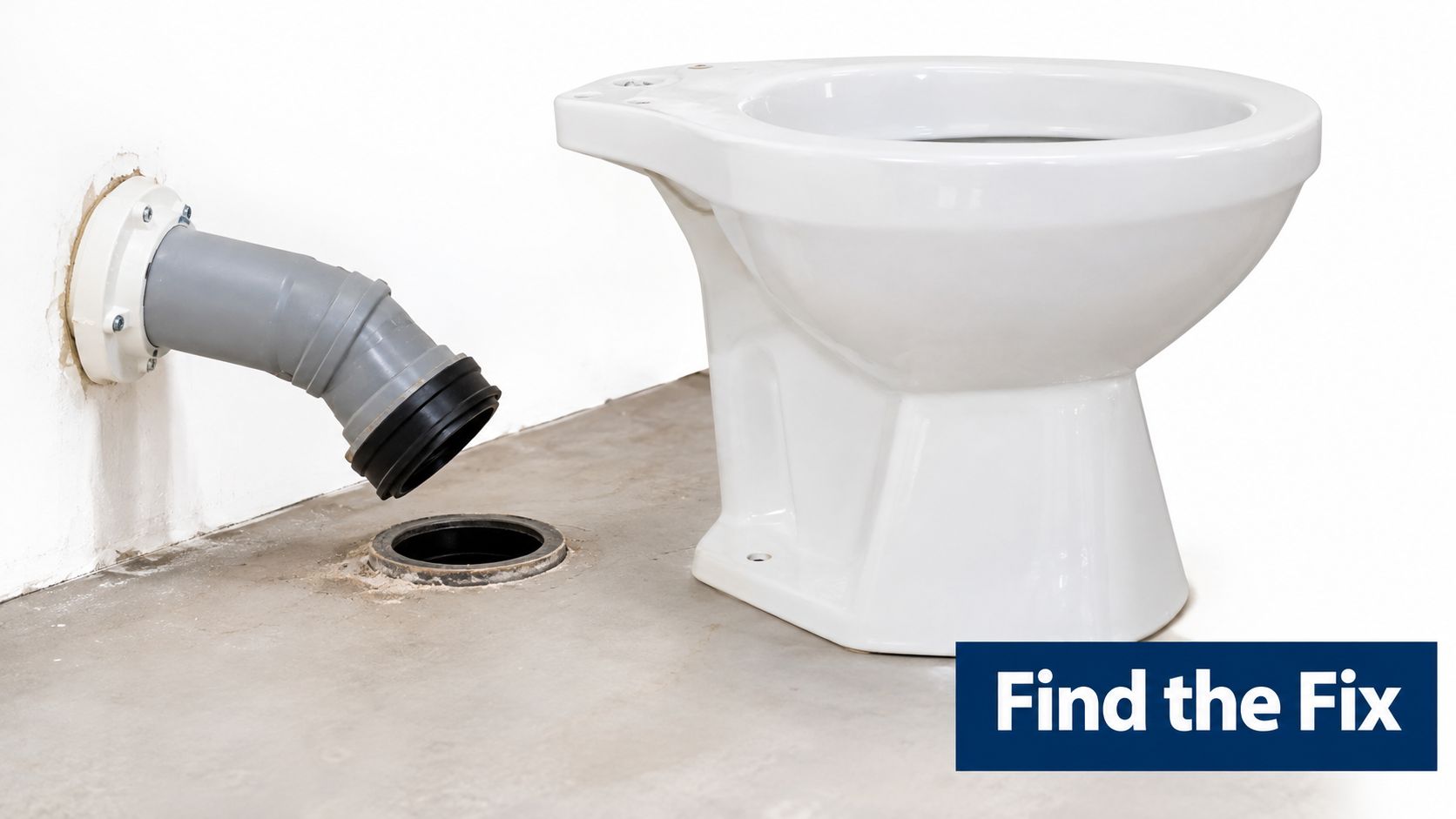
The situation is common in older Los Angeles homes. A homeowner removes a toilet during a bathroom update and expects a straightforward replacement. The new bowl sits slightly away from the wall, but the closet bolts tell a different story. One bolt lands outside the mounting slot, and the other is impossible to position without twisting the toilet.
That's when the decision becomes important. You can open the floor and move the drain, alter the bathroom layout, or use a fitting that moves the toilet connection while leaving the main waste opening where it is. A cast iron offset closet flange provides that controlled shift. Its drain connection remains tied to the existing pipe, but the closet ring moves the bowl centerline to correct a modest rough-in error.
Why the small fitting matters
A closet flange has two jobs. It connects the toilet outlet to the drainage system, and it provides the sealing and fastening surface for the bowl. Modern plumbing codes require an approved closet ring and specify a familiar geometry, including approximately a 7-inch diameter and a 1-1/2-inch flange face for the closet seal, as described in the California Plumbing Code fixture connection requirements.
An offset version preserves that basic interface while shifting the centerline. That's why it works as a correction rather than a complete redesign. The toilet still needs a stable, level flange and correctly positioned bolts, but the installer may avoid cutting into finished flooring or relocating the branch drain.
Field rule: An offset flange is a solution for alignment, not a substitute for sound pipe. Check the cast iron before deciding that the fitting is the repair.
If the pipe wall is solid and the misalignment is modest, the offset can be a sensible repair. If the hub is cracked, badly corroded, or too distorted to hold a seal, the fitting only hides the underlying problem.
What Is a Cast Iron Offset Closet Flange
A standard closet flange sits in line with the waste pipe. The toilet outlet, flange opening, and drain centerline share the same axis. An offset flange changes that arrangement by placing the closet connection to one side of the pipe connection.
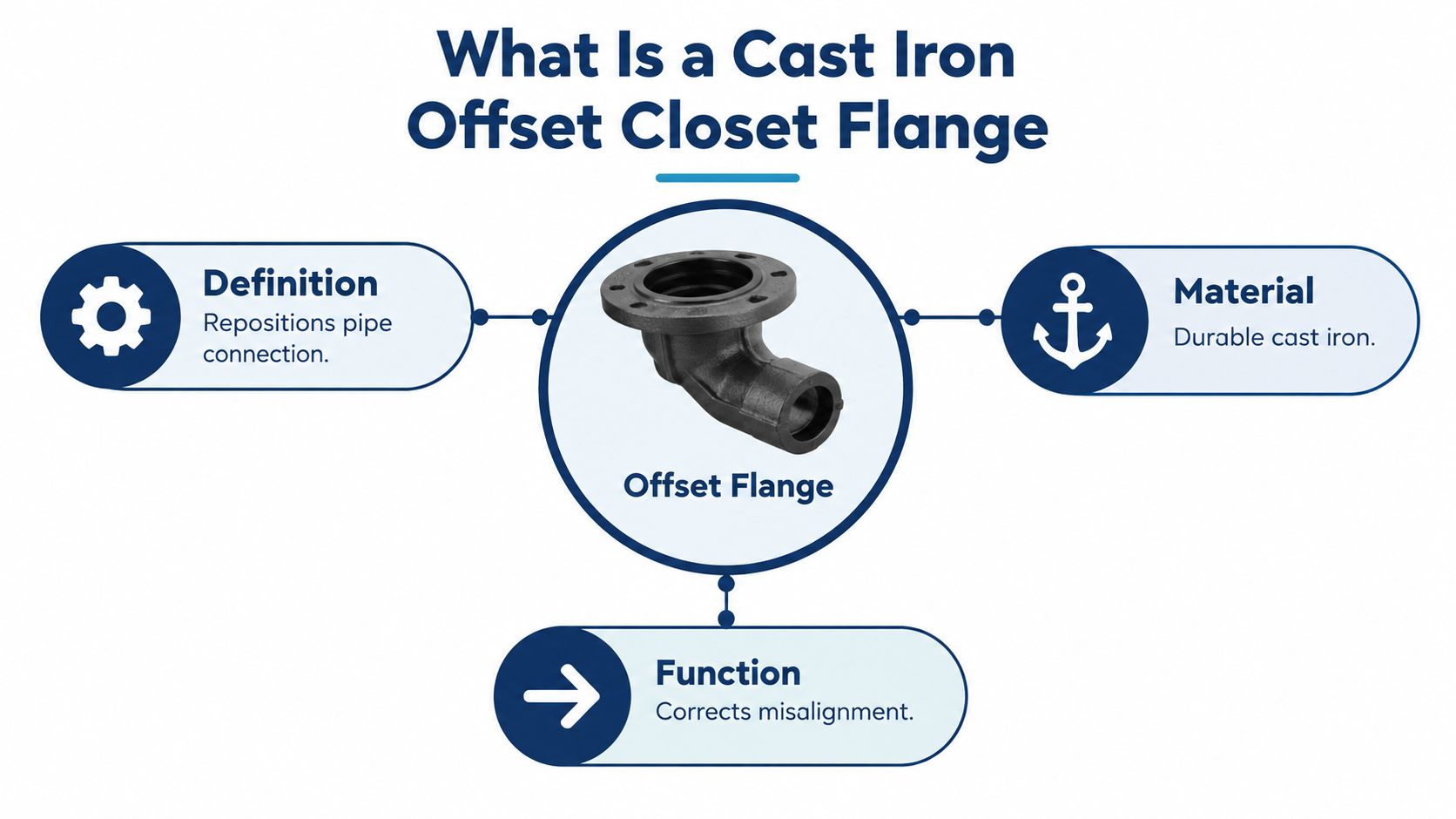
Think of it as an elbow built into the flange body, but with a flat mounting ring designed for a toilet. The lower portion, often called the hub or connection section, joins the existing cast iron system. The upper throat or spigot leads to the closet opening. Because those two portions are shifted relative to one another, the toilet can move without moving the entire drain.
The parts that do the work
The cast iron body provides stiffness and resists movement under the toilet. The offset throat establishes the new bowl centerline. The closet ring receives the closet bolts and supports the sealing surface beneath the wax ring or approved toilet seal.
The ring still has to sit correctly relative to the finished floor. A toilet can rock if the flange is loose, badly positioned, or unsupported, even when the drain connection itself doesn't leak. The installer must also rotate the bolt slots so they match the bowl before sealing the connection.
Pipe identification matters before you buy anything. Older buildings may contain cast iron soil pipe, no-hub sections, or previous repairs using other materials. For a practical visual guide to recognizing older systems, review this resource on cast iron pipes in Big Bear. For broader service-life considerations, this overview of cast iron pipe lifespan can also help frame the inspection.
ASTM maintains a dedicated standard for cast iron closet flanges used with cast iron soil pipe, identified in the verified product information as ASTM A1111-25. That standardization matters because an offset flange isn't merely a homemade workaround. It belongs to an established sanitary plumbing product category, provided the selected fitting matches the pipe and connection method.
Sizes, Offsets, and Connection Types
Selection starts at the existing pipe, not at the toilet box. Measure the pipe configuration, identify whether the connection is caulked or no-hub, and determine how far the bowl needs to move. A flange that has the right offset but the wrong hub or connection style still won't produce a dependable repair.
Common cast iron offset closet flange listings include hub sizes such as 4 x 2, 4 x 3, and 4 x 4, with typical outside and inside diameters around 7-1/4 inches and 6-1/4 inches, respectively, as shown in this ProFlo cast iron closet flange listing. Product ranges also include 3/4-inch, 1-inch, and 2-inch offsets. The offset is the amount the toilet centerline moves, not the length of the flange body.
| Hub Size | Offset Range | Connection Type | Best Use Case |
|---|---|---|---|
| 4 x 2 | 3/4 inch to 1 inch | Caulk or no-hub, depending on model | Smaller corrections where the existing branch is compact |
| 4 x 3 | 3/4 inch to 2 inches | Caulk or no-hub | Common retrofit work on cast iron toilet piping |
| 4 x 4 | 1 inch to 2 inches | Caulk or no-hub | Larger pipe arrangements and more substantial alignment corrections |
Match the offset to the obstruction
A 3/4-inch offset is a fine adjustment. It can correct a bowl that sits slightly too close to framing or a finished wall. A 1-inch offset offers more movement when the rough-in is visibly wrong but the drain remains generally usable. A 2-inch offset is a more aggressive correction for tight remodel conditions.
Don't choose the largest offset just because it offers more movement. A larger shift can affect floor openings, bolt placement, clearance around the bowl, and the ability to keep the flange fully supported. Offset flanges are intended for minor alignment corrections, generally around 1 to 2 inches, according to the product guidance summarized by HOROW's offset flange installation guide.
Connection style is just as important. Caulked flanges suit traditional cast iron stacks where the installer has a proper caulking joint and enough access to prepare it. No-hub or compression-style flanges are often more practical in retrofit work, especially where the installer can't reach below the floor. A no-hub connection may reduce demolition, but it still needs a clean, round, structurally sound pipe surface.
How to Install an Offset Closet Flange
Installation quality determines whether the offset becomes a durable correction or a short-lived patch. The work starts with inspection and dry fitting, not sealant. Before cutting or sealing anything, confirm the bowl position, floor height, pipe condition, flange orientation, and bolt alignment.
Prepare the connection
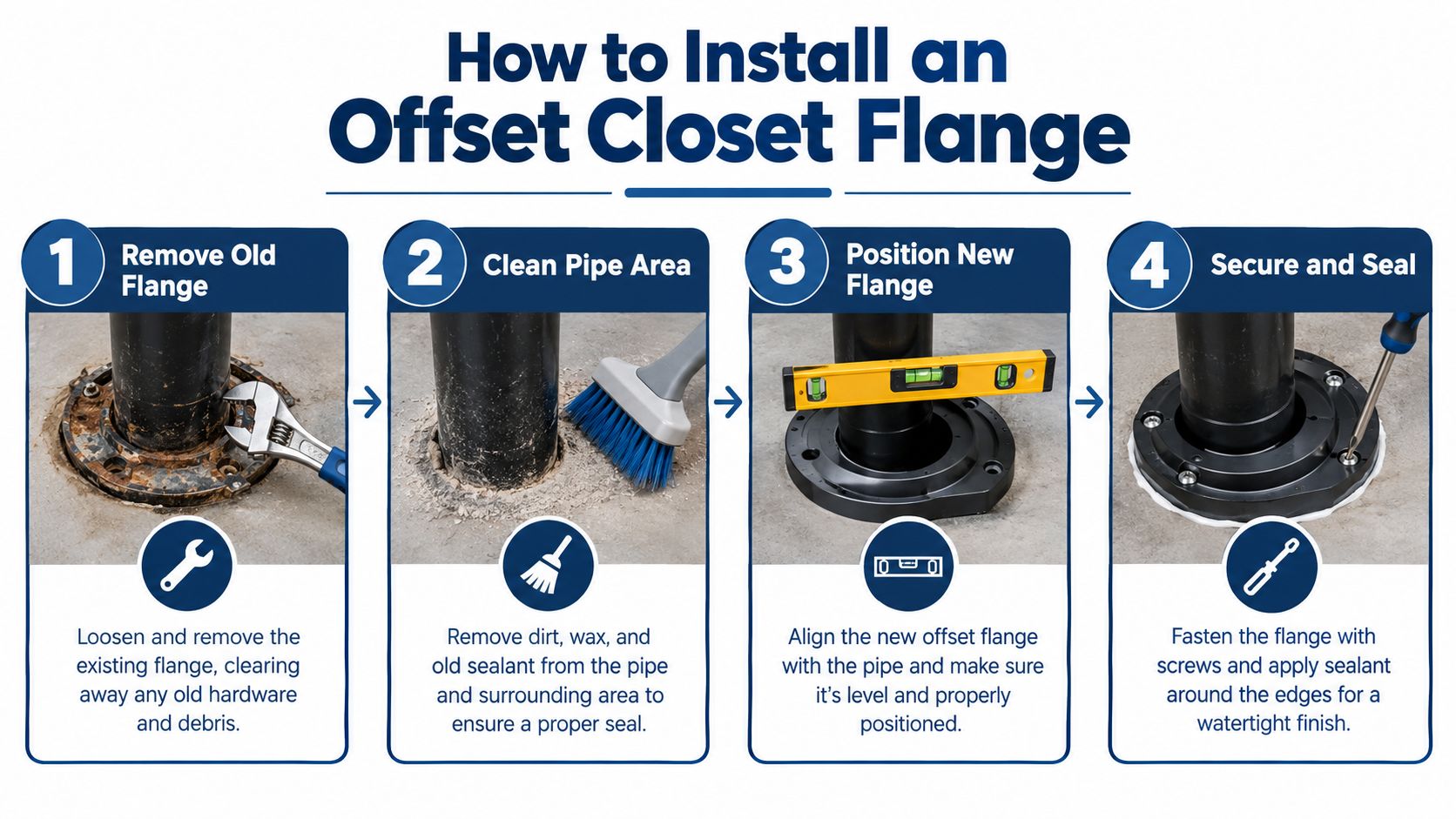
Shut off the water, remove the toilet, and protect the open drain from debris. Remove the old flange or broken ring according to its connection type. A handsaw, cold chisel, hammer, wire brush, level, tape measure, marker, approved sealant or caulking materials, closet bolts, and a new wax ring may be needed, but the exact materials depend on the flange design.
Clean the pipe until you can see its actual condition. Remove loose rust, old caulk, soil, and fragments. If the pipe edge is thin, cracked, badly out of round, or soft under the wire brush, stop treating the job as a simple flange replacement.
Dry fit before sealing
Set the offset flange in place without permanent sealant. Rotate it until the closet bolt slots align with the bowl. Position the toilet over the flange without wax, then check that the bowl sits squarely and doesn't contact the wall, baseboard, or nearby fixture.
Mark the flange orientation and the screw locations. The flange should be supported by the finished floor or a solid substrate, sit level, and be secured so it can't rotate when the closet nuts are tightened. Don't use the toilet bolts to pull a crooked or unsupported flange into position.
Make the connection
Prepare the caulked or no-hub joint exactly as the fitting manufacturer specifies. A caulked connection requires proper packing and consolidation. A no-hub model requires a clean pipe surface and correctly tightened compression hardware. The joint must seal around the pipe without restricting the drainage opening.
Secure the flange to the floor with suitable fasteners. Install the closet bolts, set the wax ring or approved seal, and lower the bowl straight down. Tighten the nuts evenly until the bowl is stable. Over-tightening can crack porcelain or distort the ring.
Practical warning: A thick bead of sealant won't repair a damaged pipe, a loose flange, or a misaligned bowl. It only makes the next inspection harder.
After connecting the water supply, flush repeatedly and inspect around the base and nearby ceiling or crawlspace if accessible. If you're dealing with a loose bowl, recurring seepage, or a damaged flange rather than a new installation, toilet repair service may be more appropriate than replacing the visible ring alone.
For a visual process reference, use this installation video:
Cast Iron Offset vs Other Solutions
An offset flange is attractive because it limits demolition. That convenience has a boundary, and the pipe condition sets it. Cast iron offers stiffness and dimensional stability, but age, corrosion, previous repairs, and distortion can undermine the connection beneath the new flange.
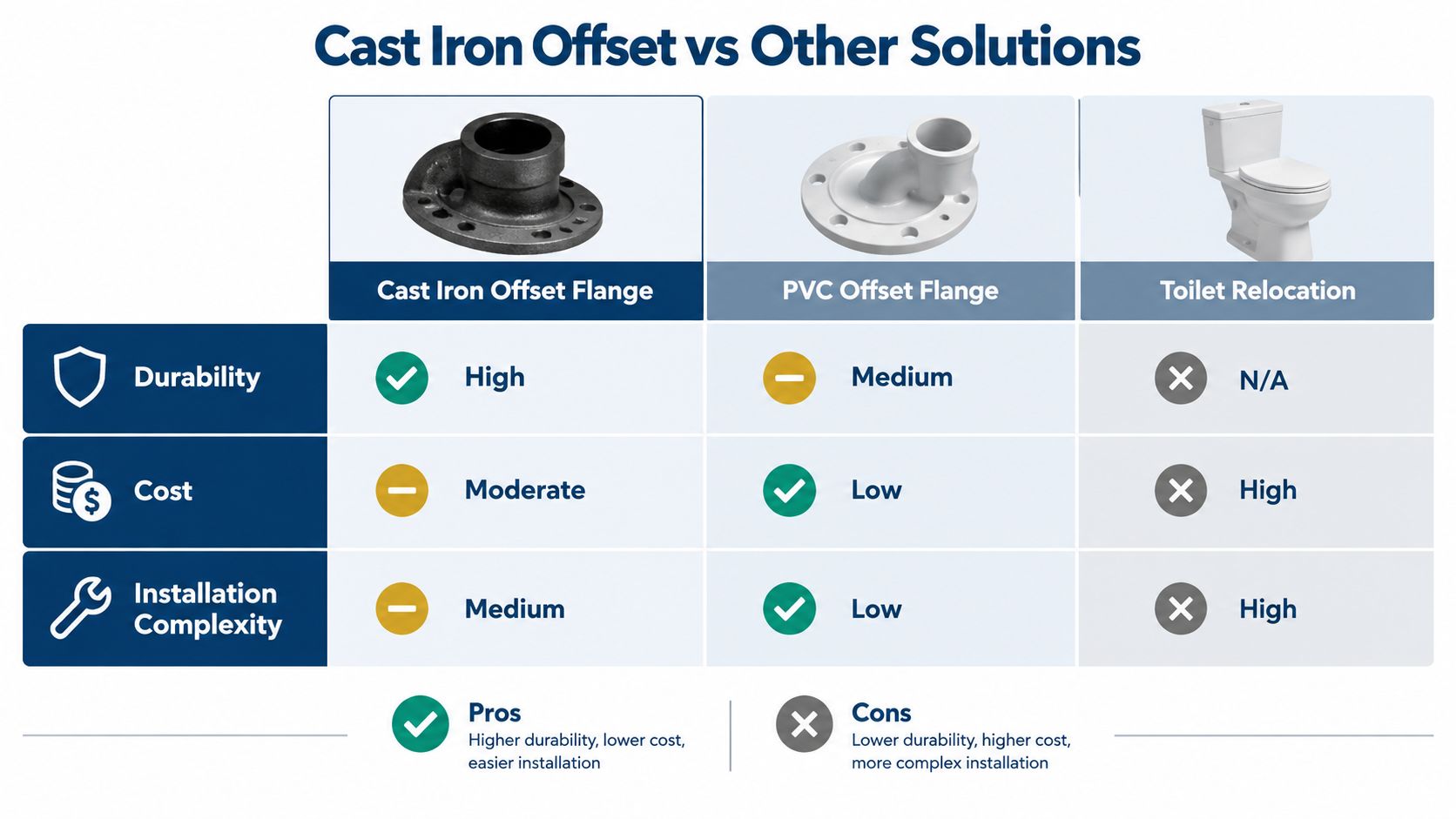
A plastic offset flange may be easier to cut, position, and connect when the drain system is PVC or ABS. It isn't automatically the right choice for an older cast iron stack. Material compatibility and the connection method matter more than the fact that plastic is lighter.
Compare the repair paths
| Solution | Main advantage | Main limitation | Appropriate when |
|---|---|---|---|
| Cast iron offset flange | Strong, stable correction that matches a cast iron system | Heavy, and dependent on the existing pipe condition | The pipe is sound and the alignment error is modest |
| PVC or ABS offset flange | Light and straightforward on compatible plastic drainage | Doesn't solve a material mismatch or deteriorated cast iron joint | The existing drain is plastic and the connection is compatible |
| Full pipe replacement or relocation | Addresses damaged pipe and incorrect routing at the source | More invasive and disruptive to flooring or surrounding finishes | The pipe is cracked, badly corroded, distorted, or poorly supported |
The cheap repair is not always the economical repair. An offset flange can fail on older cast iron when the pipe is weak or out of round. Warning signs include flaking walls, deep pitting, a cracked hub, a pipe edge that crumbles during cleaning, and old patches that no longer provide a reliable sealing surface.
Know when convenience becomes risk
Use the offset when it corrects alignment and the existing drain can hold the connection. Choose replacement when the pipe itself can't maintain that connection. A new flange cannot restore missing cast iron, straighten a collapsed section, or guarantee a seal against a badly distorted pipe.
Property owners planning a larger repair should review these homeowner pipe replacement tips before choosing a short-term correction. The key question isn't whether the flange can be installed today. It's whether the pipe will still support the flange after the floor is closed and the toilet is back in service.
When to Hire a Licensed Plumber
A licensed plumber earns the call when the repair involves more than matching a fitting to a pipe. Cast iron systems can conceal damage below the floor, behind finished walls, or at a hub that looks acceptable until the old flange is removed. A professional can inspect the connection, identify the pipe material, verify the offset, and determine whether the floor can support the new flange.
Code compliance also matters. Modern plumbing codes require an approved closet ring and a proper sealing face, and the fitting must be installed according to its listed application. The right product depends on the pipe, connection type, floor condition, and toilet position. A licensed plumber also knows when a compression-style repair is suitable and when the pipe needs to be opened and replaced.
Call before the flange becomes a larger repair
Get professional help if:
- The pipe crumbles or flexes: Deteriorated cast iron can't provide a dependable sealing surface.
- The flange sits below the finished floor: Height problems can leave the toilet unstable or compromise the seal.
- The toilet still doesn't fit after dry fitting: The offset may be wrong, or the drain location may require relocation.
- The connection is concealed: Work below tile, concrete, or a finished ceiling carries a higher risk of hidden damage.
- The repair has already leaked: Repeated seepage deserves an inspection of the flange, seal, subfloor, and drain connection.
For more context on choosing qualified help, see this guide to why hiring a licensed plumber for your home. Ask the plumber to explain the pipe condition, the proposed connection, the offset selected, and what would make replacement preferable to repair.
If your Los Angeles toilet is misaligned or the cast iron flange is deteriorated, EZ Plumbing can inspect the existing connection, assess whether an offset repair is appropriate, and handle related toilet or drain work. Contact the team to schedule service or discuss an urgent leak before a small flange problem damages the floor.