
Can You Put Grease Down the Drain? the Truth
You've just finished cooking, and the pan still holds a shallow pool of hot oil, bacon fat, gravy, or sauce. The sink is right there, the liquid disappears quickly, and running water makes the decision feel harmless. In Los Angeles homes, apartment buildings, and commercial kitchens, that convenient pour can become a slow plumbing failure that stays hidden until the sink backs up.
The short answer to can you put grease down the drain is no. Grease can move as a liquid for a while, but your drainage system eventually becomes a cooler, rougher environment where fats, oils, and grease, known as FOG, collect and harden. The reliable solution is to keep FOG out of sinks, toilets, garbage disposals, and storm drains, then use a disposal method that fits the quantity and your local waste rules.
Table of Contents
- The Grease Myth and Why It Persists
- What Actually Happens Inside Your Pipes
- The Hidden Danger of Small Amounts
- Fatbergs and Sewer System Damage
- Safe Grease Disposal Methods
- Preventative Maintenance for LA Homeowners
The Grease Myth and Why It Persists
A home cook finishes frying food, tilts the pan over the kitchen sink, and watches the grease vanish. A few seconds later, the faucet runs hot. The sink drains normally. Nothing looks wrong, so the habit gets repeated the next evening.
That's why this problem persists. The immediate result rewards convenience, while the damage forms out of sight. Many people assume water will carry grease through the house and into the sewer, especially if the grease is still hot. The drain's early performance appears to confirm the idea.
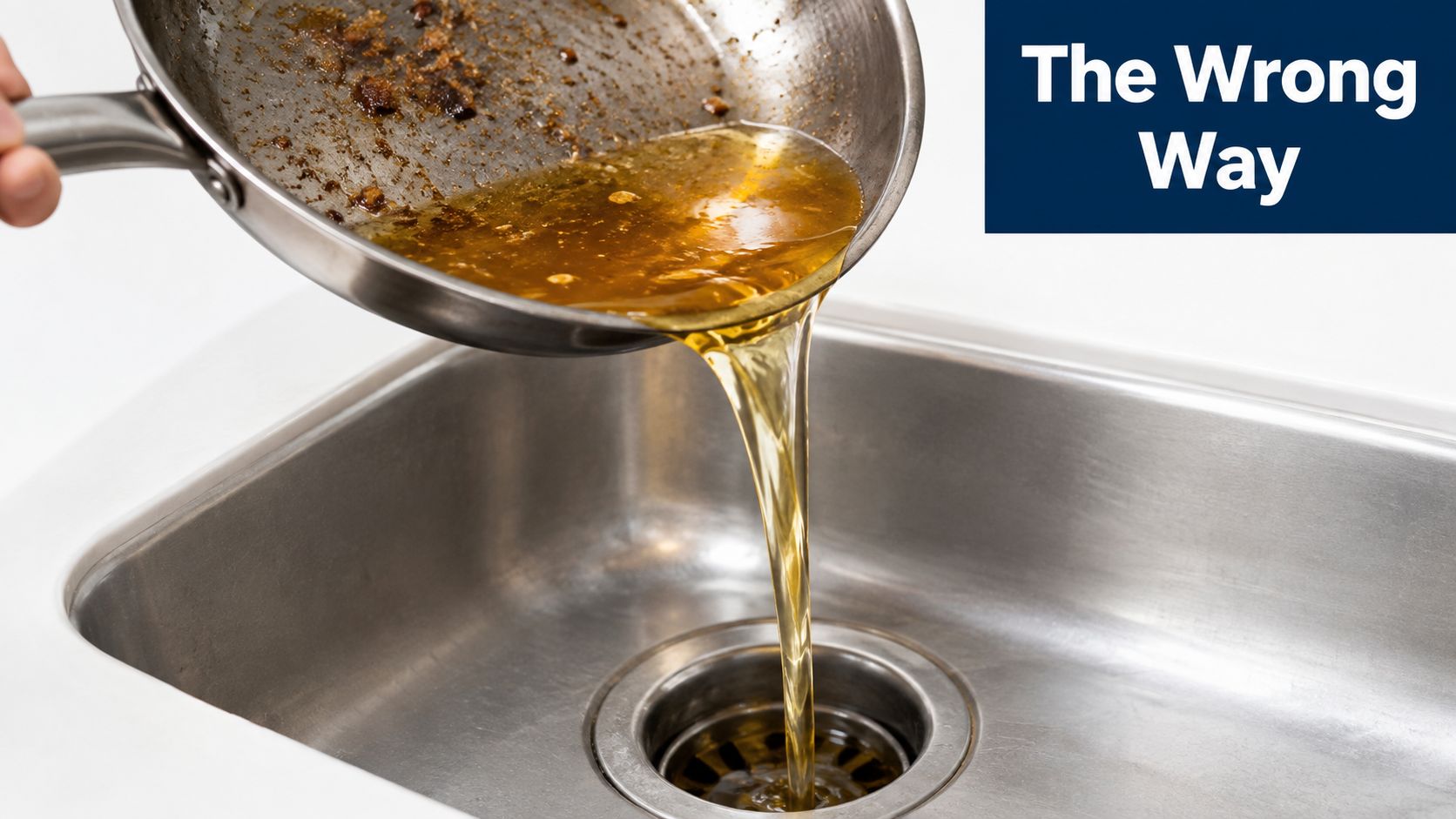
Why running water doesn't solve it
Hot water may move grease farther along temporarily, but it doesn't remove the material from the plumbing system. As the mixture travels into cooler sections, some of it can adhere to the pipe surface. Soap, food particles, and existing residue then give later grease something else to cling to.
Practical rule: A drain that accepts grease today can still be accumulating a blockage you won't notice until flow is restricted.
This is one of the common plumbing myths about household drains. The issue isn't whether the grease disappears from the sink. The issue is where it settles after leaving the sink.
For a homeowner, the first warning may be a sluggish basin, gurgling, or water rising in another fixture. In a multi-unit property, a blockage can affect shared lines and create a sanitation problem for more than one residence. Property managers also face a behavior problem, because residents may each contribute small amounts while assuming their individual actions can't matter.
The better habit is simple. Let the pan cool, scrape the residue into a container or lined bin, wipe the pan with a paper towel, and wash it only after most of the grease has been removed. That takes slightly longer than pouring, but it keeps a temporary cleanup shortcut from becoming a hidden plumbing liability.
What Actually Happens Inside Your Pipes
Grease behaves differently from water because it doesn't remain evenly mixed with the drainage flow. As hot FOG moves through a sink trap, branch drain, building lateral, or public sewer, it encounters cooler surfaces. The material begins to thicken, adhere to the pipe wall, and leave a coating behind.
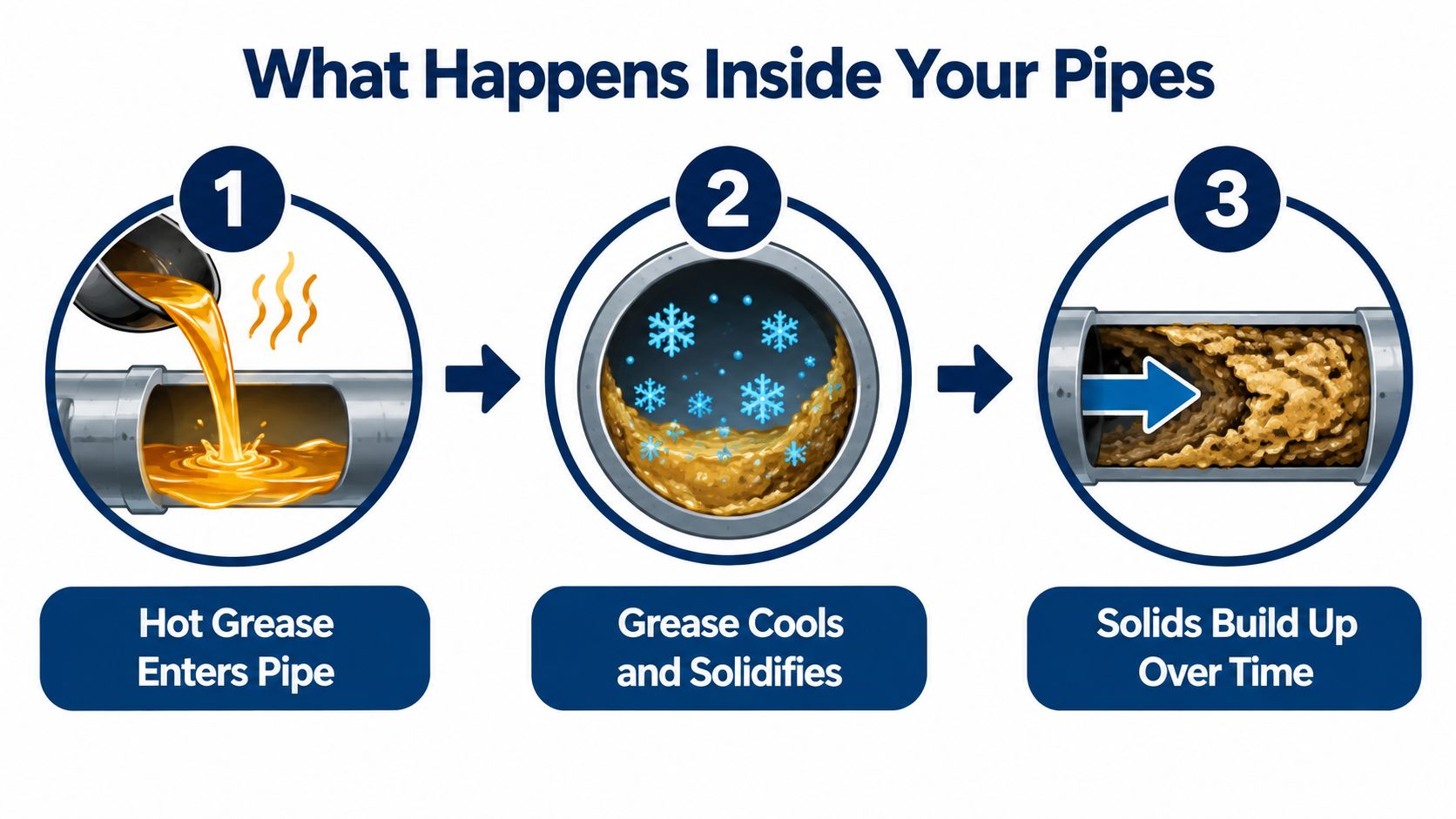
From liquid film to restricted passage
The first deposit may be thin. That doesn't make it harmless. A coated section has less usable space and a rougher interior surface, so food particles, coffee grounds, soap residue, and other debris can catch instead of passing cleanly.
The next discharge adds to that rough surface. Repeated deposits can turn a smooth pipe into a narrowed channel with a sticky, irregular lining. Eventually, the flow can slow dramatically or stop. In a kitchen, the P-trap and nearby horizontal runs often become the first places where residue creates trouble because these sections hold water and cool quickly.
A major historical benchmark in U.S. sewer-management guidance found that grease from restaurants, homes, and industrial sources accounted for 47% of reported sewer blockages, making FOG the single largest cited cause in that dataset, as described in this public-agency overview of fats, oils, and grease pollution. The important point isn't only the percentage. It's the mechanism. Grease cools, sticks, and collects with other material until the passage can no longer carry wastewater properly.
Design matters, but it doesn't make grease safe
A well-planned kitchen can make cleanup easier. For example, homeowners considering planning a kitchen island with a cleanup zone can place the sink, dishwasher, wiping area, and waste containers where scraping and wiping happen before washing. Good layout reduces the temptation to use the drain as a disposal bin.
No sink strainer, garbage disposal, or extra flush changes the basic chemistry and mechanics. A disposal can break food into smaller pieces, but it doesn't turn grease into water. Chemical drain cleaners may also fail to remove a dense greasy mass and can create hazards for anyone who later opens the trap or works on the line.
If grease has already entered the drain, don't keep adding hot water and hoping the problem has moved away. That can shift the residue farther into the system without removing it. Persistent slow drainage needs a proper inspection and cleaning method suited to the location of the buildup.
The Hidden Danger of Small Amounts
A large container of fryer oil is easy to identify as a disposal problem. The harder issue is the tablespoon of pan drippings, the oily sauce left on a plate, or the grease mixed into gravy. Homeowners often treat these amounts as too small to matter because no immediate symptom follows.
The plumbing sees repetition, not intention. Each small discharge can leave residue in a different section of the drain. Later amounts encounter that residue and add more material. Food scraps and liquid waste can provide additional particles that become embedded in the buildup.
Why daily residue changes the risk
The question isn't whether one small amount can instantly fill a pipe. It usually won't. The question is whether repeated amounts can create conditions where ordinary debris catches and expands a restriction. That is the cumulative pathway behind many frustrating blockages.
Public guidance from the New York City Department of Environmental Protection specifically warns against putting FOG down sinks, toilets, or storm drains and recognizes that the problem includes more than obvious cooking oil. Its household grease disposal guidance also addresses items such as batter, gravy, milkshake syrups, and liquid food waste.
That broader definition matters in real kitchens. A property manager who tells residents only to save frying oil may leave out the sauces, meat juices, and food residue that enter the drain during routine washing. A restaurant or shared housing facility needs the same clarity, because repeated small discharges from many users can affect common plumbing.
The useful question isn't “Was that amount small?” It's “Where will repeated residue settle, and what will stick to it next?”
Small pours create large maintenance problems
A slow drain often encourages the wrong response. Someone uses a chemical product, flushes more water, or ignores the symptom until wastewater rises into the sink. Those actions may change the symptom without addressing the coating inside the line.
A better household routine has three parts:
- Scrape first: Remove food and oily residue from plates and pans before rinsing.
- Contain the grease: Put cooled grease into a sealable container or absorb it with a suitable disposable material.
- Train every user: Give tenants, residents, employees, and cleaning staff the same written instruction.
This approach works because it prevents the first layer from entering the system. It doesn't depend on a drain appearing clear after cleanup. For HOAs and property managers, a short kitchen notice near shared waste areas can be more effective than a general warning that states grease is bad.
Fatbergs and Sewer System Damage
Inside a private drain, FOG creates a plumbing restriction. In a municipal network, it can join with wipes, paper products, food waste, sediment, and other debris. The combined mass can harden into a fatberg, a large obstruction capable of blocking sewer flow and contributing to backups.
FOG accumulation can involve solidification, saponification, crystallization, and calcium aggregation. In cooler sewer conditions, those processes help turn dispersed residue into a durable mass. One cited estimate attributes 50–70% of in-line sewer blockages to FOG, as reported in this University of Manchester explanation of fatberg formation.
How the problem travels beyond one kitchen
A private drain doesn't operate in isolation. Wastewater from homes, restaurants, and commercial buildings enters larger lines, where cooler temperatures and longer runs give grease more opportunity to settle. Once the mass restricts flow, wastewater can back up into buildings or emerge through public infrastructure.
The consequences include emergency access, contaminated areas, excavation or cleaning work, and disruption for residents and businesses. Untreated sewage can reach streets, basements, and waterways when a blockage causes an overflow. That makes grease disposal a public sanitation concern, not merely a household cleaning preference.
Dispose of it before it reaches the pipe
Use this sequence after cooking:
- Wait for the grease to cool. Don't handle a hot pan or pour hot fat into a disposable container that can soften or fail.
- Scrape and wipe. Move solid residue and oily film into a lined trash container or another approved receptacle.
- Seal liquid grease. Use a stable, leak-resistant container if your local program requires containerized disposal.
- Check local instructions. Organics programs, recycling centers, and waste haulers may handle small and large quantities differently.
- Keep all FOG out of storm drains. Stormwater systems aren't a substitute for household waste disposal.
A disposal method that works in one city may violate another city's collection rules. The safe universal principle is to keep FOG out of plumbing first, then follow the waste authority's instructions for the container you have.
Safe Grease Disposal Methods
The best disposal choice depends on quantity, temperature, container type, and local collection rules. Don't assume that every city wants liquid grease in the trash, green bin, or recycling stream. Municipal guidance can distinguish between a small amount and a larger volume, and the instructions may change based on available organics or grease-recovery programs.
One municipal example allows less than 500 mL of liquid grease to go over food scraps in a green bin, while larger amounts should be sealed and taken to recycling centers, according to Hamilton's household fats, oil, and grease guidance. That is a local rule, not a universal instruction.
Grease Disposal Guide
| Grease Type | Small Amount (<500 mL) | Large Amount | Recommended Action |
|---|---|---|---|
| Liquid cooking oil | Follow your local organics or waste rule | Seal in a sturdy container | Use an approved organics route or recycling center where available |
| Bacon fat or pan drippings | Cool, wipe, or contain it | Containerize before moving it | Keep it out of the sink and follow local collection directions |
| Gravy, batter, and oily sauces | Scrape or absorb residue | Seal liquid food waste if required | Check whether your organics program accepts it |
| Solidified grease | Place in an approved lined container | Use a secure container | Dispose of it according to local trash or organics rules |
| Commercial fryer oil | Don't pour it into any drain | Store safely for collection | Arrange approved recycling or commercial waste service |
What works at home
For many households, the practical routine is to let grease cool, pour or scrape it into a sealable container, and place it in the trash if local rules direct you to do so. A freezer can help solidify a container of grease before disposal, but the container still needs to be secure and accepted by the local waste program.
Don't pour boiling water over grease in the sink as a disposal strategy. It may liquefy the material briefly, but it doesn't guarantee removal from downstream piping. Don't rely on a garbage disposal to solve the problem either.
Commercial kitchens need a controlled collection process, documented staff instructions, and equipment maintained for FOG management. Property managers dealing with food-service tenants may also need to understand grease trap compliance in New Zealand as an example of why local requirements and maintenance responsibilities matter.
If a kitchen has a grease trap or interceptor, don't treat it as permission to pour unlimited waste into the drain. The kitchen grease trap guidance should be paired with the actual requirements of the building, municipality, and service provider.
Preventative Maintenance for LA Homeowners
Good disposal prevents new grease from entering the line, but it can't erase residue already inside an older drain. Los Angeles properties vary widely, from single-family homes to older duplexes, apartment buildings, HOAs, and commercial sites with long shared laterals. The right maintenance plan depends on the pipe material, layout, access points, drainage history, and whether the restriction is in a branch line or the sewer lateral.
Watch for changes instead of waiting for a complete failure. A kitchen sink that drains more slowly, gurgles after discharge, develops an odor, or backs up when another fixture runs deserves attention. In a multi-unit property, several residents reporting similar symptoms can indicate a shared-line issue rather than separate sink problems.
A practical maintenance routine
- Control daily inputs: Scrape plates, wipe pans, and keep FOG out of every drain.
- Track recurring symptoms: Record which fixtures slow down and whether the issue returns after temporary clearing.
- Use the correct cleaning method: A plumber may use a drain machine for a localized obstruction or hydro jetting to scour grease and debris from suitable drain and sewer lines.
- Inspect before escalating: Camera diagnostics can help identify buildup, damaged pipe, root intrusion, or a structural defect that grease alone won't explain.
- Plan for shared systems: HOAs and property managers should coordinate inspections and cleaning around building history rather than waiting for a resident emergency.
Hydro jetting can be useful when grease has coated a line, but high-pressure equipment isn't a universal DIY tool. A professional needs to assess pipe condition and choose a method that won't damage a fragile or compromised system. Older buildings may need targeted cleaning and follow-up inspection instead of repeated chemical treatments.

EZ Plumbing provides drain cleaning, hydro jetting, sewer diagnostics, and emergency plumbing service for Los Angeles homes, HOAs, property managers, and commercial properties. The company serves areas including Beverly Hills, Santa Monica, West Hollywood, Pasadena, Glendale, Burbank, and the San Fernando Valley, with 24/7 emergency response and same-day scheduling for planned repairs.
Grease prevention is an ongoing property-management task, not a one-time fix after a backup. Change the disposal habit today, document early symptoms, and arrange a professional evaluation when a slow drain keeps returning.
Call EZ Plumbing for professional drain cleaning, hydro jetting, and sewer diagnostics when grease buildup is slowing your kitchen plumbing or threatening a shared line. Their Los Angeles team can help identify the source of the restriction, recommend the appropriate cleaning method, and provide emergency response when a backup can't wait.