
Kitchen Grease Trap Guide for Los Angeles Properties
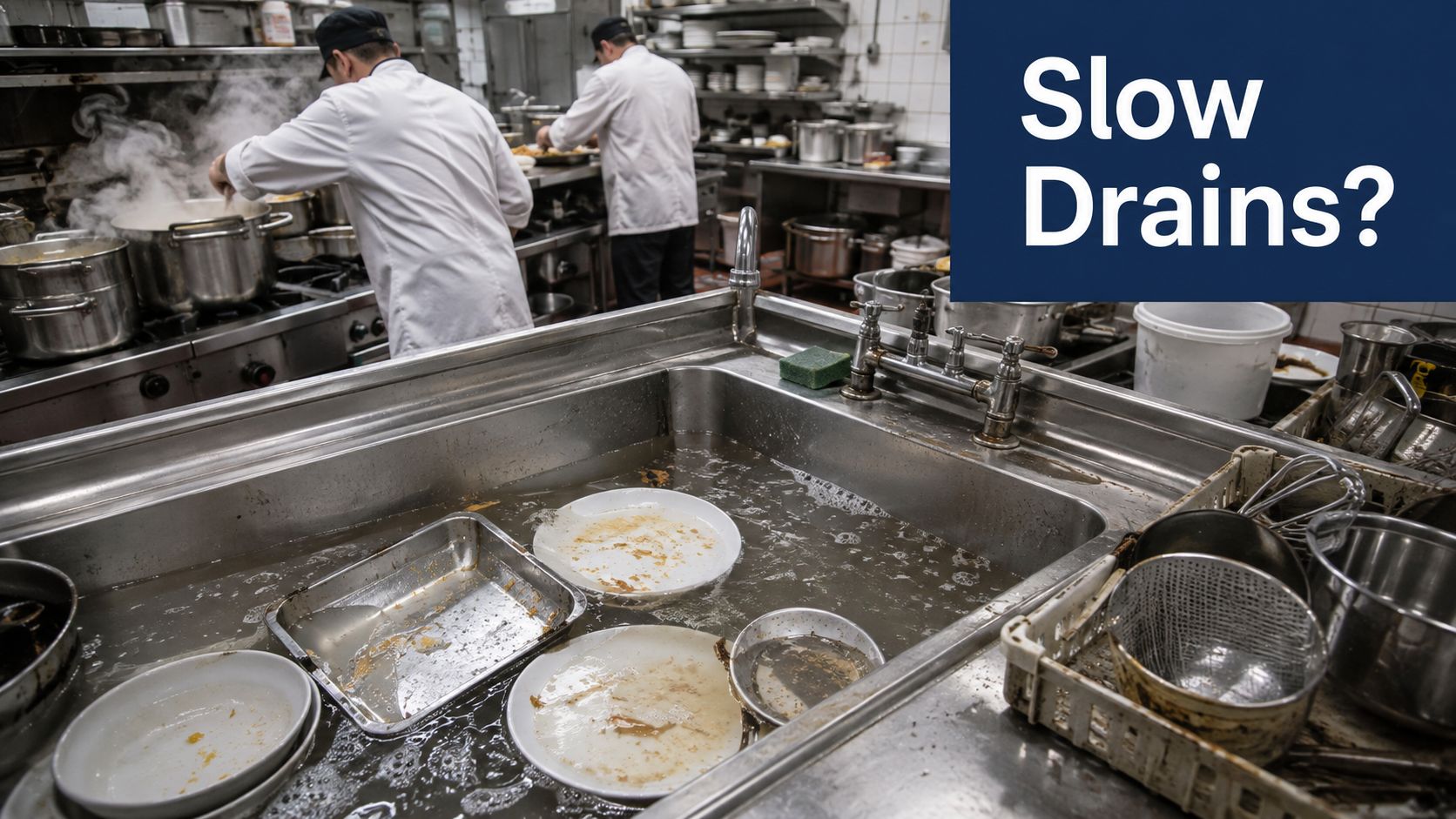
The first sign is usually not dramatic. A prep sink starts draining a little slower, somebody runs a rinse cycle, and by the middle of service the floor drain smells sour and the sink backs up far enough to stall the line. In Los Angeles kitchens, that moment usually means the kitchen grease trap is either overloaded, poorly sized, or not being maintained in a way that matches the actual fixture flow.
A grease trap is the part of the system that catches fats, oils, and grease before they move into the drain line and sewer. When it works, it keeps food waste from hardening inside pipes and causing backups, odors, and compliance headaches. When it doesn't, the kitchen keeps paying for cleanings that don't solve the root cause, and property managers end up dealing with the same problem again and again.
Table of Contents
- Why Every LA Kitchen Needs a Grease Trap
- How Kitchen Grease Traps Work
- Los Angeles Sizing and Code Requirements
- Maintenance Schedules and Safe DIY Cleaning Steps
- Hidden Causes of Grease Trap Failure
- How EZ Plumbing Solves Grease Trap Problems
- Your Grease Trap Action Plan
Why Every LA Kitchen Needs a Grease Trap
A lot of service calls start the same way. The kitchen was fine at opening, lunch hit, one sink began to lag, and by the end of the rush somebody had towels on the floor and a mop bucket parked under the drain. That is the kind of backup I see when a kitchen is pushing more FOG into the line than the plumbing can move, and the trap is only one part of that problem.
What the trap is doing in plain English
A grease trap separates wastewater so heavier solids sink and lighter fats, oils, and grease float before they move downstream. In practical terms, that keeps the sewer line from getting coated with sticky material that clings to pipe walls and narrows the flow path over time. Market data still shows these units are widely used in foodservice, with around 70–80% of installed grease traps globally serving foodservice and restaurant establishments, and the same report says they typically intercept 80–90% of fats, oils, and grease before sewer entry (market overview).
For Los Angeles properties, that matters well beyond full-service restaurants. HOAs, shared commercial kitchens, cafés, ghost kitchens, cafeterias, and multi-unit buildings with tenant food prep all create FOG, and that FOG has to be controlled before it reaches the sewer. If it is not, the usual result is not just odor. It is lost service time, emergency cleanup, and a property record that starts looking sloppy to inspectors and tenants.
Practical rule: if a sink, mop sink, or prep drain keeps slowing down after repeat cleaning, assume the kitchen is producing more FOG than the line can handle, not that the fixture is just “a little clogged.”
When a property probably needs one
Any kitchen with a recurring grease load needs a proper interceptor or trap, not just drain cleaner and optimism. The need shows up fast when the kitchen has frequent frying, heavy dish washing, or a shared drain run that serves multiple fixtures. Small operators get into the same trouble when staff pour hot grease, sauce residue, or wash water with a high FOG load straight into the drain.
That is where property managers need to pay attention. I have seen plenty of LA kitchens where the trap was technically installed, but the backup kept returning because the upstream habits never changed, the drain line layout was bad, or the trap was undersized for the actual load. A trap cannot fix a kitchen that is feeding it too fast, too hot, or with too much grease at once. It also will not protect a property if staff do not understand what belongs in the sink and what belongs in the trash or grease bin.
For a manager, the decision is practical. If a tenant kitchen, shared prep area, or food court line is generating grease, the system needs to be planned, maintained, and documented so it keeps working under real service conditions. That is where compliance and day-to-day operations meet. A recent study PDF found that proper maintenance was common, but maintenance logs were much less consistent, and staff knowledge and budget constraints were the main barriers. That kind of gap is why a grease trap has to be treated as part of the plumbing system, not as a box hidden under a sink.
How Kitchen Grease Traps Work
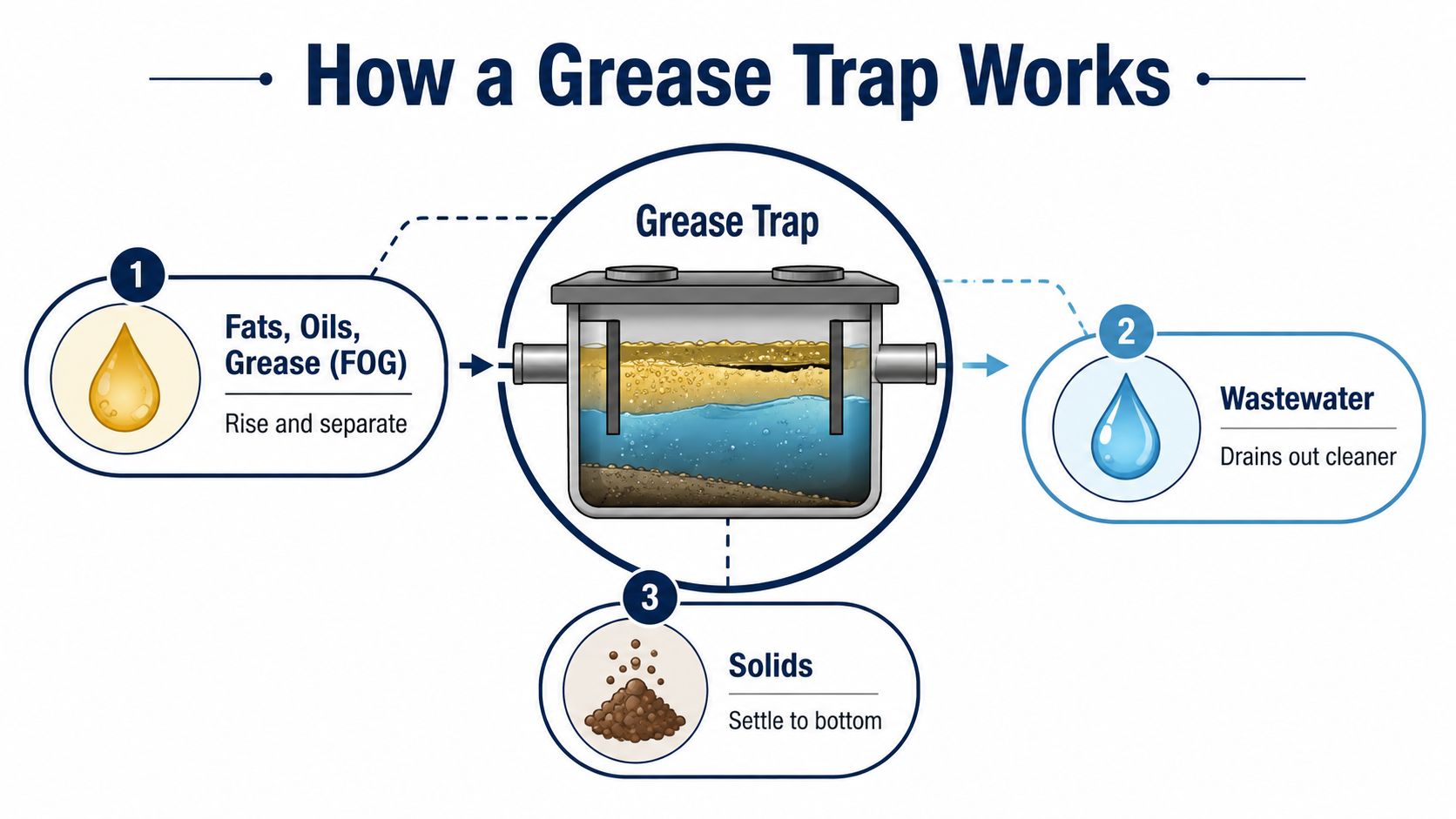
A grease trap works by slowing wastewater long enough for separation to happen. Hot water, food solids, and grease enter together. As the flow loses speed, heavier particles settle to the bottom, grease rises to the top, and cleaner water moves out through the outlet.
The parts that make separation possible
The sequence is straightforward, but the details decide whether the trap holds up in service. Wastewater comes in through the inlet, flow slows inside the chamber, heavier solids drop into the sludge zone, and lighter grease floats upward. An outlet baffle or weir keeps grease from leaving too soon, and the clarified water exits after enough retention time has passed for separation to occur. Hong Kong's environmental guidance says the trap should hold all kitchen wastewater entering during peak use for 20 minutes, recommends a single-sink unit no smaller than 250 L (55 gal), and calls for inlet baffles plus a 90° downward inlet bend that injects flow at least 100 mm below the water surface so grease can rise instead of short-circuiting to the outlet (guidance).
Field failures usually start with hydraulics, not with the grease itself. A trap can be large on paper and still perform poorly if the inlet shoots across the tank, if the water path is too short, or if the flow arrives too fast for the chamber to separate it. I have seen units that looked fine during installation and still behaved like open pipe because the internal layout was wrong, or because the kitchen kept forcing peak flow through a small body. For LA property managers, that is the part worth watching, because a trap that is sized for the fixture count but installed without proper inlet control will still back up. The practical check is to confirm the layout against a local compliance guide, such as this Los Angeles plumbing code compliance guide, before the kitchen starts generating repeat service calls.
The main trap types in LA properties
Small under-sink units are common in lighter-use kitchens, service stations, and tenant spaces where fixture flow stays modest. Larger exterior interceptors are more common in high-volume foodservice because they give the waste stream more room to slow down and they provide better access for pumping and inspection. The right choice depends on the actual kitchen load, not the amount of space left under the counter.
Maintenance access is the part owners and managers miss most often. A trap that is hard to open, hard to inspect, or hidden behind other equipment usually gets ignored until it starts failing. Once that happens, the tank fills unevenly, grease escapes earlier than it should, and the first visible symptom is often a backup somewhere else in the building. The physical layout matters just as much as the nominal capacity, especially in older LA properties where the drain run was never designed around present-day kitchen use.
Los Angeles Sizing and Code Requirements
A grease trap in Los Angeles fails for the same reason in too many kitchens. The trap was sized around the plumbing fixture count on paper, then the actual kitchen pushed more hot water, more food solids, and a faster discharge pattern through it than the unit could separate. I see that in properties that keep paying for emergency cleanouts while the problem sits in the hydraulic design.
What the sizing numbers are really saying
Sizing is tied to the connected load, the discharge pattern, and the trap's certified capacity. For owners and managers, the practical question is not whether the unit fits under a sink or in a mechanical area, it is whether it can handle the fixtures feeding it without short-circuiting flow. Los Angeles code expectations are usually read through the fixture count, discharge volume, and approved device rating, and EZ Plumbing's Los Angeles plumbing code guide is a useful plain-English reference when you need to match the field layout to local compliance.
The trap has to be matched to the kitchen, not to the leftover space around it. A small change in fixture layout can push a marginal unit into overload during service peaks, and overload usually shows up first as grease carryover in the downstream drain line, slow fixtures, or repeated backups at the same branch.
| Connected Fixtures | Minimum Flow Rate | Grease Retention Capacity |
|---|---|---|
| 1 | 76 L/min | 18 kg |
| 4 | 189 L/min | 45 kg |
| Larger installations | 75 gpm (284 L/min) maximum | Fixture discharge limited to 2.5× certified flow |
Why depth and internals matter
A trap can meet a nominal capacity and still fail in service if its internals are poorly arranged. Too much depth creates dead zones, solids settle in the wrong places, and grease has more room to bypass separation before it reaches the outlet. That is the kind of failure that keeps recurring because the tank is technically present, but the hydraulic path inside it is wrong.
Serviceability matters just as much as the rating. If the lid is buried, the baffles are awkward to reach, or the unit cannot be inspected without moving equipment, the trap usually gets neglected until the first backup forces a correction. That is why property managers should ask for the rated flow, grease capacity, fixture count, and the service access plan, not just the physical dimensions.
For design and maintenance planning, the goal is to prevent costly equipment failures before the kitchen starts generating repeat service calls. In older LA buildings, that also means checking whether the drain run, the venting, and the interceptor location were ever meant to support the current kitchen load.
Maintenance Schedules and Safe DIY Cleaning Steps
A grease trap can look fine from the outside and still be one busy shift away from a backup. In the field, that usually comes down to two things, nobody is checking the trap often enough, and the kitchen is pushing more grease and solids through the system than the trap was set up to handle. The practical failure is usually hidden until the line slows, the sink starts to rise, or the trap starts pushing grease downstream.
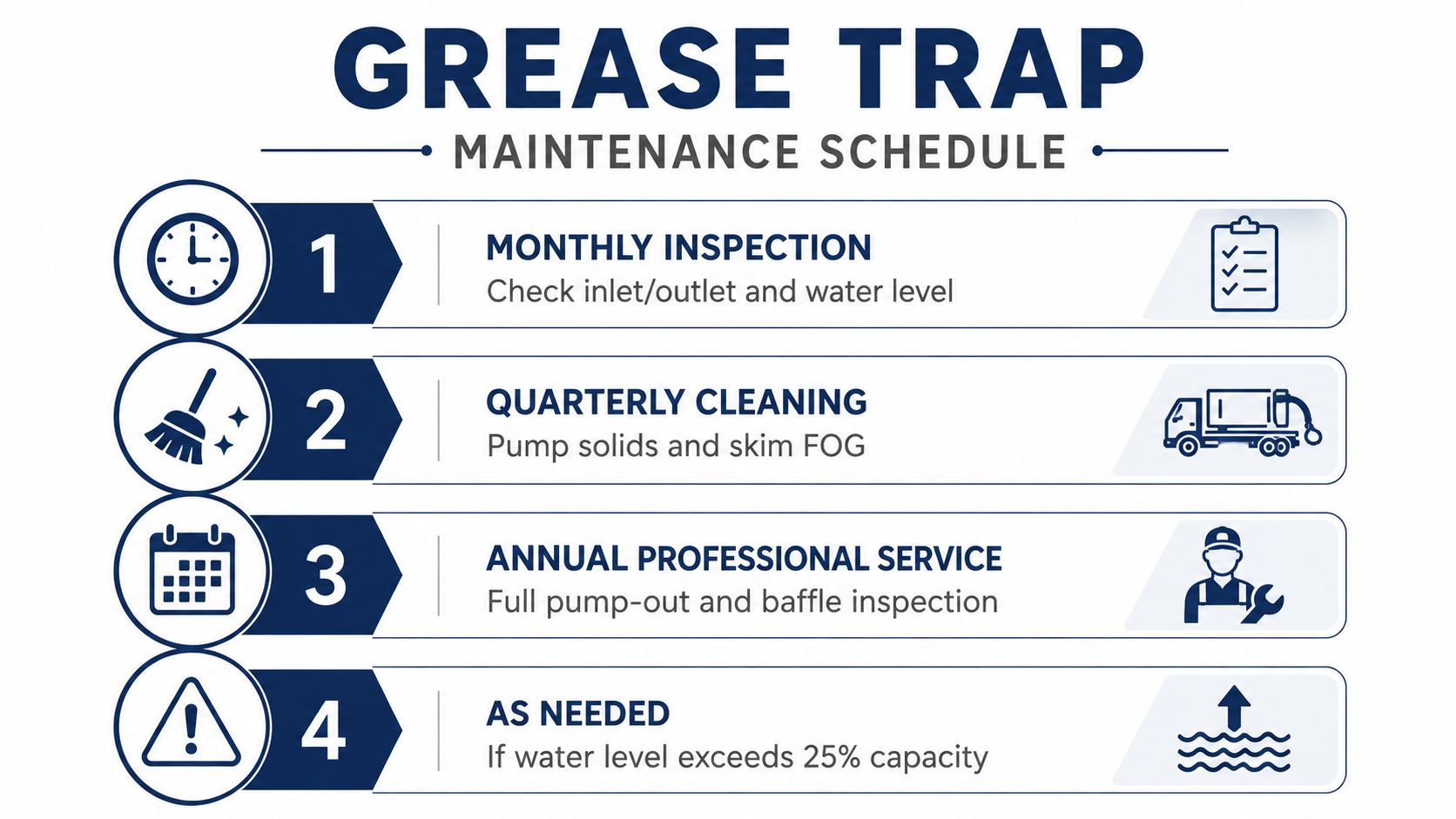
Maintenance is where many traps win or lose the battle. The hardware can be fine and the plumbing can be right, but if nobody tracks how full the unit gets or when it was last serviced, the kitchen is just waiting for a backup to prove the point. A field survey found that many users were not cleaning at a sensible fill level and some were still pouring used fats, oils, and grease down the drain, which matches what I see when a property manager is relying on memory instead of a log.
What staff can safely do
For a small under-sink trap, staff can handle simple checks if they're trained and the unit is accessible. That means opening the lid carefully, looking at the water level, checking for crusted grease around the baffles, and confirming that the inlet and outlet aren't blocked by solids. The goal is to catch a problem before the chamber fills high enough to push grease out of the unit. It also helps staff notice a slow-draining line early, which is often the first sign that the trap is getting overloaded by the way the kitchen is being used.
A maintenance log should be basic but consistent. Record the date, who checked it, whether the water level looked normal, whether the baffles were clear, and whether the unit needed service. Keep the record simple enough that an opening manager can fill it out in under two minutes, or it will get skipped during a busy shift. That habit matters because many kitchens can say they maintained the trap, but they cannot show when the unit was last checked or what condition it was in.
For staff training, a resource on prevent costly equipment failures can help reinforce the habit of sticking to a maintenance schedule rather than waiting for a visible mess.
Where DIY stops
DIY ends when the trap is exterior, heavily loaded, or tied into a kitchen that regularly handles frying and high-volume washdown. Those units need pumping equipment, proper disposal handling, and a real inspection of the baffles and inlet path. If the trap is close to overflowing, smells strongly, or has repeated backups, the issue is no longer a routine housekeeping task. In those cases, a clogged outlet, a bad slope, or a drain run that was never sized for the current kitchen load can keep sending the same problem back.
For a small accessible trap, safe cleaning means removing the top layer of grease, scooping out settled solids if the design allows it, rinsing without blasting debris downstream, and reassembling the unit so the seals sit correctly. The crew should leave the inlet, outlet, and lid seating the way they found them, because a poor reseal can create a new leak or let odors escape. For any unit that's connected to a main drain run or a shared service line, use a qualified crew instead of improvising. If you need a field-oriented walkthrough for staff or a vendor checklist, this commercial kitchen grease trap cleaning guide is the practical version I'd hand to a manager.
Hidden Causes of Grease Trap Failure
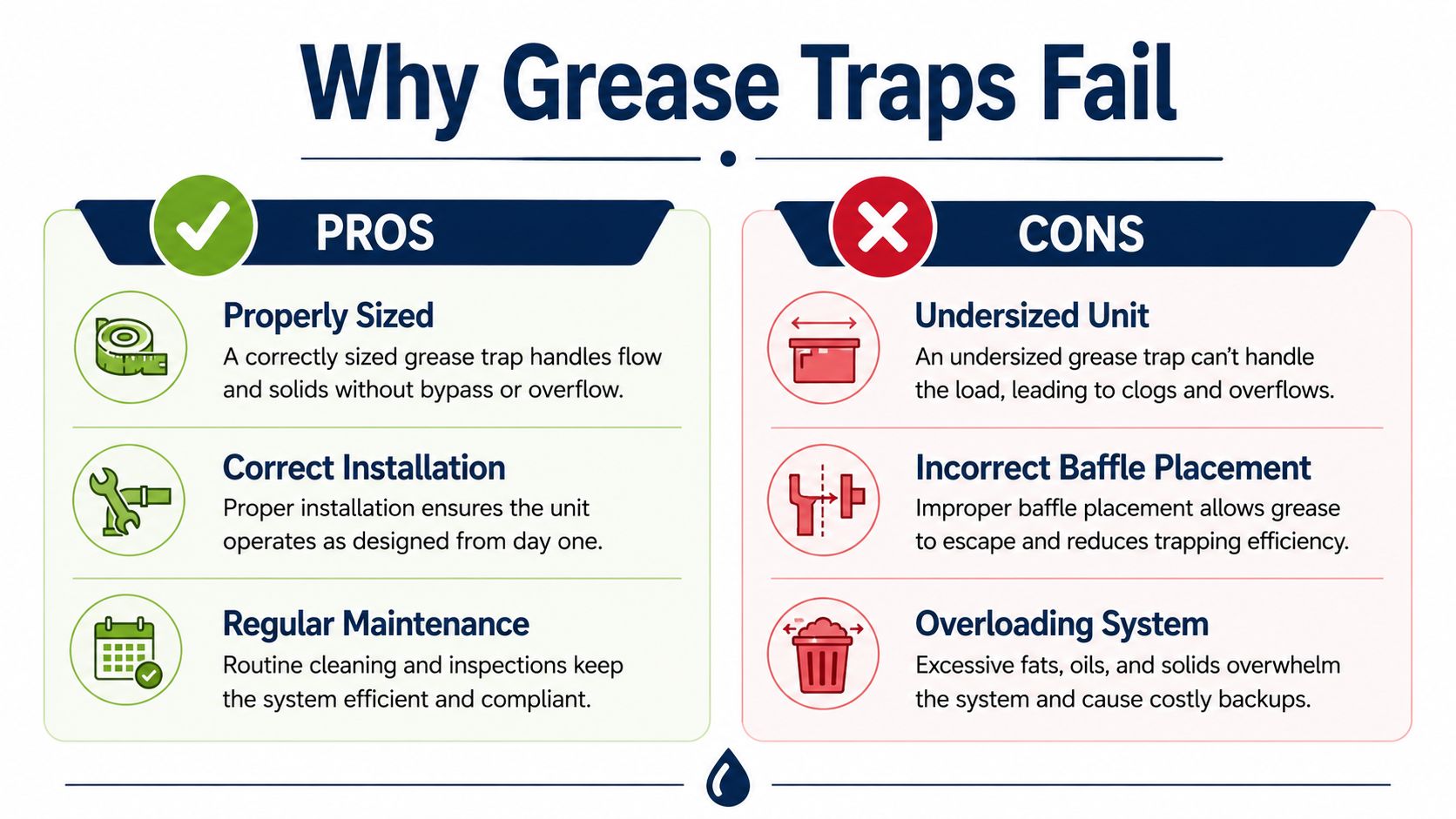
A kitchen can keep backing up even after a fresh pump-out. In the field, I usually find the problem hiding in the system design, not the cleaning log. The trap may be the wrong size, the baffles may be set up poorly, or the drain run after the trap may be carrying the primary load.
When bigger doesn't fix it
Oversized units do not automatically perform better. One industry source notes that bigger is not always better and that retention time is not a reliable performance metric, which matters because many operators assume extra tank volume solves every grease issue (industry commentary). That breaks down when the trap is too large for the flow pattern, because water can move through too quickly and leave grease behind.
Undersized units fail in a different way. They load up fast during service, then grease starts slipping into the downstream piping. The same thing happens when the inlet baffle is wrong, the water path is too short, or the connected fixtures send more flow than the trap was built to handle.
The drain line is often the failure point
A backup does not always start in the trap. The line after it may already have buildup, poor slope, or recurring debris that makes the trap look bad when the actual choke point sits farther downstream. That is why a competent technician checks the connected drain lines, not just the chamber lid, before calling the job done. If a crew keeps pumping the trap and never inspects the line beyond it, the kitchen usually sees the same symptoms again.
The waste side matters too. One source says landfill disposal is prohibited under the EPA Solid Waste Disposal Act and that intercepted grease is typically sent for reuse or recycling (waste handling overview). That makes disposal documentation worth asking for, especially when compliance records, tenant reporting, or ESG questions come up. The kitchen grease trap is part of a waste-handling chain, not just a plumbing box.
If the same kitchen keeps backing up after service, stop asking only “when was it cleaned” and start asking “was it sized right, installed right, and checked beyond the trap itself?”
For operators who need to separate a trap problem from a line problem, how to clear a grease-clogged drain is a useful reference point, but repeat backups need a proper inspection, not another chemical treatment or a quick flush.
How EZ Plumbing Solves Grease Trap Problems
A real fix starts with diagnosing the system, not just pumping the box. For Los Angeles properties, that usually means checking the trap, the connected drain line, and the service access points in one visit, then deciding whether the issue is cleaning, repair, jetting, or a new installation. EZ Plumbing handles grease trap cleaning, hydro-jetting for grease and debris, diagnostics, repairs, and installations, which is the right sequence when a kitchen keeps failing after routine service.
What a professional response should include
The technician should confirm whether the trap is properly sized, whether the baffles and inlet path are intact, and whether the drain line past the trap is contributing to the backup. If the line is fouled, hydro-jetting clears buildup more effectively than a surface-level rinse. If the trap is worn, cracked, or mismatched to the fixture load, repair or replacement is the actual fix.
For property managers and HOAs, licensing and insurance matter because these jobs affect compliance and tenant operations. A contractor who communicates clearly from dispatch to completion also makes it easier to keep maintenance logs and service records in order. That matters when inspectors ask questions or when a tenant reports the same odor twice in a month.
When to bring in a pro
Bring in a licensed plumber when the trap is exterior, the backup affects multiple fixtures, or the same kitchen keeps failing after a cleanout. Bring one in again if the unit is too deep, difficult to access, or showing signs of repeated overloading. That's the point where DIY becomes a false economy.
Your Grease Trap Action Plan
If the kitchen is draining slowly, start with the basics. Check whether the trap has been serviced recently, whether a log exists, and whether anyone has looked at the drain line after the trap. If the same problem keeps returning, treat it as a sizing or system issue, not just a cleaning issue.
Use this rule of thumb. Inspection for first-time slow drainage, cleaning for a unit that's visibly loaded, resizing or repair when backups return after service, and full replacement when the trap or internals can't do the job anymore. For LA properties, that decision is usually cheaper when made early than after one more flooded service line.
If you manage a kitchen, HOA, rental building, or commercial property in Los Angeles and you want a clear assessment of the trap, the drain line, and the fix, schedule a professional visit with EZ Plumbing. Their team handles grease trap cleaning, jetting, diagnostics, and installations, so you can stop guessing and get a system that holds up during service.