
Two Leaks in 12 Months Means Repipe: Homeowners’ Copper Pipe Lifespan
Most residential copper supply lines typically last several decades, though water chemistry, pipe type, and installation quality can significantly affect that lifespan. The decision rule is simple: once a home ages considerably and starts producing multiple pinhole leaks or discolored water, it’s time to bring in a licensed plumber for diagnostics rather than patching leak after leak. The WSSC copper pipe white paper is one of the clearest industry references on why that lifespan swings so widely.
TL;DR:
- Copper pipes in homes with aggressive water chemistry, such as low pH or high hardness, may need replacement sooner than the typical 50-year average.
- Repeated pinhole leaks within a year usually indicate systemic material degradation or early failure due to interrupted protective film formation, not old age.
- Whole-house repiping costs often become more economical than multiple repairs after three or more leaks in a year, especially when failures span the entire system.
- Maintaining water pH, pressure, and proper grounding can significantly extend copper pipe lifespan and delay the need for replacement.
- Copper’s longevity is heavily influenced by water chemistry, making it less predictable in areas with poor water quality, where PEX may be a more durable alternative.
Table of Contents
- Typical Copper Pipe Lifespan Range and Why Estimates Differ
- What Factors Actually Shorten or Extend Copper Pipe Life
- What Are the Warning Signs of Aging Copper Pipes?
- Is It Cheaper to Repair or Repipe Copper Pipes?
- How Can You Extend the Life of Copper Pipes?
- Copper vs. PEX: Which Pipe Material Lasts Longer?
- What a Licensed Plumber Checks Before Recommending a Repipe
- The Real Lesson Homeowners Miss About Copper Pipe Lifespan
- Sources
- FAQ
Typical Copper Pipe Lifespan Range and Why Estimates Differ
You’ll see different numbers depending on where you look, and both are correct for different purposes. Trade sources commonly cite several decades for actual field performance, while some engineering references use a more conservative figure purely for design calculations, not as a prediction of when pipes will fail. That gap confuses a lot of homeowners doing research.
The type of run matters too. Cold water mains tend to outlast hot water branches because heat accelerates the chemical reactions that wear down copper’s internal surface. Closed loop heating circuits are typically the shortest lived due to oxygen ingress and sludge buildup, because oxygen ingress and sludge buildup attack the metal from the inside.
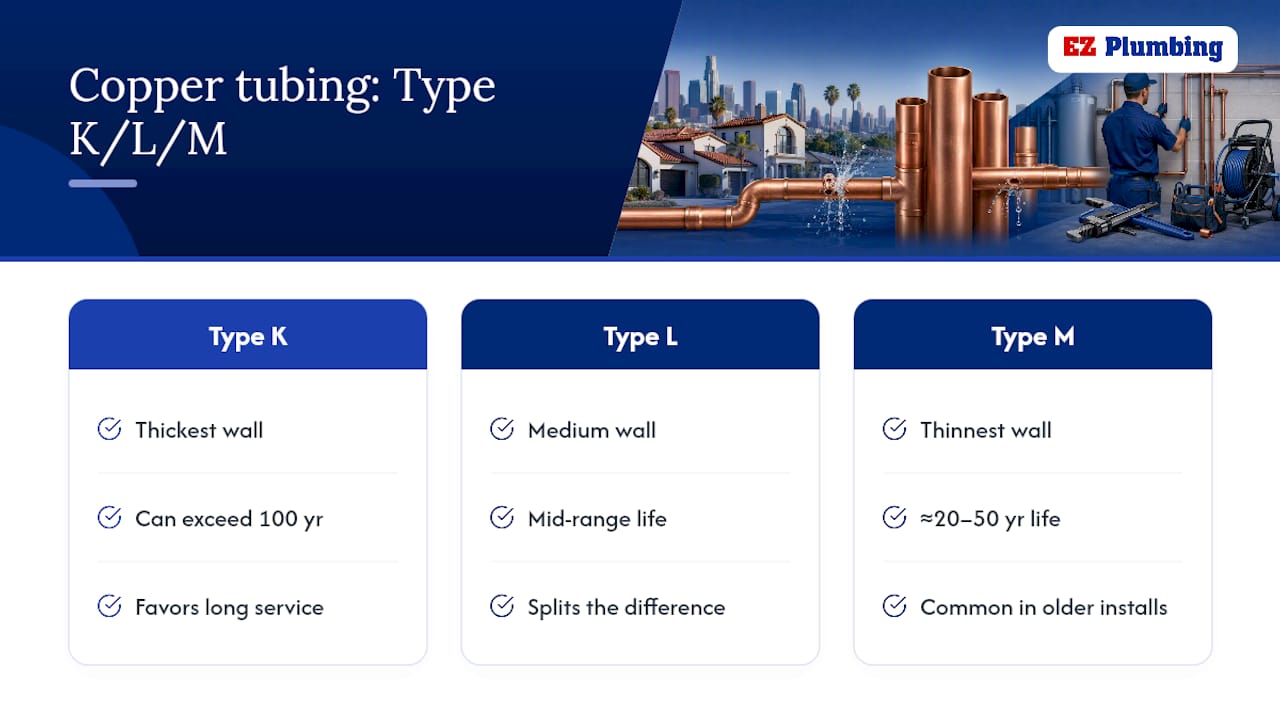
Pipe wall thickness plays an equally large role. Type K copper, the thickest grade, can exceed a century in favorable water conditions. Type L splits the difference, and thinner Type M tubing, often used in older or budget-conscious installations, can fail in as few as 20 to 50 years depending on what’s running through it, according to Repipe OC’s breakdown of copper pipe longevity.
What Factors Actually Shorten or Extend Copper Pipe Life
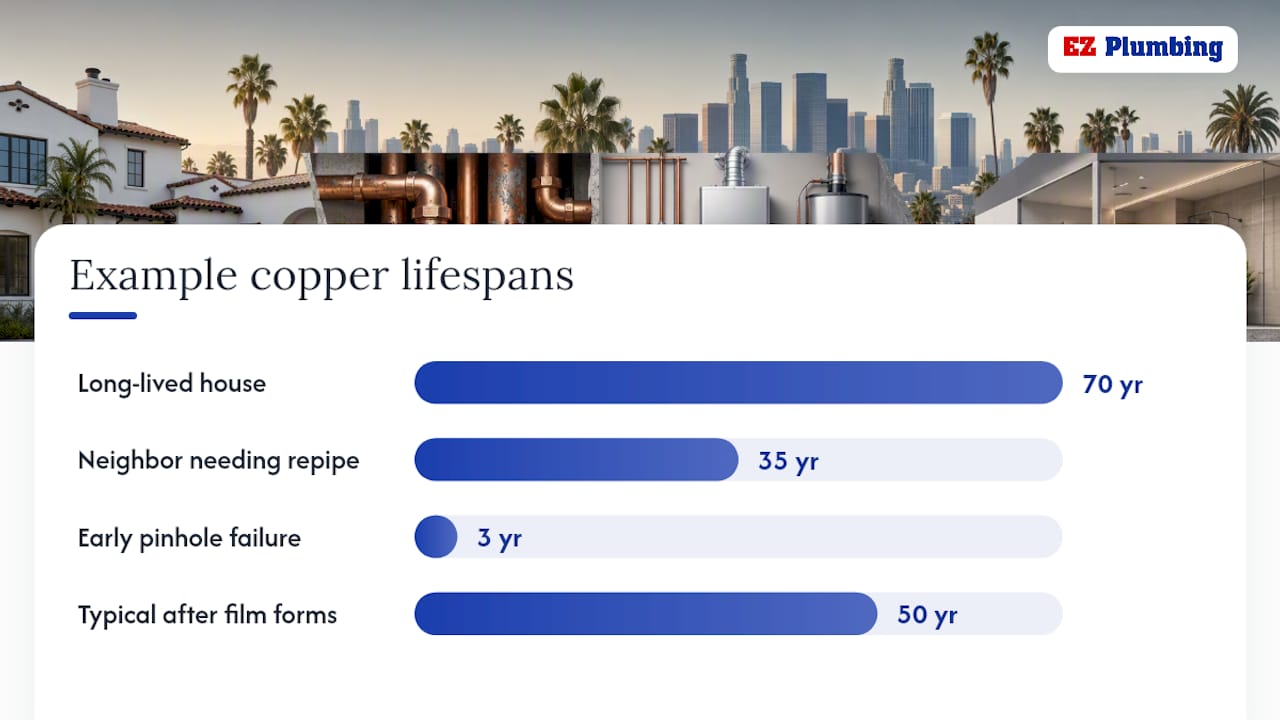
Water chemistry does more damage to copper than age alone. If you want to know why one house lasts 70 years and the identical house next door needs a repipe at 35, look at what’s flowing through the pipes before you look at the calendar.
Chemical factors:
- Water hardness above 11 grains per gallon is considered aggressive and speeds up internal corrosion, per the WSSC white paper.
- pH below 7.0 destabilizes the protective oxide layer copper needs to survive long term; the ideal range generally sits between roughly 7.0 and 9.0.
- Dissolved oxygen and residual chlorine both accelerate pitting, particularly in newer systems where the protective film hasn’t fully formed.
Mechanical and installation factors:
- Poor soldering joints, overbent tubing, and mismatched fittings create weak points long before the pipe itself would naturally fail.
- Consistently high water pressure and repeated temperature cycling (especially near water heaters) stress joints and accelerate wear.
- Stray electrical currents from grounding issues can cause localized corrosion that looks nothing like typical age related wear.
Environmental factors for buried lines:
- Acidic or high-chloride soil eats away at exterior copper surfaces from outside the pipe.
- Direct contact with concrete, common in older slab foundations, traps moisture against the pipe and accelerates corrosion at contact points.
A protective film of copper oxides and mineral scale usually forms during the first few months of service, and it’s what slows corrosion rates dramatically after that initial period. When that film formation gets interrupted, whether from a bad batch of new construction water or a botched repair, failures can show up shockingly early. That’s why some homes see pinhole leaks in year three, not year fifty.
Pro Tip: If you’ve had recent repiping or major repairs done, ask your plumber whether the new sections were flushed properly before use. Interrupted film formation is one of the most overlooked causes of early pinhole leaks in otherwise new copper.
What Are the Warning Signs of Aging Copper Pipes?
Pinhole leaks are the signature failure mode for aging copper, and they tend to cluster at two very different points in a pipe’s life. Early failures, often within the first one to six years, usually trace back to interrupted protective film formation rather than true old age. Late failures, showing up after 50 or more years of service, are the ones that actually mean the material has worn out.
One rule cuts through most of the guesswork: two or more pinhole leaks at separate locations within a 12-month window signals systemic material degradation, not bad luck. That’s the point where industry repipe advisories generally recommend planning a whole-house repipe instead of continuing to patch individual failures.
Watch for these signs between formal inspections:
- Discolored or metallic-tasting water, especially first thing in the morning.
- Noticeably lower water pressure across multiple fixtures at once.
- Visible green or blue staining on pipes, fittings, or nearby surfaces.
- Banging, ticking, or whining noises in the walls when water runs.
- Small pinhole leaks appearing in more than one room.
Pro Tip: Keep a simple log every time you call a plumber for a leak, even a minor one. Two entries within a year is your cue to stop thinking “repair” and start thinking “repipe.”
Is It Cheaper to Repair or Repipe Copper Pipes?
Spot repairs for an isolated pinhole leak typically run a few hundred dollars per incident, which sounds manageable until you’re paying that bill for the third or fourth time in a year. Whole-house repipe projects, by contrast, commonly land in permit scopes ranging from several thousand dollars to low five figures depending on home size and regional labor costs, based on repipe cost data compiled by AlertPlumber.
Run the math before deciding:
- Three or more spot repairs in a single year often add up to more than half the cost of a full repipe, and they don’t reset the clock on the underlying material problem.
- Partial repipes make sense when failures cluster in one section (a single bathroom’s hot water branch, for example) rather than throughout the house.
- A full repipe typically resets your service life to another 50 plus years, while repeated patching just delays an inevitable larger job.
- Most whole-house repipe projects for a typical single-family home usually take a few days for the plumbing work itself, though drywall and finish repairs can extend the total timeline.
The repeated-repair trap is real: homeowners who keep saying yes to $400 patch jobs often spend more over 18 months than they would have spent repiping the whole system upfront.
How Can You Extend the Life of Copper Pipes?
Most of what shortens copper pipe life is preventable, and none of it requires specialized tools you don’t already have access to through a plumber.
- Test your water’s pH and hardness annually; a hardness level above 11 gpg or a pH consistently below 7.0 warrants a water softener or neutralizer.
- Confirm your home has a working pressure regulator, since sustained high pressure quietly stresses every joint in the system.
- Keep your water heater at a reasonable, consistent temperature rather than cycling it aggressively, which reduces thermal stress on nearby copper branches.
- Check that plumbing is properly grounded and that no pipe sections sit in direct, unprotected contact with concrete.
- Schedule a professional inspection every few years, especially once your system passes the 25 to 30 year mark.
Pro Tip: If your home was built before 1990 and you’ve never had your water tested, that’s the single easiest first step. A basic water chemistry test costs far less than one pinhole leak repair, and it tells you immediately whether your home’s water is accelerating corrosion.
Copper vs. PEX: Which Pipe Material Lasts Longer?
Copper’s biggest vulnerability compared to PEX is chemical: aggressive water chemistry (low pH, high hardness, high chlorine) attacks copper directly, while PEX is largely immune to those same conditions. That’s the core trade-off behind most repipe decisions today.
- PEX installation typically involves less labor and fewer joints, which can mean lower material and labor costs and fewer potential leak points during installation.
- Copper still holds an edge in resale perception among some buyers and appraisers, and it’s fully recyclable at the end of its service life.
- PEX is a pragmatic choice in homes with known aggressive water chemistry or in budget-sensitive repipe projects where long-term corrosion risk from water quality is a bigger concern than material preference.
Neither material is universally “better.” The right choice depends heavily on your home’s water chemistry, your budget, and how long you plan to own the property.
What a Licensed Plumber Checks Before Recommending a Repipe
When Ez-plumbing evaluates a home’s copper system, the process starts noninvasive and escalates only if needed: a visual inspection of accessible pipe sections, a review of past repair history, a water pressure test, a quick water chemistry spot check, and targeted leak detection scans in areas where pinholes are likely hiding.
A repipe recommendation usually follows a clear pattern: multiple leaks within 12 months, water chemistry readings outside safe ranges, or visible pitting across several fixtures. From there, estimates are scoped around a home’s actual layout and local code requirements, so the finished work passes inspection the first time. If you’re not sure which category your home falls into, scheduling a professional pipe inspection is the fastest way to get a real answer instead of guessing based on age alone.
The Real Lesson Homeowners Miss About Copper Pipe Lifespan
The conventional advice treats copper pipe lifespan like a countdown clock: install it, wait 50 years, replace it. That framing misses the point. Age is a weak predictor of failure on its own. Water chemistry is the stronger signal, and it’s the one almost nobody checks until something has already gone wrong.
What the evidence actually supports is a shift in priority: test the water before you worry about the calendar. A 15-year-old home with aggressive water chemistry can be in worse shape than a 60-year-old home with stable, well-buffered water. That’s counterintuitive to most homeowners, who assume newer automatically means safer.
The second miss is emotional, not technical. People treat each pinhole leak as an isolated incident because that’s less alarming than admitting the whole system might be failing. The two-leaks-in-a-year rule exists precisely to override that instinct with something more objective. If you take one thing from this article, take that: stop counting years, start counting leaks, and get your water tested before you get your next quote.
— EZ
Sources
- Copper Pipe White Paper | WSSC Water
- How Long Does Copper Pipe Last: An Explainer | Repipe OC
- Signs Your House Needs a Whole-House Repipe | AlertPlumber
FAQ
How Often Should You Replace Copper Pipes?
There’s no fixed replacement schedule. Most copper systems last 50 to 70 years, but replacement timing should follow warning signs like repeated pinhole leaks or failed water chemistry tests, not a calendar date alone.
Why Do Some Plumbers Avoid Recommending Copper Anymore?
Copper’s sensitivity to water chemistry, particularly high hardness above 11 gpg or low pH, makes it less predictable in areas with aggressive water. Many plumbers now suggest PEX in those specific conditions because it resists corrosion that copper cannot.
What Lasts Longer, Copper or PEX?
It depends on your water chemistry. Copper can outlast PEX in stable, well-buffered water conditions, but aggressive water chemistry shortens copper’s life far more than it affects PEX.
Can a Copper Pipe Really Last 150 Years?
Under exceptionally favorable water conditions, thick walled Type K copper can exceed a century, though that is uncommon. Most homeowners should plan around the commonly cited 50 to 70 year range instead.