
Backflow Prevention Inspection: Your LA & CA Guide 2026
You open the mail, or more often the email, and there it is: a notice from your water purveyor telling you the backflow device on your property is due for testing. If you manage apartments, retail space, medical offices, or a mixed-use building in Los Angeles, that notice usually lands in the middle of everything else you're already juggling. Tenants need updates. Vendors need access. Someone wants to know if the water has to be shut off.
Many owners and property managers often stumble. They treat backflow prevention inspection like a simple paperwork chore. It isn't. It's a compliance requirement tied directly to water safety, and in California that means you need the right device, the right tester, the right documentation, and the right timing.
If you understand what's being inspected and why, the process gets much easier. You can schedule correctly, avoid failed visits, and deal with repairs before they turn into a violation or service interruption.
Table of Contents
- What Is Backflow and Why Is It a Serious Risk
- Backflow Inspection Laws in Los Angeles and California
- What Happens During a Professional Backflow Test
- Common Backflow Device Failures and Solutions
- Cost of Backflow Prevention Inspection and Repairs
- How to Prepare Your Property for Inspection Day
- Hiring a Certified Tester and Protecting Your Property
What Is Backflow and Why Is It a Serious Risk
A lot of people first hear the word backflow only after they get a compliance notice. By then, they're already asking the wrong question, which is usually, “Do I really need this test?” The better question is, “What is this device protecting?”
Backflow is exactly what it sounds like. Water that should move one way reverses direction and flows backward into the drinking water system. A simple way to think about it is a contaminated drink getting pulled back through a straw into a shared dispenser. If pressure drops on the supply side, or pressure builds on the private side, water can move the wrong way and carry contaminants with it.

How contamination actually happens
Two common conditions cause the problem:
- Back-siphonage happens when supply pressure drops and water gets pulled backward.
- Back-pressure happens when downstream pressure becomes stronger than the incoming supply and pushes water upstream.
That matters on real properties, not just in textbooks. Irrigation systems, fire sprinkler lines, boilers, chemical feed equipment, pools, and hose connections can all create cross-connections that need control.
Practical rule: If water on your property touches anything that shouldn't re-enter the public supply, the backflow assembly is the barrier standing between a contained plumbing issue and a public health problem.
This is why backflow prevention inspection is tied to health, not just code enforcement. If you want a broader public-health view, this guide on preventing E. coli in drinking water is useful context. The same basic principle applies here: once contamination reaches potable water, the consequences are much bigger than a single fixture or a single tenant complaint.
Why property managers should take it seriously
A visual glance at the device doesn't prove it will hold under real pressure conditions. Mechanical assemblies have to perform, not just look intact. That's one reason a proper inspection is handled with test equipment and formal documentation, not guesswork.
For a homeowner, that may mean making sure an irrigation or pool line is protected. For an HOA or commercial manager, it means protecting residents, occupants, and the building's compliance status. This is also part of the bigger connection between safe plumbing systems and household health covered in the role of plumbing in family health.
Backflow Inspection Laws in Los Angeles and California
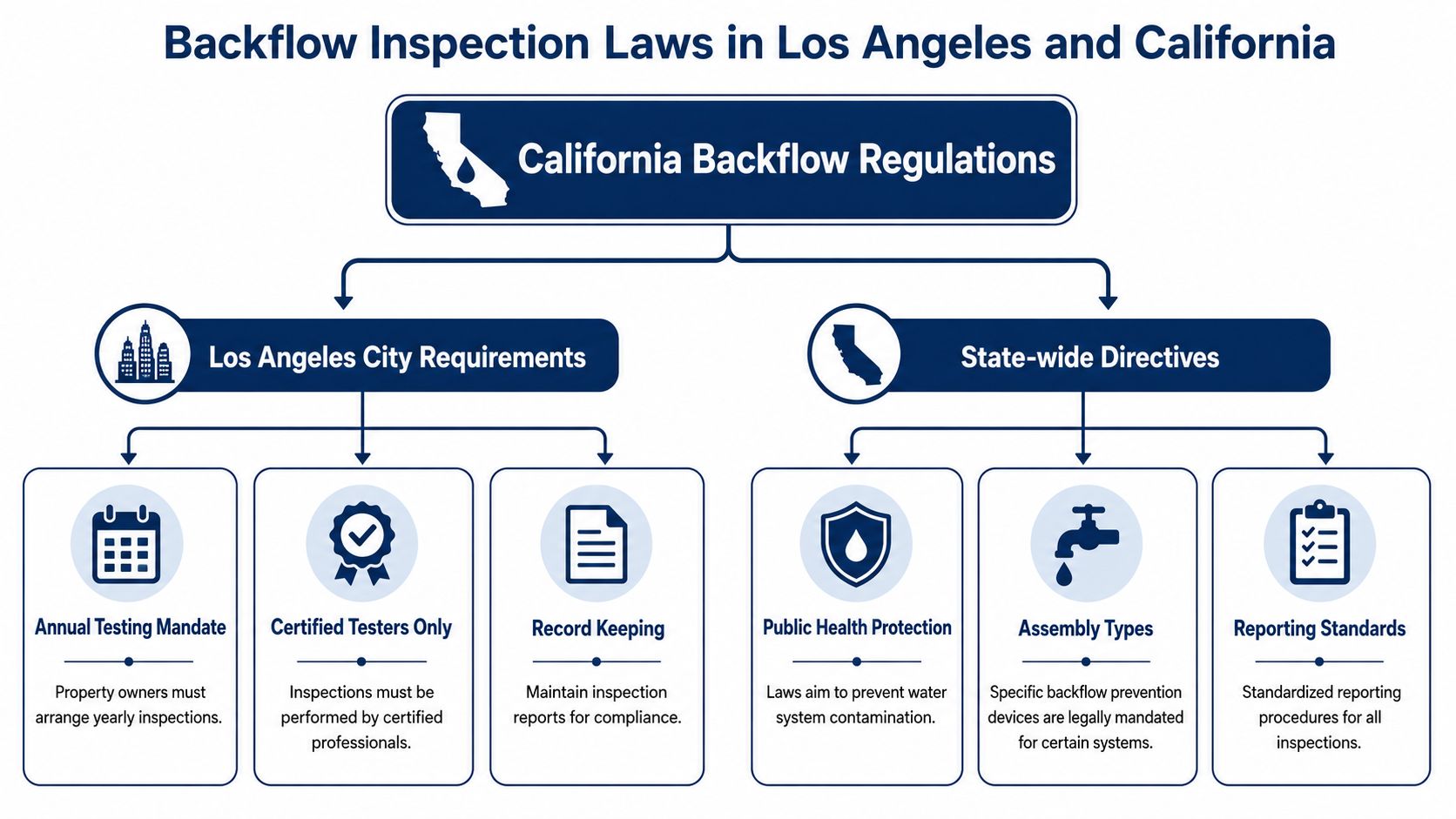
A Los Angeles property manager usually finds out about backflow law the hard way. A notice arrives from the water purveyor, the test date is close, and the assembly has not been checked yet. If the device fails or the paperwork is rejected, the problem shifts from routine maintenance to a compliance issue tied to water service.
In Los Angeles and throughout California, backflow control is enforced through the local water supplier's cross-connection control program. The practical point for owners and managers is simple. If your property has a listed backflow assembly, the agency expects it to be tested on schedule, reported correctly, and kept in operating condition.
Across many municipalities, overdue testing can trigger penalties or water shutoff action, as explained in this backflow compliance overview. In California, those requirements are usually enforced at the local level, so the deadline, report format, and tester approval rules often come from the specific water purveyor, not from a plumber's office.
What this means in Los Angeles
Los Angeles properties are commonly tracked by device, address, and hazard type. The water authority or serving utility keeps an inventory, sets the testing interval, and wants a passing report from an approved tester. If the serial number, assembly type, or location on the report does not match the record, the submission can be rejected even when the device itself passes.
That is the part many owners miss.
The legal requirement is not just to have the assembly looked at. The requirement is to submit an acceptable test result within the deadline the agency sets.
Properties that often end up in the program include:
- Commercial buildings with tenant improvements, dedicated irrigation, or fire service connections tied to domestic water concerns
- Industrial properties where process water, chemical use, or equipment creates a cross-connection hazard
- Multi-family buildings with irrigation systems, booster pumps, boilers, or shared mechanical systems
- Single-family properties with pools, irrigation, or other higher-risk connections, depending on local enforcement
Single-family owners are sometimes surprised by that last category. In California, exemption is not automatic if the property has a condition the local agency considers a hazard.
California compliance points that matter on real properties
California backflow enforcement is paperwork-heavy for a reason. The state framework supports cross-connection control, but day-to-day compliance usually depends on the local purveyor's rules, approved tester list, and reporting process.
Property managers should stay focused on three points:
Track the actual due date
Many assemblies are tested on an annual cycle, but the due date may follow the agency's inventory schedule rather than the date that is convenient for the property. Miss the deadline, and the issue moves into enforcement.Use a properly certified tester with a current gauge
A visual inspection does not satisfy the testing requirement for a mechanical assembly. California programs typically require a certified tester and acceptable test equipment, which is why owners should understand how a backflow preventer works before they assume any plumbing visit counts as compliance. As discussed in this California-focused explanation of backflow testing requirements, the test has to be performed and documented correctly.Make sure the report matches the site conditions
Wrong serial number, wrong assembly type, missing address details, unsigned forms, and unreported repairs can all create rejection problems. On some jobs, the tester can identify the failure, but a licensed plumbing contractor has to complete the repair or replacement before the retest is filed.
A backflow prevention inspection only protects the property's compliance status if the water purveyor accepts the report.
The legal risk is usually delay, not confusion
Most Los Angeles compliance problems are straightforward. The notice was ignored, access to the assembly was poor, the device failed, parts were not ordered in time, or the paperwork sat unsigned until the deadline passed.
From a plumbing standpoint, that is avoidable. Good property management means treating the backflow notice like any other regulated life-safety or health item. Schedule early, confirm the assembly record before the appointment, and leave time for repairs and retesting if the device does not pass the first time.
The owner or manager carries that responsibility. The tester performs the test. The plumber repairs the assembly if needed. The water purveyor decides whether the submission satisfies the law.
What Happens During a Professional Backflow Test
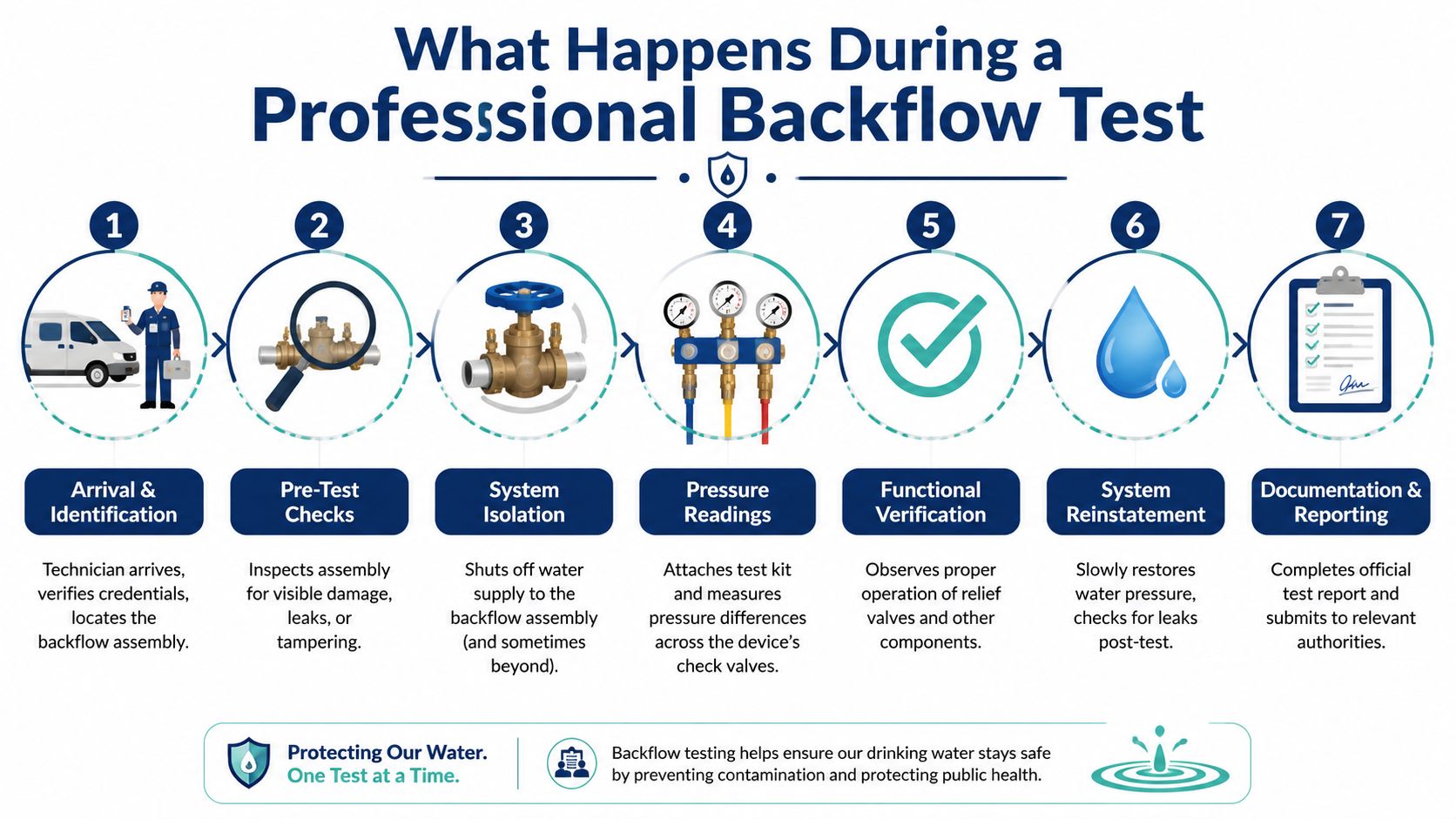
A Los Angeles property manager usually sees the testing notice first. A certified tester sees the part that decides whether that notice turns into a clean filing or a failed compliance cycle. On site, the job is straightforward. Identify the correct assembly, verify that it can be tested safely, run the required procedure, and document the result in a form the local water purveyor will accept.
The first part of the visit
The visit starts with the basics that often cause trouble later. The tester confirms the assembly type, size, manufacturer, model, serial number, and exact location. In Los Angeles, that information has to line up with the utility record and the test form. If the site has a different device than the one on file, the paperwork issue needs to be caught before the report is submitted.
Then the tester checks the condition of the installation. Leaks, damaged shutoff valves, missing test cock caps, corrosion, flooding around the assembly, poor clearance, and signs of tampering can all interfere with a valid test. Some assemblies can be tested and repaired the same day. Others have to be written up first because the device is not in testable condition.
Water interruption is another practical issue. A domestic assembly may require a short shutdown. A fire line assembly has a different level of coordination and often involves the building engineer, alarm company, or fire protection vendor before work starts. On larger California properties, that coordination matters as much as the test itself.
The actual testing process
The core of the job is a controlled performance test using a calibrated differential pressure gauge. The tester connects to the test cocks in a specific sequence and checks whether the internal checks and relief valve operate at the required points for that assembly type. A reduced pressure assembly is tested differently from a double check assembly, and the form has to match the device that is installed.
For fire protection systems, the testing schedule can be stricter and separate from the domestic water side. NFPA 25 identifies annual forward flow and backflow performance testing for fire sprinkler backflow assemblies, as explained in this NFPA 25 discussion for fire protection systems.
Later in the visit, it helps to see the process in motion:
What the tester is looking for
A professional test answers four practical questions:
- Are the check valves holding tight under test conditions
- If it is an RP assembly, does the relief valve open at the correct differential
- Can the assembly maintain protection when pressure changes
- Are the shutoff valves and test cocks in good enough condition to support a valid result
That last point gets overlooked. A backflow assembly can fail because the internal checks are worn, but it can also fail because the shutoff valves will not seal or the test cocks are damaged. In the field, that distinction matters because it affects repair scope, parts ordering, and whether the property can get back into compliance quickly.
Some fire assemblies also have separate inspection items between annual tests. This inspection summary for fire protection backflow preventers outlines weekly observation of RP relief discharge conditions, quarterly main drain testing in certain configurations, and periodic internal inspection. That is one reason Los Angeles multifamily, commercial, and mixed-use properties often need a clearer tracking system for domestic and fire line devices.
A good tester should be able to tell you exactly what passed, what failed, whether repair parts are likely available, and whether the retest can be done before your deadline.
The final step owners often overlook
The field test is only half the job. The record has to be complete, legible, and acceptable to the water purveyor or local enforcing agency. That means the make, model, serial number, assembly type, size, location, test values, tester information, and pass or fail result all need to be accurate.
In California compliance work, small paperwork mistakes create real delays. The wrong serial number, a missing signature, a form that lists the wrong assembly type, or a repair that was completed but not reflected on the retest can all hold up acceptance. For a property manager, the practical question is not whether the technician spent time on site. It is whether the report was submitted correctly and accepted.
If the assembly passes, the result is filed. If it fails, the next step is repair or replacement, then retesting, then submission of the corrected report. That is why a professional backflow test on a Los Angeles property is both a mechanical procedure and a compliance task.
Common Backflow Device Failures and Solutions
A Los Angeles property manager usually finds out about a bad assembly at the worst time. The annual notice is already in hand, the tester is on site, and a device that looked fine from the outside will not hold pressure or gives unstable readings. That is common in compliance work. Backflow assemblies often fail internally long before anyone sees a leak.
On Los Angeles and California properties, the practical issue is not just mechanical failure. It is whether the assembly can be repaired, retested, and accepted fast enough to satisfy the local water purveyor's deadline. Domestic, irrigation, and fire line devices each create different repair decisions, and older installations often bring parts availability and access problems into the equation.
What technicians commonly find
Here is what shows up most often in the field.
| Failure Symptom | Common Cause | Typical Solution |
|---|---|---|
| Continuous dripping from relief area | Debris on internal seating surfaces, worn relief valve parts, pressure imbalance | Clean internal components, install rebuild kit, retest |
| Check valve won't hold during test | Fouled check seat, mineral buildup, worn rubber parts, spring fatigue | Disassemble and rebuild if parts are available, then retest |
| Shutoff valves don't seal properly | Age, corrosion, damaged valve seats | Repair or replace shutoff valves so the assembly can be tested correctly |
| Device fails repeatedly after cleaning | Internal wear beyond rebuild condition | Replace the assembly |
| Test cocks leak or are damaged | Tampering, corrosion, age | Replace test cocks and caps, then perform a valid test |
| Visible exterior leakage | Freeze damage, cracked body, failed seals | Evaluate whether body damage allows repair or requires full replacement |
| Low or unstable gauge readings | Device problem, improper setup, or blocked passages | Confirm setup, inspect ports, rebuild or replace affected internals |
Relief valve discharge gets a lot of attention because it is visible. In practice, that symptom can mean several different things. A small discharge during testing may point to fouled internals or a relief valve that is no longer operating at the correct differential. A constant discharge after the test is a stronger sign that the assembly needs repair before it can be left in service.
Check valve failures are just as common. Mineral scale, street-side debris, and worn rubber parts keep the check from sealing tightly enough to pass. In Southern California, older assemblies on hard-water systems often fail this way. If the body is in good condition and the manufacturer still supports the model, a rebuild is usually reasonable.
Shutoff valves change the repair decision fast.
If the tester cannot rely on the shutoff valves, the test result may be invalid or the assembly may be impossible to evaluate correctly. That is where property managers sometimes spend money twice. They approve an internal rebuild, then learn the isolation valves still have to be repaired or the whole unit replaced. On an older Los Angeles installation in a vault, cage, or tight mechanical corner, replacement can be the cleaner choice.
What works and what wastes time
Cleaning debris works when the problem is recent and the assembly has not been worn down by years of service. Rebuild kits also make sense when parts are stocked, the brass body is sound, and the installation itself still meets local requirements.
Repeated failure after cleaning usually points to a device at the end of its service life. The same is true when shutoff valves are badly corroded, test cocks are damaged, or the assembly has a cracked body. At that point, trying to get one more pass out of it often costs more in labor, scheduling delays, and repeat testing than a planned replacement.
I have seen managers approve a marginal rebuild to save money, then lose a week waiting on uncommon parts and another visit for retesting. On many Los Angeles properties, especially older commercial and multifamily sites, replacement is the better compliance decision when the assembly is obsolete, poorly accessible, or tied to a deadline from the water purveyor.
A failed test is a repair decision and a compliance deadline at the same time. The right fix depends on the assembly's age, condition, service type, and how quickly the corrected result can be submitted and accepted.
The best next step is straightforward. Get a clear diagnosis, confirm whether listed repair parts are available, and decide early whether the assembly should be rebuilt or replaced. That is how owners avoid repeat failures, missed reporting windows, and unnecessary disruption to the property.
Cost of Backflow Prevention Inspection and Repairs
The first thing most owners ask is what a backflow prevention inspection costs. The honest answer is that price depends on the assembly, the site, and whether the device passes the first time. There isn't one universal number that applies to every Los Angeles property, and it's better to be wary of anyone who pretends there is.
What affects the inspection price
A basic test on a small, accessible assembly is a different job from testing a large fire line device in a locked mechanical area with coordination needs. Cost usually changes based on:
- Device type such as irrigation, domestic, or fire protection
- Assembly size and testing complexity
- Accessibility including vaults, cages, rooftops, landscaping, or tenant-controlled areas
- Scheduling conditions such as routine service versus urgent compliance response
- Paperwork requirements from the local water purveyor
If repairs are needed, the price can move a lot. Replacing rubber parts and internal checks is one level of work. Replacing shutoff valves, correcting installation issues, or swapping the entire assembly is another.
How to think about repair budgeting
The best way to budget is to separate the job into three parts:
- Inspection and report submission
- Repair or rebuild if the device fails
- Retest and final compliance paperwork
That's the practical sequence. It also helps avoid the common mistake of treating the first invoice as the whole cost of compliance.
For California managers, timing affects cost too. If you wait until the due date is on top of you, you may limit your options. You may need rush coordination, emergency access, or same-window repair approval to keep the property compliant. Routine scheduling is usually easier on everyone involved and gives you room to compare a rebuild against replacement before you commit.
How to Prepare Your Property for Inspection Day
The smoothest inspections usually happen on properties that do a little prep work. The device is accessible, the right people know about the visit, and the technician doesn't spend the first half of the appointment trying to find a valve behind storage bins or overgrown shrubs.
Properties should schedule annual tests 30 to 45 days before the due date so there's time to repair and retest any failed device before the compliance window closes, according to this backflow compliance scheduling guide.
A simple pre-visit checklist
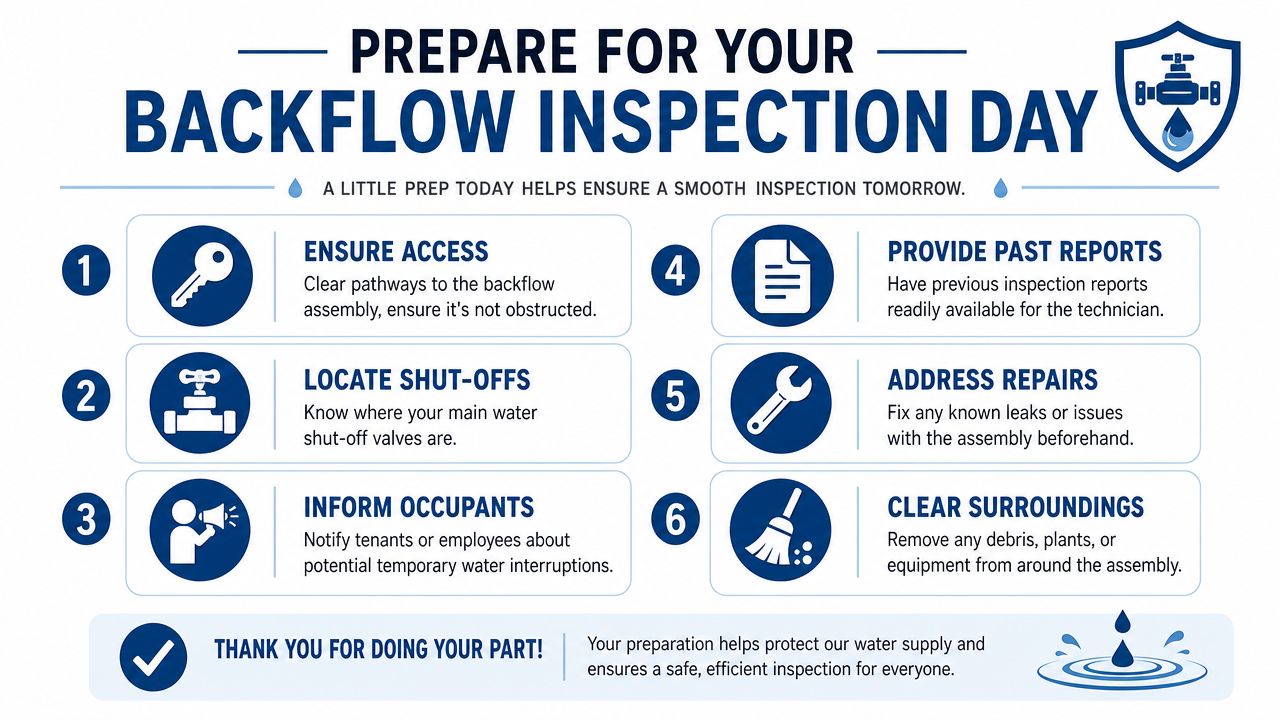
Use this before the tester arrives:
- Clear the access path so the assembly, shutoff valves, and test cocks can be reached safely.
- Confirm the device location with staff, maintenance, or building records. Don't assume everyone knows where it is.
- Notify occupants early if water service may be interrupted for part of the test.
- Pull prior reports if you have them. Old reports help verify the assembly record and speed up paperwork.
- Address obvious leaks first because active leaks around the device can complicate testing and may require repair before a valid result is possible.
- Check gates, locks, and keys so the technician can access the area during the appointment window.
Small prep steps save real time
The most common wasted trip is simple: the assembly can't be accessed or the property representative isn't available to authorize a shutdown. On larger sites, another problem is poor internal communication. Security doesn't know the technician is coming, the tenant wasn't notified, or maintenance has no idea which riser serves the device.
A little preparation also helps the technician tell you something useful. If they have the last report, know the service history, and can inspect the area cleanly, they can often give a better recommendation about rebuild versus replacement.
The best inspection day is boring. Access is clear, records are ready, the water interruption is controlled, and the report gets submitted without a scramble.
Hiring a Certified Tester and Protecting Your Property
A Los Angeles property usually gets into trouble here for a simple reason. The device gets tested, but the paperwork is wrong, the assembly is misidentified, or nobody on the contractor side can handle the repair after a failed result. The water utility still expects a compliant report, and the property manager is left chasing corrections.
California backflow compliance depends on more than showing up with a test kit. The person doing the work needs the right tester certification, a clear understanding of local program requirements, and a practical path to repair or replacement if the assembly does not pass. On many Los Angeles properties, that means choosing a provider who understands both field conditions and utility paperwork.
What to verify before you book
Ask direct questions before you schedule the job.
Tester credentials
Confirm that the person performing the test holds current backflow testing certification accepted by the local jurisdiction.Licensed plumbing support
A failed assembly often needs immediate repair planning. If the company only tests and cannot legally perform the plumbing work, you may lose time coordinating a second contractor.Current test equipment
Backflow assemblies are tested with calibrated gauges. If the gauge is out of date or poorly maintained, the result may be challenged or rejected.Property-specific experience
Irrigation devices, domestic water assemblies, and fire line backflow preventers do not create the same service conditions. A contractor who regularly handles your type of system will usually identify problems faster and document them more accurately.
The lowest quote often creates the most follow-up
Cheap testing is often limited to the pass or fail result. It may not include correcting assembly information, handling utility submission requirements, explaining whether a rebuild is realistic, or returning quickly for retesting after repairs.
That matters in Los Angeles, where delays can turn into notices, repeat visits, and frustrated tenants. I have seen properties pay for a low-cost test, then pay again for a second company to sort out the failed device and fix the report.
One qualified provider is usually the cleaner approach. Test the assembly. Document it correctly. Repair it if needed. Submit what the local authority requires.
If you want a broader explanation of why credentials matter on regulated plumbing work, this guide on why hiring a licensed plumber matters is a useful reference.
What a reliable tester should communicate
A competent contractor should be able to answer these questions without hedging:
| Question | What a solid answer sounds like |
|---|---|
| Who performs the test | A certified tester, with credentials available on request |
| What happens if the device fails | A clear explanation of repair options, replacement when needed, and how quickly the work can be scheduled |
| How is paperwork handled | The report is completed accurately and submitted in the format required by the local water authority |
| What about access or shutdowns | The contractor explains who needs to be present, whether water service will be interrupted, and how long the work should take |
| Can they support California compliance | They understand Los Angeles area utility expectations, device identification, and the documentation standards that keep the property in good standing |
The goal is simple. At the end of the visit, you should know whether the assembly passed, what failed if it did not, what the repair path looks like, and whether the reporting requirement has been handled correctly.
If your Los Angeles property needs a compliant backflow inspection, repair, or replacement, EZ Plumbing can help. EZ Plumbing is a licensed, insured contractor serving Los Angeles since 1989, with experience supporting homeowners, HOAs, property managers, and commercial sites. For scheduling or urgent service, call (818) 908-2710 or book online at EZ Plumbing.