
Protect Your Water: How Does A Backflow Preventer Work?
If you're reading this because you got an LADWP compliance notice, or because a valve outside your building keeps dripping and no one can tell you whether that's normal, you're not alone. In Los Angeles, backflow preventers get attention only when they fail a test, discharge water, or trigger questions from a property manager, HOA board, or inspector.
The basic issue is simple. Water is supposed to move one way, from the public supply into your property. When pressure changes reverse that flow, contaminated water can move the wrong direction. A backflow preventer is the device that stops that reversal before it reaches sinks, showers, drinking fountains, irrigation tie-ins, or shared domestic lines.
For LA owners, this isn't just a plumbing technicality. It's a safety device, a code issue, and a maintenance item that gets harder to ignore on multi-unit properties, irrigation systems, and commercial sites. The mechanics aren't complicated once you see how the parts work together.
Table of Contents
- Why Your Property's Water Safety Depends on Backflow Prevention
- Understanding the Forces That Cause Backflow
- A Guide to Common Backflow Preventer Types
- How a Reduced Pressure Zone RPZ Valve Works
- Los Angeles Backflow Testing and Compliance Rules
- Signs of a Failing Backflow Preventer and When to Call a Pro
- Frequently Asked Questions About Backflow Preventers
Why Your Property's Water Safety Depends on Backflow Prevention
A common LA scenario goes like this. A property manager gets a testing notice, walks outside, sees a brass assembly near the water service, and realizes no one on staff is fully sure what it does. Or a homeowner notices water under a device near the irrigation line and assumes it's just a nuisance leak.
Sometimes it is a worn part. Sometimes it's the device doing exactly what it was built to do.
Backflow means water reverses direction. When that happens at a cross-connection, water that shouldn't be in the drinking supply can be pulled or pushed into it. On a property, that might involve irrigation water, boiler-related systems, fire protection connections, or any line where potable water sits near a non-potable use.
Why this matters on real properties
Backflow protection matters most where one bad pressure event can affect more than one fixture or more than one tenant. That's why property managers, landlords, and HOA boards get pulled into this issue so often. The concern isn't abstract. It's whether the clean side of the plumbing stays clean when pressures swing unexpectedly.
Practical rule: If your property has irrigation, a fire line, chemical injection, booster equipment, or shared domestic plumbing, backflow prevention isn't a luxury part. It's a control point.
The good news is that the device itself follows clear logic. It doesn't need to be mysterious. Once you understand what causes reverse flow, the purpose of each valve makes sense, and so do the testing requirements that come with it.
Understanding the Forces That Cause Backflow
Backflow starts with pressure imbalance. Water should move one direction, from the public supply into the property. When pressure shifts the wrong way, water can reverse course through a cross-connection.
Backsiphonage creates a vacuum effect
Backsiphonage happens when supply pressure drops and the downstream side has enough remaining pressure to pull water backward. The effect is similar to drinking through a straw. A lower-pressure area forms, and water moves toward it.
In Los Angeles, that pressure drop can show up during water main work, heavy neighborhood demand, or firefighting activity. Older infrastructure and elevation changes across LA add to the problem. A property may seem normal indoors while the service line outside is seeing a short pressure event.
That is why hose bibbs, irrigation systems, and other outdoor connections get so much attention during cross-connection inspections. If those lines are tied into potable water and pressure falls suddenly, non-potable water can be drawn back toward the city side.
Backpressure comes from the property side
Backpressure is different. The pressure inside the private plumbing system becomes higher than the city supply pressure, so water is forced backward instead of pulled backward.
I see this on sites with booster pumps, equipment at higher positions, boilers, closed heating systems, and some commercial process lines. Multi-story buildings in Los Angeles can be especially prone to pressure management issues because the plumbing has to compensate for height, demand swings, and added equipment. Thermal expansion can also add force where owners do not expect it.
What property owners in Los Angeles usually miss
Reverse flow does not require a dramatic failure. A brief pressure dip or a short pressure spike is enough.
That matters in Los Angeles because LADWP and local cross-connection rules focus on the condition that can occur, not just the problem you can see at a fixture. A backflow assembly may be doing its job outside, discharging or cycling under stress, while everything indoors still appears normal. Property managers who want a clearer overview of system issues can review EZ Plumbing's Los Angeles plumbing guides and compliance resources.
Common conditions that lead to trouble include:
- Street-side pressure loss: Utility work, nearby water use, or emergency demand can lower supply pressure fast enough to create a siphon condition.
- On-site pressure increase: Pumps, heating equipment, and pressurized systems can overpower incoming city pressure.
- Complex property layouts: Irrigation, fire protection, domestic water, and auxiliary lines create more cross-connections to monitor.
- Poor maintenance: Debris, worn check valves, and mineral buildup reduce how fast and how well an assembly responds.
Understanding these two forces explains why the device has to be matched to the hazard and tested regularly, especially on Los Angeles properties where local enforcement is stricter than many generic plumbing guides suggest.
A Guide to Common Backflow Preventer Types
Not every property needs the same device. The right backflow preventer depends on hazard level, whether the concern is backsiphonage only or both backsiphonage and backpressure, and where the device sits in the plumbing layout.
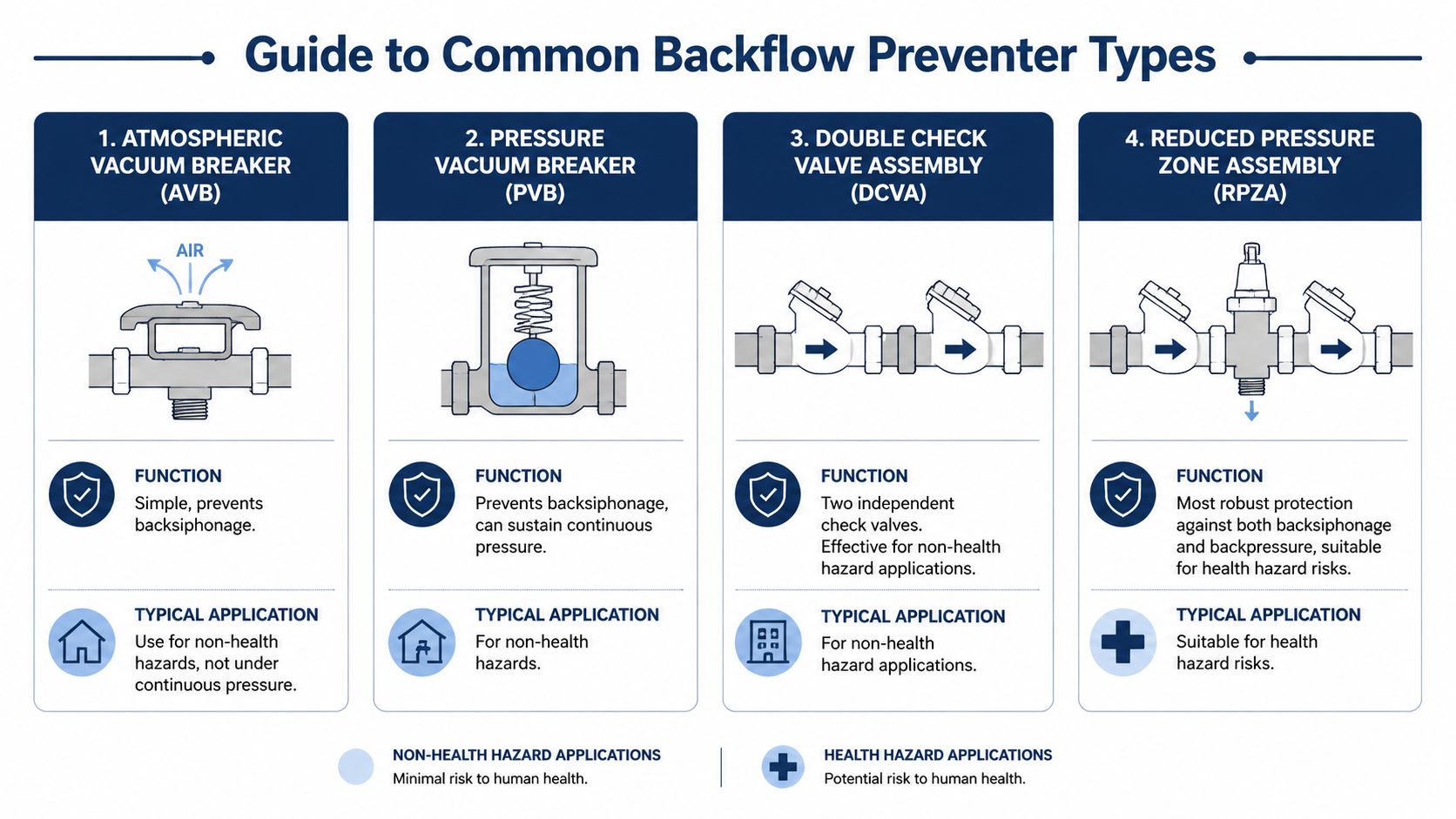
The common device types at a glance
| Device | Best fit | What it handles | Typical limitation |
|---|---|---|---|
| AVB | Simple low-hazard point uses | Backsiphonage | Not for continuous pressure |
| PVB | Irrigation and similar low-hazard setups | Backsiphonage | Installation height matters |
| DCVA | Non-health hazard lines and some fire systems | Backpressure and backsiphonage | Not the top choice for high-hazard risk |
| RPZ | High-hazard applications | Backpressure and backsiphonage with fail-safe discharge | Needs proper drainage and testing |
Atmospheric Vacuum Breaker AVB
An Atmospheric Vacuum Breaker is one of the simplest forms of protection. It lets air into the line when pressure drops so a vacuum can't pull contaminated water backward. You'll see AVBs on basic low-hazard points, often where the risk is limited and the line isn't kept under constant pressure.
Its strength is simplicity. Its weakness is also simplicity. It isn't the right device where water pressure stays on continuously or where the hazard is more serious.
Pressure Vacuum Breaker PVB
A Pressure Vacuum Breaker is a step up. It's often used on irrigation systems where the concern is mainly backsiphonage. It can stay under continuous pressure, which makes it more practical than an AVB for many residential and light commercial properties.
This is the device many owners recognize because it often sits above grade and is exposed to weather. When installed incorrectly, especially at the wrong elevation relative to downstream outlets, it can create nuisance problems and fail testing.
Double Check Valve Assembly DCVA
A Double Check Valve Assembly uses two independent check valves in series. If one check doesn't seal properly, the second check provides backup. DCVAs are commonly used where the hazard isn't considered a health hazard but reliable mechanical protection is still required.
They're often a practical fit for certain fire systems and other non-health hazard applications. In the field, they can be a good answer when conditions are right, but they're not the device to force into a high-hazard job just because they seem simpler.
Reduced Pressure Zone Assembly RPZ
A Reduced Pressure Zone assembly is the heavy-duty option for higher-risk conditions. It uses two independent check valves and a differential relief valve to create a zone of reduced pressure, and that fail-safe design is required for high-hazard LA applications under USC-FCCCHR. In testing, RPZ assemblies achieve 99.999% containment efficacy and discharge through the relief valve if the system is compromised, according to ValveMan's explanation of how RPZ backflow prevention works.
That discharge is the part many owners mistake for failure. Sometimes it is failure. Sometimes it's proof the assembly prevented contamination from moving upstream.
The best backflow device isn't the most expensive one. It's the one that matches the hazard, the code requirement, and the way the system actually behaves under pressure.
What works and what doesn't
Here are the trade-offs property owners usually care about most:
- For basic low-hazard points: An AVB can work, but only where its limitations are respected.
- For many irrigation systems: A PVB is a common answer when the hazard is lower and the installation can meet height and exposure requirements.
- For certain non-health hazard systems: A DCVA is often appropriate, especially where a full RPZ would be unnecessary.
- For high-hazard situations: An RPZ is the safer choice and, in many LA situations, the required one.
If you're trying to identify what you have on site or compare options before replacement, a practical next step is reviewing a visual plumbing guide library with common system layouts.
How a Reduced Pressure Zone RPZ Valve Works
A common Los Angeles service call goes like this. A manager sees water dripping from the backflow assembly near the meter or irrigation line and assumes the valve failed. On an RPZ, that discharge can be the device doing its job. The assembly is built to vent water before contaminated water has any path back into the potable supply.
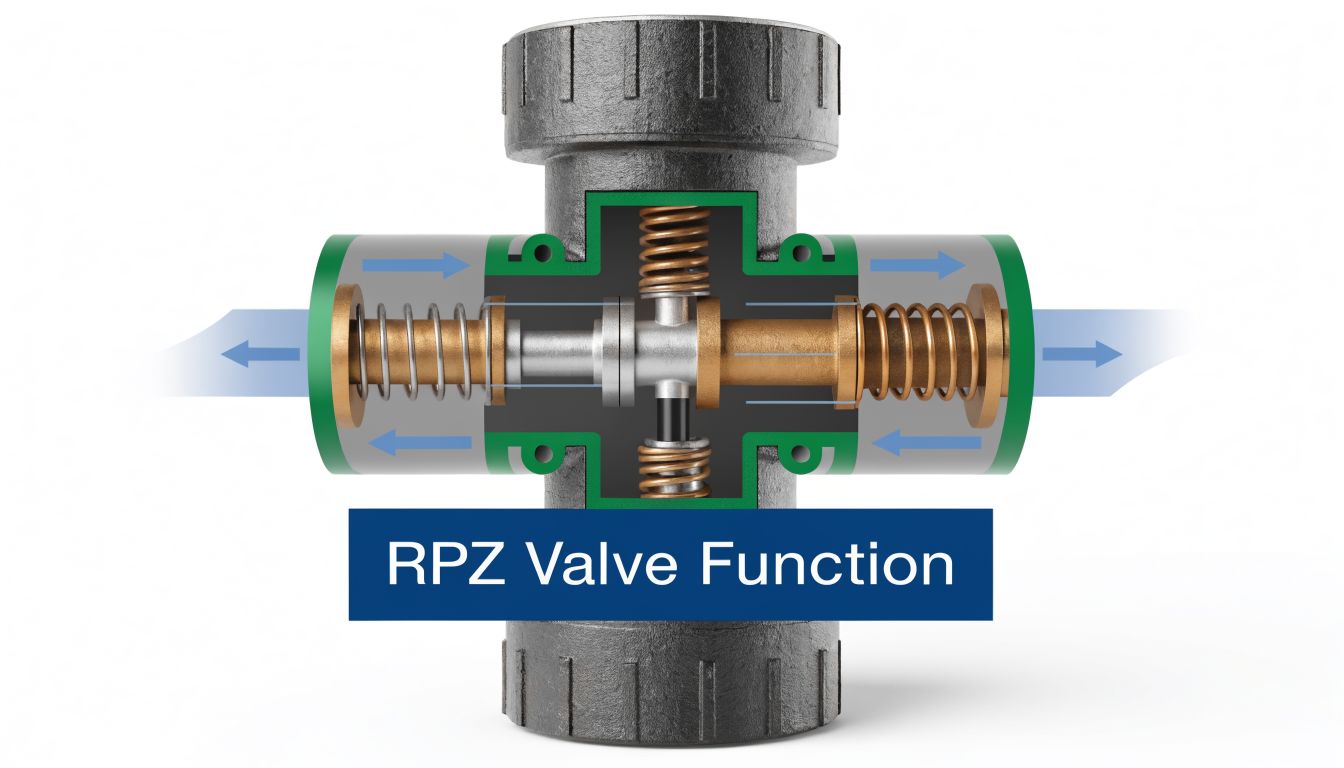
During normal flow
Inside the assembly are two independent check valves with a reduced-pressure zone between them, plus a differential relief valve tied to that middle chamber. Under normal supply conditions, water pressure on the street side stays higher than pressure on the building or irrigation side. That pressure relationship keeps water moving one direction and keeps the relief valve shut.
The trade-off is pressure loss across the device. On larger LA properties, that matters. A poorly sized RPZ can leave upper-floor fixtures, hose bibbs, or irrigation zones short on pressure, especially in neighborhoods already dealing with variable street pressure. That is one reason proper sizing and placement matter as much as the valve type itself.
During a backflow event
If downstream pressure starts pushing back toward the supply, the second check valve closes first. If debris, wear, or fouling keeps that check from sealing fully, pressure in the intermediate zone rises. Once that zone no longer stays safely below the inlet side, the relief valve opens and dumps water out of the body of the assembly.
That discharge is the fail-safe function. The RPZ gives contaminated or suspect water a path to atmosphere instead of letting it travel upstream.
In the field, I tell owners to pay attention to the pattern. A brief discharge during pressure fluctuation can point to operating conditions. Ongoing discharge usually means the assembly needs to be tested, cleaned, repaired, or replaced by a certified tester.
Why the drain and air gap matter
RPZs need room to discharge safely. In Los Angeles, that means planning for drainage before installation, not after the first relief event floods a planter box, walkway, or equipment pad. A proper air gap at the drain connection helps keep discharged water from creating a new cross-connection problem.
That detail gets missed on remodels and exterior piping changes. It also gets expensive when property staff have to correct water damage, failed inspections, or access problems around the assembly. For owners coordinating several repairs at once, this step-by-step guide to managing plumbing repairs in Los Angeles helps keep the work organized.
On LA sites, I also look at practical conditions that generic guides skip. Cage clearance, slab drainage, sun exposure, and local debris all affect service life and testing access. An RPZ that is technically installed but hard to test, hard to drain, or constantly sitting in runoff becomes a compliance problem fast.
This walkthrough helps if you'd like to see the internal sequence in motion:
Los Angeles Backflow Testing and Compliance Rules
A manager in Los Angeles usually finds out about backflow compliance the same way. A notice arrives, the tester needs access, and someone on site is asking whether the water at the relief port means a simple leak or a failed assembly. At that point, the job is not guesswork. It is code compliance, clean paperwork, and getting the device back into passing condition.
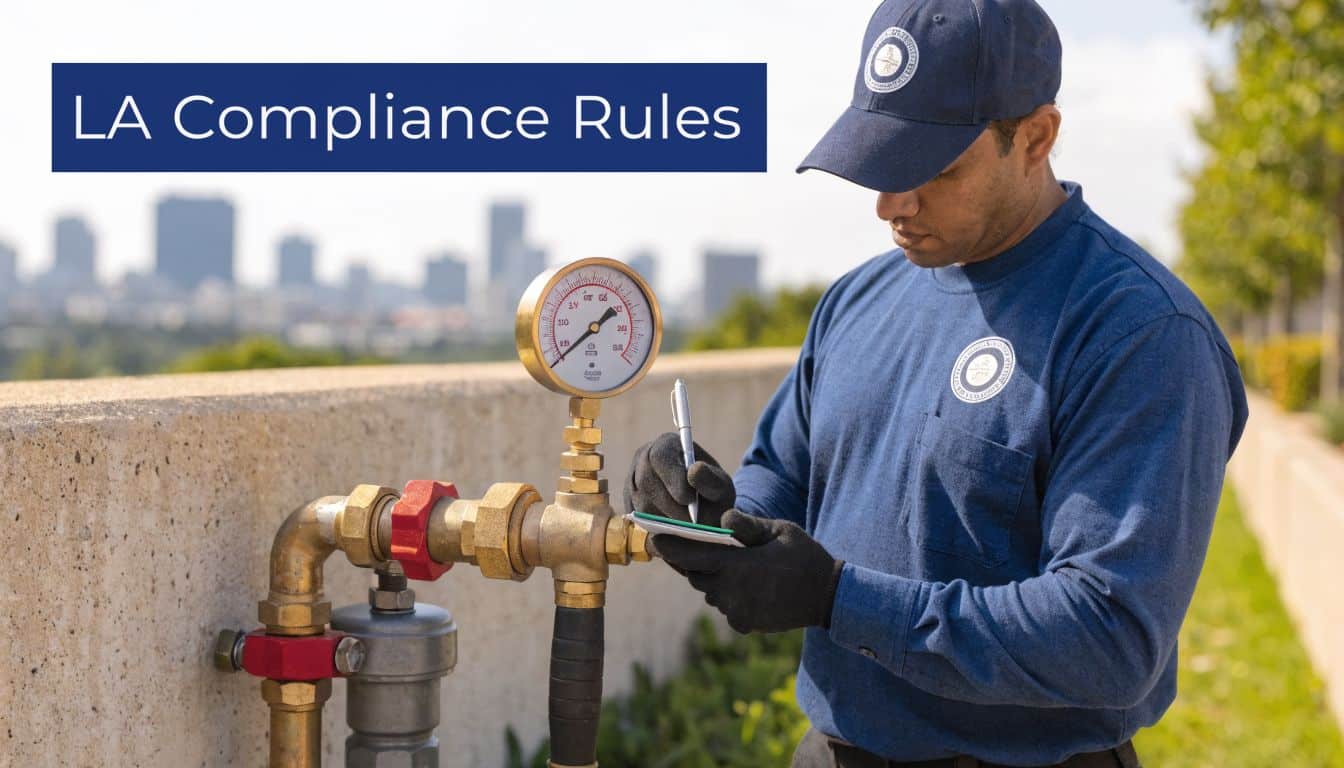
What annual compliance actually means
For Los Angeles properties with a required assembly, annual testing is part of owning and operating the site. The test confirms the device still performs the way LADWP expects under controlled conditions. On an RPZ, that includes check valve performance and relief valve operation at the proper differential.
Owners and property managers usually need to stay on top of three things:
- Certified testing: Use a tester qualified to perform and document the inspection properly.
- Accurate paperwork: Results need to be recorded clearly and submitted where required.
- Repairs and retesting: If the assembly fails, the fix is not complete until the device passes a follow-up test.
I see the same delay pattern across LA. Testing gets pushed back, landscaping or maintenance staff report water near the assembly, and the owner loses time sorting out whether the problem is drainage, pressure fluctuation, or an actual device failure.
On Los Angeles properties, backflow compliance problems usually start with delayed maintenance and poor access, not with a dramatic event.
Why Los Angeles properties need a local compliance approach
Generic backflow articles tend to stop at "test it once a year." That is not enough in Los Angeles. LADWP enforcement, site access, older service lines, hillside elevation changes, and remodel work done around existing piping all affect how these assemblies perform and how easy they are to test.
Pressure conditions are not the same across the city. A multi-unit building in an older neighborhood can behave very differently from a newer commercial site in the Valley. I also pay attention to practical issues that often get missed during inspections: blocked cages, poor drainage around the assembly, sun exposure, vandal-resistant enclosures that leave no service room, and irrigation tie-ins that create cross-connection concerns.
Recent industry coverage and LADWP-related discussions have pointed to increased concern about pressure variability and system changes affecting backflow performance in some areas. That should be treated as a local operating issue to monitor, not as a reason to assume every discharge event means the same failure. On LA sites, the right response is testing the assembly, reviewing site conditions, and documenting what changed.
What owners and managers should watch for
Certain property types in Los Angeles tend to run into compliance trouble more often because the systems are harder to maintain and the symptoms are easier to misread:
- Multi-unit properties with shared plumbing lines: One pressure or isolation issue can affect several tenants at once.
- Sites with large irrigation systems: Grounds crews often spot the first signs, but discharge and runoff are often mistaken for a basic valve leak.
- Older buildings and older service areas: Aging piping, retrofits, and unclear as-builts make testing and repairs slower.
- Properties that have gone through recent remodels: New hose bibbs, boiler work, irrigation changes, or equipment replacements can create code issues the owner did not expect.
The practical goal is simple. Keep the assembly accessible, test it on schedule, and correct failures before they turn into notice problems or repeat service calls. If you are coordinating vendors, tenants, and repair timing, this Los Angeles plumbing repair planning guide for property managers helps keep the work organized.
Signs of a Failing Backflow Preventer and When to Call a Pro
Most failing backflow preventers don't announce themselves with a dramatic event. They show up as a nuisance symptom that someone on site ignores for too long. A puddle near the relief opening. Chattering when water demand changes. Corrosion around the body. Intermittent discharge that keeps coming back after someone assumes it "stopped on its own."
Symptoms that deserve attention
Some warning signs are straightforward:
- Constant or repeated dripping: On an RPZ, this can mean debris, worn internals, pressure instability, or the device responding to an actual fault.
- Banging or chatter: Rapid pressure changes can make checks or internal components cycle noisily.
- Visible leaks at shutoffs or test cocks: That points to wear, sealing problems, or aging components.
- Rust, corrosion, or mineral buildup: External condition often mirrors internal wear.
- Poor downstream performance: If pressure at fixtures has changed, the assembly may be contributing, especially where hydraulic loss was never accounted for correctly.
What doesn't work
Backflow problems are not a good DIY project. Replacing random parts, tying off a discharge, or assuming a leaking relief port just needs to be "tightened" creates bigger risk. A backflow assembly is a life-safety and code device, not a decorative valve.
Owners also get into trouble when they treat the symptom and skip the cause. If a relief valve is discharging because upstream and downstream pressures are behaving badly, changing one seal may not solve the problem for long. The device and the system conditions both need to be evaluated.
A backflow preventer can leak because it's failing, and it can leak because it's doing its job. You need a qualified test to know which one you're looking at.
When to make the call
Call a licensed professional when the device discharges repeatedly, fails a test, shows visible deterioration, or starts making noise during normal use. On regulated assemblies, repair isn't finished when the wrench work is done. The device must be tested again and documented correctly.
That protects more than water quality. It protects the owner from compliance issues, repeat service calls, and the liability that comes with an improperly handled cross-connection device.
Frequently Asked Questions About Backflow Preventers
How much does backflow testing cost in Los Angeles
Pricing varies by device type, access, paperwork requirements, and whether the assembly passes the first time. The smart move is to ask for testing, any needed minor repair allowances, and retest procedures in writing before work starts.
Can I install my own backflow preventer
For regulated assemblies, that isn't a casual DIY item. Installation has to match code, hazard classification, orientation, clearance, and drainage requirements. Testing and certification also have to be handled properly, so most owners should leave this to licensed professionals who know LA compliance.
What's the difference between repairing and replacing a device
A repair means the existing assembly body remains in place and worn internal parts are serviced, then the device is retested. A replacement means the whole assembly is changed out because age, condition, repeated failure, or code fit makes repair the wrong long-term choice.
Where can I find answers to related plumbing questions
A solid starting point is a local plumbing FAQ resource for common service and compliance questions, especially if you're comparing next steps for a home, HOA, or commercial property.
If your property has a backflow preventer that’s leaking, due for annual testing, or raising compliance questions, EZ Plumbing can help. Their licensed, insured team serves Los Angeles homes, HOAs, multi-unit properties, and commercial sites with practical diagnostics, certified plumbing expertise, and responsive service that keeps water systems safe and code-ready.
Made with Outrank tool