
Tankless Water Heater Pros and Cons: An LA Homeowner’s Guide
You're probably here because your current water heater is doing one of two things. It's either running out of hot water at the worst possible time, or it's getting old enough that you don't want to wait for the failure.
In Los Angeles, that decision isn't as simple as “tankless is newer, so it must be better.” A bungalow in Burbank, a condo in Santa Monica, a duplex in Glendale, and a mixed-use building on the Westside don't have the same hot water pattern, venting options, electrical capacity, or ownership constraints. Tankless water heater pros and cons become apparent in the install details, the morning demand, and the utility bill months after the work is done.
If you want a second practical read on continuous flow systems from another plumbing perspective, Voyager Plumbing's guide to hot water continuous flow systems is worth a look. It helps frame the same core question most owners face. Is endless hot water worth the trade-offs on your property?
Table of Contents
- Is Going Tankless Worth It for Your Home
- How On-Demand Hot Water Actually Works
- The Major Advantages of Tankless Water Heaters
- Potential Drawbacks and Hidden Considerations
- A Realistic Cost Comparison Tank vs Tankless
- Which System Is Right for Your Los Angeles Property
- Your Next Steps for a Water Heater Upgrade
Is Going Tankless Worth It for Your Home
A lot of homeowners start this search after a cold shower cuts into a rushed morning. Someone's in the bathroom, the dishwasher is running, maybe a load of laundry just started, and suddenly the water temperature drops. That moment usually pushes people into comparing a standard storage tank with a tankless unit.
The short answer is this. Tankless can be a very good upgrade, but it's not automatically the right one. For some Los Angeles homes, it solves a real problem. For others, it shifts the problem from “I ran out of hot water” to “I spent more money and still can't run everything at once.”
A practical decision comes down to a few questions:
| Question | Tankless often fits better | Tank often fits better |
|---|---|---|
| Space | Tight utility area, garage conversion, small mechanical closet | You have room and layout isn't an issue |
| Usage pattern | Staggered hot water use through the day | Heavy simultaneous use in short windows |
| Ownership horizon | You plan to keep the property long enough to benefit from long-term savings | You need the lowest upfront cost now |
| Building constraints | Property can support venting, gas, or electrical upgrades | Upgrades would be difficult or expensive |
| Decision priority | Efficiency, wall-mounted footprint, longer service life | Lower install complexity and simpler replacement |
Los Angeles adds a local wrinkle. Older homes often have infrastructure limitations. Condos may have HOA approval issues. Multi-unit buildings need demand planning, not wishful thinking. A tankless recommendation that works in one property can be a bad fit a few blocks away.
Practical rule: Buy for your peak hot water hour, not for the sales brochure.
That's the lens to use for every tankless water heater pros and cons discussion. Start with how your property uses hot water, then match the equipment to that pattern.
How On-Demand Hot Water Actually Works
A traditional tank stores heated water and keeps reheating it so it's ready when you open a faucet. A tankless unit works differently. It waits.
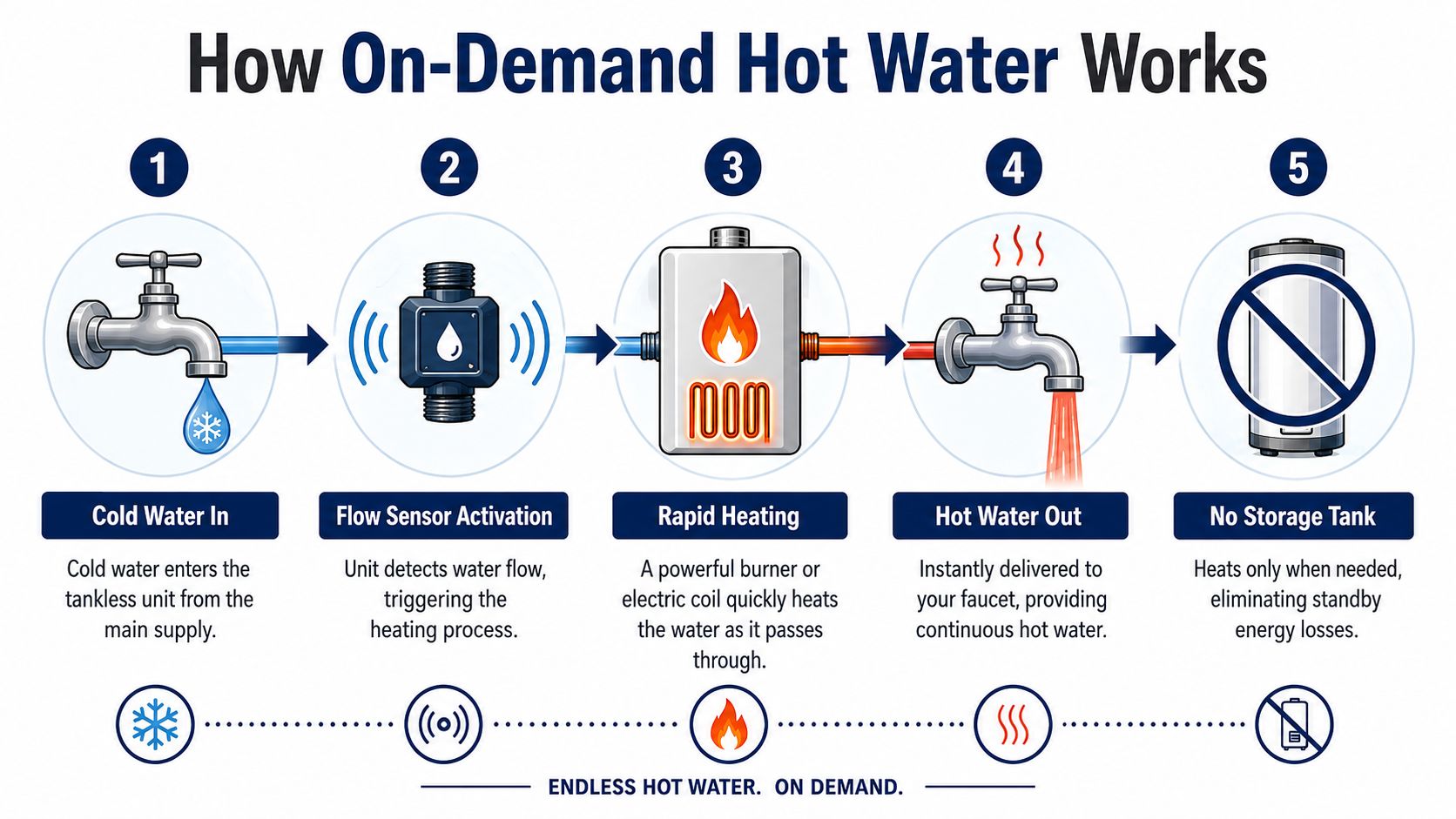
When someone turns on the hot side at a shower, sink, or appliance, the unit senses water flow and starts heating water as it moves through the heat exchanger. No stored reserve. No big cylinder sitting full of hot water in the garage.
The basic sequence
The process is straightforward:
- Cold water enters the unit from the main supply line.
- A flow sensor detects movement when a hot tap opens.
- The heating system activates immediately.
- Water passes through the heat exchanger and gains temperature on the way through.
- Hot water leaves the unit and heads to the fixture that called for it.
That's why people call these units on-demand or continuous flow systems. They don't hold hot water in reserve. They create it as it passes through.
Gas and electric units don't behave the same way
A gas tankless unit uses a burner to heat the exchanger. In practice, these are usually the better fit for whole-house applications where owners want stronger hot water delivery across more than one fixture.
An electric tankless unit uses heating elements instead of a burner. These can work well in the right setup, but they're generally more sensitive to demand and property infrastructure. In older Los Angeles homes, panel capacity becomes part of the conversation fast.
A simple analogy helps. A tank heater is like filling a bathtub in advance and keeping it warm. A tankless heater is like running water through a high-output heater only when you need it. That's efficient, compact, and responsive, but only if the system is sized to the actual demand coming from the property.
Tankless works best when the unit size, fuel source, and fixture demand all line up. If one of those is off, the ownership experience gets frustrating quickly.
The Major Advantages of Tankless Water Heaters
Tankless systems have real strengths. When the property is a good match, they solve several common complaints at once.
Better efficiency over the long run
The biggest performance argument for tankless is efficiency. Because the system heats water only when you call for it, it avoids the standby heat loss that comes with keeping a stored tank hot all day.
For households using lower daily hot water volumes, the savings can be meaningful. The U.S. Department of Energy estimate cited by A1 SolarStore's review of tankless water heater performance says homes using 41 gallons or less of hot water daily can achieve 24–34% energy savings by switching to tankless systems. The same source notes that over a 20-year lifespan, households can save about $2,000 in utility costs.
That doesn't mean every owner gets the same payoff. Usage habits matter. But as a category benefit, better efficiency is one of the strongest points in favor of tankless.
Hot water that doesn't run out
This is the feature most homeowners care about first. A properly selected tankless unit can keep producing hot water without the “empty tank” problem that happens after back-to-back showers or high household demand.
For some properties, that changes daily life in a real way:
- Busy family homes can avoid the last-person-cold-shower routine.
- ADUs and guest spaces can benefit from independent hot water delivery.
- Properties with staggered use do well because the system keeps producing as long as demand stays within the unit's capacity.
That last part matters. “Endless” doesn't mean unlimited simultaneous output. It means the unit can continue heating without depleting stored volume.
More usable space
A tankless unit mounts on the wall and takes up far less room than a floor-standing storage tank. In Los Angeles, that matters more than people think.
Small garages, tight side utility corridors, compact laundry rooms, and closet installations all benefit from a smaller footprint. In condos or remodeled homes where every square foot has already been claimed, getting rid of a bulky tank can be a legitimate design upgrade, not just a plumbing one.
Longer service life
Service life is another strong point. The source above notes a 20-year lifespan, which is close to double what many owners expect from a standard tank.
That longer replacement cycle matters most for owners who plan to stay put, landlords managing long-term hold properties, and anyone who doesn't want to revisit a full replacement too soon.
A tankless unit usually makes the most sense when the owner values efficiency, floor space, and long-term ownership more than the lowest possible install price.
Potential Drawbacks and Hidden Considerations
Tankless units get oversold when people talk only about the upside. In the field, the downsides are where most complaints come from.
Flow rate is the deal-breaker in many homes
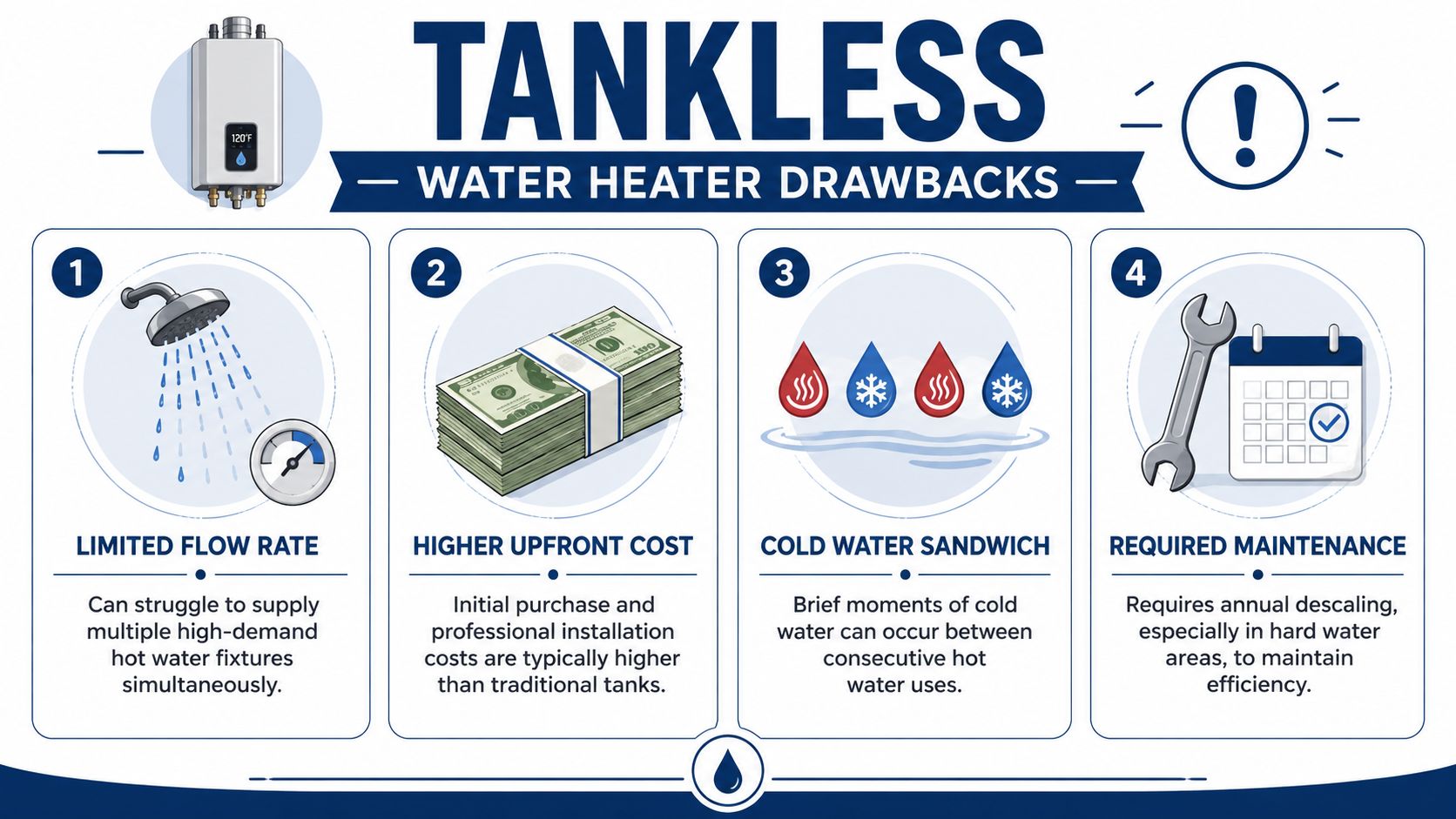
Tankless systems don't store a reserve of hot water. They heat what passes through them, and that means the unit has a maximum output at any given moment.
According to Hot Water's breakdown of tankless pros and cons, electric models typically deliver 2–5 gallons per minute, while gas units typically deliver 5–10 gallons per minute. If a property tries to run a shower, dishwasher, and washing machine at the same time, that demand can exceed the unit's capacity.
In plain language, owners often say, “I thought tankless meant unlimited.” It doesn't. It means continuous hot water within the flow limit of that specific unit.
There's often a short warm-up delay
A storage tank starts with water that's already hot. A tankless unit has to detect flow and fire up first. That usually creates a brief delay before hot water reaches the fixture.
Some owners barely notice it. Others hate it. The issue gets more noticeable in larger homes with longer pipe runs, or in houses where people expect immediate hot water at every fixture.
Blackouts can leave you with no hot water
This is one of the most overlooked parts of the tankless water heater pros and cons discussion in Los Angeles. Tankless units require power for ignition and control systems. If the power is out, the unit won't operate.
That matters in neighborhoods where outages happen, even if they're occasional. Many property owners assume a gas-fired appliance will keep going during a blackout. With tankless, that assumption can be wrong.
If hot water availability during a blackout matters to you, ask that question before you buy, not after the first outage.
Maintenance isn't optional
Tankless ownership is more demanding than many brochures suggest. These systems need routine service to stay efficient and reliable, especially where scale buildup is a concern. If you want a clear overview of what regular upkeep looks like, this guide on how to maintain a water heater is a useful starting point.
A neglected tankless unit often loses performance slowly. Owners notice inconsistent output, reduced efficiency, or nuisance issues, then assume the product is bad. In many cases, the maintenance plan was bad.
A Realistic Cost Comparison Tank vs Tankless
Sticker price alone doesn't answer the cost question. A real comparison has to include the installed price, the building upgrades, the expected service life, and whether the property will benefit from the efficiency side.
Early in the conversation, many owners compare a basic replacement tank job against a tankless proposal and get sticker shock. That reaction is understandable.
Upfront cost is where tankless hits hardest
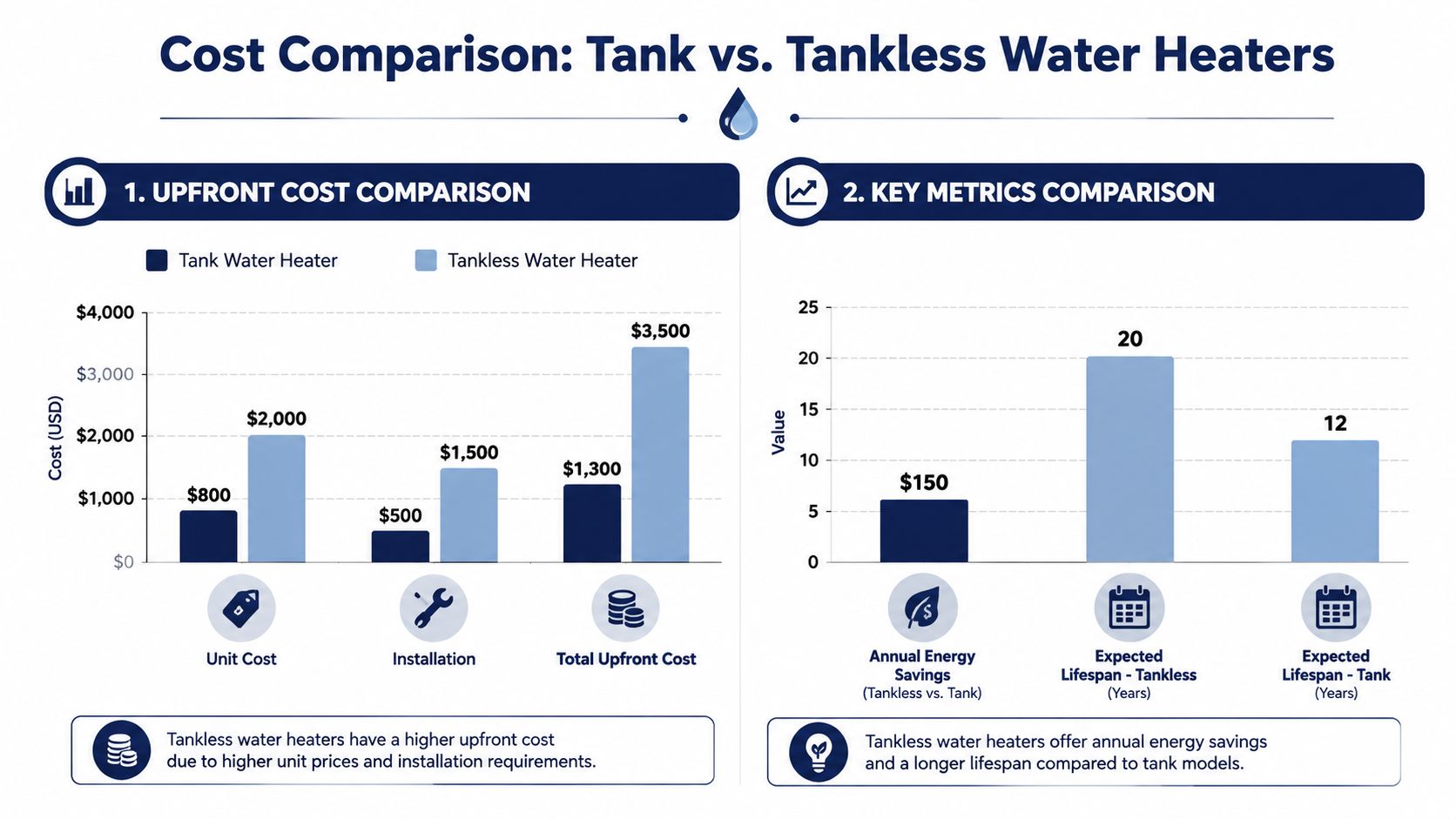
The biggest barrier is the initial investment. Based on the verified pricing range already noted in industry summaries, tankless systems can land far above a straightforward tank replacement once venting, gas work, or electrical upgrades enter the job.
Here's the core comparison:
| System type | Typical installed cost range |
|---|---|
| Traditional tank heater | $700 to $2,000 |
| Tankless system with possible upgrades | $4,400 to $7,000 |
That higher tankless cost comes from more than the appliance itself. A job may require a larger gas line, different venting, electrical panel work, relocation planning, or other modifications that a direct tank swap doesn't need.
Long-term cost depends on ownership habits
The financial case for tankless improves when all of these are true:
- You'll stay in the property long enough to benefit from lower operating costs.
- Your usage pattern fits the equipment instead of forcing oversized demand.
- You keep up with service so efficiency and reliability don't slide.
- The install doesn't trigger major infrastructure surprises that wipe out the long-term savings.
Many bad decisions occur when owners hear “lower utility bills” and ignore the install conditions. If the job needs significant upgrades, payback takes longer and may not pencil out the way they expected.
For a broader homeowner-facing breakdown of the trade-offs, this article on the difference between tank and tankless water heater systems helps frame the ownership side clearly.
A short visual can help if you want to see a general comparison in action:
When the extra cost makes sense
Tankless often makes financial sense for owners who value the whole package, not just utility savings. If the unit frees up space, lasts longer, improves comfort, and fits long-term ownership, the higher entry cost can be justified.
If your main goal is the cheapest possible replacement this month, a standard tank usually wins.
Which System Is Right for Your Los Angeles Property
A good recommendation depends on the property type. That's where generic advice usually falls apart.
Single-family homes
In a single-family house, the question is how many fixtures need hot water at the same time. A small home with predictable use can do very well with tankless. A larger family with stacked morning demand needs more caution.
A few common examples in Los Angeles:
- Burbank bungalow with one or two bathrooms and staggered use. Tankless can be a strong fit if the utility connections support it.
- Expanded Valley home with multiple bathrooms, teenagers, and heavy pre-work demand. Tankless can still work, but only if sizing is based on actual simultaneous demand.
- Older character home with aging infrastructure. Installation complexity may push the economics back toward a tank.
The mistake is assuming a single compact wall unit will solve every comfort issue. In some homes, the owner is better served by simpler equipment that matches the plumbing layout and demand pattern.
Condos and HOAs
Condos are where tankless decisions get political as fast as they get mechanical. Even when the owner wants the upgrade, the building may control venting routes, exterior penetrations, equipment location, or shared utility constraints.
That means condo owners should verify:
- Approval rules for equipment changes and venting modifications.
- Access limits in utility closets or confined service spaces.
- Building system overlap if the property has shared plumbing considerations.
- Noise and placement concerns that can affect neighboring units.
In many HOA environments, a tankless installation isn't impossible. It's just not a solo decision. The board, building engineer, or management company may shape what's practical.
In condos, the best water heater choice is often the one the building can actually support without turning a simple replacement into a months-long approval process.
Multi-unit and commercial properties
Apartment buildings, mixed-use properties, and commercial spaces need a different conversation. At that level, the issue isn't just one tenant or one owner. It's occupancy pattern, peak draw, maintenance planning, and service continuity.
Tankless can work very well in these settings when the system is designed for the building rather than dropped in as a one-for-one replacement concept. Property managers often look at centralized strategies, staged demand, and maintenance access before making a decision.
The overlooked issue of behavioral rebound
There's one angle almost nobody talks about when selling tankless systems. People often use more hot water once they believe they have an endless supply.
The Four Seasons discussion of tankless decision factors notes this behavioral rebound issue directly. Homes with tankless units can see 5–10% higher water consumption after installation, which can chip away at the projected 24–34% energy savings.
That matters in Los Angeles, where owners already juggle utility costs and conservation habits. If a household starts taking longer showers because it no longer “runs out,” some of the efficiency advantage gets spent away in behavior.
The best-fit summary is simple:
- Choose tankless if the property has manageable simultaneous demand, the infrastructure can support the install, and the owner plans to keep the system long enough to benefit.
- Choose tank if the budget is tight, the building constraints are real, or the demand profile is more brute-force than efficient.
- Pause the decision if you're in an HOA or multi-unit building and the approval or design path isn't clear yet.
Your Next Steps for a Water Heater Upgrade
Before replacing anything, pin down the actual demand. Count the fixtures that may call for hot water at the same time. Don't size based on guesswork, and don't size based on a showroom promise.
Then check the property itself. A tankless install may depend on gas line capacity, electrical panel room, venting path, unit location, and access for future service. That's where many “simple upgrades” stop being simple.
A short pre-install checklist
- Confirm peak hot water demand so the equipment matches real usage.
- Verify utility capacity for gas, power, and venting requirements.
- Review building restrictions if the property is a condo, HOA unit, or multi-tenant site.
- Plan for maintenance access so future service isn't a struggle.
- Get a professional installation plan rather than relying on generic sizing charts.
If you want a homeowner-friendly overview of the replacement process before scheduling work, this water heater installation guide for homeowners lays out the basics clearly.
This is not a DIY project. Water heaters involve gas, electricity, combustion safety, venting, code compliance, and property-specific conditions that can't be handled well with one-size-fits-all advice. A correct installation protects safety, equipment life, and warranty coverage.
If you want a straight answer on whether tankless is the right fit for your Los Angeles property, EZ Plumbing can inspect the existing setup, evaluate demand, and give you a clear recommendation with transparent pricing. Whether you're replacing a failed unit in a single-family home or planning around HOA and multi-unit constraints, they can help you choose the system that works for the building.