
How to Increase Water Pressure in Shower: A DIY Guide
You turn the shower on, step in, and instead of a steady spray you get a weak, annoying drizzle. It takes longer to rinse shampoo out. The temperature swings when someone uses a sink. You start wondering if you need a new showerhead, a pump, or a plumber.
Guessing often leads to wasted time.
The better approach is to treat low shower pressure like a diagnosis. Start with the simplest checks. Test what's happening. Fix the parts most likely to be clogged or restricted. Only then move into valves, regulators, and hidden plumbing issues. That order matters because the cheapest fix is often the right one, and the expensive fix is often wrong when you skip the basics.
I've seen homeowners replace perfectly good fixtures when the actual problem was mineral buildup inside the showerhead. I've also seen people obsess over the showerhead when the whole house had a supply issue. Those are two very different jobs.
If you're trying to figure out how to increase water pressure in shower performance without throwing money at the problem, this guide follows the same path an experienced plumber would use on site. You'll check the shower first. Then the nearby controls. Then the house-wide components. If the issue is deeper, you'll know what symptoms point to pipe restriction, water heater trouble, or trapped air in the lines.
By the end, you should land in one of two places. Either you've fixed it yourself with a straightforward adjustment, or you know exactly why it's time to bring in a pro.
Table of Contents
- The Frustration of a Weak Shower and Your Path to a Fix
- Your 5-Minute Water Pressure Diagnosis
- The Easiest Fixes Targeting Your Showerhead
- Checking Valves and Simple System Adjustments
- Deeper Plumbing Issues and Hidden Causes
- Troubleshooting Checklist and When to Call EZ Plumbing
The Frustration of a Weak Shower and Your Path to a Fix
A weak shower wears people down because it happens every day. You don't notice one bad flush or one slow drain the same way you notice a shower that never feels right. It turns a basic routine into a small hassle that repeats morning after morning.
What makes it more frustrating is that “low pressure” can mean different things. Sometimes the water pressure is fine, but the flow is being choked by limescale inside the showerhead. Sometimes only the hot side is weak, which points you toward the water heater or a valve problem. Sometimes the whole house feels sluggish, which pushes the diagnosis toward a regulator, main valve, or supply issue.
That's why the smartest fix starts with a simple question: Is this a shower problem or a house problem?
Practical rule: If you haven't measured anything yet, you're still guessing.
The order matters. First, test the shower itself. Next, compare it with other fixtures. After that, clean or inspect the parts that are easiest to reach. Only then should you touch valves or start thinking about bigger upgrades.
Here's the path that saves the most time and money:
- Measure before changing parts: A quick flow test tells you whether the shower is performing near normal or clearly underperforming.
- Isolate the problem: If the kitchen sink and bathroom sink both run strongly, the showerhead or shower valve is the likely culprit.
- Start with buildup and restrictions: Mineral deposits and restrictors are common, especially in homes with hard water.
- Move to controls next: Partially closed valves and misadjusted regulators can reduce flow without any visible leak.
- Escalate only when symptoms point deeper: Corroded piping, heater sediment, and trapped air aren't beginner jobs.
That's how an experienced plumber approaches how to increase water pressure in shower systems. Not by swapping random parts, but by narrowing the problem until the next step is obvious.
Your 5-Minute Water Pressure Diagnosis
A weak shower can come from two very different problems. The shower itself may be restricted, or the house may not be delivering enough water to that bathroom in the first place. Five minutes of checking saves a lot of wasted effort.
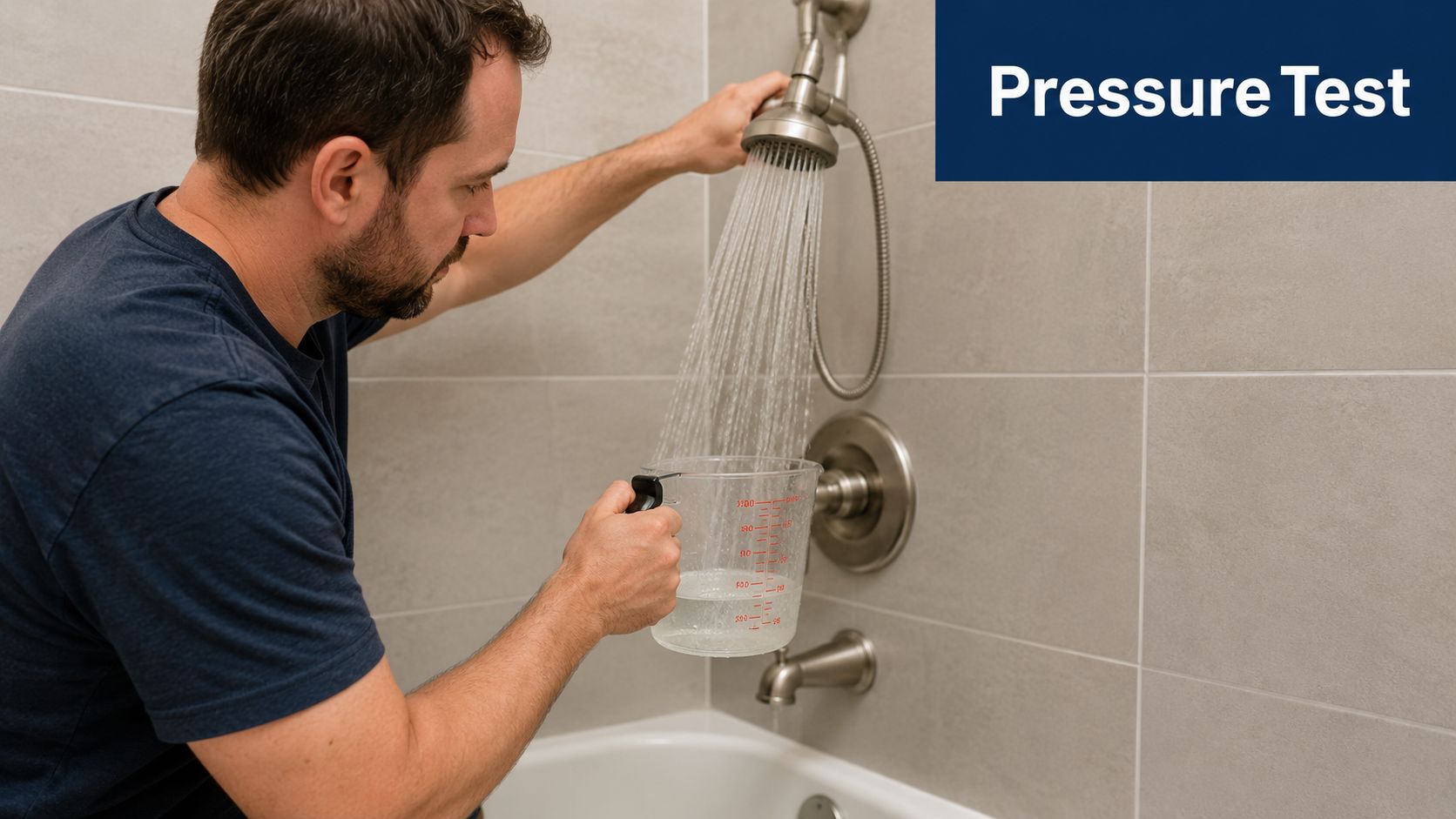
Run the bucket test first
Use a 1-gallon bucket or another container with clear volume markings, plus a phone timer. Turn the shower to full flow and measure how long it takes to collect a set amount of water. The exact number matters less than getting a real baseline you can compare against the rest of the house and against the shower after each fix.
If the bucket fills quickly, the issue may not be supply at all. In a lot of bathrooms, the complaint is really poor spray pattern, mineral buildup, or a showerhead that never matched the user's preferences. That is also why choosing bathroom fixtures matters more than people expect. A lower-GPM head can sometimes feel stronger because it concentrates the spray better, even though it uses less water.
If the bucket fills slowly, keep going before you buy parts.
Compare the shower to the rest of the house
Check a nearby sink, then one other fixture somewhere else in the home. Do it on both hot and cold if you can. You are looking for a pattern, not a perfect lab test.
| What you find | What it usually means |
|---|---|
| Shower is weak, other fixtures are fine | Problem is likely at the showerhead, hose, cartridge, balancing spool, or shower valve |
| Hot side is weaker than cold | Water heater issue, hot-side valve restriction, sediment, or a partially blocked hot line |
| Several fixtures are weak | Main shutoff, pressure regulator, supply problem, or broader piping restriction |
A sudden change is a useful clue. Slow decline usually points to scale or wear. A sharp drop can come from debris in a valve, a regulator problem, recent utility work, or a valve that was not reopened fully after plumbing work. If that sounds familiar, this guide on a sudden drop in water pressure throughout the house can help narrow it down.
Separate pressure from flow
Homeowners often use those words interchangeably, but they are not the same thing. Pressure is the force behind the water. Flow is the amount of water getting through. In the field, a restriction at the showerhead or valve can make good supply pressure feel weak because the fixture cannot pass enough water.
That distinction keeps the diagnosis honest. If only one shower feels bad, stay focused on parts at that shower before touching whole-house controls.
The Easiest Fixes Targeting Your Showerhead
If the rest of the house seems fine, the showerhead is where I'd look first. It's the most common choke point, it's easy to reach, and the fix is often cheap.
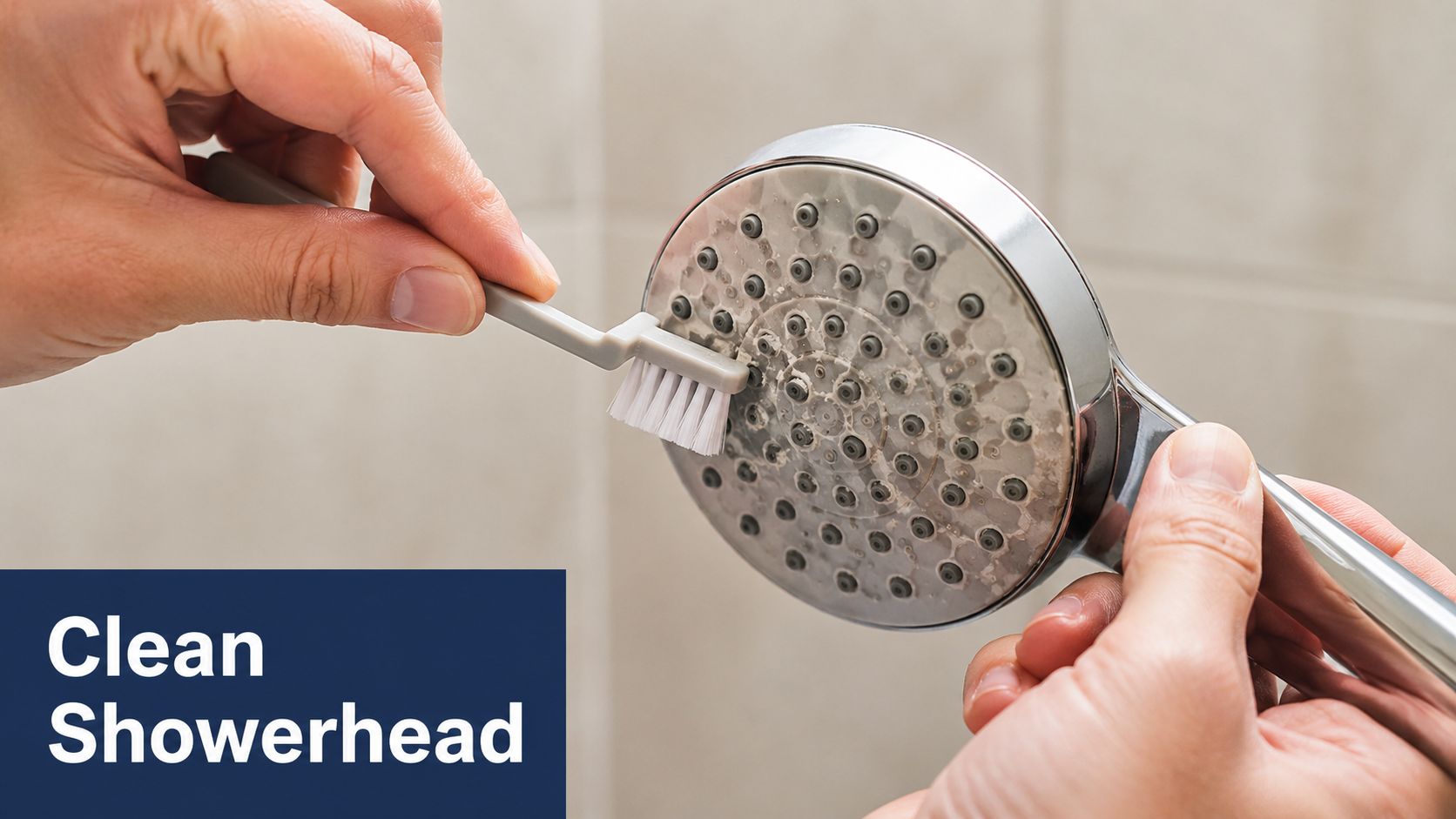
Clean the showerhead before you replace anything
Limescale and mineral debris collect where the water has to pass through the smallest openings. That means the nozzles, screen, and internal passages of the head. You might see crust on the face, but the heavier buildup is often inside.
For a basic cleaning, you need:
- White vinegar: Good for dissolving mineral deposits.
- A plastic bag or bowl: For soaking the showerhead.
- An old toothbrush or nylon brush: To scrub the spray nozzles.
- Slip-joint pliers and a rag: If you need to remove the head without scratching the finish.
If the showerhead can be removed easily, take it off and soak it. If not, tie a vinegar-filled bag around it so the face stays submerged. After soaking, scrub the nozzles and rinse thoroughly before testing again.
A lot of homeowners stop at the outside face. Don't. The filter screen near the connection often catches grit and scale too.
If you're dealing with recurring hard-water crust, this overview of calcium buildup in water helps explain why the problem keeps coming back.
Check the flow restrictor carefully
Most modern showerheads include a flow restrictor. It's usually a small plastic insert, often green or blue, tucked behind the screen and washer. If the showerhead has mineral buildup and the restrictor is also catching debris, the flow can feel especially weak.
According to Fresh Water Systems' shower pressure guide, removing the internal flow restrictor from a standard showerhead can increase flow to 2.5 to 3.0 GPM, and the same source says this works in 85% of households dealing with calcification-related flow reduction.
Common tools are simple:
- Unscrew the showerhead.
- Remove the washer and filter screen gently.
- Look for the plastic restrictor behind them.
- Use needle-nose pliers or a small flat-head screwdriver to lift it out carefully.
- Reassemble and test.
Be careful here. If you gouge the housing or damage the washer, you can create leaks. If the showerhead is old or cheaply made, replacing it may be smarter than forcing parts out.
For homeowners planning a larger bathroom refresh, fixture choice matters more than people think. This guide to choosing bathroom fixtures is useful because spray design, internal passages, and overall build quality affect how the shower feels even when supply pressure stays the same.
Here's a visual walkthrough if you want to see the process before taking the head apart:
The counterintuitive fix that sometimes feels better
This surprises people. More flow doesn't always feel like more pressure.
Some showerheads are designed to shape and tighten the spray so the stream feels stronger on your skin, even while using less water. In narrow pipes or marginal plumbing setups, a lower-GPM showerhead can sometimes improve the perceived pressure because the system loses less force pushing water through a demanding head.
A shower can feel stronger after installing a lower-flow head if the old head was asking more from the plumbing than the piping could deliver.
That's one reason random “high flow” upgrades don't always solve the problem. If your piping is restricted or undersized, a better-engineered low-flow head can outperform a bulkier one that attempts to dump more water.
So if cleaning and restrictor work don't solve it, don't assume the next move is always “more GPM.” Sometimes the better answer is a better spray pattern.
Checking Valves and Simple System Adjustments
A weak shower often comes down to a valve that is not fully open or a pressure setting that was changed at some point and never put back. This part of the diagnosis is still homeowner-friendly, but it is also the point where small mistakes can affect the whole house.
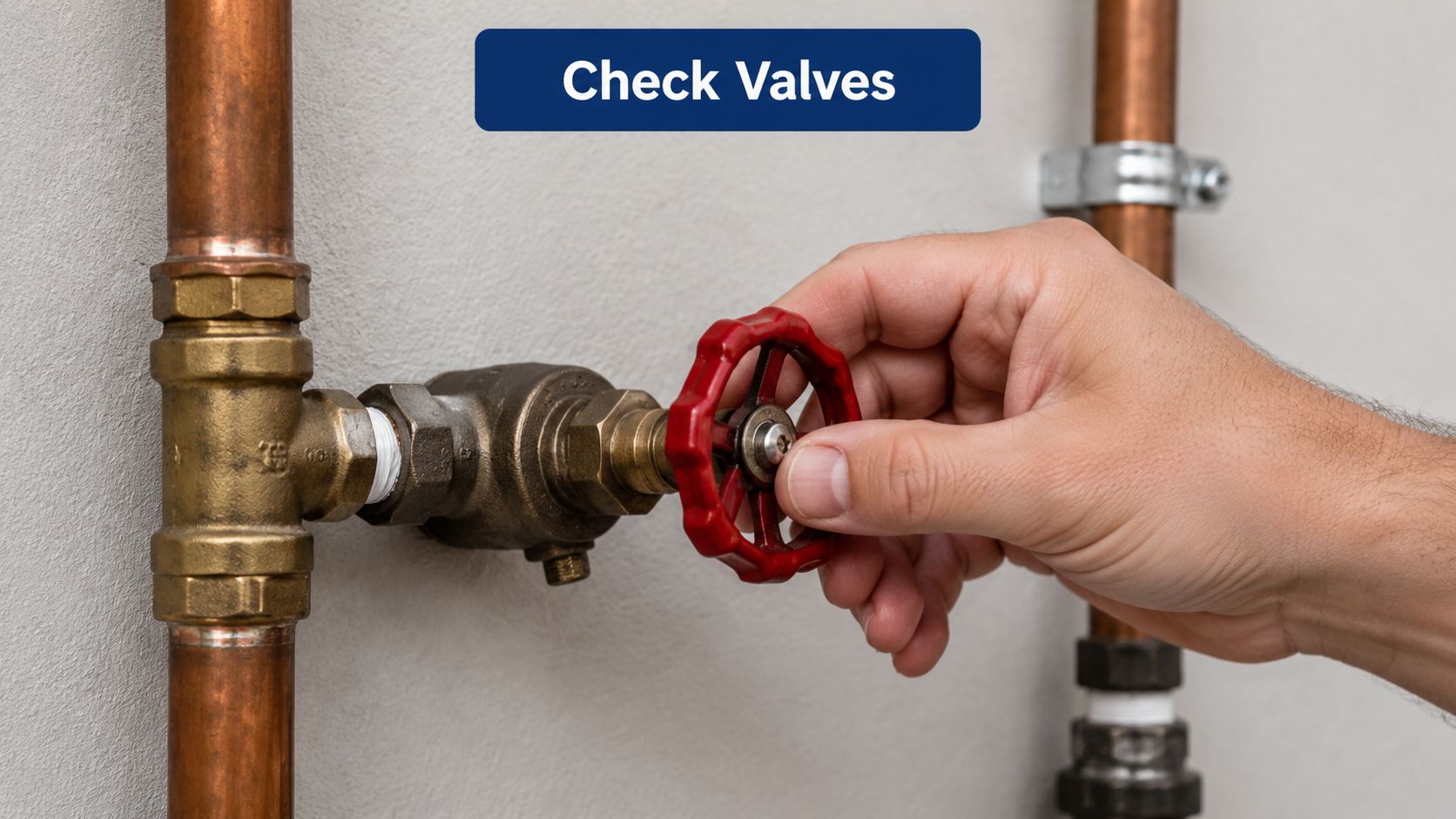
Confirm the obvious valves first
Start with any valve that directly serves the shower or bathroom. In some homes, that means an access panel behind the tub wall. In others, it is a branch shutoff in the basement, crawlspace, or near the water heater. If someone did repair work recently, this is one of the first places I check.
Then look at the main shutoff for the house. A partially closed main can cut performance everywhere, but people often notice it most in the shower first because that is where low flow feels most frustrating. Older gate valves are especially tricky because the handle may turn, but the internal gate may not open fully.
A few patterns help narrow it down:
- Only one shower is weak: Check for a local shutoff, debris in the shower valve, or a problem isolated to that branch.
- One bathroom is weak: Look for a branch valve serving that bathroom.
- Multiple fixtures are weak: Inspect the main shutoff and the incoming pressure setup.
- The problem started after plumbing work: Suspect a valve left partly closed or debris knocked loose into the line.
If you see corrosion, staining, or active dripping around a shutoff, stop treating it like a simple pressure issue. A bad valve can fail when touched. This guide on a shut-off valve leaking helps explain when a small leak points to a valve that needs replacement.
Check house pressure before touching the regulator
If the whole house feels weak, the next component to inspect is the pressure reducing valve, or PRV. You will usually find it near the water meter or where the main water line enters the home. Its job is simple. It lowers street pressure to a level your plumbing can handle safely.
Do not adjust a PRV just because the shower feels disappointing. Test first. A basic pressure gauge on a hose bib or laundry faucet will tell you whether the house pressure is low or whether the shower problem lives farther downstream at a valve, cartridge, or branch line.
As a practical benchmark, most homes perform normally with pressure somewhere in the middle range, not extremely low and not pushed too high. If the reading is clearly below normal across the house, the PRV may be out of adjustment or starting to fail. If the reading is normal, turning the regulator up will not fix a blocked shower valve or a restricted pipe.
If you decide to make a small adjustment, be methodical:
- Mark the current position first.
- Turn the adjustment only a little.
- Retest at the same fixture.
- Stop if pipes start banging, fixtures get noisy, or flow becomes erratic.
That trade-off matters. More house pressure can make a shower feel better, but it also puts more stress on supply lines, toilet fill valves, washing machine hoses, and aging stops under sinks. I tell homeowners to treat regulator adjustments as fine-tuning, not a cure-all.
Sometimes the smarter move is reducing demand at the shower instead of raising pressure for the entire house. That is why the lower-GPM point from the last section matters. In marginal plumbing systems, a showerhead that asks for less water can feel stronger than one that dumps more. If mineral buildup keeps returning and starts affecting several fixtures, water quality may be part of the bigger picture. This article on choosing home water purification is useful background for that side of the problem.
Deeper Plumbing Issues and Hidden Causes
When the easy fixes don't change much, the problem usually lives deeper in the system. In such situations, symptoms matter more than parts swapping.
Some homes have aging galvanized piping that has narrowed internally over time. From the outside, the pipe can look fine. Inside, rust and mineral buildup can leave only a small passage for water to move through. The result is a gradual decline in performance, often worse at fixtures farther from the main supply or when more than one fixture runs at once.
When old pipes are the real bottleneck
Pipe restriction tends to show up as a slow, stubborn problem rather than a sudden one. Homeowners often say the shower “used to be stronger years ago” but can't point to a specific day it changed.
Watch for patterns like these:
- Older house with original metal piping: Internal restriction becomes more likely.
- Several fixtures weak, not just one: The bottleneck may be in branch lines or the main distribution piping.
- Pressure feels somewhat normal at first, then fades under use: Restricted piping struggles to maintain flow when demand increases.
This is also where people start thinking about treatment equipment, especially if scale and sediment keep returning. If you're comparing long-term options, this guide to choosing home water purification is worth reading because water quality affects fixture lifespan, heater performance, and mineral buildup across the system.
Hot water side problems and trapped air
If the shower is weak mostly on the hot side, shift your attention to the water heater and the hot-water path feeding the bathroom. Sediment inside the heater can interfere with performance, and hot-side valves or strainers can also clog. In real homes, this shows up as decent cold pressure with disappointing hot flow.
That's not usually a DIY rebuild. It's a diagnostic clue.
Then there's a culprit many guides skip entirely: air trapped in the plumbing lines. Emerging home renovation diagnostics cited by Home Renovision DIY on Facebook say air entrapment in residential plumbing lines can reduce shower flow by up to 30%.
Air problems often announce themselves before you ever see the pressure issue clearly. Listen for:
| Symptom | What it can suggest |
|---|---|
| Sputtering at startup | Air mixed in the line |
| Gurgling in nearby pipes | Air pockets moving through the system |
| Uneven spray bursts | Intermittent air release |
| Problem appeared after plumbing work | Air introduced when the system was drained or opened |
When vertical piping runs are involved, trapped air can act like an invisible blockage. Homeowners describe it as the shower “spitting” or “breathing” before settling down. If that sound is familiar, mention it when you call a plumber. It helps narrow the diagnosis fast.
Strange noises matter. A sputter, hiss, or gulping sound often tells more than the pressure complaint itself.
At this stage, the goal isn't to start tearing into walls. It's to recognize when the problem has moved beyond fixture maintenance and into system diagnosis.
Troubleshooting Checklist and When to Call EZ Plumbing
When shower pressure is weak, most problems fall into a short list of causes. A good diagnosis is really about ruling them out in the right order.
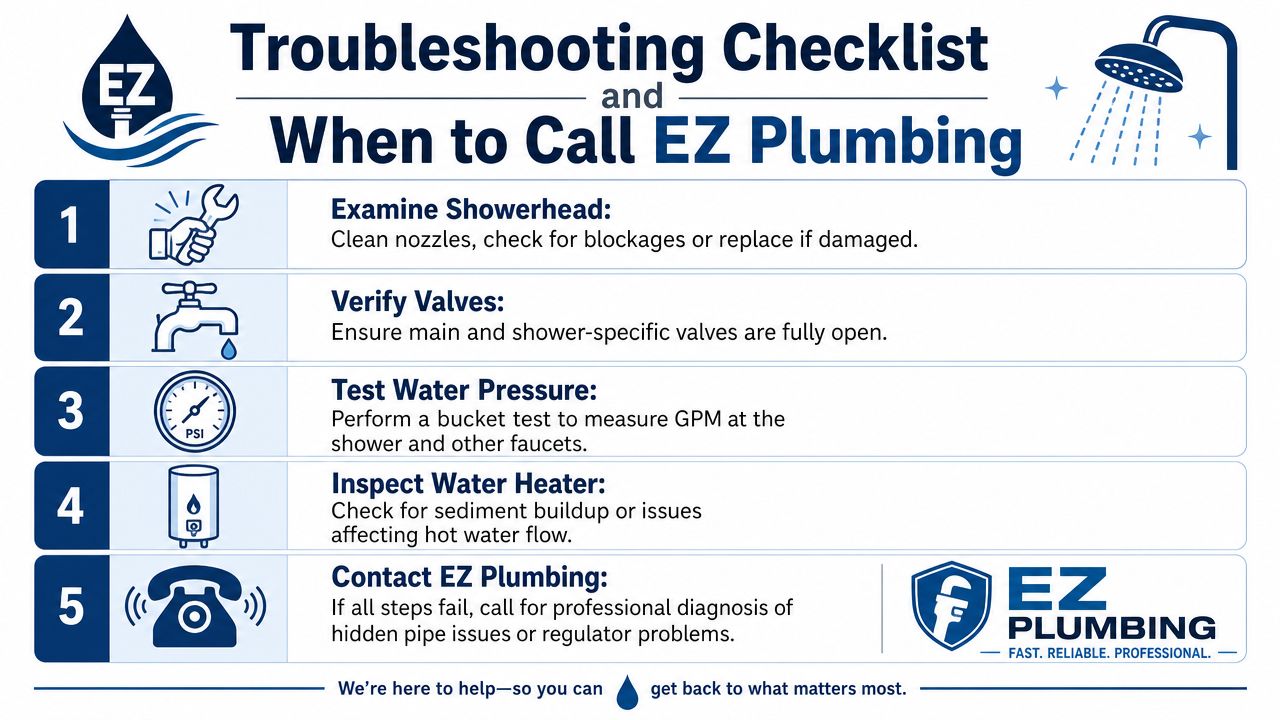
Quick reference table
| Symptom | Likely Cause | Solution (DIY or Pro?) |
|---|---|---|
| Weak spray only at one shower | Clogged showerhead or internal restriction | Clean, descale, inspect restrictor. DIY |
| Shower weak but sinks feel normal | Local shower valve, cartridge, or fixture issue | Basic checks first, plumber if valve work is needed |
| Weak hot water more than cold | Water heater sediment or hot-side restriction | Usually professional diagnosis |
| Whole house pressure feels low | Main valve, PRV, or supply problem | Check valves first, then call a pro if needed |
| Sputtering or gurgling | Air in lines | Professional diagnosis if it doesn't clear |
| Gradual decline over time in an older home | Pipe corrosion or mineral narrowing | Professional evaluation |
The line between DIY and professional work
Here's the practical dividing line.
A homeowner can usually handle cleaning a showerhead, soaking parts in vinegar, checking whether accessible valves are fully open, and testing flow at fixtures around the house. Those are low-risk jobs if you move carefully.
You're getting in over your head when any of these show up:
- The issue affects the whole house
- Pressure is poor on the hot side only
- The PRV appears faulty or needs diagnosis
- The shutoff valve leaks or won't operate normally
- You suspect old corroded piping
- There's noise in the walls, sputtering, or signs of trapped air
- Any fix requires opening walls, replacing valves, or servicing the water heater
That's where experience matters. A pro can test the system, isolate whether the restriction is local or house-wide, inspect the regulator, evaluate the water heater, and determine whether hydro jetting, valve replacement, or pipe work is the right next step.
If you're in Los Angeles and the shower still runs weak after the basic checks, call EZ Plumbing. They've served Los Angeles since 1989, handle 24/7 emergency plumbing, and provide same-day scheduling for planned repairs. Their licensed, insured team works on everything from stubborn shower pressure issues and faulty regulators to water heater performance problems, drain cleaning, hydro jetting, sewer diagnostics, and gas leak repairs. You can call (818) 908-2710 or schedule online for a clean, accurate diagnosis and a repair that gets done right the first time.