
24 Hour Plumbing Los Angeles: What to Do Before Help Arrives
It's 2 a.m. and something's wrong under the sink, behind the wall, or in the hallway ceiling. You're standing there listening to water move where it shouldn't, trying to decide if this is a real emergency or just a miserable annoyance that can wait until morning.
In Los Angeles, that decision matters fast. After-hours plumbing is materially more expensive than daytime service, and the wrong delay can turn a repair into water damage, a shutdown, or a much larger bill. If you need 24 hour plumbing Los Angeles residents can trust, the question isn't who promises the quickest truck. It's who stops the damage cleanly and leaves you with a path to permanent repair.
Table of Contents
- When a Plumbing Problem Cannot Wait Until Morning
- What Actually Counts as a Plumbing Emergency
- How Response Times and Pricing Work in Los Angeles
- The Most Common 24 Hour Plumbing Calls in Los Angeles
- Your First 10 Minutes Before the Plumber Arrives
- What a Professional Dispatch and Onsite Visit Should Look Like
- Trust Signals That Matter for LA Homes, HOAs, and Commercial Properties
- How to Reach EZ Plumbing Right Now
When a Plumbing Problem Cannot Wait Until Morning
At 2 a.m., the room changes character the second you hear dripping inside a wall or see water creeping across tile. A lot of homeowners waste ten minutes arguing with themselves, hoping the leak slows down, hoping the toilet resets, hoping the smell near the laundry room is just bad drainage. That hesitation is expensive.
Treat the situation like damage control, not a shopping decision. If water is actively moving, if wastewater is coming back up, or if you smell gas, your job is to stop escalation first and ask questions later. That's the only sensible order.
The first call isn't about perfection
A burst pipe is obvious. A ceiling stain that is growing, a toilet that keeps overflowing after you've stopped flushing, or a basement drain that's pushing water back into the room are all urgent in the same way, because they affect the structure of the property, not just the fixture itself. When a failure can spread beyond one room, it doesn't belong on a “tomorrow morning” list.
A slow faucet drip, one weak drain that still clears, or a toilet that's just running a bit longer than usual is a different category. Those problems still need attention, but they usually don't justify panic at midnight unless they start affecting multiple fixtures or creating active water loss.
Practical rule: if you'd regret waiting until the sun comes up because the damage could spread, call now.
The stress test is simple. If you can safely shut off the affected water and the problem stops, you may have bought yourself time. If you can't isolate it, or the issue involves sewage or gas, waiting is the wrong move.
What Actually Counts as a Plumbing Emergency
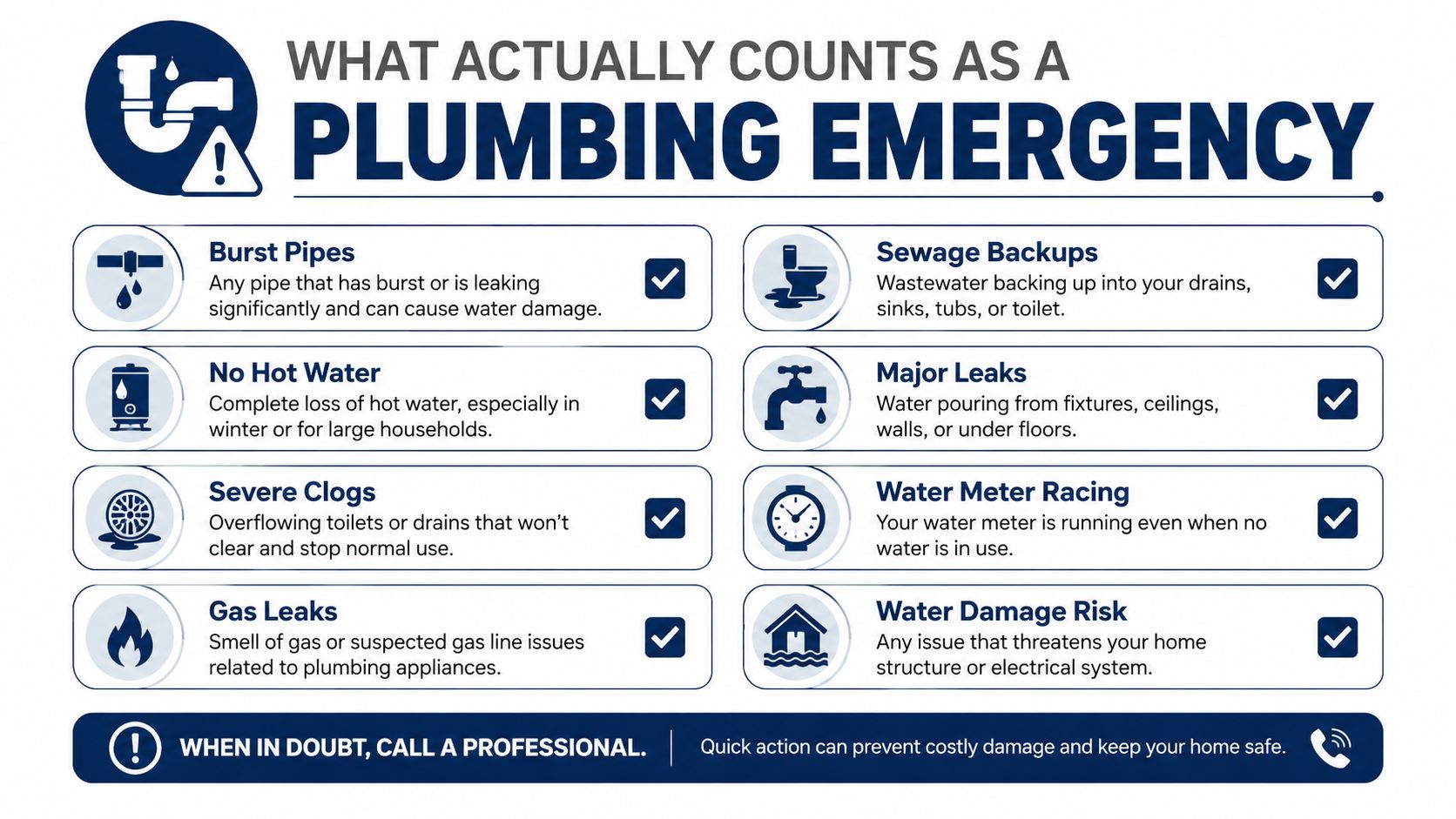
The cleanest way to think about plumbing emergencies is simple. Active water loss, sewage backup, and gas odor are emergencies. Slow drainage, an isolated fixture issue, and a minor leak that can be contained are usually not. That's the line.
If water is spraying, pooling, or soaking building materials, you're in emergency territory. If sewage is coming back through a drain or toilet, that's urgent because it's a sanitation problem as much as a plumbing problem. If you smell gas near a water heater or appliance, leave the area and treat it as a safety issue, not a repair estimate problem.
For a practical guide built for Los Angeles homeowners, use the same decision rule found in EZ Plumbing's emergency plumbing guide for LA homeowners, but keep the logic even simpler than the article title makes it sound. If the issue can spread damage or make the property unsafe, call immediately. If it's isolated and stable, schedule it.
A fast decision tree
- Call now: burst pipe, active leak, sewer backup, gas smell, water heater leaking heavily.
- Call now if worsening: repeated toilet overflow, drain backup affecting more than one fixture, visible ceiling leak, water coming from a wall or baseboard.
- Schedule soon: single slow drain, dripping faucet, occasional gurgle, one fixture that's just not performing normally.
A lot of homeowners talk themselves into the wrong choice. A clog in one sink is annoying. A clog that starts affecting the shower and toilet too is a system problem, and system problems don't wait politely.
How Response Times and Pricing Work in Los Angeles
Emergency plumbing in Los Angeles does not cost like a routine weekday visit. A single pricing guide puts regular plumbing labor at $95–$200 per hour with service call fees of $75–$150, while emergency or after-hours work rises to $200–$400 per hour according to this Los Angeles pricing guide. That spread is the market reality. Night calls, weekend calls, and holiday calls cost more because the plumber is leaving a normal schedule to stop active damage and get the property stable.
The core question is not who can show up first. It is who can arrive with the right plan, contain the problem, and keep the repair from turning into drywall, flooring, or framing loss. A fast truck matters. A clear path from mitigation to permanent repair matters more.
What the bill usually reflects
The bill is not just labor. It usually includes the service call, the urgency of the dispatch, and the work required to reach the source before the problem spreads. An accessible pipe under a sink and a slab leak are not priced the same because the repair access, time, and risk are completely different.
| Typical 2026 Emergency Plumbing Costs in Los Angeles | Typical LA Price Range |
|---|---|
| Burst pipe in an accessible location | $200–$600 |
| Slab leak repair | $1,500–$4,000 |
| Sewer backup hydro jetting | $400–$900 |
| Gas leak repair | $300–$1,000 |
Those ranges make the point clearly. A 24-hour call can be expensive, but delay can cost more if water keeps moving into framing, drywall, flooring, or neighboring units. The smart move is to use emergency service to stop the damage first, then insist on a permanent repair plan once the property is stable.
The Most Common 24 Hour Plumbing Calls in Los Angeles
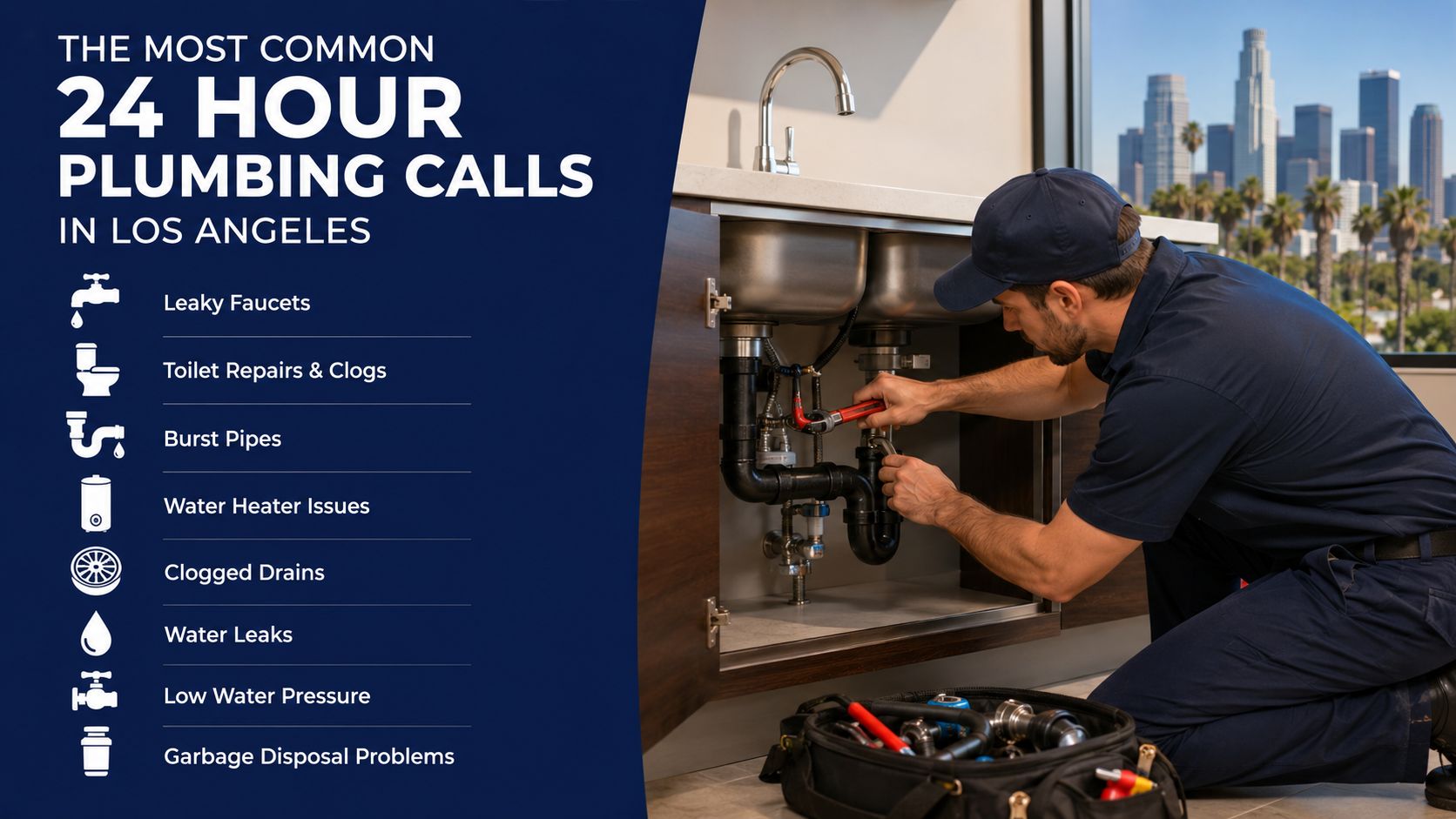
Los Angeles after-hours calls usually fall into a few hard categories. Each one demands a different first move, and that first move decides how much secondary damage you avoid before the truck gets there. A burst pipe needs one response. A sewer backup needs another. Treating them the same is how homeowners turn a manageable problem into drywall, flooring, and cabinet damage.
Burst pipes and active leaks
Burst or frozen pipes account for 32% of emergency calls in the 2026 industry data summarized from this emergency call statistics report. In Los Angeles, the frozen part shows up less often than the burst part, but the damage pattern is the same, water is escaping where it should not.
What you usually see is sudden flow, ceiling staining, or fast pooling near walls and cabinets. Shut off the water feeding that area if you can. Then move anything valuable out of the way and stop testing the leak. Every extra minute gives the water more places to spread.
Sewer backups and toilet overflows
Sewer line backups make up 22% of emergency calls, and toilet overflows and clogs are another 16% in the same 2026 breakdown. Older LA buildings and multi-unit stacks can go bad quickly, especially when the blockage sits in the main line.
If wastewater is backing up, stop using water in the building right away. Do not run the dishwasher, do not flush again, and do not keep forcing the same drain. If the main line is blocked, every extra gallon pushes the mess farther into the property.
Water heater failures and gas concerns
Water heater failures account for 18% of emergency calls, and gas line concerns account for 12% in the same data set. A failed water heater is a problem you can live with for a while. A gas odor is a safety issue that needs immediate action.
If the heater is leaking, isolate the area and shut off the water if it is safe to do so. If you smell gas, leave the property and call for emergency help right away.
Why drain clearing isn't always enough
Recurring drain or sewer trouble usually needs more than a quick cable run. Simple cabling can buy time, but it does not clear everything hanging on the pipe walls. In Los Angeles properties, hydro jetting is the better fix because it removes grease, mineral scale, debris, and root intrusion instead of just punching a temporary hole through the blockage as described by this Los Angeles emergency plumbing service. That matters most in older service lines and multi-unit systems, where partial obstructions keep coming back.
For property managers handling several units at once, the Homebase guide for syndicators lays out why fast containment matters as much as the repair itself. The same rule applies in single-family homes. Stop the active damage first, then push for a permanent solution that keeps the call from coming back.
Your First 10 Minutes Before the Plumber Arrives
The first ten minutes decide how bad the damage gets. Don't pace around the issue, don't keep checking it, and don't reopen anything you just shut down to “see if it fixed itself.” That habit turns a contained failure into a bigger one.
Minute by minute
- Find the water shutoff. If it's a local fixture problem, use the stop under the sink or behind the toilet. If the leak is not isolated, go straight to the main shutoff. For a clear walkthrough on locating and using the main shutoff, use EZ Plumbing's main water shutoff guide.
- Kill the source, not the symptom. A towel on the floor doesn't stop a leak. Shutting off the valve does.
- Move valuables first. Put rugs, boxes, electronics, paper files, and anything that absorbs water out of the path immediately.
- Take photos before cleanup. Capture the source, the spread, and any visible damage. Insurance adjusters care about what happened before the mop.
- Don't keep using the fixtures. One flush, one sink run, or one shower test can make a backup worse.
- If you smell gas, leave. Don't light anything, don't flip switches, and don't stay inside trying to diagnose it.
- Keep one person on the phone. The dispatcher needs current information, not a long story from three people at once.
- Write down what changed. Note when it started, what you shut off, and whether the leak slowed.
- Protect the floor. Use towels only to contain spread after the source is shut off.
- Prepare access. Clear the hallway, open gates, and make sure the plumber can get to the shutoff and affected area fast.
For HOAs and landlords, the problem after an emergency is often coordination, not the leak itself. A practical facilities workflow like the one discussed in the Homebase guide for syndicators helps because someone has to manage tenants, access, documentation, and follow-up without improvising under pressure.
Shutoff first. Documentation second. Cleanup third. If you reverse that order, you usually regret it.
What a Professional Dispatch and Onsite Visit Should Look Like
A good dispatcher does not waste your time with scripted cheerfulness. They ask for the address, whether water is still running, whether you smell gas, what type of building you're in, and how the plumber can get inside. Those questions are not small talk. They tell the crew what tools to bring, what safety issues to expect, and how urgent the response really is.
A competent emergency company gives you a real arrival window and then works to hit it. EZ Plumbing states that a licensed plumber typically arrives within 60–90 minutes of an emergency call, with dispatch operating 24/7 across Los Angeles and the San Fernando Valley according to EZ Plumbing's emergency service page. That kind of window matters because the point is to stabilize the failure before the property takes on more water, more waste, or more structural damage. If you want to see how that response is handled in the field, EZ Plumbing's emergency plumbing response for LA homes lays out the same kind of practical first steps homeowners should expect.
At the door, the work should be methodical
The tech should identify the source, isolate the problem, and explain the next step in plain language. For a burst line, that means finding the stop and checking the spread. For a backup, it means verifying where the blockage sits before opening walls or recommending a major repair. For gas concerns, it means treating safety as the first priority.
The visit should end with documentation. You want photos, a written scope of work, and a clear estimate for the permanent repair path, not just a vague promise to come back later. If you're managing a property, that paper trail is not optional. It is what lets you hand the job off cleanly to an owner, board, insurer, or facility manager without reopening the same mess later.
A rushed truck roll helps no one if the crew guesses at the problem. A good onsite visit gives you control of the situation, a clear repair plan, and a clean record of what happened.
Trust Signals That Matter for LA Homes, HOAs, and Commercial Properties
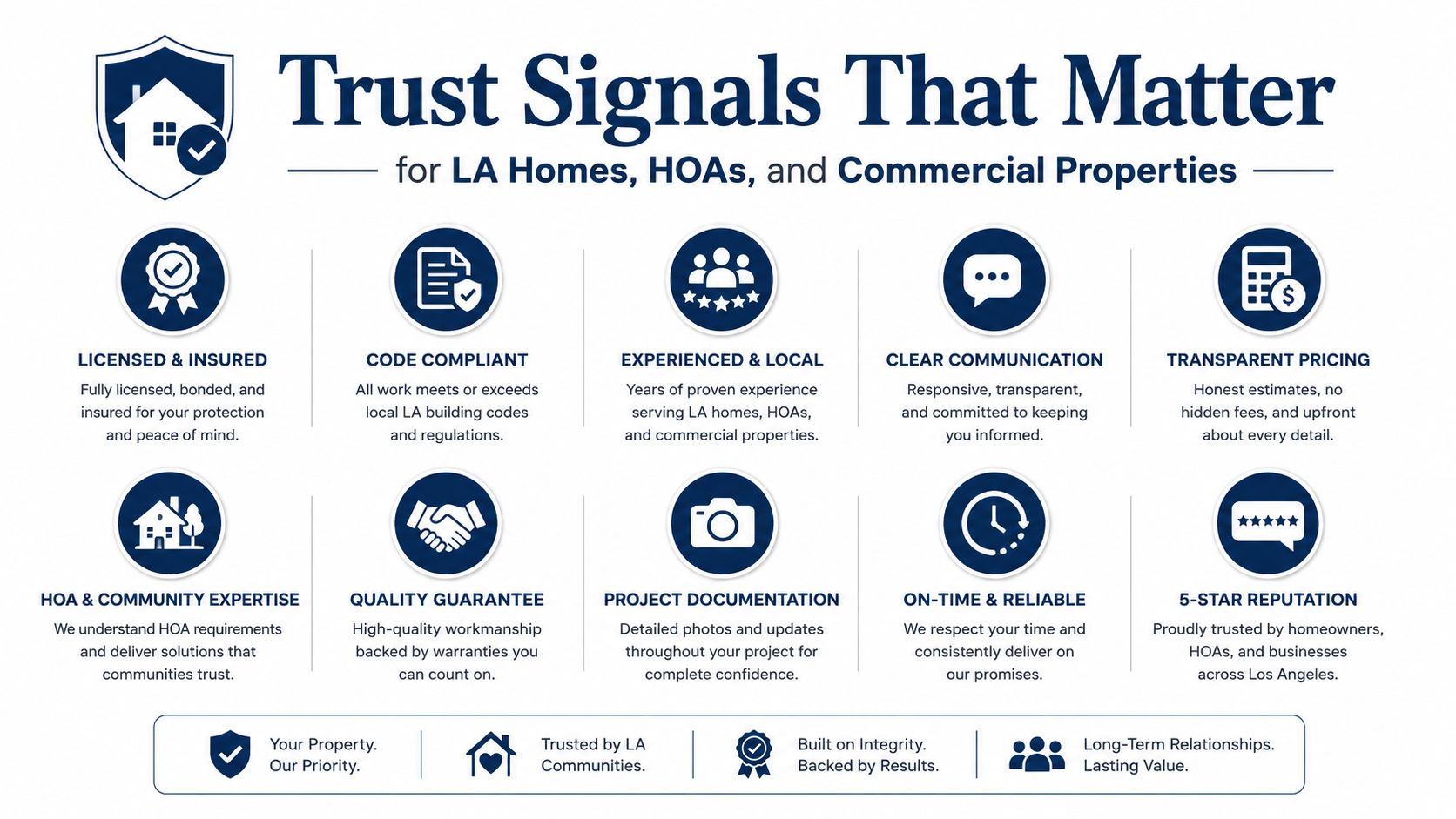
For homeowners, the trust test is simple. For HOAs, landlords, and facility teams, it's broader. You're not just buying a repair, you're buying a record, a liability shield, and a clean handoff to the next phase of the job.
Start with the basics. Licensing, insurance, written guarantees, and clear documentation matter more than a catchy promise of fast service. A provider who can show up fast but leaves no usable record creates problems later. A provider who can explain the failure, document the fix, and map the permanent repair is the one who helps.
For recurring drain and sewer issues, hydro jetting is often the right call because it clears the pipe wall, not just the opening. That's especially important in older LA properties where grease and root intrusion keep bringing the same problem back. A strong emergency company should be comfortable pairing that work with sewer diagnostics and minimal-disruption repair planning.
If you're choosing between options, use this filter:
- Documentation: ask for photos and a written scope.
- Coordination: confirm the crew can work with building staff or management.
- Repair path: make sure the company can explain the temporary fix and the permanent one.
- Property fit: make sure they understand single-family homes, multi-unit stacks, and commercial access issues.
- Follow-through: verify there's a real plan for the next day, not just a truck tonight.
That's why the smartest 24-hour provider is often the one that minimizes secondary damage and creates a clear repair path, not the one that shouts about speed.
How to Reach EZ Plumbing Right Now
If you need help now, call (818) 908-2710. EZ Plumbing provides 24/7 emergency dispatch across Los Angeles and the San Fernando Valley, and their service area includes Beverly Hills, Santa Monica, West Hollywood, Pasadena, Glendale, Burbank, and nearby neighborhoods. They also handle homes, HOAs, property managers, and commercial properties with licensed, insured service.
You can also schedule through EZ Plumbing. If the leak is active, the drain is backing up, or you smell gas, call first and clean up later.
If you're dealing with an emergency, stop the damage before you chase the perfect repair plan. Call EZ Plumbing for 24/7 response, clear communication, and a path from immediate mitigation to permanent fix, then visit EZ Plumbing to get the help moving now.
Recent EZ Plumbing Jobs in Los Angeles
Real, recent work from our crews — updated automatically as jobs complete.