
Why Sewer Line Maintenance Matters for Homeowners
Most homeowners think about their sewer line exactly once: the moment it fails. That mindset is why sewer line maintenance gets deferred year after year until a backup floods the basement or raw sewage surfaces in the yard. Understanding why sewer line maintenance belongs on your regular home care schedule, not just your emergency call list, can save you thousands of dollars and protect your property from damage that goes far deeper than a clogged drain.
Table of Contents
- Key takeaways
- Why sewer line maintenance gets ignored
- Inspection methods and tools that work
- Financial and health benefits of proactive care
- Seasonal and situational risk factors
- Practical steps to protect your sewer line
- My honest take on sewer line care
- Let Ez-plumbing protect your sewer line
- FAQ
Key takeaways
| Point | Details |
|---|---|
| Prevention beats emergency repair | Proactive maintenance costs a fraction of emergency excavation and pipe replacement. |
| Camera inspections are non-negotiable | Older homes and properties near mature trees need scheduled video inspections every 2 to 3 years. |
| Tree roots are a silent threat | Root intrusion in clay or Orangeburg pipes often goes undetected until a full blockage occurs. |
| Winter is peak risk season | Cold weather and holiday grease buildup significantly increase the chance of a sewer backup. |
| Insurance rarely covers it fully | Most standard homeowner policies exclude underground pipe failure, leaving you to cover the bill. |
Why sewer line maintenance gets ignored
Your sewer line runs underground, out of sight, and out of mind. Unlike a leaking faucet or a running toilet, it gives you very little feedback until something is seriously wrong. That invisibility is the core reason most homeowners skip routine care entirely.
The main sewer line carries every drop of wastewater out of your home. Every shower, toilet flush, dishwasher cycle, and laundry load depends on that single pipe staying clear and intact. When it fails, nothing in your home drains properly, and the consequences spread fast. Neglected sewer lines risk structural damage, health hazards from wastewater exposure, and expensive emergency repairs that could have been avoided entirely.
The warning signs are easy to miss if you do not know what to look for. Slow drains throughout the house (not just one fixture) are a key signal. Gurgling sounds coming from toilets after you run a sink, or a persistent sewer odor in the yard, both indicate a line under stress. Acting on those signs early is far less disruptive than waiting for a full backup.
Common causes of sewer line failure include:
- Tree root intrusion: Roots aggressively invade clay or Orangeburg pipes, exploiting joints and cracking pipe walls from the inside out.
- Grease and FOG buildup: Fats, oils, and grease solidify inside the pipe over time, progressively narrowing the flow path.
- Soil movement and settling: In Los Angeles, seismic activity and expansive clay soils cause pipe joints to shift and separate.
- Pipe aging and corrosion: Homes built before 1980 often have clay sewer laterals or Orangeburg pipes that degrade with age.
Inspection methods and tools that work
The most reliable way to understand what is happening inside your sewer line is a professional camera inspection. A technician feeds a waterproof camera through a cleanout access point and transmits live footage of the pipe interior. You see exactly what is there: root intrusions, grease accumulation, pipe bellies, offset joints, or cracked sections. There is no guessing.
Camera inspections are especially critical for properties built before 1980. Older pipes are more likely to have developed bellies (low spots where water and debris pool), root penetration at aging joints, or sections that have partially collapsed. None of those conditions are visible from the surface, and all of them worsen without intervention.

For cleaning, hydro jetting is the gold standard in professional sewer maintenance. A hydro jet uses high-pressure water delivered through a specialized nozzle to scour the pipe walls clean. It removes grease, debris, and minor root intrusions more thoroughly than mechanical snaking, and it does not damage intact pipe walls.
Here is a practical maintenance schedule to follow:
- Annual drain cleaning: Schedule a professional drain cleaning once per year to clear grease buildup before it becomes a blockage.
- Camera inspection every 2 to 3 years: Inspections every 2 to 3 years are non-negotiable for older homes or properties near large trees.
- Post-blockage inspection: After any significant backup, always follow up with a camera inspection to understand the root cause before assuming the problem is fully resolved.
- Pre-purchase inspection: If you are buying an older property, a sewer camera inspection before closing can reveal hidden damage that changes your negotiation or decision entirely.
Pro Tip: When selecting a sewer maintenance provider, ask specifically whether they provide recorded footage of the camera inspection. A reputable company will give you a copy. That footage becomes part of your property records and is useful for insurance claims or future buyers.
Financial and health benefits of proactive care
The financial case for regular sewer maintenance becomes very clear when you look at what an emergency replacement actually costs. Pipe replacement runs $50 to $250 per linear foot, but that is only the pipe itself. The total cost almost always doubles once you factor in landscaping, driveway, and hardscape restoration after the excavation. A 60-foot sewer lateral replacement can easily reach $15,000 to $30,000 by the time your yard is restored.
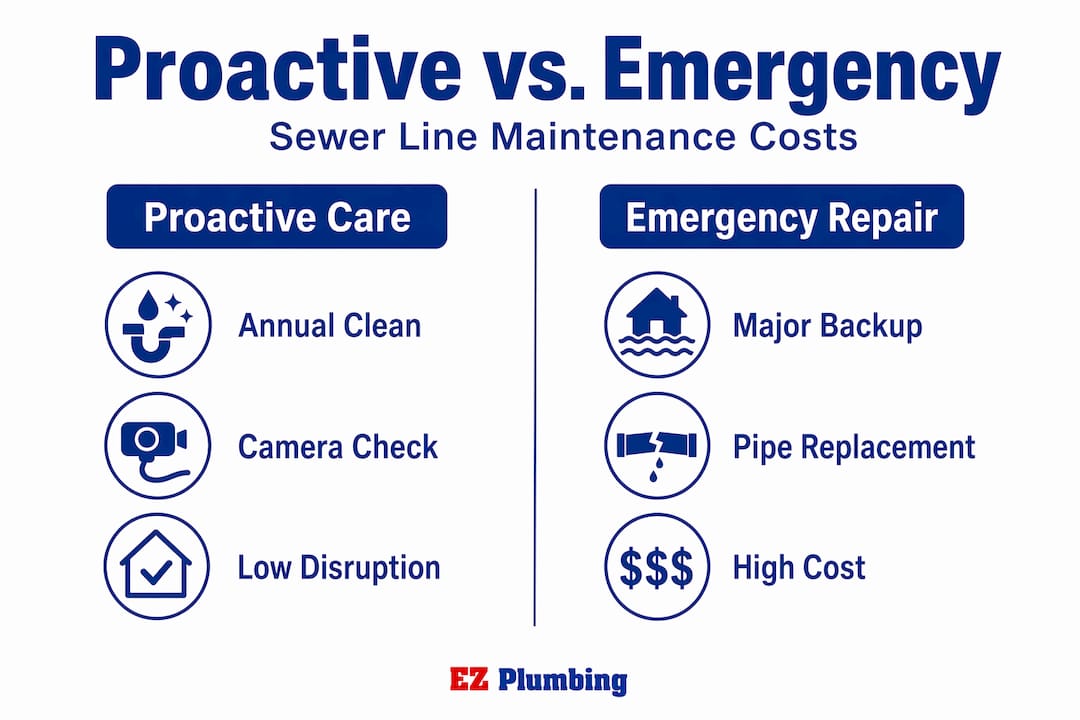
Compare that to a camera inspection running $150 to $400 and an annual hydro jet cleaning at $300 to $600. The math is not complicated.
| Maintenance approach | Typical cost range | Disruption level |
|---|---|---|
| Annual drain cleaning | $300 to $600 | Minimal, 1 to 2 hours |
| Camera inspection | $150 to $400 | Minimal, 1 to 2 hours |
| Hydro jetting service | $300 to $800 | Low, 2 to 3 hours |
| Emergency sewer repair | $3,000 to $10,000+ | High, days of disruption |
| Full sewer line replacement | $10,000 to $30,000+ | Very high, landscape damage |
The health dimension is equally serious. A backed-up sewer line introduces raw sewage into your living space, including pathogens like E. coli, hepatitis A, and other bacteria. Cleanup requires professional remediation, and depending on the extent of contamination, drywall, flooring, and personal property may need to be discarded.
Many insurance policies exclude or significantly limit coverage for underground pipe failure. Standard homeowner policies often treat sewer line failures as a maintenance issue rather than a covered loss, meaning the full repair cost falls on you. Some insurers offer sewer backup riders as optional add-ons, and knowing your policy details now is far better than discovering the gap after a backup.
“Sewer failures are not typically postponable emergencies the way cosmetic repairs are. Proactive maintenance is simply a financial reality of homeownership.” — Sewer Surgeons, Sunset Daily News
Seasonal and situational risk factors
Not all times of year carry the same sewer risk. Winter is consistently the most vulnerable season. Frozen soil and grease solidification during colder months increase blockage risk significantly. In Los Angeles, temperatures rarely freeze pipes directly, but the cooler ground causes grease that would normally flow through the pipe to solidify and cling to the walls instead.
The holiday season compounds this problem. Thanksgiving and Christmas generate more cooking grease, more guests, and heavier water use than any other period of the year. A line that was marginally clear in October can block completely by December under that load.
Mature trees are a year-round concern. Root growth is continuous, and roots follow moisture. Once a root finds a small crack in a sewer joint, it grows toward the water source inside the pipe. Left alone, a small root intrusion becomes a dense mass that blocks flow entirely.
Seasonal maintenance tips worth following:
- Schedule your annual drain cleaning before the fall/winter season, ideally in September or October.
- Avoid pouring cooking oils and fats down the drain during and after holiday cooking. Collect them in a container and dispose of them in the trash.
- If you have large trees in your yard or adjacent properties, ask your plumber about root barrier installation or chemical root inhibitors that are safe for your pipe type.
- After heavy rain events, watch for slow drains or gurgling sounds, which can indicate soil displacement affecting the line.
Pro Tip: Many homeowners do not realize that trees on neighboring properties can still send roots into your sewer line. The root system of a mature tree can extend well beyond the tree’s visible canopy. If you have large trees within 30 to 40 feet of your sewer lateral, that line deserves regular attention regardless of whose yard the tree is in.
Practical steps to protect your sewer line
Routine care does not require specialized tools or technical knowledge. Most of what protects your sewer line comes down to consistent habits and scheduled professional service.
- Keep grease out of the drain. FOG and “flushable” wipes are among the top causes of residential sewer blockages. Neither belongs in your drain system. Collect cooking grease in a jar and dispose of it in the trash.
- Only flush toilet paper. Wet wipes, paper towels, feminine products, and cotton swabs do not break down in sewer pipes. They accumulate at bends and joints until they form a blockage.
- Schedule annual professional drain cleaning. A professional drain cleaning service removes the gradual buildup that home remedies never fully address.
- Install a backwater valve if you do not have one. A backwater valve prevents sewage from flowing back into your home during a municipal sewer system overload, which is a real risk in dense urban areas during heavy rain events.
- Act on early warning signs immediately. Slow drains, gurgling sounds, or sewer odors are not minor inconveniences. They are signals that something in the line needs attention before it becomes a failure.
- Maintain a service record. Keep documentation of every inspection and cleaning. That history helps technicians identify developing problems and is valuable if you ever sell the property.
My honest take on sewer line care
I have seen what happens when a sewer line finally gives out after years of deferred maintenance. The homeowner is always shocked, not just by the cost, but by the disruption. A full excavation means your driveway or yard is torn up, your home may be uninhabitable for days, and the remediation bill for contaminated areas adds to the already steep repair cost.
What strikes me most is how preventable those situations are. A $300 annual cleaning and a camera inspection every couple of years would have caught every one of those problems at a fraction of the cost. The challenge is that sewer maintenance produces no visible result. You spend money and nothing looks different. That makes it psychologically difficult to prioritize, especially against other home projects with clear before-and-after results.
The way I think about it is this: your sewer line is the single pipe that everything in your home depends on. When it works, you never think about it. When it fails, everything stops. That asymmetry is exactly why the importance of sewer maintenance belongs at the top of your home care list, not at the bottom.
— EZ
Let Ez-plumbing protect your sewer line
Ez-plumbing provides sewer camera inspections and full sewer line services to homeowners and property managers across the greater Los Angeles area. Whether your home was built in the 1960s with original clay laterals or you simply want to know the current condition of your line, our licensed technicians use current camera and hydro-jetting technology to give you an accurate picture and real options. We do not recommend work you do not need. If we find a problem, we explain it clearly and give you a plan that fits your situation. For preventive cleanings, inspections, or sewer line repair in Los Angeles, contact Ez-plumbing to schedule your service today.
FAQ
Why is sewer line maintenance important for homeowners?
Regular sewer maintenance prevents backups, health hazards from sewage exposure, and emergency repair costs that can exceed $15,000 or more once excavation and surface restoration are included.
How often should a sewer line be inspected?
Camera inspections every 2 to 3 years are recommended for older homes or properties near mature trees. Newer construction with PVC piping can typically go longer between inspections if no warning signs appear.
What are the most common sewer line problems?
Tree root intrusion, grease and FOG buildup, pipe bellies, and offset or cracked joints from soil movement are the most frequent causes of sewer line failure in residential properties.
Does homeowner insurance cover sewer line repairs?
Standard residential policies often exclude underground pipe failure, treating it as a maintenance issue rather than a covered loss. A separate sewer backup rider may provide some protection, but coverage limits vary widely.
What can I put down the drain to maintain my sewer line?
Nothing replaces professional cleaning. At home, avoid pouring fats, oils, or grease down any drain, and flush only toilet paper. Enzyme-based drain treatments can help slow buildup between professional services but are not a substitute for hydro jetting.