
Why Is My Water Heater Leaking? a Los Angeles Homeowner
You walk into the garage or utility area, and there it is. A puddle under the water heater, maybe a slow drip down the jacket, maybe water creeping toward boxes, paint cans, or the wall. Most Los Angeles homeowners have the same first thought. Is this a small plumbing issue, or is the tank about to let go?
Treat it as urgent, but don't panic. A leaking water heater isn't always a full replacement. Sometimes it's a loose connection, a relief valve, or condensation that only looks serious. Sometimes it is serious, and waiting turns a manageable service call into flooring, drywall, and storage damage. That risk is real. Approximately 40% to 50% of all water heater failures lead to significant property damage requiring repairs beyond replacing the unit itself, according to this property-damage overview on water heater failures.
In Los Angeles, I see two patterns often. Hard water shortens the time between “working fine” and “suddenly leaking,” and older homes tend to have tight, awkward heater locations that make small leaks harder to spot early. If water has already spread to rugs or nearby soft goods, this guide on How to save a soaked rug is useful while you're handling the plumbing side.
The right approach is simple. Secure the area first. Shut down the heater safely. Then identify where the water is coming from before anyone starts guessing.
Table of Contents
- That Puddle in the Garage A Homeowners First Response
- Safety First Your Immediate Action Plan
- How to Find the Source of the Leak
- Making the Call Repair vs Replace Your Water Heater
- Understanding Water Heater Costs in Los Angeles
- When You Must Call a Los Angeles Plumber Immediately
That Puddle in the Garage A Homeowners First Response
A lot of leaks start the same way. You notice a small ring of water under the tank and hope it's nothing. Maybe someone just spilled laundry water nearby. Maybe the garage floor was already damp. Then you touch the pipe, see a fresh drip, and your stress level jumps.
That reaction makes sense. Water heaters usually fail gradually before they fail dramatically. A minor drip can sit unnoticed in a drain pan, under insulation, or behind stored items until the leak spreads far enough to stain drywall, swell trim, or soak whatever you've kept nearby. In older Los Angeles homes, the heater may be tucked into a closet, side yard enclosure, or garage corner where nobody looks closely until water is already on the floor.
Practical rule: If you can see water outside the heater, act as if the leak could get worse today, not next week.
The first response isn't to grab a wrench and start tightening random fittings. It's to slow the situation down. Move items away from the water path. Confirm whether the leak is active. Look for where the drip begins, not just where the puddle settles. Garage floors slope, and water often travels before it pools.
Three details matter right away:
- How fast the water is appearing: A drop every few seconds is different from a steady stream.
- Where the water seems to begin: Top, side, bottom, or nearby piping all point to different causes.
- What type of heater you have: Gas and electric units carry different safety steps.
If you're asking why is my water heater leaking, the answer usually becomes clearer once the area is safe and the leak location is narrowed down. Guessing too early leads homeowners to replace parts that weren't the problem, or worse, ignore a tank that's already failing internally.
Safety First Your Immediate Action Plan
The first job is containment. Stop incoming water. Then make the heater safe to be around.
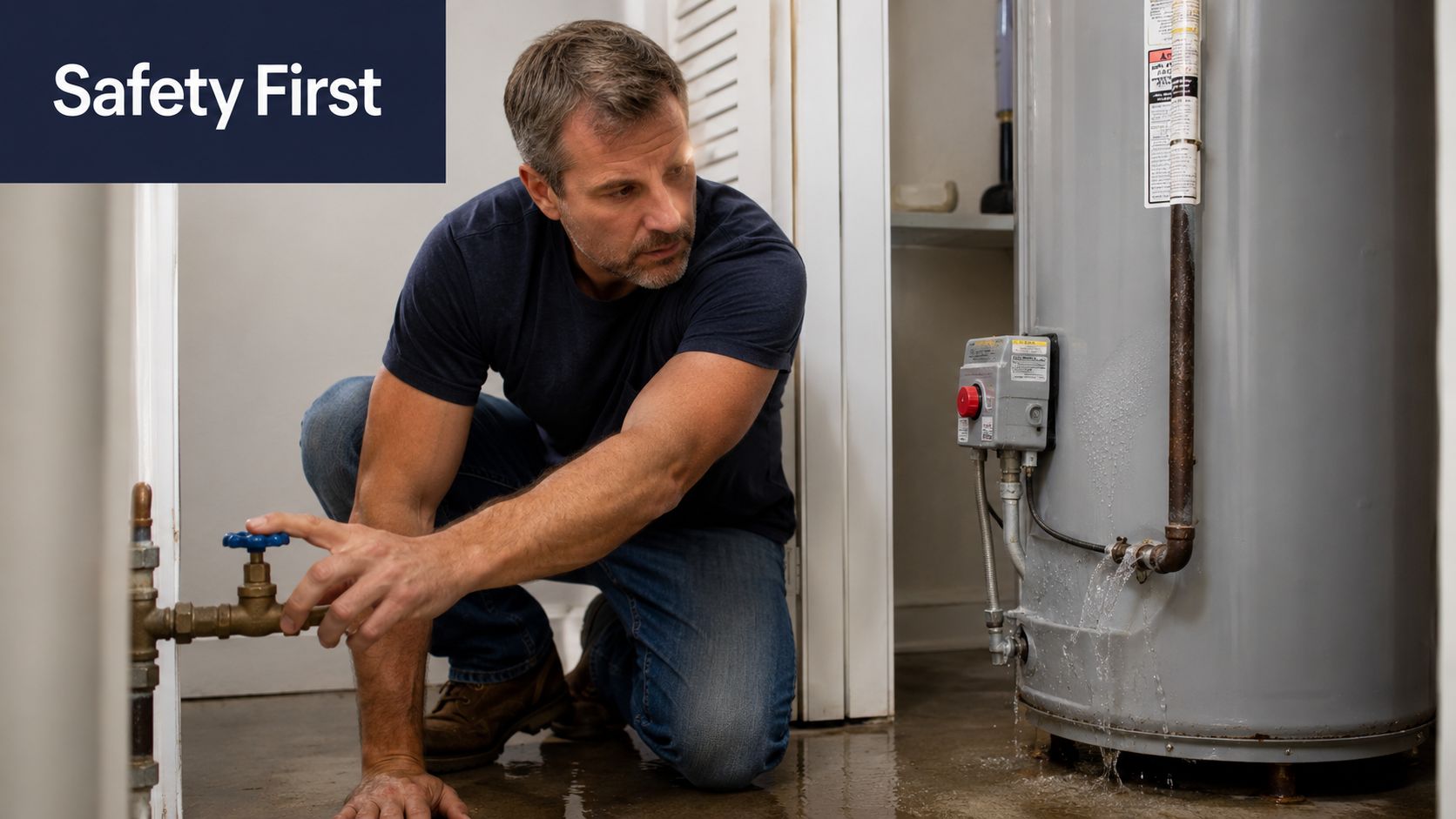
Shut off the water first
Find the cold water shutoff valve above the heater. On most installations, it's on the cold inlet pipe entering the top of the tank. Turn the handle clockwise if it's a wheel-style valve. If it's a lever-style ball valve, rotate it so the handle sits perpendicular to the pipe.
If that valve is stuck, corroded, or missing, shut off the home's main water supply instead. In Los Angeles houses, the main is often near the front hose bib, garage wall, or meter area.
Do this before diagnosis for one reason. A leaking heater under pressure keeps feeding the problem.
Use this quick sequence:
- Keep clear of standing water near electrical components: Don't step into pooled water if cords, outlets, or wiring are nearby.
- Close the heater's water supply valve: That limits additional leakage from the unit.
- Open a nearby hot water faucet: This can help relieve some pressure in the line.
- Place towels or a shallow pan only if it's safe: Containment is fine. Repair attempts can wait.
If the leak is active and you're not sure which valve to touch, it's better to stop and call for help than force a broken shutoff. If you need a reference point for what a failed unit can look like, this page on a broken water heater shows the kind of situations that move beyond a minor drip.
Cut power or gas safely
After the water is off, shut down the energy source.
For an electric water heater, go to the electrical panel and switch off the dedicated breaker. Don't remove access covers on the heater. Don't test wet components. Water and live electrical parts are a bad combination.
For a gas water heater, turn the gas control to the off position if you can do it safely and without forcing anything. If you smell gas, stop immediately, leave the area, and get professional help.
If there's any doubt about electricity, don't touch the heater itself. Use the breaker panel only.
A visual walkthrough helps if you're trying to stay calm and work methodically:
Once the incoming water and power source are shut down, the pressure comes off. That's when you can inspect without making the problem worse.
How to Find the Source of the Leak
Water rarely falls straight down from the part that failed. It tracks along the jacket, follows the piping, and pools at the lowest point. In Los Angeles garages and utility closets, that often sends homeowners to the bottom of the heater first, even when the leak started at the top.
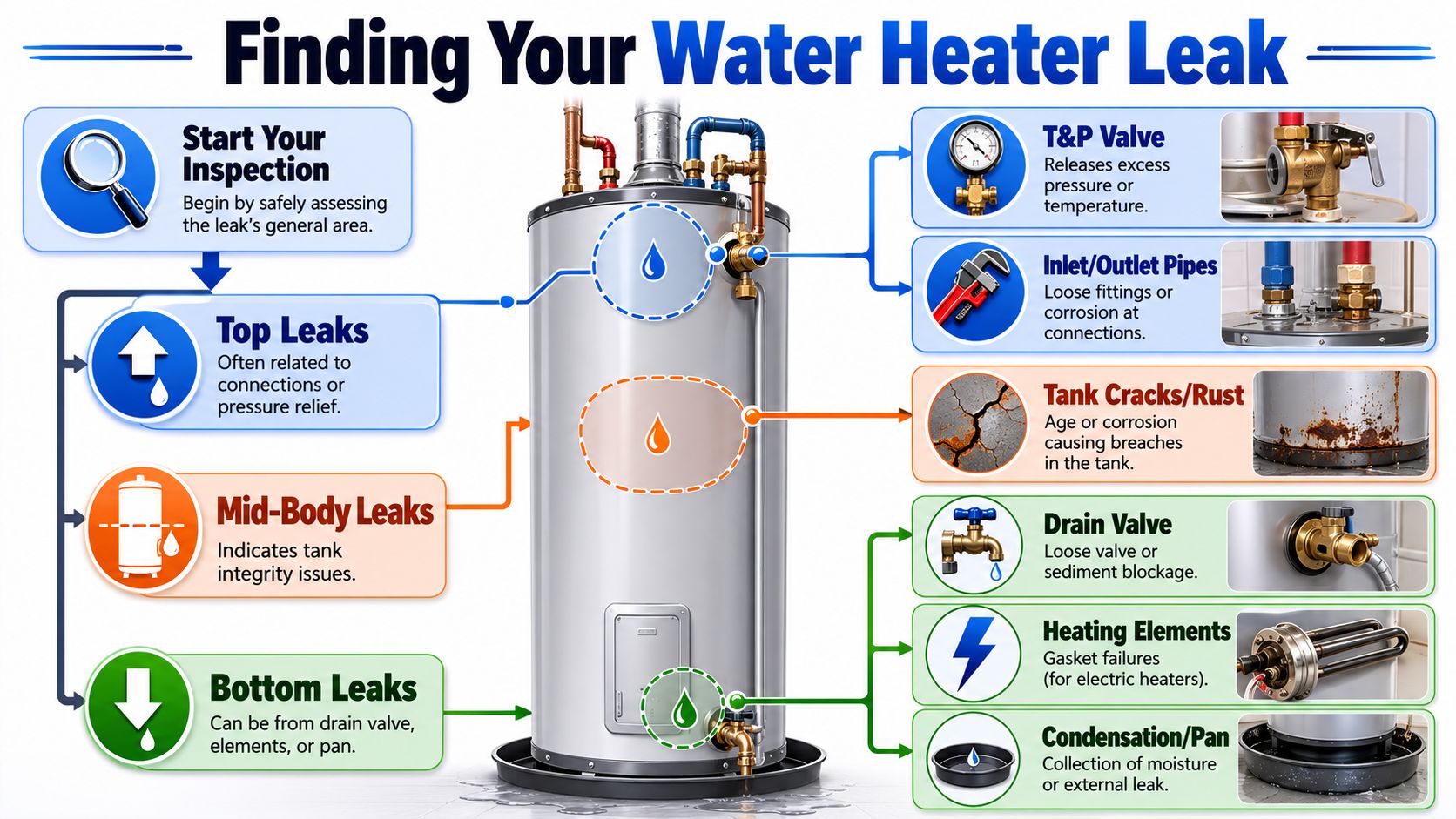
Use a flashlight and wipe the unit dry with a rag or paper towels before you inspect. Fresh moisture tells the story. Old rust stains and dried mineral crust tell you where water has been leaking for a while, which is common in older LA homes with hard water.
Check the top first
The top of the heater is the best place to start because many leaks there come from replaceable parts, not a failed tank.
Look at the cold water inlet and hot water outlet connections. Check the threaded fittings, flex connectors, and dielectric unions for active beads of water, green or white mineral buildup, or rust streaks running downward. In neighborhoods with older galvanized or mixed-metal piping, these joints often corrode slowly and stay unnoticed until the puddle finally reaches the floor.
Then inspect the temperature and pressure relief valve, or T&P valve, and the discharge pipe attached to it. If that pipe is wet, the valve may be doing its job in response to excess pressure or overheating, or the valve itself may be failing. Either way, treat relief-valve discharge as a warning sign, not just a nuisance drip.
A few clues help narrow it down:
- Moisture limited to the upper fittings: More likely a connection or union leak.
- Water at the relief pipe opening: Pressure, temperature, or valve trouble.
- Rust or mineral trails starting high and running down the shell: The water likely began above the jacket seam.
If you want to rule out a separate plumbing leak elsewhere in the house, this guide on how to read a water meter for leaks can help you check whether water is still moving through the system when fixtures are off.
Look at the middle of the heater
Water showing up on the sidewall deserves more caution.
If you see bubbling paint, rust bleeding through the jacket, or active seepage from the body of the heater, the inner tank may be compromised. The outer metal jacket is only a cover. The pressurized tank sits inside it, wrapped in insulation. Once water is coming through that section, repair options get very limited.
Electric models add one important exception. They can leak from heating element gaskets on the side of the tank. When that happens, the water usually starts at a round element port rather than appearing randomly through the jacket. That can be a repairable issue, but only after the unit has been shut down safely and inspected without live power present.
A leak from the body of the heater usually points to replacement, not adjustment.
Inspect the bottom area carefully
The bottom is where homeowners make the most expensive wrong call. Water under the heater can mean a failed tank, but it can also be runoff from above, condensation, or a slow drain valve drip.
Check the drain valve first. Sediment from hard water can keep it from sealing cleanly, especially on older tanks that have not been flushed regularly. In Los Angeles, that is a frequent pattern. Mineral-heavy water settles at the bottom, bakes onto the steel, and leaves homeowners with a valve that drips and a tank bottom that runs hotter than it should.
Next, look at the drain pan, if there is one. If the pan is wet but the underside of the heater looks dry, the source may still be higher up on the unit or on nearby piping.
Then look closely at the bottom seam and the underside of the tank. If water is collecting right at the base, the metal is rusted, or the leak appears to come from underneath the tank body itself, the tank is usually done. That kind of failure is common on older units, especially where hard water has accelerated sediment buildup and internal corrosion over time.
The practical trade-off is simple. A leaking fitting, valve, or gasket may be repairable. Water from the lower tank seam or from the tank body usually means replacement is the honest answer.
Making the Call Repair vs Replace Your Water Heater
Once the leak source is narrowed down, the next question is whether fixing it makes sense or whether you're about to spend money on a heater that's already at the end.
When repair still makes sense
Repairs are reasonable when the leak comes from an external component and the tank itself is still sound. That includes some connection leaks, certain valve issues, and some electric element gasket failures. These problems are frustrating, but they don't automatically mean the whole heater is done.
I usually tell homeowners to think in terms of where the failure lives. If the failed part sits outside the pressure vessel and can be replaced cleanly, repair stays on the table. If the pressure vessel itself is leaking, the conversation changes fast.
When replacement is the only honest answer
A corroded tank isn't a repair candidate. Corrosion-induced tank failure is directly tied to depletion of the sacrificial anode rod, which should be replaced every 3 to 5 years. Once consumed, corrosion attacks the steel tank and creates irreversible pinhole leaks that require full unit replacement, as explained in Lennox's discussion of water heater leaks and anode rod failure.
That's the trade-off homeowners hate, but it's better to hear it plainly. You can replace a valve. You can replace a flex connector. You cannot restore structural integrity to a steel tank that has started leaking from internal corrosion.
Here's a practical comparison.
| Factor | Lean Towards Repair | Lean Towards Replacement |
|---|---|---|
| Leak location | Leak is clearly at a fitting, valve, or serviceable gasket | Leak is from tank body, lower seam, or rusted shell |
| Condition of tank exterior | Jacket is dry, solid, and free of rust trails | Visible corrosion, swelling, rust streaks, or active seepage |
| Recent service history | Heater has otherwise been reliable | Multiple issues are stacking up |
| Confidence in diagnosis | Source is easy to identify and isolated | Source is uncertain or appears internal |
| Long-term risk | Repair addresses the full problem | Repair would only delay a likely replacement |
A lot of owners also want to know whether age alone decides it. Not by itself. Age matters because it changes the odds that the leak is part of a larger decline, especially if the heater hasn't had regular maintenance. If you're weighing that side of the decision, this overview of how long a water heater lasts helps frame what's typical before you approve another repair.
If a plumber says the tank is leaking internally, the useful question isn't “Can it be patched?” It's “What replacement option fits this home and this budget?”
That distinction saves people from paying for temporary work on a unit that won't hold up.
Understanding Water Heater Costs in Los Angeles
Los Angeles pricing varies more than homeowners expect because the heater itself is only part of the job. Access, venting, code upgrades, permit requirements, and the age of the home all affect the final number.
A simple repair is usually priced very differently from a full replacement because replacement often triggers related work. The plumber may need to bring the installation up to current code, correct venting or seismic strapping issues, replace shutoff valves, or address older connectors that shouldn't be reused. In hillside homes, condos, and older houses with tight closets, labor can climb because moving the old unit in and the new unit out takes more time and care.
What changes the final quote
A good estimate usually reflects factors like these:
- Type of problem: A leaking connection or serviceable valve is different from a failed tank.
- Fuel type and venting: Gas units often involve combustion and vent checks. Electric units involve circuit safety.
- Access conditions: Garage is easier than attic, crawlspace, or cramped closet.
- Permit and code compliance: Los Angeles work often includes local compliance items on replacements.
- Property protection needs: Finished garages, wood flooring, and interior closets add setup and cleanup time.
What doesn't work is shopping only by the lowest number over the phone. If the quote doesn't account for code, haul-away, permit handling, or access, the “cheap” option often changes once the job begins. The better approach is to ask what the price includes, what conditions could change it, and whether the recommendation is tied to the actual leak location rather than a generic sales script.
When You Must Call a Los Angeles Plumber Immediately
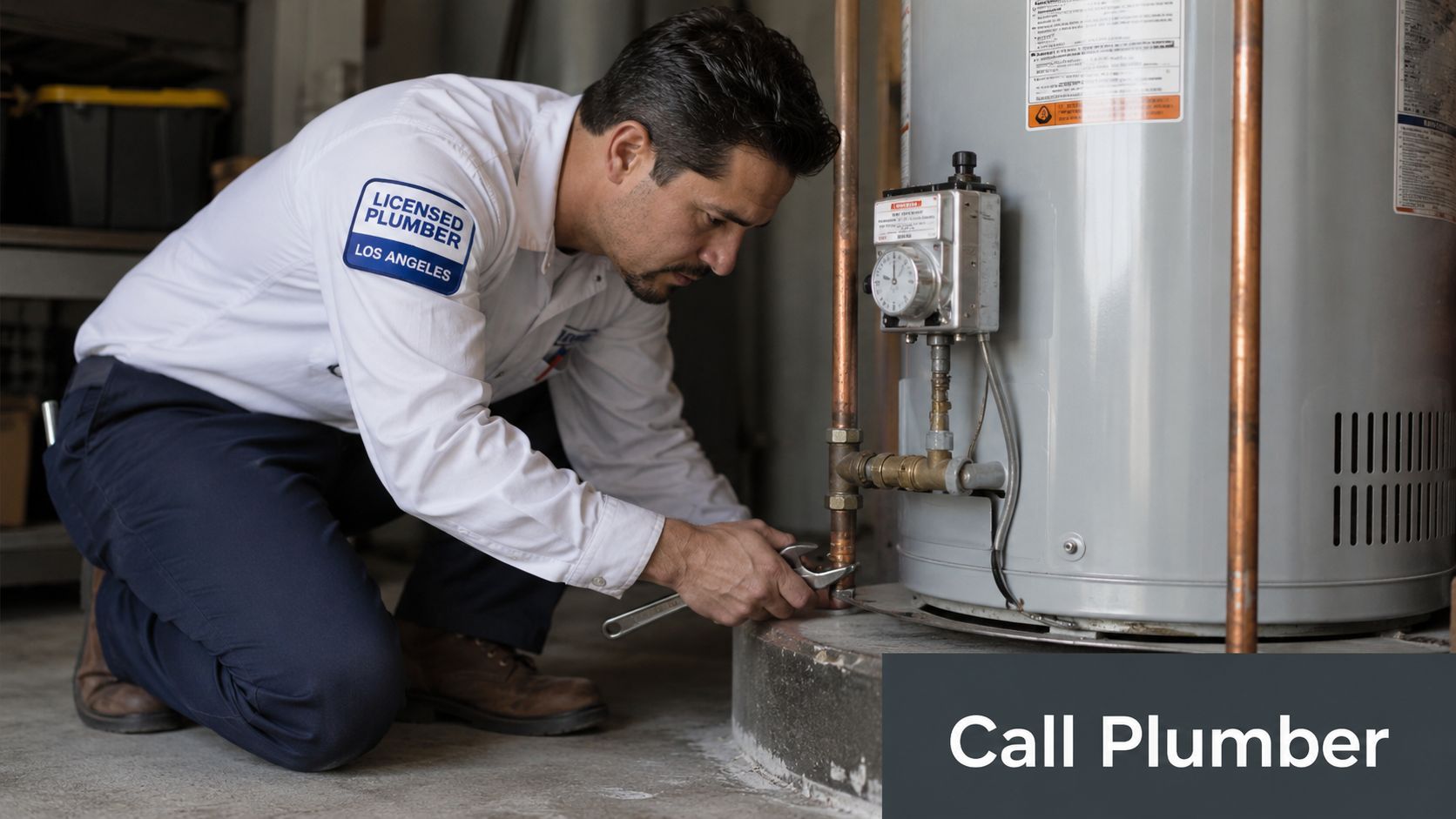
A small drip can wait long enough to identify the source. Active leaking, gas odor, or any uncertainty around electricity should end the inspection right there. At that point, the safest move is to shut down what you can safely shut down, keep people clear of the area, and call a licensed plumber.
In Los Angeles, I see this go sideways in older homes and garage installations all the time. Hard water shortens the life of valves and fittings, scale hides where water is really coming from, and an old heater in a tight utility closet can leak into framing long before the puddle looks serious.
Red flags that should stop the DIY process
Call a licensed plumber right away if any of these are happening:
- The tank is leaking from the bottom seam or body: That usually means the tank itself has failed. A tank leak is not a part swap.
- Water keeps running after you try the shutoff: The valve may be stuck, worn out, or the water may be coming from another point in the system.
- You smell gas near a gas heater: Leave the area, avoid switches or flames, and treat it as a gas safety problem first.
- The heater is near electrical equipment or standing water is spreading toward outlets: Wet surfaces and live power create a real shock hazard.
- There is heavy rust at the base, around fittings, or on the jacket: Corrosion like that often means the leak has been developing for a while.
- The unit is inside the house or near finished materials: Drywall, cabinets, flooring, and baseboards can absorb water fast, especially if the leak started slowly and went unnoticed.
Rental properties, duplexes, and HOA-managed buildings raise the stakes. A leaking heater in one garage or closet can turn into tenant disruption, access issues, and property damage in neighboring spaces if it is left alone.
EZ Plumbing handles water heater leak diagnosis, emergency shut-down situations, and replacement planning in Los Angeles. The value in a service call is not guesswork. It is getting a licensed plumber on site who can tell whether you have a repairable leak at a valve or connector, or a failed tank that needs to be replaced before more water gets loose.