
What to Do When Your Basement Floods: An LA Guide
You walk downstairs, hear the splash before you see it, and then your stomach drops. Boxes are floating. The water heater looks wet. There’s a smell you can’t place yet. In Los Angeles, basement floods don’t always come from the same place. Sometimes it’s a burst supply line, sometimes storm runoff, sometimes a sewer backup that turns a simple cleanup into a health problem fast.
When people search for what to do when your basement floods, they usually need more than a generic checklist. They need the first moves in the right order. They also need to protect their insurance claim and avoid the contamination mistakes that cause trouble later. The right response is calm, quick, and methodical.
Table of Contents
- Your First 15 Minutes Safety and Stopping the Water
- Assess the Damage and Document Everything
- Emergency Water Removal and Initial Drying
- Finding the Flood Source and When to Call a Pro
- Navigating Insurance Claims and Restoration
- Proactive Flood Prevention for LA Properties
Your First 15 Minutes Safety and Stopping the Water
The first mistake people make is treating every basement flood like a cleanup job. It’s a safety event first. You need to decide whether the area is safe to enter before you try to save property.
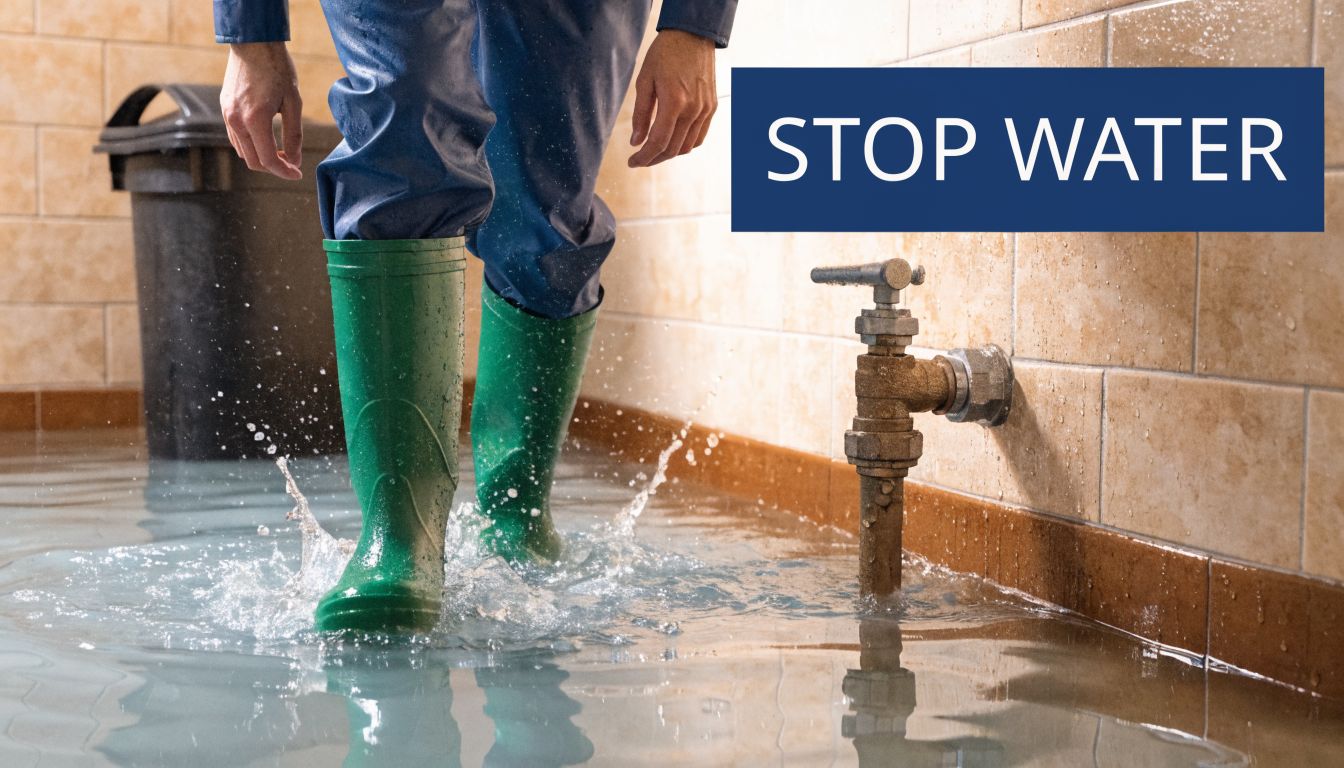
Start with the electrical decision
If water is touching outlets, appliances, extension cords, or the breaker area, stay out. If you hear buzzing or crackling, smell gas or sewage, see structural sagging, or the water is deep enough that you’d need to wade, back away and call for qualified help.
One safety rule is not negotiable. If the main electrical panel is submerged or inaccessible, you must call a licensed electrician immediately rather than risk electrocution. Approximately 50% of homeowner injuries during basement floods result from unsafe electrical contact attempts, according to this basement flood emergency response guide.
Practical rule: If you have to step through water to reach the panel, it’s already the wrong move.
If the panel is outside the flooded zone and you can reach it without crossing wet flooring or standing water, shut off the basement circuits or the main breaker. Don’t touch metal surfaces with wet hands. Don’t guess. If you’re uncertain, wait for a licensed electrician.
Stop more water from entering
Once the electrical risk is handled, find out whether the water is still actively coming in. A supply line failure usually means clean water under pressure and a steady flow. Appliance failures often pool near the water heater, washing machine, or utility sink. Storm seepage often shows up along wall-floor joints or through cracks. Sewer backups usually come with dark water, debris, and odor.
Use this order:
- Shut off the home’s main water valve if you suspect a burst pipe or failed plumbing connection.
- Stop appliance supply valves if the leak is isolated to a water heater, washing machine, or sink line.
- Don’t run more fixtures if drains are backing up. Running sinks, toilets, or laundry can make a sewer-related flood worse.
- Call the gas utility or a licensed pro if you smell gas. Don’t flip switches or use open flames.
If you’re not sure what the shut-off looks like, review a leaking shut off valve guide before an emergency happens. In the moment, the valve is often near the water meter, where the main line enters the house, or beside the affected fixture.
A few things don’t work well in real emergencies. Towels won’t matter if the source is still running. A shop broom won’t stop seepage. And walking in to “take a quick look” before dealing with power exposes you to the most serious risk in the room.
Assess the Damage and Document Everything
Once the area is safe enough to approach, switch from reaction to evidence. Good documentation helps you make better decisions about cleanup, and it can make the difference between a smooth claim and a drawn-out dispute.
Sort the water before you touch anything
Not all floodwater is the same. In Los Angeles properties, this matters because urban backups can bring contamination into storage areas, utility rooms, and lower-level living spaces.
Floodwater from sources like sewer backups often contains E. coli and norovirus. The CDC reports that post-flood gastrointestinal illnesses can surge 2-3x in affected areas, as noted in this flooded basement drying and cleanup article.
Use this quick reference before handling contents:
| Water Type | Source Examples | Health Risk | Recommended Action |
|---|---|---|---|
| Clean | Burst supply pipe, leaking water heater line, failed appliance hose | Lower risk at first, but it worsens if left sitting | Limit contact, document, remove water quickly |
| Gray | Overflow from sinks, laundry, or other used water sources | Elevated contamination risk | Wear protection and clean more cautiously |
| Black | Sewer backup, drain overflow with waste, visibly foul floodwater | Highest risk due to pathogens and contaminants | Avoid contact and bring in professional help |
If there’s any sewage smell, visible waste, or murky black water, don’t sort belongings with bare hands and don’t let children or pets near the area.
Floodwater classification changes the cleanup plan. A storage-room inconvenience can become a sanitation problem in one bad backup.
Build an insurance record that holds up
Start with wide photos and slow video before you move anything. Stand in each doorway and capture the full room. Then get closer.
Photograph these items clearly:
- High-water marks: Show the line on foundation walls, drywall, posts, and stored items.
- Source clues: Capture burst pipes, failed hoses, overflowing drains, foundation cracks, or seepage points.
- Damaged systems: Include the water heater, furnace area, electrical components, flooring, baseboards, and insulation if visible.
- Personal property: Open bins, document labels, and photograph each damaged item before disposal.
- Serial and model plates: On appliances and equipment, these help establish value and age.
Keep a written log while you take photos. Note the time you found the flood, what you shut off, what smelled unusual, and whether the water appeared clean, gray, or black. Don’t rely on memory. By the time an adjuster asks questions, the details blur.
Emergency Water Removal and Initial Drying
Once you’ve documented the scene, speed matters. Basement water doesn’t just sit on the surface. It moves into wood framing, insulation, drywall edges, stored fabrics, and subfloor materials.
Choose the right extraction method
Stagnant water allows mold growth potential to accelerate significantly after 24-48 hours of exposure, and this basement flood cleanup resource notes that extraction within the first few hours is optimal because delays sharply increase structural and remediation problems.
The first decision is volume. For shallow water, a wet/dry vacuum can help. For larger accumulation, you need a pump rated for flood removal or a mitigation crew with extraction equipment. Trying to remove a major flood with a small vacuum wastes the time window that matters most.
A practical way to choose:
- Minor pooling or a thin layer of water: Wet/dry vacuum, absorbent pads, and fast drying may be workable.
- Water covering the full floor or collecting in low spots: Use a sump-style or utility pump designed for water removal.
- Contaminated water or heavy saturation: Skip DIY extraction and go straight to professionals.
Dry the structure, not just the floor
Homeowners often stop once the visible water is gone. That’s where secondary damage starts. Concrete holds moisture. Cardboard boxes trap it. Drywall wicks it upward. Carpet pad keeps it hidden.
Move contents out in stages. Hard plastic bins, metal shelving, and sealed containers can often be cleaned and dried. Wet cardboard, loose paper goods, insulation, and porous stored materials usually don’t improve by sitting there.
Set up drying with intent:
- Air movement: Use fans to move air across wet surfaces, not just toward the middle of the room.
- Moisture removal: Run dehumidifiers continuously and empty them as needed.
- Separation: Lift furniture and storage off the floor so air can circulate underneath.
- Material checks: Pull back area rugs, inspect baseboards, and check behind stored items along exterior walls.
Dry floors can fool you. The framing, lower drywall, and contents can still be holding moisture.
If the floodwater was contaminated, don’t use household fans in a way that spreads dirty residue around the basement. In those cases, controlled removal and sanitation matter more than focusing on rapid air movement.
Finding the Flood Source and When to Call a Pro
A dry basement means very little if the cause is still there. The pattern of the water usually tells you where to start looking. Good troubleshooting saves time. Bad troubleshooting sends people after the wrong repair.
Internal failures vs outside intrusion
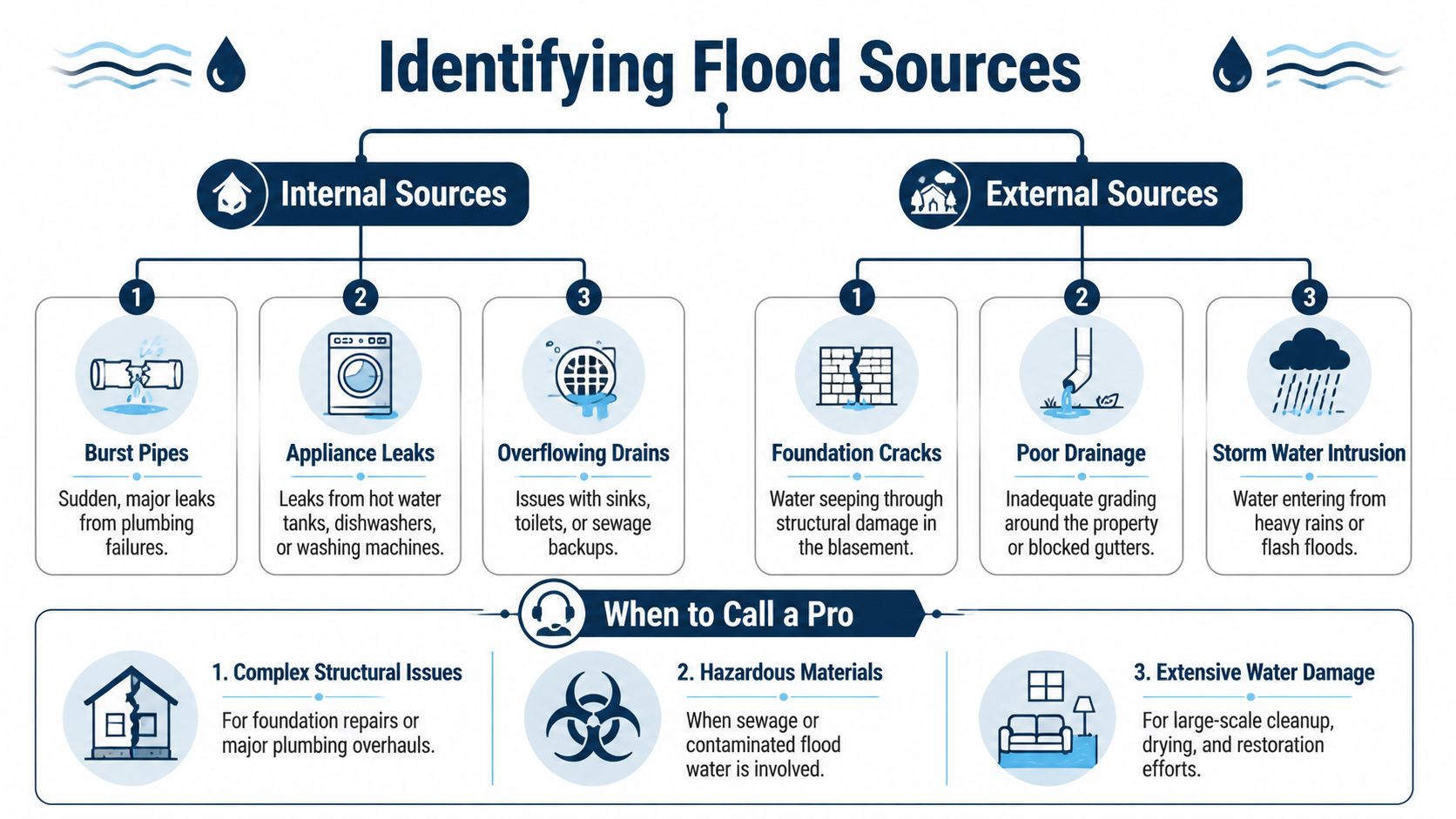
Start by asking one question. Did the water likely come from inside the plumbing system, or did it come from outside the structure?
Internal failures usually leave tighter clues:
- Burst pipes: Sudden water movement, active spray, or heavy flow from a wall, ceiling, or exposed line.
- Water heater or appliance leaks: Pooling near the unit, rust trails, failed supply connectors, or pan overflow.
- Drain or sewer backups: Water emerging from floor drains, toilets, utility sinks, or lower fixtures.
External intrusion tends to show differently:
- Foundation cracks or wall seepage: Dampness or flowing water along one wall, often after rain.
- Poor drainage outside: Pooling near the foundation, gutter overflow, or downspouts dumping water too close to the house.
- Stormwater entry: Water appearing at door thresholds, window wells, or wall-floor joints during weather events.
In older Los Angeles properties and multi-unit buildings, more than one issue can be happening at once. A clogged line can back up while exterior runoff adds seepage. That’s why source confirmation matters more than assumptions.
If you need to pinpoint hidden plumbing failures, professional leak detection services can identify whether the flood began with a supply line, drain issue, or another concealed source.
Signs you should stop troubleshooting and bring in help
Some situations have a bright line. They aren’t homeowner projects anymore.
Call a licensed pro immediately if you notice any of these:
- Sewage indicators: Strong waste odor, dark water, toilet or floor drain overflow.
- Recurring flooding: The water returns after cleanup or shows up during every storm.
- Water through concrete or masonry: Seepage from walls, slab edges, or visible structural cracks.
- Mechanical system involvement: Water around the electrical system, furnace, or water heater connections.
- Hidden leaks: You can hear water, but can’t see the break.
- Large-scale saturation: Contents, framing, flooring, and wall materials are all involved.
A small fixture leak is one thing. A basement flood tied to drainage failure, concealed plumbing, or contaminated water needs diagnostics, not guesswork.
When the source isn’t obvious within a short inspection, the safest move is to stop opening walls and start confirming the cause with the right tools.
Navigating Insurance Claims and Restoration
A lot of homeowners think the claim starts after cleanup. It starts the moment you identify the event and describe it. The words you use matter. So does the proof behind them.
Why wording and evidence matter
Standard homeowner policies often exclude flood damage. That’s why source identification is critical. Related to California’s 2025 atmospheric river floods, 40% of claims were denied due to poor documentation or misclassification, and professional intervention boosts claim approval rates by 65%, according to this guide on what to do when your basement floods.
If a pipe failed suddenly, say that and preserve the evidence. If a drain backed up, document where it emerged. If water entered from outside, don’t describe it loosely as a plumbing issue. Claims often get tangled when homeowners use “flood,” “backup,” and “leak” interchangeably.
A cleaner claim file usually includes:
- Timestamped photos and video
- A written timeline
- The apparent source
- A list of damaged materials and contents
- Invoices for emergency mitigation
- Professional findings when the source isn’t obvious
What to save before cleanup moves too far
Keep damaged parts if it’s safe to do so. A split hose, failed angle stop, broken supply connector, or cracked pipe section can matter. Don’t throw out ruined materials too early if your insurer may want to inspect them.
Call your carrier early, but don’t wait for approval to take reasonable mitigation steps. Most policies expect owners to prevent further damage. That means extraction, drying, and source control should move quickly.
Restoration decisions also affect the claim. If drywall wicked water, if insulation got soaked, or if contaminated water touched porous materials, partial cleanup may not be enough. The goal is to restore the property correctly, not just make it look dry for a few days.
Proactive Flood Prevention for LA Properties
Prevention is cheaper than emergency response, and it protects more than finishes. Over a 30-year mortgage, the chance of a flooded basement is more than five times greater than the chance of a fire, and about 38% of basements with existing moisture problems develop mold and fungus growth, according to this basement waterproofing facts infographic.
That’s why smart prevention focuses on both weather exposure and plumbing failure.

Exterior protection that actually helps
In Los Angeles, long dry stretches can hide drainage problems until a serious rain hits. Then water finds the weak point all at once.
Focus on these basics:
- Keep gutters clear: Overflow at the roof edge often ends up at the foundation.
- Extend downspouts away from the house: Water dumped near basement walls eventually shows up inside.
- Correct negative grading: Soil should slope away from the structure, not toward it.
- Seal obvious openings: Foundation cracks and wall penetrations should be evaluated and repaired before storm season.
What doesn’t help much is cosmetic patching alone. Smearing a sealant over an active water path without fixing exterior drainage usually turns into repeat flooding.
Interior plumbing defenses for urban properties
Urban properties need interior protection too. Sewer backups, blocked drains, and neglected lower-level plumbing can produce the worst kind of flood because cleanup becomes a sanitation job.
Useful measures include scheduled drain cleaning, sewer camera inspections where backup history exists, and a review of whether a sump pump installation makes sense for the property. If a basement or lower utility area has flooded before, don’t wait for another storm to decide.
This walkthrough gives a helpful visual overview of flood prevention measures homeowners can review before the next emergency:
Property managers should also keep a simple readiness list: shut-off locations, utility contacts, photo documentation protocol, and which tenants or staff report first signs of backup or seepage. The best flood response starts before water appears.
If you need fast, professional help with a basement flood, EZ Plumbing serves Los Angeles with 24/7 emergency response, leak diagnostics, drain and sewer services, and practical repair recommendations that help protect your property and support a smoother recovery.