
What Is a Storm Drain System for LA Homeowners?
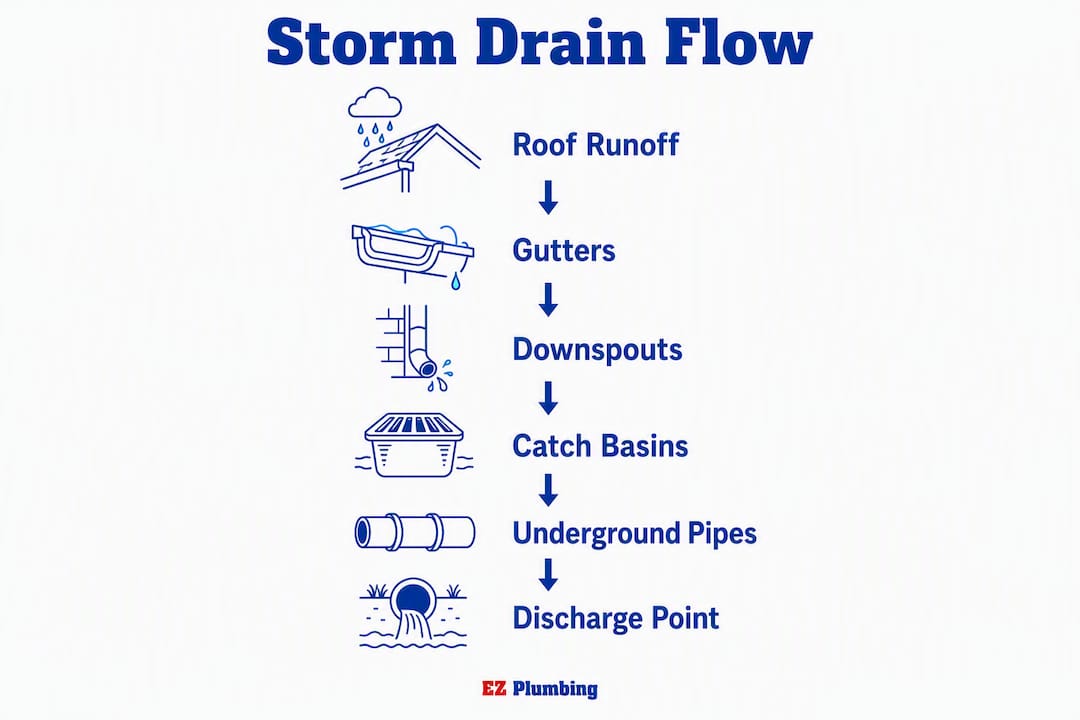
A private on-property storm drain system is a network of gutters, downspouts, catch basins, underground pipes, and discharge points that collects roof and surface runoff and moves it safely away from your structures to either a municipal connection or on-site infiltration. For Los Angeles homeowners and property managers, that distinction matters practically: a failed or missing system means foundation seepage, landscape erosion, and standing water that compounds with every atmospheric river event. The core components you need to understand are gutters and downspouts, catch basins and area drains, yard or French drains, underground conveyance pipe, cleanouts, and the discharge point where water finally exits your property.
Table of Contents
- What does a private storm drain system include?
- How does a private storm drain system move water?
- Why LA clay soils change your drainage design
- Common failures and how to maintain your system
- When should you call a licensed drainage contractor?
- Los Angeles permitting and LID policy notes
- Your inspection checklist and contractor questions
- Key Takeaways
- What field experience actually teaches about LA drainage
- Ez-plumbing handles drainage from inspection to installation
- Useful sources and further reading
What does a private storm drain system include?
Every on-property drainage system is built from a small set of components, each with a specific job.
Gutters and downspouts intercept roof runoff at the eave and route it vertically to ground level. A downspout adapter connects the downspout to underground pipe, keeping debris from entering the line directly.
Catch basins and area drains sit at low points in paved or landscaped areas, collecting surface runoff through a grated top while a sump below traps sediment and debris before it enters the pipe. Grate sizing depends on the drainage area; a standard residential catch basin handles typical yard runoff, while larger paved areas may need multiple inlets.
Yard and French drains use perforated pipe surrounded by washed drainage rock to intercept both surface sheet flow and shallow subsurface water. They are not appropriate for direct downspout connections, where solid pipe is required.
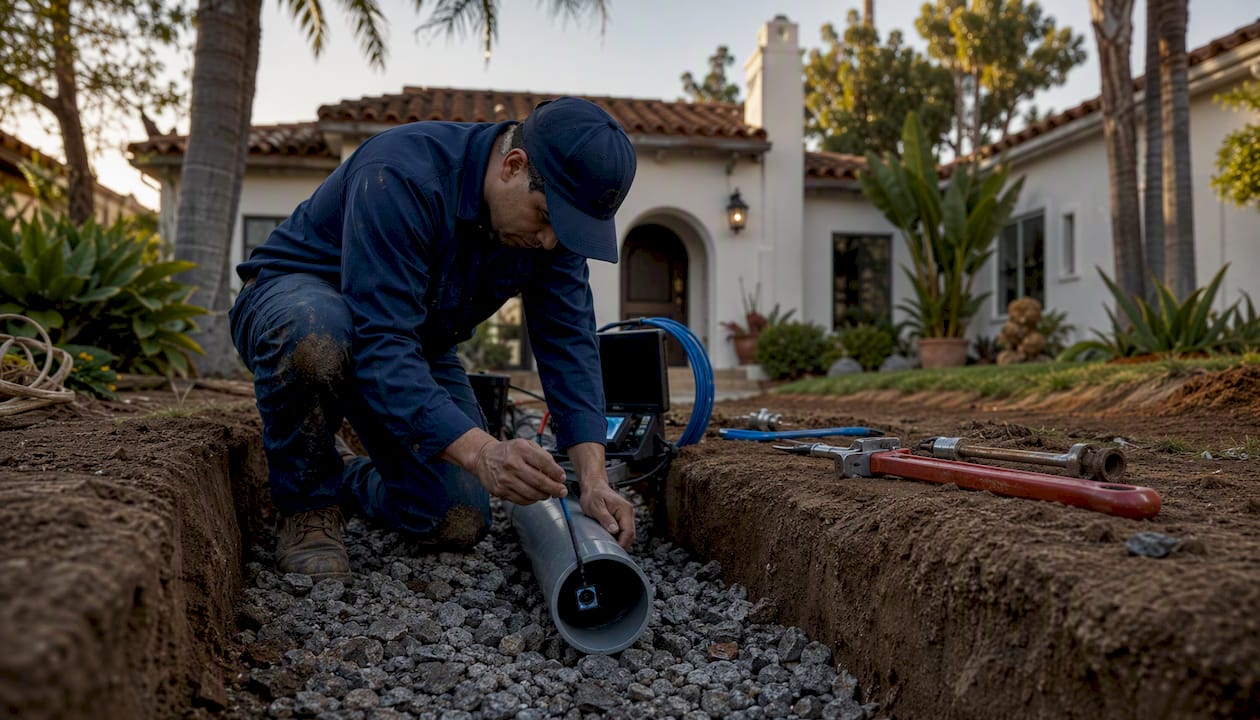
Underground conveyance pipe carries collected water to the discharge point. A 4-inch solid pipe is the residential standard, capable of handling runoff from roughly 1,000 square feet of roof; larger combined loads call for 6-inch pipe. Minimum slope is 1% (1 foot of drop per 100 feet of run) to prevent sediment accumulation and backflow.
Discharge options include pop-up emitters at grade, daylight outlets at a slope face, and drywells for on-site infiltration. Pop-up emitters work well for moderate flows but can be overwhelmed during heavy storms on large roofs; a drywell or split-load configuration handles higher volumes. Where infiltration is feasible, a drywell sized for your soil type is often the preferred LA County approach under Low Impact Development standards%20Manual.pdf).
Cleanouts are the component most often skipped and most often regretted. A cleanout tee or accessible cap at each direction change lets a technician snake or hydro-jet the line without excavation. Without one, clearing a deep blockage means digging up your yard.
How does a private storm drain system move water?
The flow path is straightforward: rain hits the roof, gutters collect it, downspouts carry it to ground level, a catch basin or direct pipe connection receives it, underground pipe conveys it under grade, and a discharge point releases it safely away from the structure.
Getting that path to work reliably comes down to three installation priorities. First, slope: every underground run needs at least 1% grade. Second, debris capture: a catch basin with a removable basket at the downspout entry intercepts leaves and sediment before they travel into the pipe. The downspout-to-pipe junction is the most common failure point, with debris accumulating within the first 15–20 feet of the run. Third, accessible cleanouts at every direction change.
For sizing context, a 2,000-square-foot roof generates roughly 1,250 gallons of runoff per inch of rainfall. Los Angeles atmospheric river events regularly deliver 2 or more inches in a short window, so systems sized for average rainfall will fail during the storms that matter most.
Pro Tip: Install a catch basin with a removable debris basket directly at the downspout-to-pipe transition. That single fitting is the cheapest maintenance investment in the system and prevents the majority of underground blockages.
Why LA clay soils change your drainage design
Most of Los Angeles sits on adobe clay or expansive clay soils that resist infiltration. That single fact changes the correct drainage solution for a large share of LA properties.
Standard filter fabrics commonly clog quickly in LA clay soils; non-woven geotextiles specifically rated for clay are the correct specification. For French drain backfill, use clean washed drainage rock in the 3/4-inch to 1.5-inch range. Crusher fines and recycled concrete fill the voids between stones and turn the trench into a slow-draining column within a few seasons.
In adobe clay, a drywell must be sized significantly larger than for sandy loam soils. Undersized, it becomes a storage pit that saturates and fails. Worse, a poorly placed infiltration facility near a foundation can create a perched water table that pushes moisture into the structure rather than away from it. When clay conditions are severe, the right answer is often a conveyance-only system that moves water to a daylight outlet or a permitted connection rather than attempting infiltration at all.
Pro Tip: Before specifying any infiltration facility, have a soils engineer confirm the percolation rate and groundwater depth. LADBS requires this evaluation near buildings and in hillside or liquefaction zones.
| Design element | Clay soil specification |
|---|---|
| Filter fabric | Non-woven geotextile rated for clay |
| Drainage rock | Washed 3/4" to 1.5", no fines |
| Drywell sizing | 2–3× sandy loam volume |
| Infiltration near foundation | Avoid; use conveyance to daylight instead |
Common failures and how to maintain your system
Most on-property drainage failures trace back to common causes including clogging, root intrusion, silted rock and fabric in French drains, and the absence of accessible cleanouts.
Routine maintenance keeps those failure modes from becoming expensive repairs. Clean gutters at least twice a year, and inspect downspout adapters after every significant storm. Catch basins need annual cleaning to remove accumulated sediment from the sump. Underground lines should be flushed periodically; if you have cleanouts, this is a straightforward task. If you do not, deferred maintenance on drain lines tends to compound until excavation is the only option.
Watch for these warning signs between maintenance visits: recurrent ponding in the same backyard area after rain clears, slow drainage at multiple catch basins simultaneously, or gurgling sounds from area drains. Any of these points to a partial or full blockage in the underground line. Hydro-jetting clears most root intrusion and sediment buildup without excavation; camera inspection confirms the line condition and locates the problem before work begins. Keeping gutters clear is the simplest upstream step that reduces the load on everything downstream.
| Task | Frequency |
|---|---|
| Gutter cleaning | Twice per year (fall and spring) |
| Downspout adapter inspection | After each significant storm |
| Catch basin cleaning | Annually |
| Underground line flush | Every 2–3 years, or as needed |
| French drain rock/fabric inspection | Every 3–5 years |
When should you call a licensed drainage contractor?
Some drainage work is within reach of a capable homeowner. Cleaning gutters, clearing a catch basin grate, and extending a downspout with a surface extension are reasonable DIY tasks. Underground work is a different category.
Call a licensed contractor when you see persistent ponding within 5 feet of your foundation, when a blocked underground line has no accessible cleanout, when new construction or significant regrading is involved, or when a sump pump or drywell installation is required. Pipe replacement under a driveway or patio, slope regrading that could affect neighboring properties, and any work that connects to the public storm drain system all require a licensed contractor and, in most cases, a permit.
For cost planning: scope, soil conditions, access, and permit requirements all affect the final number. Trenching under hardscape adds significant cost compared to open-ground work. A camera inspection before any repair gives you an accurate picture of what you are actually dealing with.
Pro Tip: Ask every contractor for their C-36 license number before they start. A C-36 plumbing license covers underground drainage work in California; a general landscaping license does not.
When you contact a contractor, ask these questions:
- What is your C-36 license number and insurance carrier?
- Will this project require a permit, and will you handle the application?
- Where will cleanouts be placed, and how many?
- What pipe material and fabric specification will you use?
- What is your warranty on materials and labor?
Los Angeles permitting and LID policy notes
Many routine on-property drainage repairs do not require a permit. New installations, infiltration facilities, and any connection to the public storm drain system are a different matter.
Per LAMC 64.12, connecting private drainage to the City of Los Angeles storm drain system requires a Storm Drain Connection Permit issued through the Bureau of Engineering. Separately, LA County’s LID requirements apply to new development and significant redevelopment, requiring a minimum of two LID Best Management Practices for residential projects of four units or less. For hillside properties, catch basins and inlets discharging to storm drains must be labeled to discourage illegal dumping.
LADBS infiltration guidelines require infiltration facilities to sit at least 10 feet above groundwater and generally mandate a soils-engineer evaluation near buildings. Hillside and liquefaction zones carry additional restrictions. Always check local zoning and HOA covenants before trenching; some HOAs restrict discharge locations and surface drainage patterns.
Pro Tip: Design any infiltration facility with an overflow path to the street. Documenting setbacks and overflow routing in your permit application speeds the review process at LADBS.
Your inspection checklist and contractor questions
A quick walkaround after a rain event tells you most of what you need to know. Look for standing water within 5 feet of the foundation, downspouts that terminate directly against the building, cracked or missing catch basin grates, and any area where soil has eroded in a channel pattern.
For a more thorough inspection:
- Measure where each downspout terminates; it should connect to underground pipe or discharge at least 6 feet from the foundation.
- Lift catch basin grates and check the sump depth; more than 2 inches of sediment means it is due for cleaning.
- Locate pop-up emitters and confirm they open freely.
- Note any large trees within 10 feet of underground pipe runs; root intrusion is a predictable maintenance issue.
- Identify whether accessible cleanouts exist on underground runs.
Red flags when reviewing contractor proposals: no cleanouts specified, landscape fabric instead of non-woven geotextile, crusher fines or recycled concrete as backfill, a proposal to connect to the public storm drain without a permit, or a contractor who cannot provide a C-36 license number.
Pro Tip: Take photos of every component during your walkaround and bring them to your contractor consultation. Visual documentation speeds the diagnosis and gives you a baseline for future inspections.
Key Takeaways
A private on-property storm drain system protects your building by moving roof and surface runoff away from the foundation through gutters, catch basins, underground pipe, and a safe discharge point, with accessible cleanouts and correct soil-specific materials determining whether the system lasts or fails.
| Point | Details |
|---|---|
| Cleanouts prevent costly excavation | Install accessible cleanout tees at every direction change to avoid digging up your yard for blockage repairs. |
| LA clay requires specific materials | Use non-woven geotextile and washed 3/4"–1.5" drainage rock; standard fabric clogs within 2–3 years in clay soils. |
| Size for peak storms, not averages | A 2,000 sq ft roof produces roughly 1,250 gallons per inch of rain; design for atmospheric river intensity, not typical rainfall. |
| Permits apply to new connections | Connecting to the public storm drain requires a permit under LAMC 64.12; infiltration facilities near buildings need a soils-engineer evaluation. |
| Ez-plumbing for local inspections | Ez-plumbing (C-36 License #583868) provides inspections, hydro-jetting, French drain installation, and permit-compliant drainage work across greater Los Angeles. |
What field experience actually teaches about LA drainage
The conventional wisdom on residential drainage tends to focus on the visible parts: clean your gutters, extend your downspouts. That advice is not wrong, but it misses where the real money gets spent. In the field across greater Los Angeles, the two most consistent cost drivers are clay soils that were never accounted for in the original design, and underground pipe runs with no cleanout access. A system installed without cleanouts is not a finished system; it is a deferred excavation bill.
Clay soil behavior also gets underestimated. A French drain that functions well in year one can become a saturated trench by year three if the fabric specification was wrong or the rock had fines in it. The fix is not complicated, but it requires knowing the soil you are working with before the trench is dug. That is why a soils check is part of every drainage evaluation, not an optional add-on.
The properties that hold up best over time share two traits: accessible cleanouts at every bend, and discharge points designed with an overflow path. Neither costs much to include at installation. Both are expensive to retrofit.
Ez-plumbing handles drainage from inspection to installation
When standing water near your foundation or a blocked underground line needs more than a walkaround, Ez-plumbing brings licensed, insured expertise to the job. Serving the greater Los Angeles area under C-36 License #583868, Ez-plumbing handles the full scope of on-property drainage work: camera inspections to locate blockages, professional drain cleaning and hydro-jetting, French drain and drywell installation, downspout-to-pipe conversions, sump pump installs, and permit-compliant connections to the public storm drain system.
Every job starts with a site evaluation that includes a soils check and a cleanout placement recommendation, so you know exactly what the system needs before work begins. Code-compliant installations, documented setbacks, and a clear warranty on materials and labor are standard. For underground line repairs that require excavation, Ez-plumbing also offers sewer line repair services when the scope extends beyond drainage into the main line. Call or request an inspection online to schedule your site evaluation.
Useful sources and further reading
These primary sources cover permits, LID standards, and technical design details. Save them before a contractor visit or permit application.
- LADBS Guidelines for Storm-Water Infiltration (P/BC 2020-118): setbacks, soils-engineer requirements, groundwater minimums, and hillside restrictions for infiltration facilities.
- LA County Public Works LID Standards Manual%20Manual.pdf): BMP guidance for rain gardens, porous pavement, and infiltration facilities for new and redevelopment projects.
- LID Requirements for Residential Projects (LA County): specific BMP minimums for residential development of four units or less, including hillside labeling requirements.
- Storm Drain Connection Permit Overview, Bureau of Engineering: LAMC 64.12 permit requirements for connecting private drainage to the City of Los Angeles storm drain system.
- LA County Land Development Storm Drain System: planning and zoning process for storm drain construction, including Regional Planning approval steps.
Print or bookmark the LADBS infiltration bulletin and the Bureau of Engineering permit overview before your first contractor meeting; they are the two documents most likely to affect your project scope and timeline.