
Weak Toilet Flush: Causes, Fixes and When to Call a Plumber
A weak toilet flush almost always comes down to one thing: not enough water reaching the bowl fast enough to start a strong siphon. The cause is usually a low tank level, a flapper chain with the wrong slack, or mineral-clogged rim jets. If other drains gurgle when you flush, or more than one toilet is sluggish, the problem is likely in the vent or the sewer line, and no tank adjustment will fix it.
This guide walks you through the checks in the order a plumber would run them, explains why Los Angeles homes are prone to this problem, and tells you plainly when to stop and call someone.
TL;DR
- Start with the tank: if the water sits more than about half an inch to an inch below the overflow tube, the flush will be weak. Adjust the fill valve or float.
- Check the flapper chain. It needs a small amount of slack, roughly a quarter to half an inch, so the flapper opens fully and still seals.
- Los Angeles has hard water, and mineral scale narrows the rim jet holes under the bowl. Descale them with a non-abrasive method, never a metal tool.
- Gurgling in a shower or sink, or several slow toilets at once, points to a vent problem or a sewer line issue. That is a job for a licensed plumber.
- A toilet that is 1.6 gallons per flush or older may qualify you for an LADWP rebate if you replace it.
Table of Contents
- How a toilet flush works, and why it weakens
- Step 1: Check the tank water level
- Step 2: Adjust the flapper and chain
- Step 3: Clear the rim jets and siphon jet
- Step 4: Rule out a partial clog
- When the problem is not the toilet
- Our perspective: what we see on LA service calls
- What a plumber will check, and what it costs
- When replacing the toilet makes sense
- Keeping the flush strong
- Frequently asked questions
- Sources
How a toilet flush works, and why it weakens
A toilet does not push waste down with water pressure. The tank releases a fixed volume of water quickly, some of it through the rim and some through a jet at the bottom of the bowl. That surge fills the trap and the drain outlet, and a siphon pulls the contents through. The siphon needs three things: enough water, openings clear enough to deliver it fast, and a drain line that can breathe through its vent so air does not stop the flow.
When any of the three is compromised, you get the symptoms people describe as a slow flush, a toilet that does not flush fully, or a bowl that swirls and then settles with waste still in it. Matching the symptom to the stage of the flush is the fastest way to find the cause.
Modern toilets are also designed around low water volumes. EPA WaterSense specifications cap a high-efficiency tank-type toilet at 1.28 gallons per flush and require it to pass a solid waste removal test of 350 grams or more. A toilet built to do that with so little water has less margin for error. A tank that is a little low or a jet that is partly scaled over matters more than it would on an old 3.5-gallon model.
Step 1: Check the tank water level
Lift the lid and look at the water. A level that is too low is the most common cause of a weak flush, and it is the easiest to fix.
The water should sit at the fill line marked inside the tank, or just under the top of the overflow tube. Fluidmaster’s troubleshooting guide notes that if the level is more than half an inch to an inch below the overflow tube, there will not be enough water for a powerful flush.
How you raise it depends on the fill valve:
- Float cup fill valve (a cylinder that rides up and down the shaft): pinch the clip on the rod and slide the cup up, or turn the adjustment screw on top.
- Ball float (an older arm with a ball on the end): bend the arm gently upward or turn the adjusting screw.
Flush once after each small change and watch where the water settles. Do not go above the overflow tube, or the tank will drain constantly into it and the toilet will run.
Also confirm the shut-off valve on the wall is fully open. A valve nudged partway closed during bathroom cleaning limits how fast the tank refills, and it can leave the tank short of water at flush time. If the bowl water itself is low after a flush, American Standard’s troubleshooting steps point to the small refill tube in the tank, which should be firmly attached to the overflow tube.
Step 2: Adjust the flapper and chain
The flapper is the rubber seal at the bottom of the tank. When you press the handle, a chain lifts it so the tank can empty into the bowl. Two problems show up here.
Chain too tight. The flapper never opens fully, so water leaves the tank slowly. Chain too loose. The chain tangles or the flapper drops before the tank has emptied, which cuts the flush short.
Aim for about a quarter to half an inch of slack when the flapper is seated, a range Fluidmaster gives as the typical manufacturer recommendation. Move the chain clip one link at a time.
Watch the flush with the lid off. If the flapper falls back while the tank still has water in it, the chain is too long or the flapper is worn and floating poorly. Flappers wear out, often in the range of several years depending on water chemistry, and a replacement is inexpensive and fits most standard toilets. Take the old one to the hardware store to match the size, since 2-inch and 3-inch flush valves are both common.
One habit to drop: holding the handle down to force a full flush. The water volume in the tank is the limit, and holding the handle only stresses the linkage. If you need to do it regularly, something upstream is wrong.
Step 3: Clear the rim jets and siphon jet
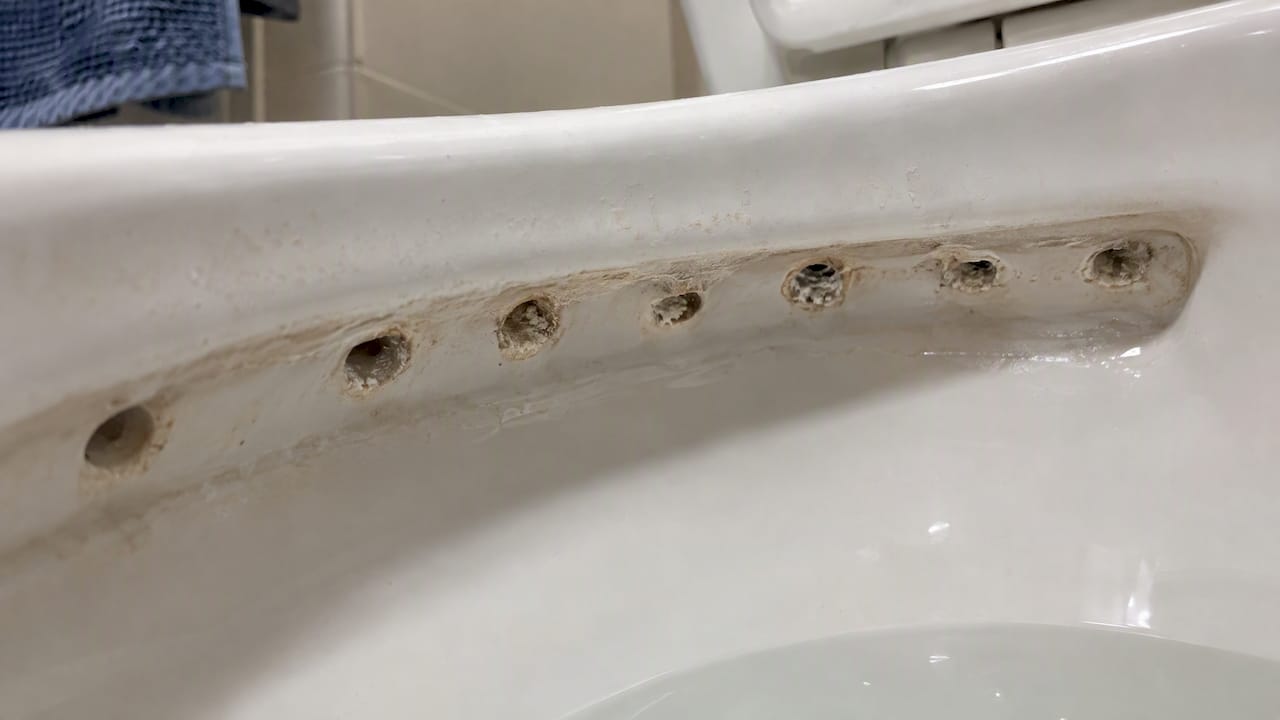
If the tank level and flapper are fine, look at the bowl. Under the rim are small holes that feed water around the bowl. At the bottom of the bowl, in the trapway, is a larger siphon jet hole. Scale builds up in all of them.
Why this is common in Los Angeles
Los Angeles water is hard. According to LADWP’s water quality FAQs, average hardness is about 8.6 grains per gallon in the San Fernando Valley and Western Los Angeles, about 9.8 in Silver Lake, Downtown and South Los Angeles, and about 16.3 in Eastern Los Angeles and the Harbor area. Those numbers vary within each area, but all of them are high enough to leave calcium and lime deposits over the years.
The deposits do not need to block a hole completely. The Spruce explains that mineral buildup shrinks the opening, and a smaller opening slows the water entering the bowl, which weakens the siphon.
How to descale them
You can check by running a small mirror under the rim. Clogged holes look crusty or have a rough white or brown edge.
- Turn off the water at the wall valve and flush to empty the tank.
- Pour a descaling cleaner into the overflow tube so it runs down into the rim. A common method, described in Drano’s slow toilet guide family of advice, is to use a toilet bowl cleaner or white vinegar. Follow the label, and never mix cleaners, especially anything containing bleach with anything containing acid or ammonia.
- Let it sit for the time on the label, commonly a few hours or overnight for heavy scale.
- Turn the water back on and flush several times.
If some holes stay blocked, clear them with a soft plastic or wooden pick. Do not use a screwdriver, wire or other rigid metal tool. American Standard’s guidance begins with a clean bowl and a fully open supply valve for a reason: chipped porcelain leaves a rough surface, and a rough surface collects scale faster than a smooth one. You trade a temporary improvement for a permanent problem.
Step 4: Rule out a partial clog
A partial clog in the trap is different from a stuck-solid blockage. The bowl may empty slowly, rise higher than normal before draining, or leave paper behind. Use a flange plunger, which has a rubber extension that seals the drain opening, and push and pull steadily rather than hard. A closet auger can reach further if the plunger does not help, but turn it gently to avoid scratching the bowl.
Two cautions. Chemical drain openers are a poor choice for toilets: they sit in the bowl, can damage older pipes and fittings, and are hazardous if the toilet then needs to be plunged or serviced. And if the bowl is already overflowing, stop flushing, close the supply valve and call us.
When the problem is not the toilet
Here is where a quick DIY fix stops being the answer. The tank, flapper, and jets are all part of one fixture. If the weak flush follows you from toilet to toilet, or if it comes with other symptoms, the cause is probably in the home’s drain system.
| What you notice | Likely cause | What to do |
|---|---|---|
| One toilet, low tank water | Fill valve or float setting | Adjust the level (Step 1) |
| One toilet, flapper drops early or does not open | Chain slack or worn flapper | Adjust or replace (Step 2) |
| One toilet, white crust under rim, hard-water area | Scaled rim jets | Descale (Step 3) |
| Bowl rises, drains slowly, paper left behind | Partial clog in trap or branch drain | Plunge or auger, then call if it returns |
| Gurgling from shower or sink when you flush | Vent restriction or drain line partially blocked | Licensed plumber |
| Two or more toilets slow, or water backing up in a tub | Main sewer line issue | Licensed plumber, soon |
Plumbing professionals separate tank-level problems from downstream drainage problems for exactly this reason. According to one plumbing guide, the last two rows of that table, gurgling in other fixtures and a main line backup, cannot be solved from inside the tank. We have written about the gurgling symptom in more detail in our guide to what causes a toilet to gurgle when the shower drains, including how to tell a vent problem from a clog.
Vents and the air behind the flush
A drain line needs air. When a flush sends water down, the vent pipe lets air in behind it so the water moves freely. Kohler’s flush troubleshooting is a good manufacturer reference for how those parts depend on each other. A vent clogged by debris, a bird’s nest or an old modification makes the flush sluggish and noisy, and no bowl-level fix will change it.
Old pipes in older LA homes
Many Los Angeles houses were built decades ago, and their piping reflects the era. Galvanized steel supply and drain lines corrode from the inside, and clay sewer laterals can shift or be invaded by tree roots. In both cases the internal diameter shrinks or the slope fails, and flow slows. Not every weak flush in an older home is a clog. Sometimes the pipe is simply narrower than it was. A camera inspection tells you which it is, and it can save you from repeating cheap fixes that do not hold.
Our perspective: what we see on LA service calls
We are a family-owned, licensed plumbing company (C-36 License #583868), and weak flush calls are some of the most common we get. Our experience is that most people have already done the tank and flapper checks by the time they call, which is the right instinct. What they have not done is look at the pattern.
A single toilet with a single symptom is almost always a fixture problem, and we would rather you fix it yourself in 20 minutes than pay for a visit. What worries us is the weak flush that is the first sign of something larger: a second toilet that has started to slow, a floor drain that gurgles, or a house with original galvanized or clay lines where the toilet has been “a little slow” for years. In those homes the toilet is reporting a problem that sits somewhere else.
We see two mistakes more than any other. One is replacing a toilet that was fine, because the real restriction was in the vent or the branch line, and the new toilet flushes just as badly. The other is waiting on a drain symptom until it becomes a sewage backup. Diagnosing first, with a camera when needed, and giving you the price in writing before work starts, is how we avoid both.
— EZ
What a plumber will check, and what it costs
On a visit for a weak flush, a licensed plumber typically checks the tank and flush hardware, then inspects the bowl jets, tests the trap with a closet auger, and checks other fixtures for gurgling or slow drains. If the symptoms point further down, the next step is a camera inspection of the drain or sewer line, with hydro jetting or a repair if the line is restricted.
Our published hourly rate range for residential plumbing is $150-$280 per hour, and for commercial work $120-$240 per hour. You can see how the figures apply in our rate calculator. We give up-front written pricing, so you know the cost before we start. If you are in the area, our toilet repair service in Los Angeles covers fill valves, flappers, jets, resets and replacements, and we also serve Pasadena. If you want to tackle the simple jobs first, our toilet repair walkthrough covers the common ones step by step.
If a drain line turns out to be the problem, our drain cleaning service uses hydro jetting and camera inspection, and our sewer line repair page explains what happens if the line itself is damaged. For a flush that stops entirely or a backup that will not stop, our 24/7 emergency plumbing team is dispatched locally.
When replacing the toilet makes sense
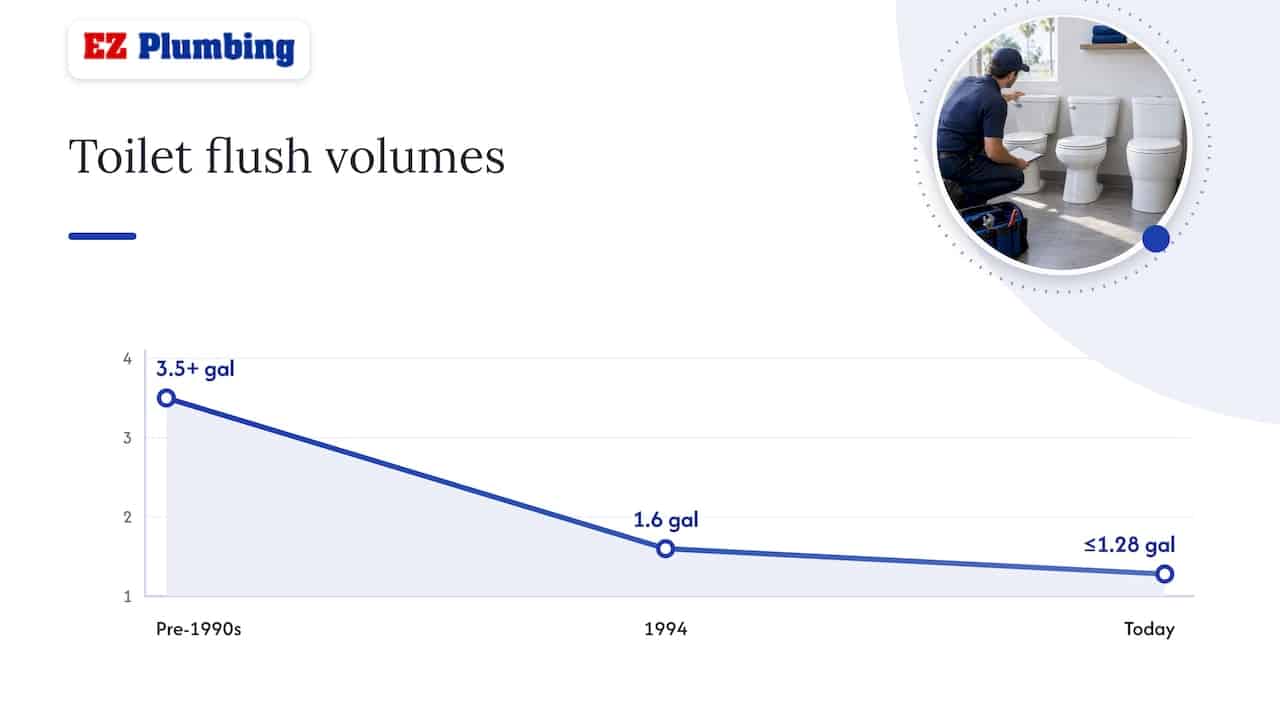
Sometimes the right answer is a new toilet. Consider it if the toilet is cracked or has a chronic leak, if the toilet is old and heavily scaled inside the trapway where you cannot reach, or if repeated repairs have not restored performance. Choosing a newer model also matters for water use. A toilet that was made before the early 1990s may use 3.5 gallons or more per flush, and the national standard moved to 1.6 gallons in 1994, per American Standard’s explanation of the Energy Policy Act. Today’s WaterSense models use 1.28 gallons or less.
If you live in the City of Los Angeles, check the rebate before you buy. As of this writing, the LADWP SoCal Water$mart program offers $250 per unit for homeowners with one to four units, and $300 for commercial and multi-family properties with five or more units, when you replace a toilet rated at 1.6 gallons per flush or more with one rated at 1.1 gallons per flush or less. Rebates need proof of purchase and a recent LADWP bill, and the program can change or end without notice, so confirm the terms first. We have a separate guide on Los Angeles toilet rebates and a checklist for hiring a pro, and one on water conservation plumbing for LA homes.
A word for property managers and small businesses: if several toilets in a building flush weakly, do not swap fixtures one by one. Have the vent stack and main line looked at first. For ongoing buildings, commercial plumbing and maintenance contracts let us schedule jetting and inspections before small flow problems become tenant complaints.
Keeping the flush strong
A few habits stop most repeat problems. Descale the rim jets every few months if you are in a hard-water area. Replace the flapper when it gets soft or warped. Use only toilet paper, and avoid flushing wipes, even ones labeled flushable. Do not use in-tank bleach tablets, which shorten the life of rubber parts. And pay attention to the first sign of a pattern: a slow toilet is a nuisance, but a slow toilet plus a gurgling tub is information. Our essential plumbing maintenance tips for Los Angeles homeowners cover the regular checks worth doing.
Frequently asked questions
Why is my toilet flush not powerful enough?
The three usual causes are low water in the tank, a flapper chain with the wrong slack, and scaled rim jets. Check them in that order, since the first two take minutes. If none helps, or other drains gurgle when you flush, the vent or drain line is the next suspect.
Can I make my toilet flush stronger?
Yes, if the toilet is underperforming because of a fixable fault. Raise the tank level to the fill line, set the chain with about a quarter to half an inch of slack, and descale the jets. You cannot safely push a toilet beyond its design by adding water volume, for example with tank bricks or by overfilling past the overflow tube. If the toilet is old, a newer model may flush better and use less water.
Why is my toilet flushing slowly in more than one bathroom?
When several toilets are slow, the shared part of the system is the likely cause: a vent restriction, a partly blocked branch line, or the main sewer line. Corroded galvanized pipe and root-invaded clay laterals are common in older Los Angeles homes. A camera inspection will show which one you have.
Is it safe to use drain cleaner in a slow toilet?
We advise against it. Chemical openers do not reliably clear a toilet trap, they can damage older pipes and fittings, and the standing liquid becomes a hazard if the toilet has to be plunged or removed. Use a plunger or closet auger, and call a licensed plumber if the problem persists.
When should I call a plumber for a weak flush?
Call if more than one fixture is affected, if you hear gurgling, if water backs up in a tub or floor drain, or if the tank and flapper checks do not help. Call right away if the toilet overflows. You can reach us any time through our emergency plumbing line.
Sources
- EPA WaterSense Specification for Tank-Type Toilets
- Fluidmaster: Weak Toilet Flush
- LADWP Water Quality FAQs
- The Spruce: Why Your Toilet Flushes Slow
- American Standard: How do I troubleshoot a poor flush
- American Standard: How do I fix a toilet with a poor flush
- Drano: How to Fix a Slow Running Toilet
- Kohler: Poor Flush
- LADWP SoCal Water$mart Rebate Program
- Williams Plumbing and Drain: Toilet Isn’t Flushing All the Way