
Water Heater Problems LA: Diagnose & Get Expert Help
You turn on the shower, wait for the usual warm-up, and get a blast of cold water instead. Or the water goes hot, then lukewarm, then cold again while everyone in the house starts asking the same question at once. In Los Angeles, that problem is more than an annoyance. It can interrupt school mornings, tenants' routines, cleanup, laundry, and basic daily life.
Most water heater problems start with a symptom you can notice before you ever touch a tool. No hot water. A small puddle near the unit. Rumbling sounds. Rusty water from the tap. The key is knowing which issues are safe to check yourself and which ones can get dangerous fast if you guess wrong.
That's especially important in older LA homes, multi-unit properties, and neighborhoods where hard water keeps showing up as scale, sediment, and repeat heater complaints. A small leak around a heater can also turn into interior damage if it spreads into walls or flooring. If you've seen how major drywall problems from leaks develop, you already know why fast action matters.
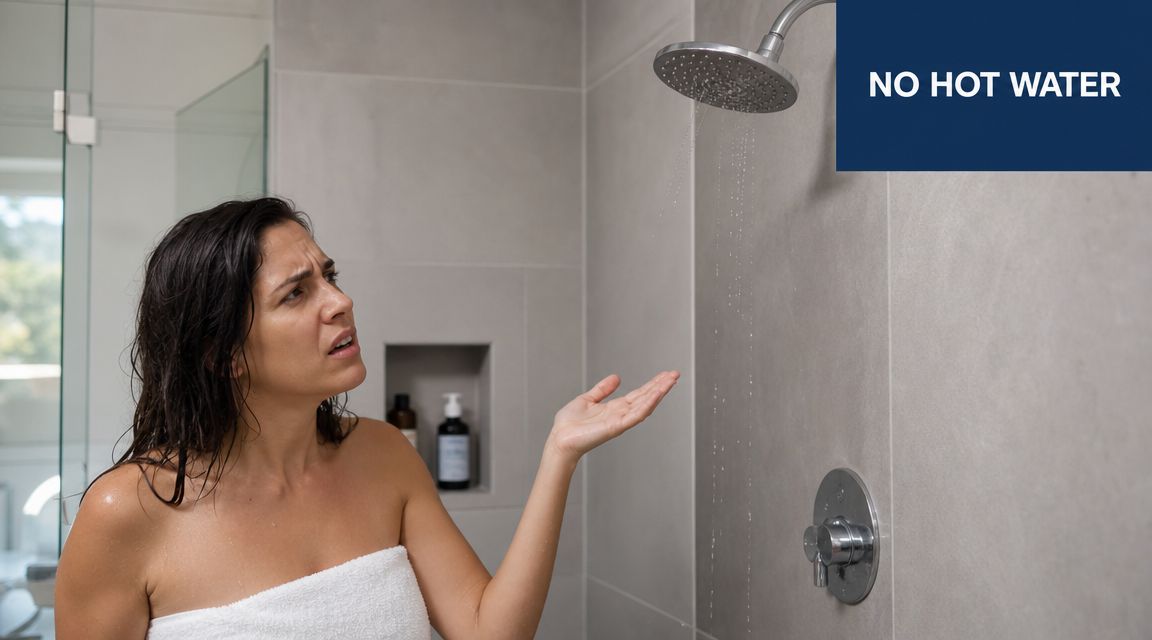
A calm approach works better than random troubleshooting. Start with the symptom. Identify whether you have a tank or tankless unit. Rule out the safe basics. Then decide whether the next move is a reset, a maintenance step, or a service call.
Table of Contents
- Is Your Hot Water Out Again?
- What's Wrong with My Water Heater Common Symptoms
- Safe DIY Troubleshooting Steps Before You Call
- Understanding Tank and Tankless Water Heater Issues
- Repair or Replace Costs and When to Call a Pro
- How to Prevent Common Water Heater Problems
- Water Heater FAQ and Your 24/7 LA Plumbing Solution
Is Your Hot Water Out Again?
When hot water disappears without warning, it's common to jump straight to the worst-case scenario. Sometimes it is a failed heater. Sometimes it's a tripped breaker, a reset switch, a pilot issue, or scale buildup that's been building for a long time. The trick is not treating every symptom like the same problem.
In Los Angeles homes, I'd pay attention to context first. Is the unit in a garage or closet where a leak can go unnoticed? Is the hot water weak in one bathroom or throughout the home? Did the issue show up suddenly, or has the heater been noisy and inconsistent for weeks? Those details matter because they tell you whether you're dealing with a supply problem, a heating problem, or a failing appliance.
The first decision is simple
Start by separating the problem into one of three buckets:
- No hot water at all means the unit may not be heating.
- Some hot water, but not enough points more often to sediment, scale, thermostat issues, or demand exceeding capacity.
- Leaks, gas odor, or repeated breaker trips move the problem out of DIY territory quickly.
Practical rule: If water and electricity are both involved, or you smell gas, your goal is not to be brave. Your goal is to be safe.
A good diagnosis usually saves time and money. It also prevents the common mistake of replacing parts that weren't the underlying issue. That happens a lot when homeowners focus on the symptom they can feel at the faucet, instead of the cause inside the heater.
What's Wrong with My Water Heater Common Symptoms
Most water heater problems announce themselves in ways that are easy to notice but easy to misread. A tank heater and a tankless heater can create similar complaints for different reasons. If you name the symptom correctly first, the next step gets much clearer.
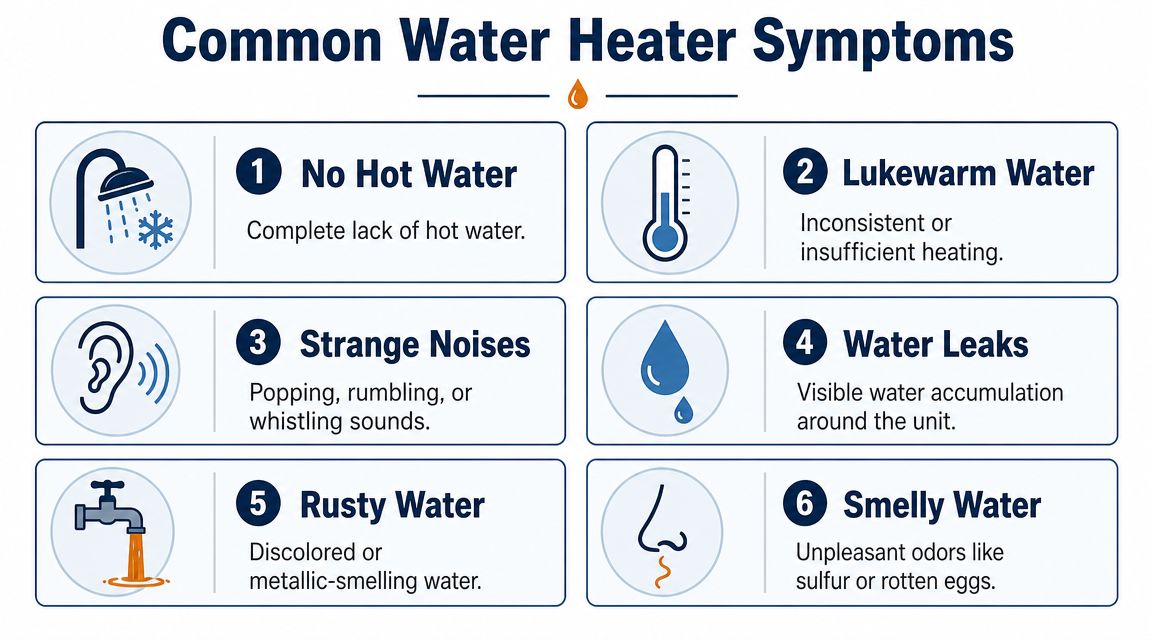
What each symptom usually means
No hot water is the clearest complaint. On electric units, that can mean loss of power, a tripped reset, or failed heating components. On gas units, it often points to ignition or burner-related issues. On tankless systems, it can also mean the unit isn't firing because of a flow or internal fault.
Lukewarm water usually means the heater is working, but not properly. In tank systems, sediment can interfere with heat transfer and reduce usable hot water. In tankless systems, scale, undersizing, or flow-related limits can show up as inconsistent temperature.
Water that's too hot can be a thermostat problem or a control issue. This is one of those symptoms people ignore until someone gets scalded. If the water temperature jumps unexpectedly, stop treating it like a minor inconvenience.
Noises, leaks, and water quality clues
Popping, rumbling, or whistling noises often point to buildup inside the system. Tank heaters tend to make more obvious sediment-related noise. Tankless units can also become noisy when scale restricts flow through tight internal passages.
Visible leaks can come from fittings, valves, or the tank itself. A loose connection is one thing. Water seeping from the body of the tank is another. If the tank shell is failing, repair options narrow fast.
Rusty, cloudy, or metallic-smelling hot water usually means you need to think beyond simple thermostat adjustments. Discolored hot water can signal corrosion inside a tank system or related plumbing issues. Smelly hot water can also point to conditions inside the heater that need direct service, not guesswork.
Strange sounds plus weak hot water usually means the heater has been struggling for a while, even if the outage feels sudden.
Quick Diagnostic Chart for Water Heater Issues
| Symptom | Possible Causes (Tank vs. Tankless) | First Action |
|---|---|---|
| No hot water | Tank: breaker, reset, pilot, heating element, burner issue. Tankless: ignition, sensor, flow, internal fault | Check power or gas status safely, then stop if the issue isn't obvious |
| Lukewarm water | Tank: sediment, thermostat, failing element. Tankless: scale, flow limit, sizing mismatch | Lower simultaneous hot water demand and inspect for recurring performance issues |
| Strange noises | Tank: sediment at bottom of tank. Tankless: scale in heat exchanger or internal passages | Note when the noise happens and schedule service if it persists |
| Water leaks | Tank: valve, fitting, corroded tank. Tankless: fittings, pressure-related leak, internal component issue | Shut off water if needed and inspect whether leak is from a connection or unit body |
| Rusty water | Tank: corrosion inside tank, anode depletion. Tankless: usually less about storage, more about related piping or internal issue | Compare hot vs. cold water appearance and call for diagnosis if only hot is affected |
| Smelly water | Tank: internal water-quality issue or buildup. Tankless: water-quality issue, internal fouling | Avoid repeated guessing and have the system evaluated |
Safe DIY Troubleshooting Steps Before You Call
There are a few checks homeowners can do safely. There are also plenty of ways to get hurt, flood a space, or misdiagnose the problem. If you're not comfortable working around electricity, gas, or shutoff valves, stop early.
Start with safety
Turn off the relevant power or fuel source before opening anything. Keep the area dry. Don't remove covers just to “take a look” if you aren't sure what's behind them.
If you smell gas, don't keep troubleshooting. Leave the area and arrange professional help. The same goes for active leaking around electrical components.
Checks homeowners can usually do safely
On an electric tank water heater, the first checks are the breaker and the high-temperature limit reset. Field guidance notes that power interruption at the breaker or reset circuit can stop the 208–240 V supply, and for a typical 4,500 W element, a healthy resistance reading is about 12.5 ohms, while infinite or zero suggests a failed element, as described in this electric water heater troubleshooting guidance.
That doesn't mean every homeowner should use a meter. It means repeated reset trips usually point to a real electrical fault, not bad luck. If you're comfortable and properly de-energize the unit, learning how to test a hot water element can help you understand what a technician is checking.
For gas models, look for the simple issues first:
- Pilot status: If the pilot is out, follow the manufacturer's instructions exactly. Don't improvise.
- Gas supply condition: If other gas appliances also seem affected, stop and have the supply checked.
- Thermostat setting: Make sure no one turned the control down while adjusting something else.
For both tank and tankless units, basic visual checks still matter:
- Look at the floor and fittings for drips, rust trails, or moisture.
- Listen during operation. A noise that appears only during a heating cycle is more useful than a general “it sounds weird.”
- Check whether the problem affects every faucet or only one area of the house.
If you know you have a gas unit and the symptoms point toward burner or ignition trouble, professional service is usually the cleanest next step. A licensed plumber who handles gas water heater repair can test the problem without turning a heating issue into a safety issue.
When to stop troubleshooting
Stop when the reset keeps tripping, the leak is more than a minor fitting drip, the pilot won't stay lit, or the heater shows signs of internal failure. DIY works best for ruling out obvious causes. It doesn't work well for live electrical diagnosis, combustion issues, or tank integrity problems.
If a “quick fix” requires you to guess around gas, voltage, or a leaking tank, it's no longer a quick fix.
Understanding Tank and Tankless Water Heater Issues
Tank and tankless units fail in different ways. If you know which type you have, the symptom starts making more sense.
The shift toward tankless systems is easy to understand. The U.S. Department of Energy says tankless, or demand-type, water heaters heat water only when needed and can be 24%–34% more energy efficient than conventional storage water heaters in homes using 41 gallons or less of hot water per day. Even at about 86 gallons daily, they're still estimated to be 8%–14% more efficient, according to the DOE guide on tankless water heaters. That efficiency is one reason more LA homeowners now ask about tankless conversion and service.
How tank heaters usually fail
A storage tank heater has a simpler concept and a familiar set of problems. Water sits in the tank, gets heated, and stays ready for use. Over time, that stored water leaves behind sediment. In Los Angeles, that often means noise, reduced output, slower recovery, and parts that work harder than they should.
Common tank-specific trouble spots include:
- Sediment at the bottom of the tank
- Heating element or burner failure
- Corrosion inside the tank
- Valve or fitting leaks
- A tank body that has started to fail
A corroded tank is the line many homeowners don't want to hear about, because there usually isn't a meaningful repair for the tank shell itself.
How tankless units usually fail
Tankless systems avoid standby storage losses, but they're more sensitive to flow conditions, water quality, and internal scaling. In hard-water areas, scale can build inside the heat exchanger and narrow passages. That can show up as fluctuating temperature, weak performance, shutdowns, or noise.
The other issue homeowners run into is expectation. Tankless doesn't mean unlimited hot water under every condition. The DOE notes that demand systems have flow-rate limits, so the right sizing and fuel type matter if you want to avoid lukewarm water or supply complaints. If you're comparing options or troubleshooting one already installed, it helps to understand how a tankless water heater system behaves under real household demand.
Repair or Replace Costs and When to Call a Pro
This is usually the main question. Not “What's wrong?” but “Is it worth fixing?”
Some water heater problems are repair decisions. Others are safety decisions. If you're facing gas odor, a significant leak, repeated electrical faults, or visible tank corrosion, you don't keep experimenting. You get the unit diagnosed.
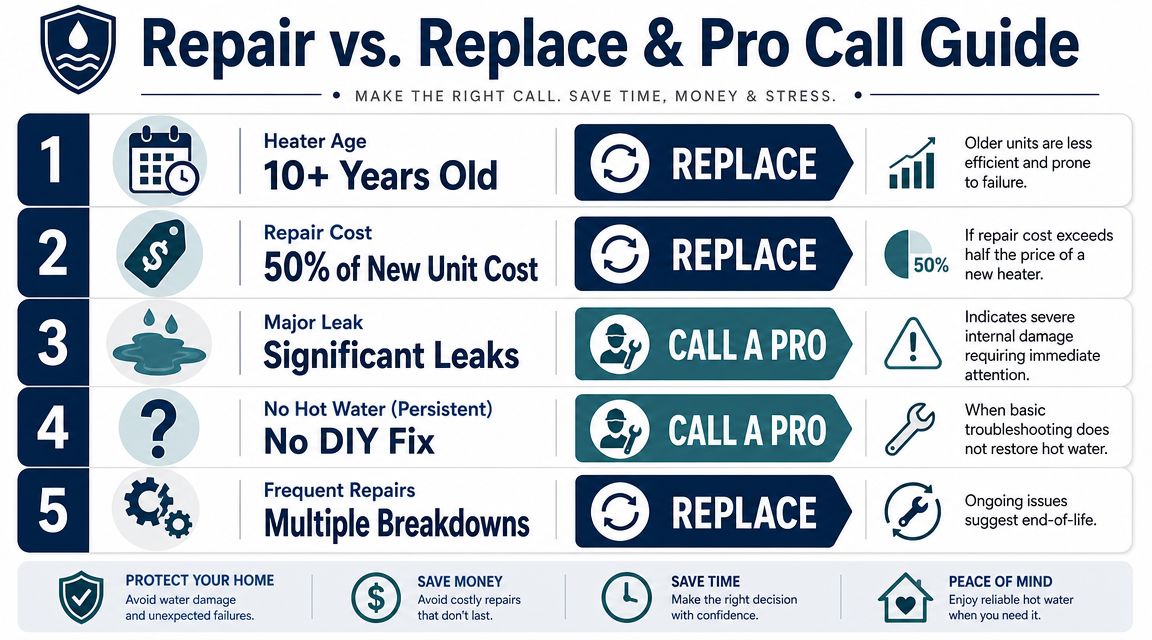
Call a pro right away for these issues
Use a hard line on these symptoms:
- Gas smell: Leave the area and get qualified help.
- Water leaking from the tank body: That's very different from a small fitting drip.
- Breaker or reset keeps tripping: Persistent electrical faults need diagnosis, not repeated resets.
- Severe noise with poor performance: That often means long-term buildup or internal damage.
- Rust streaks and ongoing leakage: Those signs often show a unit near the end of serviceable life.
For standard service work, one option is scheduling a direct water heater repair visit with a licensed plumbing contractor that handles both diagnosis and replacement decisions on site.
What repairs and replacement can cost
The cost spread matters because not every failure belongs in the same category. According to AHRI guidance summarized with pricing references, thermostat or pressure relief valve replacement typically costs $150–$300, heating element or gas valve repairs run about $200–$500, and major tank or heat-exchanger issues can reach $500–$1,500. The same AHRI page notes Angi's 2026 figures showing professional repair costs ranging from $228 to $1,016, with an average repair bill of $606, while replacement often costs $850 to $1,800, as outlined by AHRI's homeowner water heater guidance.
That cost range tells you something important. Small component failures can still make sense to repair. Once you're dealing with major internal damage, repeated visits, or a leaking tank, the economics usually shift.
Paying for one solid diagnosis is often cheaper than paying for the wrong part, then the right part, then a replacement anyway.
A professional diagnosis is worth it when the symptom could come from multiple causes. That's especially true in LA properties where scale, older shutoff valves, aging electrical circuits, and mixed plumbing upgrades can blur the underlying problem.
How to Prevent Common Water Heater Problems
Prevention isn't glamorous, but it's what keeps a water heater from becoming an emergency. In Los Angeles, the biggest mistake I see is treating repeat symptoms like isolated events. A noisy heater, weak hot water, and recurring service calls often point back to the same root issue.
What matters most in Los Angeles
Many water heater problems are really water-quality and scale-management problems. In hard-water regions, mineral buildup can reduce efficiency, create noise, and shorten equipment life. Consumer guidance also points to sediment buildup as a major cause of overheating, reduced hot-water output, and leaks, as discussed in this overview of water heater issues and sediment buildup.
That's why flushing once and forgetting about it usually isn't enough if the same symptoms keep returning. Recurring sediment means you need to think about maintenance intervals, descaling needs, and whether the heater has already taken too much damage.
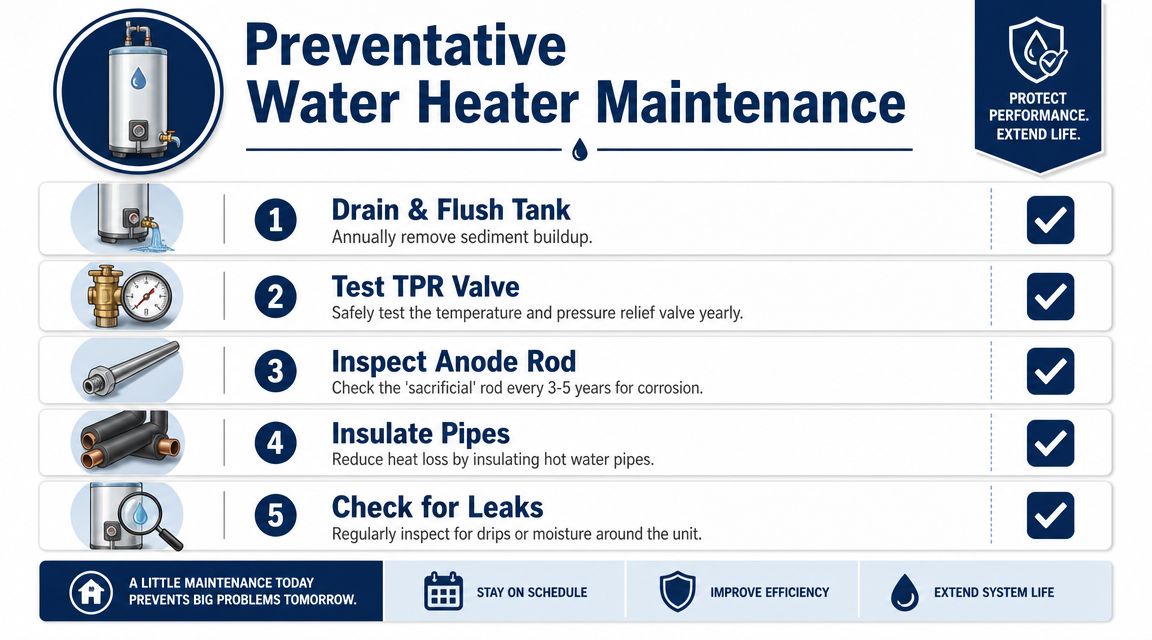
A practical maintenance routine
A useful routine looks like this:
- Flush the tank on schedule: AHRI advises flushing every six months, while another industry recommendation is at least yearly to remove sediment.
- Test the temperature-pressure relief valve carefully: AHRI advises lifting the trip lever. If no air, water, or vapor is released, the valve should be replaced.
- Watch for recurring signs, not just dramatic failure: Noise, reduced output, and small leaks rarely improve on their own.
- Treat tankless descaling as real maintenance: Hard water doesn't care that the unit is newer or more efficient.
- Inspect the area around the heater: Moisture, rust marks, and staining often show up before full failure.
A heater that gets routine maintenance gives you better odds of catching a small valve or control problem before it turns into a major expense. A heater that keeps collecting scale will usually keep asking for attention until someone addresses the underlying water conditions.
Water Heater FAQ and Your 24/7 LA Plumbing Solution
FAQ
Is a noisy water heater dangerous?
Not always, but it shouldn't be ignored. Noise often points to sediment or scale buildup, and that can lead to overheating, poor performance, or shortened equipment life.
Why do I get hot water in one fixture but not another?
That often means the problem may be at the fixture, local mixing valve, or branch plumbing, not the heater itself.
Can a small leak wait a few days?
A tiny drip at a connection might not be an emergency, but you shouldn't assume that's all it is. Water around a heater can spread into flooring, walls, and adjacent materials quickly.
Do tankless units still need maintenance?
Yes. They avoid some storage-tank issues, but scale and flow-related problems still matter, especially in hard-water areas.
When hot water fails in Los Angeles, speed matters. So does judgment. A careful homeowner can rule out a few basics, but gas odor, active leaks, repeat electrical faults, and internal heater failures need licensed service.
If you need help now, EZ Plumbing provides 24/7 emergency plumbing and same-day scheduling across Los Angeles, including the San Fernando Valley, Westside, Pasadena, Glendale, Burbank, Beverly Hills, Santa Monica, and West Hollywood. They serve homeowners, HOAs, property managers, and commercial properties, and you can call (818) 908-2710 to schedule service or request a professional diagnosis.