
Water Heater Combustion Air: What Code Requires and How to Check
A gas water heater needs a steady supply of fresh air to burn fuel cleanly, and it needs somewhere safe to send the exhaust. If the heater sits in a small closet, a tight utility room or a sealed-up house, it may not get enough air. Then it can produce carbon monoxide or pull exhaust back into the living space. Under the California Plumbing Code, the rule of thumb is that the room must hold at least 50 cubic feet of space for every 1,000 BTU/hr of appliance input. If it doesn’t, you must bring in outdoor air through permanent openings or switch to a sealed-combustion unit. This guide explains how to check your own situation and what to expect from a Los Angeles inspection.
TL;DR
- Atmospheric (natural draft) gas water heaters take combustion air from the room around them. Sealed-combustion (direct-vent) units take it from outdoors through dedicated piping.
- In a confined space, the California Plumbing Code calls for 50 cubic feet of room volume per 1,000 BTU/hr of input. Smaller rooms need outdoor air openings or ducts.
- A louvered closet door or a cracked window does not automatically count as compliant combustion air.
- Air sealing, new range hoods and exhaust fans can turn a heater that once worked fine into a backdrafting risk.
- In the City of Los Angeles, a gas water heater replacement generally needs a permit and an inspection. If you are unsure about your closet, have a licensed plumber test it.
Table of Contents
- Why a water heater needs combustion air at all
- Natural draft versus sealed combustion
- The 50 cubic feet rule, worked through
- Bringing in outdoor air
- Special locations: bedrooms, bathrooms and garages
- When the house changes around the heater
- What to expect in Los Angeles
- Our perspective: why we steer closet installs toward sealed combustion
- Getting it checked or replaced
- Frequently asked questions
- Sources
Why a water heater needs combustion air at all
Burning natural gas or propane takes oxygen. The U.S. Department of Energy’s combustion safety brief explains that sealed-combustion appliances draw that air from outside, while atmospheric units draw it from the combustion appliance zone, the part of the home where the appliance sits. When air is short, the flame burns incompletely and carbon monoxide becomes a concern.
There is a second job the surrounding air does. Atmospheric heaters have a draft hood, an opening on top of the unit that is open on purpose. Room air mixes with exhaust there and helps it rise up the flue. Many homeowners assume the hood should be airtight, like a pipe. It shouldn’t be, according to the combustion safety guidance from the Department of Energy program materials. That also explains the risk: if the house is under negative pressure, the open hood can become the place where exhaust gets pulled into the home instead of going up the flue.
So combustion air is really two questions. Is there enough air to burn the fuel? And is the pressure in the house balanced so exhaust goes up and out?
Natural draft versus sealed combustion
The type of heater you own decides most of what follows.
| Feature | Natural draft (atmospheric) | Power vent | Sealed combustion (direct vent) |
|---|---|---|---|
| Combustion air source | Room air | Usually room air | Outdoors, through sealed piping |
| Exhaust path | Rises through a draft hood and flue by buoyancy | Pushed out by a blower | Sealed vent pipe to outdoors |
| Sensitive to house pressure | Yes | Less so | Largely isolated |
| Room-volume calculation | Yes | Often | Not needed |
A note on the middle column: power-vent models vary by manufacturer, and some are direct vent while others use room air. Check the installation manual or the label for the exact configuration.
Sealed-combustion units are widely treated as the safest standard for modern installs because they pull air only through sealed piping from outdoors. The same combustion safety guide notes they are not affected by indoor air pressure swings and are preferred when the heater is inside living space. That is also why they sidestep the room-volume math described below.
The 50 cubic feet rule, worked through
California cities publish short handouts that summarize the code for homeowners. The City of Alameda’s water heater requirements summarize the 2022 California Plumbing Code this way: a fuel-burning water heater in a confined space, where the room has less than 50 cubic feet per 1,000 BTU/hr of total input, needs dedicated combustion air from a larger interior space or directly from outdoors. The Montana State University weatherization examples use the same 50 cubic feet figure and show how to add up several appliances.
Here is how it plays out. We will use round numbers that are common for a standard tank unit, but read your own data plate.
- Find the input rating. A typical 40-gallon gas tank heater may be rated around 40,000 BTU/hr. The label on the unit gives the real number.
- Add other appliances in the same space. If a furnace shares the closet or room with it, add its input too. A furnace at 80,000 BTU/hr plus a heater at 40,000 gives 120,000 BTU/hr, the same combination used in the Montana State example.
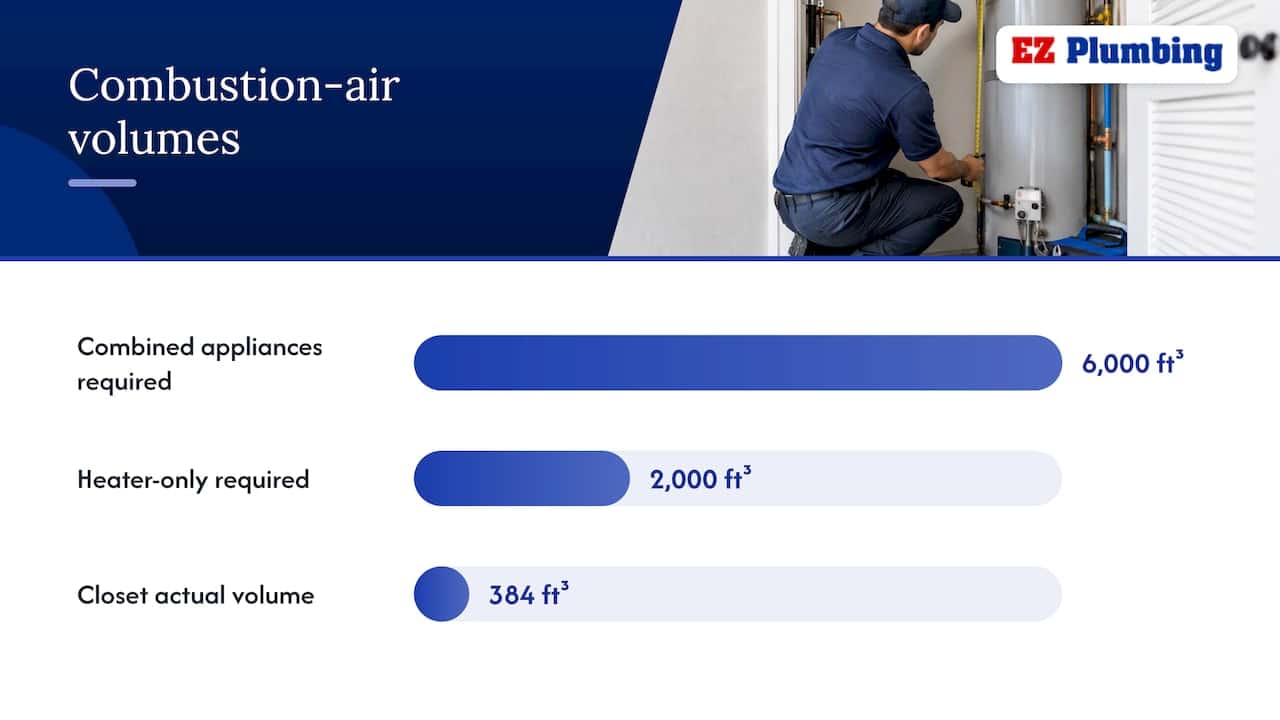
- Multiply. 120,000 divided by 1,000 is 120, and 120 times 50 is 6,000 cubic feet of required volume.
- Measure the room. Length times width times ceiling height. A 6 by 8 foot closet with an 8 foot ceiling holds 384 cubic feet. That is nowhere near 6,000.
Even the heater alone, at 40,000 BTU/hr, needs 2,000 cubic feet. With an 8 foot ceiling, that is a 250 square foot room. Most hallway closets and many garage corners fall short, which is why they are treated as confined spaces.
The code allows the volume of connected rooms to count when they are joined by permanent openings, and the ICC’s CodeNotes on indoor combustion air describe the several methods the model codes recognize, from all-outdoor air to indoor air and combinations. The rules are detailed, so treat this arithmetic as a screening test, not a substitute for a code check.
Bringing in outdoor air
When the room is too small, the usual answer is permanent openings or ducts to the outdoors. A California handout summarizing the 2010 code lays out several configurations, with free-area sizing that depends on the layout. For vertical ducts to the outdoors, for example, it lists a minimum of 1 square inch of free area per 4,000 BTU/hr for each of two openings. For two openings in an exterior wall, the figure is 1 square inch per 2,000 BTU/hr each.
On a 40,000 BTU/hr heater, that works out to:
- Two vertical ducts: at least 10 square inches of free area each.
- Two horizontal openings in an exterior wall: at least 20 square inches each.
Two caveats matter. First, that handout is based on the 2010 code, and the current edition adopted in California may differ in detail, so confirm against the code your city enforces. Second, “free area” is the open area after the louver or screen takes its share, so a 20 square inch grille nameplate does not necessarily deliver 20 square inches of airflow.
One of the commonest mistakes we see described in inspections is assuming that swapping a solid closet door for a louvered one solves the problem. Louvers connect the closet to the house, which only helps if the house itself provides the required volume. Where the closet is the problem, the air has to come from outdoors or from a large enough connected space.
Special locations: bedrooms, bathrooms and garages
Certain locations carry extra rules, and combustion air is part of them. Per the City of Cupertino’s updated water heater handout, a fuel-burning heater in a bedroom or bathroom must be the direct vent type, or sit in a closet with a listed gasketed, self-closing door assembly. In the second case combustion air must come from outdoors and the closet must be for the heater alone.
Garages have their own requirement. The Alameda handout above says burners and ignition devices must be at least 18 inches above the floor unless the unit is listed as flammable vapor ignition resistant, and that appliances subject to vehicle damage need protective barriers or elevation. Garage heaters in Los Angeles bungalows and 1950s tract homes are common, so this comes up often. Garage air is another reason homeowners ask about ventilation: a closed garage that is also tightly sealed can be a poor source of combustion air.
When the house changes around the heater
A heater can pass inspection and still become a problem years later. The Department of Energy brief points out that older homes were often leaky enough to provide plenty of air to natural draft appliances, and that modern insulation and air sealing reduce that passive supply. Homeowners tightening up a house to cut cooling costs can unknowingly starve an atmospheric heater.
Pressure is the other half. A powerful kitchen range hood, a bathroom fan, a clothes dryer or a forced-air system can pull the house into negative pressure. The combustion safety guide linked above describes how this can reverse the draft at the hood. Backdrafting is often intermittent, showing up only in certain weather or when several fans run together, which is why a heater that looks fine on a quiet afternoon can still spill exhaust at 7 a.m. when the shower fan, dryer and hood are all going.
Warning signs to take seriously:
- Soot or scorching around the draft hood or on the top of the heater
- A yellow or lazy flame instead of a steady blue one
- Rust streaks or water stains on the flue pipe or around the hood
- Excess condensation on windows near the appliance, since water vapor is a normal combustion byproduct that builds up when exhaust is not leaving the house
- A carbon monoxide alarm that sounds, even once
If an alarm sounds, get everyone outside into fresh air and call 911 or your gas utility. Do not go back in to troubleshoot. For a heater you suspect is misbehaving but no alarm has gone off, shut off the gas at the unit if you know how, and call a licensed plumber the same day.
What to expect in Los Angeles
In the City of Los Angeles, LADBS answers that a plumbing permit is required to replace a gas water heater in a single-family home, unless the work is done by a contractor holding a Certificate of Registration as a Certified Licensed Contractor. That exception is limited to replacing a heater with one of equivalent capacity in gallons, BTU rating and vent capacity. Swapping to a different type, or relocating the heater, changes the picture.
The permit leads to an inspection. LADBS owner-acknowledgment paperwork and the inspection process cover items such as seismic strapping, gas shut-off valves and, when applicable, a compliant combustion air supply. Details differ between the City of Los Angeles and neighboring jurisdictions like Pasadena or Long Beach, so confirm with the building department that covers your address.
We cover the full checklist in our guide to passing LA water heater inspections, and the installation side in our natural gas water heater installation guide.
Our perspective: why we steer closet installs toward sealed combustion
We have worked on Los Angeles plumbing since 1989, and the same pattern keeps repeating with combustion air. A homeowner has a 1960s or 1970s heater in a hall closet, a louvered door, and no known problem. Then they replace the windows, add attic insulation, or install a stronger range hood, and nobody rechecks the heater.
Our view is simple. If the heater is in a confined space and the calculation does not clearly pass, do not try to rescue it with one more grille. Either build proper outdoor air openings that match the BTU input, or install a sealed-combustion or direct-vent unit. The sealed option takes room volume and house pressure out of the equation. It is often the cleaner answer in condos, townhomes and older bungalows where adding ducts through finished walls is awkward.
We also test, not guess. When we look at a heater, we look at the whole combustion appliance zone: the flue, the draft hood, other gas appliances, the fans that compete for air, and whether the job will pass the city’s inspection. We document the work so the permit record matches what is actually in the house. Customers talk to real local staff, and we put pricing in writing before work begins.
Calm is the right tone here. Most combustion air problems are fixable, and many are found before anyone is harmed. The goal is to find them early.
— EZ
Getting it checked or replaced
If you have an atmospheric heater in a closet, a bedroom-adjacent space or a tightly sealed garage, we can look at the air supply, the venting and the permit situation together. Start with our water heater installation page if you are replacing the unit, or our water heater repair page if the current one is acting up. Our published hourly rate is $150 to $280 for residential plumbing and $120 to $240 for commercial, with details on the rate calculator page. If you smell gas or suspect exhaust spilling, our 24/7 emergency plumbing line is the faster route. For safety background on gas units, read our gas water heater repair safety guide.
Property managers and HOAs with several buildings can also ask us about commercial maintenance contracts, which are a practical way to keep combustion appliances inspected on a schedule.
Frequently asked questions
Can I just add a vent to my water heater closet?
Sometimes, but the opening has to be sized to the heater’s BTU input and connect to the outdoors or to a large enough space. Louvers into the house only help if the house provides the required volume. A licensed plumber should size it and the city may inspect it.
Do sealed-combustion water heaters need combustion air calculations?
No room-volume calculation is needed, because they draw air through dedicated piping from outdoors. They still need a correctly installed, correctly terminated vent, a permit where required, and the same gas and seismic safety items as any other heater.
Does the garage count as enough air for a water heater?
Don’t assume it does. A garage may be large, but it may also be sealed tight, and it comes with its own rules, such as keeping burners at least 18 inches above the floor unless the heater is listed otherwise. Have the installation checked against the code your city enforces.
How do I know if my water heater is backdrafting?
Soot, scorching, rust on the flue and unusual condensation are clues, but backdrafting can be intermittent, so a visual check can miss it. Professional combustion testing, run while fans and other appliances are on, is the reliable way to find it. Install carbon monoxide alarms near sleeping areas regardless.
Sources
- U.S. Department of Energy, Combustion Appliance Safety and Efficiency Testing
- Combustion safety guide (DOE program materials)
- City of Alameda, Water Heater Installation Requirements
- Montana State University Extension, Combustion Air Examples
- ICC, CodeNotes on indoor combustion air methods
- California water heater requirements handout (2010 CPC)
- City of Cupertino, Water Heater handout
- LADBS, plumbing permit for gas water heater replacement