
Trenchless Pipe Lining: What LA Homeowners Need to Know
Trenchless pipe lining can be a durable option, but it isn't a universal cure. Cured-in-place pipe, or CIPP, has been used since a London project in 1971 and now represents more than 40% of the trenchless pipe rehabilitation market according to industry market research on CIPP, yet the first question for a Los Angeles homeowner is simpler: does the existing pipe have enough structure left to support a liner?
That question usually arrives after a familiar scene. A toilet backs up during a Sunday shower, the kitchen sink drains slowly, or a sewer camera reveals roots beneath a patio that nobody wants demolished. Trenchless pipe lining may spare a driveway, slab, or mature tree, but only after a contractor proves that the host pipe is a suitable candidate.
Table of Contents
- When a Sewer Line Problem Becomes a Lining Decision
- How CIPP and Trenchless Lining Work
- Trenchless Lining vs Dig-and-Replace
- When Lining Is the Right Call and When It Isn't
- What to Expect When You Hire a Contractor
- Typical Los Angeles Costs and Timelines
- Resin Chemistry and Site Safety Most Articles Skip
- Choosing a Los Angeles Contractor and Next Steps
When a Sewer Line Problem Becomes a Lining Decision
A 1920s Craftsman in Echo Park may have a clay sewer lateral with root-filled joints beneath a back patio. A Mid-City duplex may have a low section, or belly, under stamped concrete. Both properties can produce the same warning signs, but they don't automatically need the same repair.
Recurring backups deserve more attention than a single clogged toilet. Slow drainage across several fixtures, gurgling toilets, persistent sewer odors, soggy yard areas, and wastewater returning through a floor drain can point to a problem in the building sewer rather than an isolated fixture. A contractor should first identify where the obstruction or structural defect sits, then determine whether the line can be cleaned and inspected properly.
Los Angeles has many older homes with original clay, cast-iron, or other aging lateral systems. In neighborhoods with patios, concrete driveways, landscaping, hillside access challenges, or slab-on-grade construction, excavation can damage more than the pipe. The surface restoration may involve masonry, irrigation, tree roots, hardscape, and interior flooring.
A professional sewer line inspection turns a worrying symptom into a condition report. The camera should show the material, joints, cracks, deformation, roots, standing water, and any missing sections. It should also show whether cleaning equipment can pass through the run without destroying the host pipe.
The first estimate shouldn't be “lining or digging.” It should be “what condition is the pipe actually in?”
The central decision is structural. A liner needs a continuous path, controlled geometry, and enough remaining host-pipe integrity for the designed system to perform. If the pipe has collapsed, lost its shape, or disappeared in sections, the contractor may need a spot repair, open-trench replacement, or another trenchless replacement method instead.
How CIPP and Trenchless Lining Work
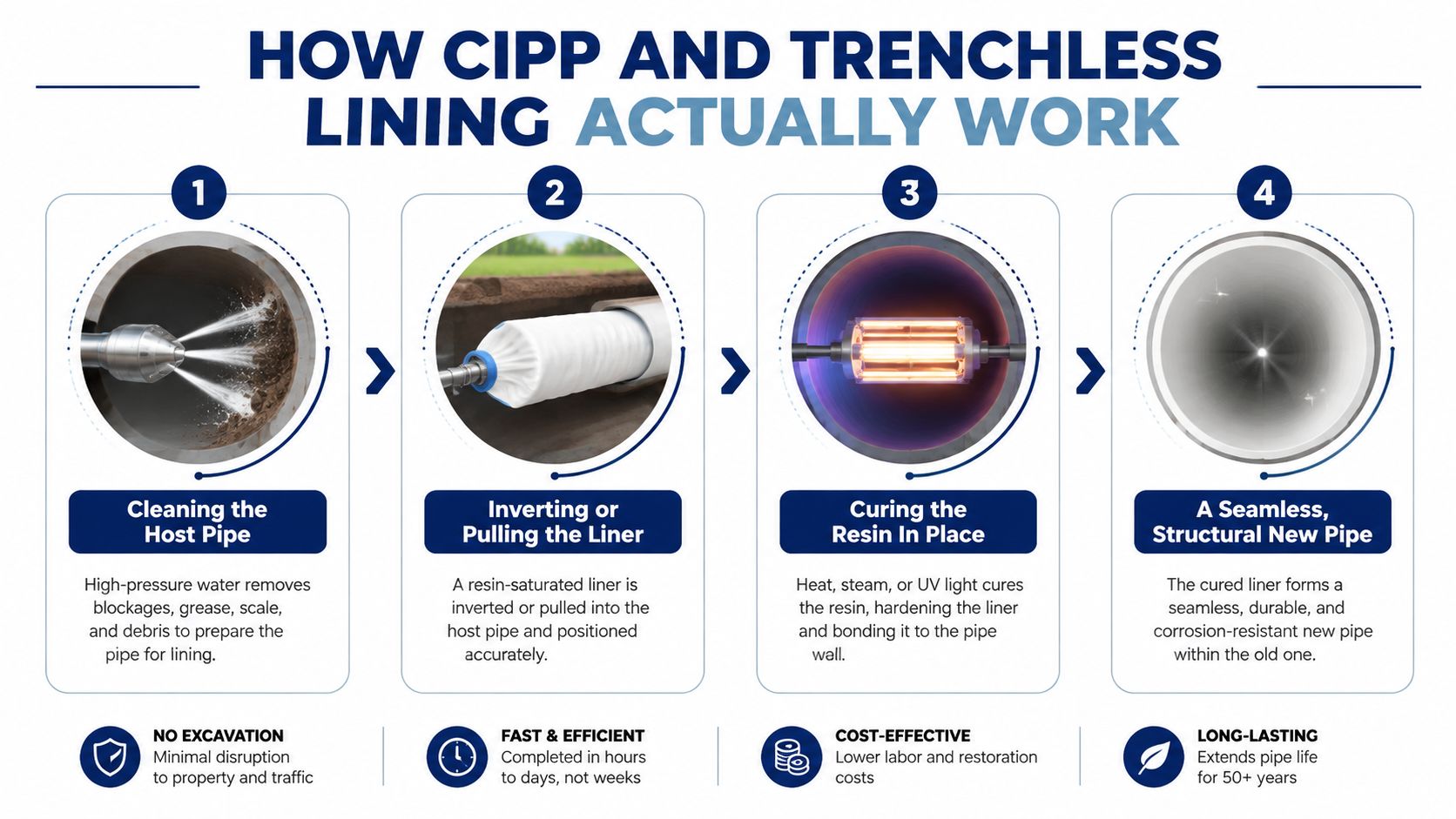
A liner is a new pipe formed inside the old one. A flexible fabric tube saturated with resin enters the host pipe through an access point. Air or water pressure presses it against the interior wall while the resin cures into a hard, continuous lining.
The process begins with preparation:
- The crew cleans the host pipe. Hydro-jetting removes grease, sediment, loose debris, and roots. Mechanical tools can address hard scale or deposits that water pressure cannot safely remove.
- A camera verifies the route. The technician confirms that equipment can pass, measures the run, locates service connections, and identifies defects that could interfere with installation.
- The installer chooses and saturates the tube. Felt, fiberglass, or another textile receives a thermosetting resin. The resin and reinforcement must match the diameter, service conditions, structural demands, and curing method.
- The liner is pulled or inverted into place. ASTM F2599 describes sectional CIPP as a continuous resin-impregnated textile tube inserted by air or water inversion and inflation into existing pipe sizes from 4 inches to 60 inches. It describes the cured result as a tight-fitting, corrosion-resistant, verifiable, non-leaking pipe segment. The ASTM F2599 technical description provides the formal scope.
- The resin cures. Depending on the system, heat, steam, hot water, ambient conditions, or ultraviolet light hardens the resin. The crew then inspects the interior by camera and reopens covered branch connections.
The host pipe still matters. Structural CIPP differs from a spot patch or spray coating because the completed liner can be specified and tested for material properties, adhesion, tensile strength, and hydrostatic burst strength. A smooth camera image alone does not prove that the system can support the load.
For pressure-pipe rehabilitation, the design range depends on the product and application. One specification lists host diameters from 2 inches to 55 inches, installation lengths up to 4,000 meters, operating pressures from 1.0 to 4.0 MPa, burst pressures from 3.0 to 12.0 MPa, wall thicknesses of 6 to 8 millimeters, and a 50-year service-life target. These figures come from the NuFlow pressure-pipe specification. They do not promise that every residential sewer liner has the same properties.
A short installation video shows the sequence:
Trenchless Lining vs Dig-and-Replace
For a Los Angeles property, the surface above the pipe often determines the value of trenchless work. A line under a bare side yard presents a different calculation from one beneath a driveway, mature jacaranda, finished patio, or occupied building.
Trenchless lining usually needs limited access rather than a continuous excavation. Dig-and-replace exposes the damaged section, removes the old pipe, installs new pipe, and restores the surface. The second method gives the contractor more direct access and may be the safer choice when the host pipe has collapsed or shifted severely.
| Factor | Trenchless Lining | Dig-and-Replace |
|---|---|---|
| Surface disruption | Usually limited to access points and connection work | Requires an excavation along the repair path |
| Structural suitability | Needs a host pipe with usable shape and supporting condition | Can remove missing, collapsed, or badly deformed sections |
| Interior diameter | The liner reduces the opening slightly | New pipe size can be selected directly, subject to site conditions |
| Landscaping and hardscape | May preserve patios, driveways, and established planting | Restoration can involve concrete, soil, irrigation, and plants |
| Access constraints | Works best when the crew can reach and prepare the entire run | Provides direct access but may require more room and restoration |
| Project planning | Requires careful design, cleaning, curing, and branch reinstatement | Requires excavation safety, utility coordination, bedding, and backfill |
Price isn't the only comparison. A lining proposal that looks attractive can become unsuitable if cleaning reveals a collapsed section. A dig proposal that appears disruptive may be the responsible option when the old pipe cannot support a liner.
Lining also isn't the same as preserving every millimeter of capacity. The new wall occupies space inside the host pipe, so the contractor should consider the remaining diameter, pipe slope, flow needs, and branch connections. A balanced review of trenchless sewer repair advantages and drawbacks can help homeowners prepare questions, but the camera inspection remains specific to the property.
Permits, access agreements, hillside conditions, historic-district requirements, and HOA rules may influence either method. The right decision balances pipe condition, site disruption, hydraulic capacity, restoration, and long-term maintainability, not just the first line on an estimate.
When Lining Is the Right Call and When It Isn't
A liner doesn't float independently inside an empty tunnel and solve every structural problem. Its design depends on the geometry and condition of the host pipe, the loads around it, the liner's reinforcement and wall thickness, and the way the resin cures.
Small cracks, root-intruded joints, isolated leaks, moderate corrosion, and limited offsets can often be evaluated as lining candidates. Clay laterals and cast-iron lines may respond well when the pipe remains substantially continuous and cleaning can remove the material blocking the liner's path.
The difficult cases are the ones that marketing language tends to skip. A fully collapsed run, a missing segment, severe ovality, major backfall, or a joint offset that the selected liner can't bridge may require excavation or a different rehabilitation approach. A pipe that disintegrates during descaling also raises a serious question about whether the host has enough remaining structure for the planned installation.
What the camera must establish
A useful inspection should answer practical questions:
- Is the pipe continuous? The camera should identify gaps, collapses, and missing sections.
- Is the shape acceptable? Severe flattening or ovality can prevent uniform liner placement.
- Can the crew clean it? Roots and deposits must be removed without causing further failure.
- Can branches be reopened? Service connections need accurate locations before and after installation.
- Does the design match the condition? The proposed wall thickness and reinforcement should reflect pressure, soil loading, groundwater, temperature, and corrosion exposure.
A 2025 Ohio University project funded by the Federal Highway Administration received $455,000 to study CIPP liners and develop an equation for minimum liner thickness for durable rehabilitation. The university's project announcement illustrates why minimum-thickness and performance-limit questions matter. Market growth demonstrates demand, but it doesn't prove that lining suits every damaged pipe.
| Pipe Condition | Lining Candidate? | Why |
|---|---|---|
| Isolated crack or leaking joint | Often, subject to inspection | A continuous host can provide a stable path for the liner |
| Root intrusion at joints | Often, after proper cleaning | The liner can create a continuous interior over the joint area |
| Moderate cast-iron corrosion | Potentially | The designer must account for remaining wall, scale, and structural loading |
| Minor offset | Possibly | The liner system must be able to pass and bridge the measured offset |
| Fully collapsed section | Usually not | The liner may lack a stable route and adequate support |
| Missing pipe segment | Usually not without additional work | The open area may exceed the liner's designed bridging capability |
| Severe ovality or backfall | Condition-dependent | Geometry can prevent proper fit, flow, or structural performance |
| Host pipe that crumbles during cleaning | Poor candidate | Preparation may remove the very support the liner requires |
The contractor's first responsibility is to prove candidacy before quoting a full lining job. A camera alone may not answer every engineering question, but a clear recording, measurements, cleaning assessment, and written design basis are far more useful than a blanket promise.
What to Expect When You Hire a Contractor
A careful project begins before equipment arrives. During the initial call, a contractor should ask about backups, fixture locations, prior repairs, cleanouts, access, building occupancy, and whether the problem affects one branch or the entire property. Property managers should also mention tenant schedules, commercial operating hours, and any sensitive indoor-air requirements.
The on-site inspection comes next. The technician locates access points, runs a camera, documents pipe material and defects, and measures the line. Request the recorded pre-installation video, not only a verbal description, because the proposal should connect the recommended repair to visible conditions.

What belongs in the written proposal
The estimate should identify:
- The liner details: length, diameter, textile or reinforcement, resin family, and intended structural role.
- Preparation work: hydro-jetting, root removal, mechanical descaling, and any spot repairs.
- Branch reinstatement: the locations and method for reopening lateral connections.
- Site logistics: bypass needs, access requirements, protection of surfaces, and cleanup.
- Administrative items: permits, inspections, fees, exclusions, payment terms, and warranty language.
A vague “sewer lining” allowance leaves too many decisions unresolved. Ask whether the price changes if cleaning reveals a collapse, whether a short replacement section can be combined with lining, and what happens if the crew can't safely pass the liner through the prepared pipe.
Installation and closeout
Preparation may occur separately from installation. The crew cleans and dries or conditions the host pipe, controls flow if necessary, and confirms measurements. On installation day, the liner is impregnated, inverted or pulled into position, cured, and checked for wrinkles, voids, incomplete cure, or blocked connections.
After curing, a robotic cutter may reopen branch connections. The contractor should provide a final camera recording that shows the completed segment and confirms that fixtures and branches remain open. The warranty should state what is covered, the covered length or segment, exclusions, transfer terms, and whether workmanship and liner materials have separate coverage.
For ongoing care, ask the contractor whether the building's use, roots, grease, or scale justify periodic camera review or cleaning. The answer should reflect the actual line, not a generic maintenance script.
Typical Los Angeles Costs and Timelines
A credible Los Angeles estimate needs the inspection behind it. Pipe diameter, liner length, access, depth, branch connections, cleaning difficulty, resin selection, bypass requirements, permitting, and restoration can move the total substantially.
Because project-specific pricing isn't established by the verified technical data available here, homeowners should treat any uninspected flat quote as provisional. The Los Angeles trenchless sewer repair cost guide can help frame the questions to ask, but it shouldn't replace a camera-based proposal.
| Project Type | Typical Price Range | Typical Timeline | Key Cost Drivers |
|---|---|---|---|
| Residential lateral | Must be confirmed by inspection and written scope | Depends on preparation, curing, access, and approvals | Length, diameter, roots, branches, cleanout access, resin system |
| Duplex or small multifamily line | Must be confirmed by inspection and written scope | Depends on tenant coordination and flow control | Multiple connections, bypass needs, depth, operating schedule |
| Small commercial line | Must be confirmed by inspection and written scope | Depends on service interruptions and staging | Traffic, access, flow control, diameter, curing logistics |
The timeline has several separate clocks. Inspection and proposal preparation depend on contractor availability and the complexity of the run. Permitting depends on the responsible jurisdiction, project scope, and site conditions. Installation itself depends on how much cleaning, drying, connection work, and curing the liner requires.
A short, accessible line with one clear path may be straightforward. A deep lateral beneath a driveway, with roots and several branch connections, demands more preparation. After-hours work can protect a restaurant or office schedule but may add coordination requirements.
A spot repair can also be more sensible than lining the full run when inspection identifies one isolated failure and the surrounding pipe remains serviceable. Conversely, repeated defects across the lateral may make a continuous liner more practical than several excavations. Ask for an itemized comparison that includes lining, spot repair, and open replacement where each remains technically viable.
Resin Chemistry and Site Safety Most Articles Skip
“Trenchless” describes the excavation approach, not the complete health and safety profile. A liner can reduce surface disruption while the resin and curing process still require controlled handling, ventilation, worker protection, and communication with occupants.
CIPP systems may use polyester, vinyl ester, or epoxy resin families. The appropriate choice depends on chemical exposure, temperature, pressure, structural demand, cure method, pipe service, and the manufacturer's installation requirements. A contractor should name the resin rather than describe it only as a proprietary coating.
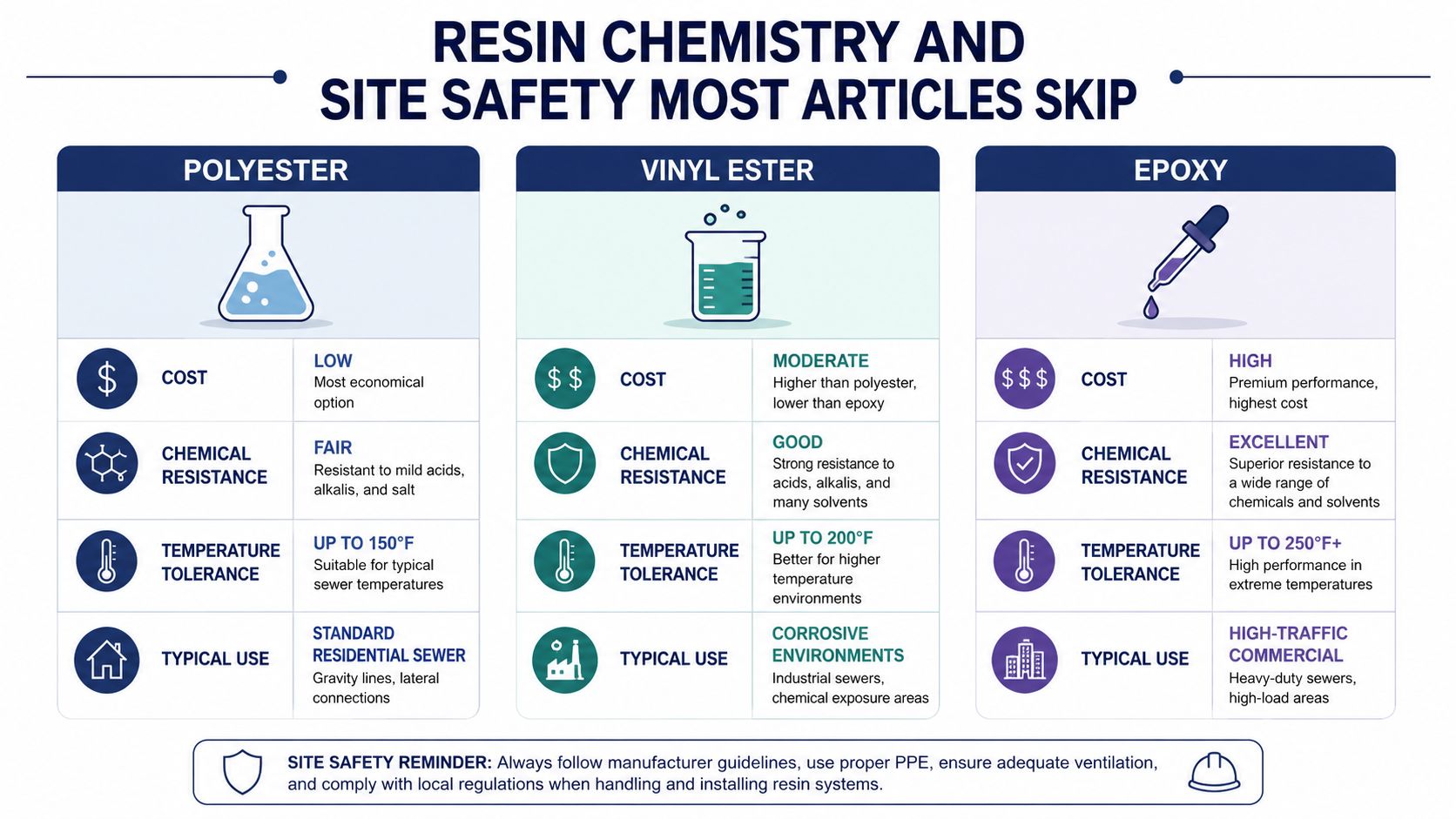
Styrene emissions deserve direct discussion, particularly with polyester-based systems. A 2025 peer-reviewed review of CIPP environmental and occupational health implications identifies continuing work on styrene emissions across multiple jobsites. That means air quality and worker exposure remain active considerations, not topics a contractor should dismiss as irrelevant.
Questions for an occupied Los Angeles property
Ask these before installation:
- Which resin will you use? Request the product name and current safety data sheet.
- How will you cure it? Steam, hot water, ambient, and UV systems create different site procedures.
- Where will air go? The contractor should explain ventilation, exhaust routing, and how fumes will be kept away from occupied rooms.
- Who needs to leave? Residents, tenants, pets, and workers may need clear instructions during preparation and cure.
- How will you monitor the work area? The contractor should identify controls for confined spaces, openings, equipment, and resin handling.
EPA material on styrene, OSHA confined-space requirements, and the manufacturer's safety data sheets provide useful baselines, but the contractor still has to adapt the plan to the property. A slab-on-grade home, a duplex with shared walls, and a commercial building with occupied suites don't present the same ventilation challenge.
If a contractor won't identify the resin, cure method, and ventilation plan, pause the project.
Newer materials and curing approaches, including UV-cured systems and liners designed for additional monitoring capabilities, show that the industry is looking beyond basic pipe renewal. The practical standard for today's homeowner remains straightforward: understand what enters the pipe, how it cures, how air is controlled, and whether the proposed chemistry fits the occupants and site.
Choosing a Los Angeles Contractor and Next Steps
The right contractor won't begin with a sales promise. They'll begin with evidence from the pipe and a clear explanation of the available repair paths.
Use this checklist when comparing proposals:
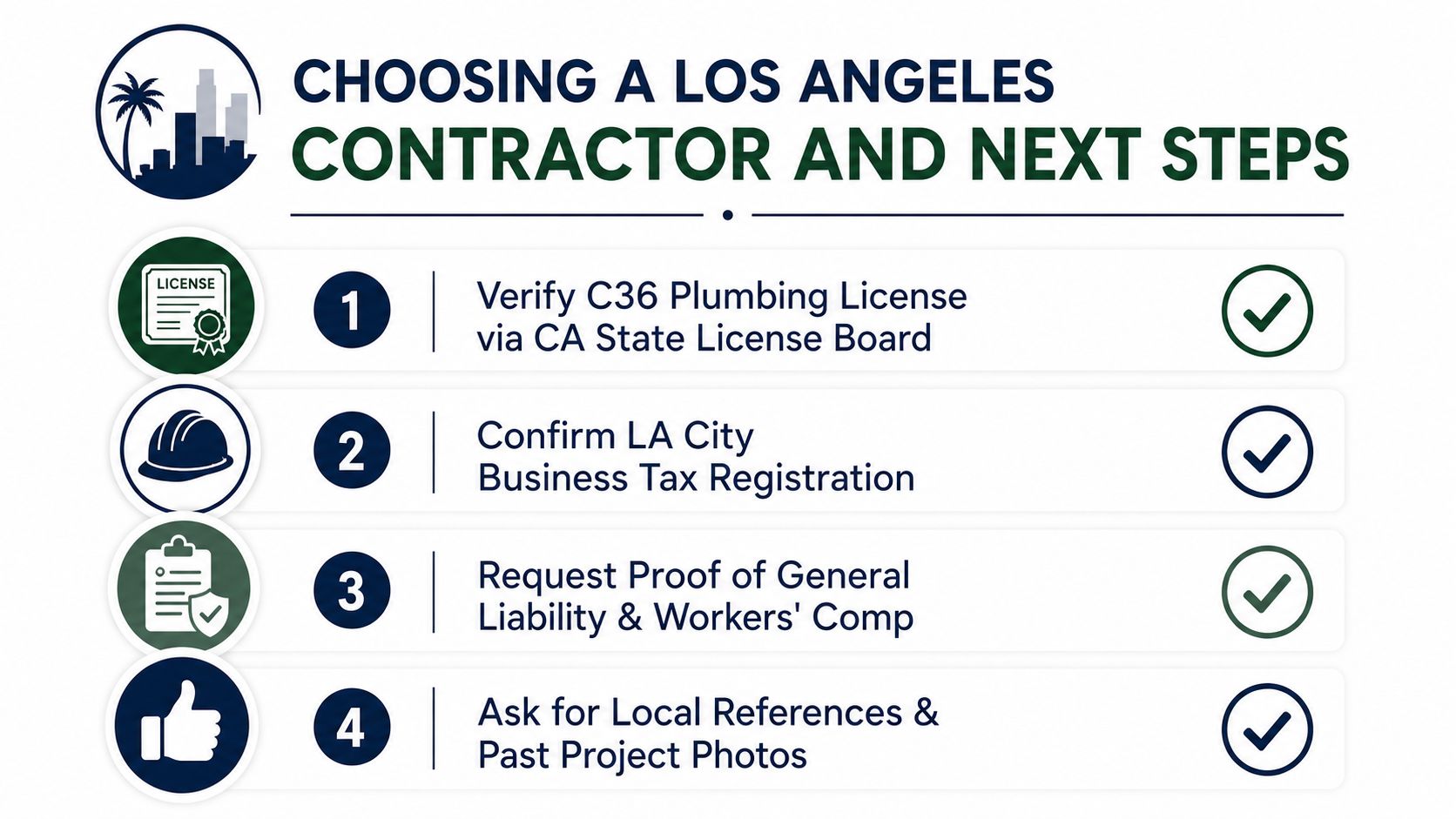
- Verify licensing: Confirm the contractor's C36 plumbing license through the California State License Board.
- Check local requirements: Ask about applicable Los Angeles City, Los Angeles County, or neighboring-city permits and inspections.
- Request CIPP qualifications: Look for CIPP-specific training, manufacturer certification, and experience with the pipe material and diameter involved.
- Review the footage: Require pre-cleaning and post-installation camera recordings, with defect locations identified.
- Read the warranty: Confirm the covered liner, workmanship terms, exclusions, transfer conditions, and required maintenance.
- Compare scopes: Make sure bids separate liner installation, cleaning, branch reinstatement, spot repairs, permits, bypass work, and surface restoration.
Los Angeles properties can hide important differences. An older Eastside or San Fernando Valley home may have an aging lateral that needs special assessment. A hillside property may involve easements, access restrictions, or additional permitting. A slab-on-grade home may depend on the location and condition of its cleanouts more than on the homeowner's preference for avoiding excavation.
EZ Plumbing offers sewer-line diagnostics and trenchless pipe lining where inspection shows that the pipe qualifies. Its service description includes inserting a resin-coated liner through access points to form a new pipe within the existing line, with the repair path determined by the pipe's condition.
The useful next step isn't committing to lining before anyone sees the pipe. Schedule a camera inspection, ask for the recorded findings, and require the contractor to explain why the host pipe can or cannot support a liner. If the recommendation includes resin work, ask for the chemistry, cure process, ventilation plan, branch-reinstatement method, and warranty in writing.
A small recurring symptom is easier to investigate than an emergency failure beneath a finished driveway. Early diagnosis gives you time to compare lining, spot repair, and replacement based on the actual condition underground.
EZ Plumbing can inspect your sewer line, determine whether trenchless pipe lining is a suitable option, and explain the proposed resin and cure method in plain language. Visit EZ Plumbing to request a Los Angeles camera inspection and candidacy assessment before a manageable sewer problem turns into an emergency excavation.