
Toilet Keeps Running? Find the Cause and Fix It
A toilet that keeps running is almost always leaking water from the tank into the bowl, or sending it straight down the overflow tube. The usual culprit is a worn flapper. The second most common is a fill valve or float set too high. Both are inexpensive parts, and you can tell which one you have in about fifteen minutes with a bottle of food coloring.
This guide walks through that diagnosis in order. It also covers the related symptoms people describe differently: a toilet that runs on and off by itself, a tank that refills slowly, and the “ghost flush” that happens when nobody has touched the handle. We also explain where a DIY fix stops being the right call, which matters more in Los Angeles homes and buildings than most national guides admit.
TL;DR
- Remove the tank lid and watch. Water spilling into the overflow tube points to a high water level or a fill valve that will not shut off. A normal level with water leaking into the bowl points to the flapper or its seat.
- Confirm a flapper leak with food coloring in the tank, no flushing, and a 10 to 15 minute wait. Color in the bowl means the seal is failing.
- EPA says a constantly running toilet can waste 200 gallons or more per day, so do not leave it for later.
- Stop and call a licensed plumber if the shutoff valve will not close, water is on the floor, the bowl rocks, or you smell sewage.
- If the same toilet keeps failing, replacement may cost less than repeated repairs, and LADWP customers may qualify for a rebate.
Table of Contents
- What is actually happening inside the tank
- Check the water level first
- If the level is normal, test the flapper
- Slow refill, ghost flushing and other variations
- What a running toilet costs you
- Check the toilet, then check the property
- When to stop and call a licensed plumber
- Repair or replace the toilet
- For property managers and small businesses
- Our perspective: why a cheap repair still deserves a careful look
- What a plumber visit looks like
- Keeping it from coming back
- Frequently asked questions
- Sources
What is actually happening inside the tank
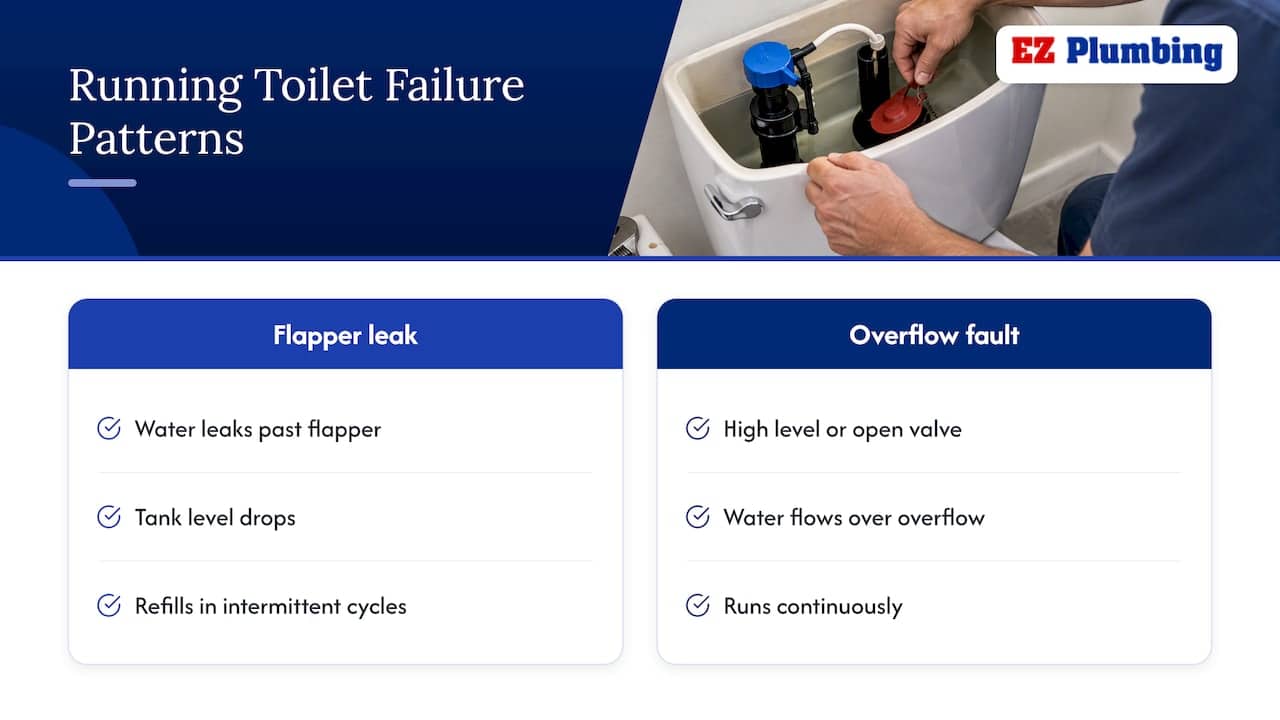
A toilet tank has two jobs: hold enough water for a flush, and stop filling when that water reaches the right level. Two assemblies handle this. The flush valve, which includes the flapper, holds water in the tank until you press the handle. The fill valve, with its float, lets water in after a flush and shuts off at a set level.
When either one fails, the toilet runs. The two failures look different, and telling them apart is the whole diagnosis.
In the first, water leaks past the flapper into the bowl. The tank level drops slowly, the fill valve opens to replace what was lost, and you hear the toilet run. Once the tank is full again, it goes quiet until the level drops enough to trigger another refill. That is why Kohler’s troubleshooting guidance explains intermittent running as a slow tank leak that periodically wakes the fill valve.
In the second, the water level is simply too high, or the fill valve does not close. Water keeps flowing over the top of the overflow tube and down into the bowl. This version runs continuously rather than in cycles.
Check the water level first
Take the lid off the tank and set it somewhere it cannot fall. Flush once and watch the tank refill.
Look at where the water stops. Portland’s water bureau guidance puts the normal level about half an inch to an inch below the top of the overflow tube, and says to follow the manufacturer’s marked fill line when the tank has one. If water is rising into the overflow tube, the level is too high.
That points you to the fill valve or float. Most fill valves have an adjustment screw or a sliding clip on the float. Lowering the float a little usually brings the level down below the overflow. If the water still will not stop at any setting, the valve itself is worn or fouled and needs cleaning or replacement.
Check one more detail while you are there. The small refill tube from the fill valve should be clipped above the overflow tube, not pushed down inside it. A tube inserted deep into the overflow can siphon water out of the tank and keep the fill valve working constantly.
If the level is normal, test the flapper
When the water stops below the overflow tube but you still hear running, the flapper is the likely cause. EPA WaterSense notes that an old or faulty rubber flapper is often the cause, because rubber deteriorates and mineral deposits get in the way of the seal. EPA suggests checking it periodically and replacing it at least every five years.
The dye test
The dye test removes the guesswork, and it works for a toilet that only runs now and then.
- Let the tank fill completely and do not flush.
- Add a few drops of food coloring to the tank water, or use a dye tablet.
- Wait at least 10 minutes. LADWP advises 10 to 15 minutes; Portland suggests at least 15 if you want to be thorough.
- Look at the bowl without flushing. Any color in the bowl means water is escaping past the flapper or flush valve seal.
- Flush afterward so the dye does not stain the tank.
LADWP lists free toilet leak detection dye tablets for its customers and a water conservation line at 1-800-544-4498, press 5. Program availability can change, so confirm before you count on it.
What to do when the dye shows up
Turn off the water at the wall shutoff valve behind the toilet, flush to empty the tank, and look at the flapper and the valve seat it sits on. Run a fingertip over the seat. Grit, mineral crust or a rough edge will stop the flapper from sealing, and a gentle cleaning is sometimes enough.
If the rubber is soft, warped, slimy or cracked, replace it. Take the old flapper to the hardware store and match it, because flapper sizes and styles differ by toilet model. Also check the chain. It should have a little slack when the flapper is closed. A chain that is too tight holds the flapper slightly open, and a chain that is too long can slip under the flapper and block it.
Restore the water and run several test flushes. Then repeat the dye test the next day, since a seal that looks fine can still weep.
Slow refill, ghost flushing and other variations
People describe a failing toilet in different ways, and the symptom usually narrows the cause.
The toilet runs on and off by itself. This is the classic slow flapper leak, often called a ghost flush or phantom flush. The tank loses a little water into the bowl, then the fill valve briefly opens. Do the dye test, since the toilet can sound normal right after a flush and still be leaking.
The tank fills slowly. Slow refill is a supply problem more often than a leak. Start with the shutoff valve at the wall: if it has been bumped or is only partly open, the tank refills slowly. Next, the fill valve may be partly blocked by sediment, which is common after nearby water work or after a shutoff valve has been closed and reopened. Remove the cap, flush the valve with a cup held over it as you briefly open the supply, and see whether the flow improves. If a corroded or old shutoff valve will not open fully, that is a job for a plumber, not for force.
The toilet refills on its own right after flushing, then keeps cycling. Check the refill tube position and the float setting again. If the level is correct and dye test is clean, the fill valve may be failing and should be replaced.
Water trickles into the bowl constantly. The usual mechanism is tank water escaping through a worn, dirty, misaligned or incorrectly chained flapper or flush valve seal. Water pouring into the overflow tube instead means the level is too high or the fill valve is not shutting off.
| What you see | Most likely cause | First fix |
|---|---|---|
| Water flowing into the overflow tube | Level too high or fill valve not closing | Lower the float, clean or replace the fill valve |
| Level normal, dye in bowl | Worn flapper or dirty seat | Clean the seat, replace the flapper |
| Runs briefly every few minutes | Slow flapper leak | Dye test, then flapper |
| Constant hiss, level below overflow | Refill tube or fill valve fault | Re-clip refill tube, service valve |
| Slow refill after flush | Partly closed shutoff or clogged fill valve | Open the valve fully, flush debris from the fill valve |
What a running toilet costs you
Ignoring it is the expensive option. You keep paying for water that goes straight down the drain, and a concealed leak can run even when you cannot hear it. EPA states that the average household’s leaks can waste more than 9,300 gallons per year in the home and that fixing easily corrected leaks can save about 10 percent on water bills. LADWP warns that running toilets and leaky faucets can waste up to 10,000 gallons a year per household.
Those are educational estimates, not measurements of your toilet. Even so, they show why a few dollars of rubber is worth replacing quickly. Listening alone is not a reliable inspection either, because some leaks are silent. That is why the dye test matters.
A toilet that leaks externally is a different problem, and a more costly one. Water at the base can damage flooring, subflooring and baseboards, and in a condo or apartment it can reach the ceiling below.
Check the toilet, then check the property
If you pay a LADWP bill, there is a second check worth doing once the toilet is fixed. Shut off every fixture, then watch the leak indicator on the water meter. LADWP says movement on the indicator means water is being used somewhere on the property, and that tells you whether you fixed the whole problem or only one source. The agency’s leak detection guidance lays out both the dye test and the meter check.
The two-step approach is especially useful in multi-unit buildings and small businesses. The dye test isolates one fixture. The meter check shows whether something else, such as a second toilet or a supply line, is also losing water. If the meter keeps moving after every toilet tests clean, a hidden leak is likely, and our leak detection service exists for exactly that situation.
When to stop and call a licensed plumber
Most running toilets are tank problems, not sewer problems, and most are within reach of a careful homeowner. Some situations are not.
Call a plumber when:
- The wall shutoff valve will not close, is corroded, or drips when you turn it. Do not force it. A valve that breaks in your hand turns a small repair into a flood.
- You see water around the base of the toilet, staining on the floor, or damage on the ceiling below.
- The bowl rocks or the base feels loose.
- You smell sewage, or the toilet backs up as well as runs.
- The porcelain is cracked.
- You have replaced the flapper and fill valve correctly and the toilet still runs.
In older Los Angeles homes, shutoff valves and supply lines are often decades old. A valve that has not been turned in years is the most common reason a ten-minute job becomes a service call. In that case, the fix is replacing the valve, then the flapper.
Our toilet repair service in Los Angeles covers running, leaking and clogged toilets. If a leak has already reached the floor or the wall, our leak repair team can trace and fix it. For after-hours flooding, we run 24/7 emergency plumbing with local dispatch.
Repair or replace the toilet
A new flapper or fill valve is the right answer far more often than a new toilet. Replacement starts to make sense when:
- Leaks return after you have replaced the right parts correctly.
- The tank or bowl is cracked, or the toilet is unstable.
- Parts are obsolete and you cannot find a match.
- Repeated service is adding up to more than a current high-efficiency fixture.
In Los Angeles, the rebate can change that math. The current LADWP residential rebate page lists up to $250 per qualifying toilet per household, for upgrading from 1.6 gallons per flush or more to 1.1 or less. The commercial program lists $300 for qualifying toilets, with its own product and eligibility rules.
The details matter. Check the qualifying model list before you buy, keep your recent bill and an itemized receipt, and confirm whether your property counts as residential, multifamily or commercial. Rules and funding can change, so do not promise yourself a rebate until the application is approved. We summarize the steps in our guide to Los Angeles toilet rebates.
For property managers and small businesses
A single running toilet in a rental or a restaurant is easy to ignore, because the person who pays the water bill is rarely the person who hears it. Three habits keep this from becoming a pattern.
Test vacant and rarely used bathrooms as well as occupied ones, since silent leaks continue unnoticed. Keep a record for each toilet with the dye test result, the parts replaced and the final flush test. And compare the meter at the property level after repairs, so you know the building as a whole is tight.
If you manage several buildings, consistent records also show which fixtures keep failing and are candidates for replacement. Our commercial plumbing team offers maintenance contracts for property managers, HOAs and commercial clients.
Our perspective: why a cheap repair still deserves a careful look
We have been a family-owned Los Angeles plumbing company since 1989, and running toilets are among the calls we see most often. The flapper is usually the answer, and we are glad when it is, because that means a short visit and a small bill.
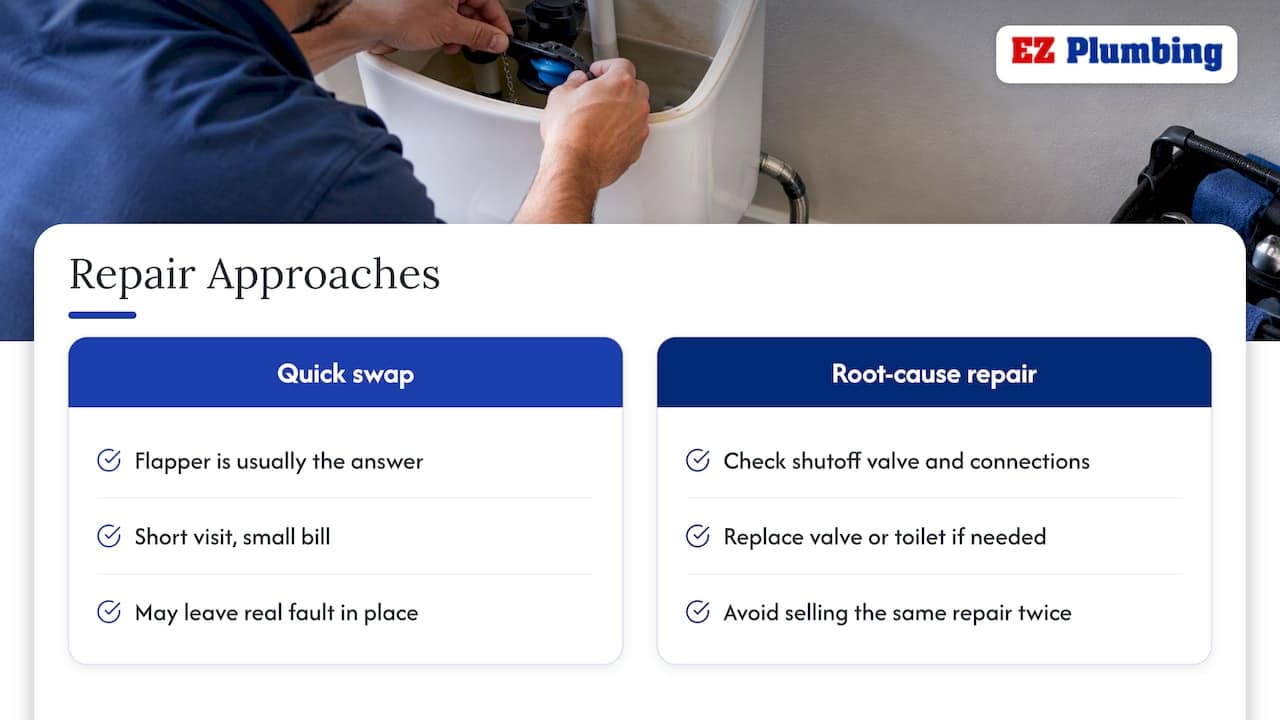
What we watch for is what sits behind the flapper. In an older LA house, a running toilet often leads us to a seized shutoff valve, mineral-crusted supply connections or a fixture that has been patched repeatedly. In those cases, a quick part swap treats the symptom while the real fault stays put. We would rather tell you honestly that the toilet is worth replacing, or that the valve needs to go first, than sell you the same repair twice.
We are licensed (C-36 License #583868) and insured, we document our jobs for code compliance, and you speak with real local staff, not a remote call center. We also give written pricing up front, so you know the cost before work begins. If you can fix it yourself with a flapper and twenty minutes, do it. If the valve will not budge or the floor is wet, call us.
— EZ
What a plumber visit looks like
For a running toilet, we diagnose before we replace anything. We confirm the water level and fill valve operation, run a dye test, and inspect the flapper, seat, chain and refill tube. We test the shutoff valve and supply line, because those decide whether the repair is simple.
Our published residential rate is $150-280 per hour, and our commercial rate is $120-240 per hour. You can estimate your own job with the rate calculator. If you want to see the common repairs laid out first, our toilet repair walkthrough shows what each fix involves. We also serve neighborhoods across the city, including Reseda and Los Feliz. To book a visit, start at our residential plumbing page.
Keeping it from coming back
A few habits make the next running toilet less likely.
- Replace the flapper at least every five years, as EPA recommends, or sooner if the rubber feels soft or slimy.
- Skip drop-in tank cleaning tablets. They sit in the tank and can speed up wear on rubber parts.
- Do the dye test once a year. It takes a few minutes and catches silent leaks.
- Operate your shutoff valves once or twice a year, gently, so they do not seize. If one resists, leave it and call a plumber.
- Handle the flush lever lightly, and do not hold it down. A handle that sticks can keep the flapper open.
Frequently asked questions
How do you fix a toilet that keeps running?
Remove the tank lid and flush while watching. If water rises into the overflow tube, lower the float or service the fill valve. If the level is normal but water trickles into the bowl, shut off the supply, empty the tank, clean the flapper seat and replace the flapper if it does not seal. Check the chain slack and the refill tube position, then run several test flushes.
What is the most common cause of a constantly running toilet?
An old or faulty rubber flapper. EPA WaterSense says rubber deteriorates and mineral deposits interfere with the seal, so the tank slowly leaks into the bowl. The fill valve then turns on to replace the water, and the toilet seems to run by itself.
What happens if I ignore a running toilet?
You keep paying for water that goes down the drain. EPA says the average household’s leaks can waste more than 9,300 gallons a year, and a running toilet can waste 200 gallons or more per day. A toilet that leaks externally can also damage flooring and ceilings below.
Why does my toilet tank fill slowly?
Check that the wall shutoff valve is fully open, then look at the fill valve for sediment or a worn seal. A corroded shutoff valve that will not open fully, or one that leaks when moved, should be handled by a licensed plumber rather than forced.
Is a running toilet worth replacing?
Sometimes. If leaks return after correct repairs, the toilet is cracked or unstable, or parts are obsolete, replacement may cost less over time. LADWP customers may also qualify for a rebate on a qualifying high-efficiency model, so check eligibility before buying.
Sources
- Fix a Leak Week, US EPA WaterSense
- How to find and fix a toilet leak, Portland.gov
- Toilet Occasionally Leaking or Running, Kohler Assist
- How to Detect a Water Leak, LADWP
- Residential SoCal Water $mart Water Rebate Program, LADWP
- Commercial SoCal Water $mart Water Rebate Program, LADWP