
8 Signs You Need a New Water Heater
That morning shower that suddenly turns cold. The mysterious puddle in the garage. These aren't just minor inconveniences. They're early warnings that your water heater may be close to failing.
A failed water heater doesn't just leave you without hot water. It can soak drywall, damage flooring, disrupt tenants, and force you into an expensive emergency replacement at the worst possible time. In Los Angeles, I see the same pattern over and over. Hard water loads tanks with sediment faster, coastal air speeds corrosion in some neighborhoods, and high utility costs punish homeowners who keep limping along with an inefficient unit.
The good news is that most water heaters give you several signs before they quit completely. The key is knowing which issues are repairable, which ones mean replacement is the smarter move, and which ones demand immediate action. A loose connection is one thing. A leaking tank is another.
This guide breaks down the most important signs you need a new water heater, with practical advice for Los Angeles homeowners, landlords, HOAs, and property managers. Each sign includes the actual risk level, what to check yourself, and when it's time to bring in EZ Plumbing for same-day service or 24/7 emergency help.
Table of Contents
- 1. Age of Water Heater (8-12+ Years Old)
- 2. Rusty Water or Discoloration
- 3. Leaks or Pooling Water Around the Tank
- 4. Strange Noises (Popping, Banging, Rumbling Sounds)
- 5. Inconsistent Water Temperature or Inadequate Hot Water Supply
- 6. Rising Energy Bills Without Increased Usage
- 7. Visible Corrosion, Rust, or Deterioration on Tank Exterior
- 8. Warranty Expiration or Outdated Technology
- 8-Point Comparison: Signs You Need a New Water Heater
- Don't Wait for a Flood Schedule Your Water Heater Inspection
1. Age of Water Heater (8-12+ Years Old)
Age is the first thing I check. Most traditional tank-style water heaters have a service life of 10 to 15 years, and ENERGY STAR® recommends replacement once the unit is over 10 years old, according to water heater lifespan guidance. If you're in Los Angeles and your tank is in that range, it deserves a serious evaluation even if it still makes hot water.
Risk level: inconvenience moving toward emergency.
Aging tanks don't fail on a clean schedule. They lose efficiency, build sediment, corrode from the inside, and then one day the leak shows up. For homeowners, that often means no warning beyond a little less hot water and a little more noise. For property managers, older tanks create a scheduling problem because one failure can disrupt multiple residents fast.
Why age matters more in Los Angeles
Hard water is rough on storage tanks. Mineral-heavy water leaves sediment behind, and that sediment settles at the bottom where heat is applied every day. In older homes across Pasadena, Glendale, and the Valley, I often find tanks that are still operating but are already past the point where repairing them makes practical sense.
If your home was built or remodeled years ago and the heater hasn't been changed since then, check the manufacturer label. If you're not sure how old it is, start with this guide on how long a water heater lasts.
- Check the label: Look for the manufacture date or serial information on the tank jacket.
- Check your records: Permit paperwork, home inspection reports, and service invoices often reveal installation timing.
- Plan before failure: Replacing on your schedule is almost always easier than replacing after a leak starts.
Practical rule: Once a tank water heater is past the point where age alone puts it in the risk zone, every new symptom matters more.
A Los Angeles homeowner with an older garage unit may still have hot water today. That doesn't mean the tank is healthy. It may just mean the failure hasn't shown itself yet.
2. Rusty Water or Discoloration
You turn on the shower before work, and the hot water comes out yellow-brown for a few seconds. In Los Angeles homes, that is a warning I take seriously because hard water speeds up wear inside tank-style heaters, and coastal air can shorten the life of metal components around the unit. If the discoloration shows up on the hot side only, the water heater is one of the first places to investigate.
Risk level: urgent.
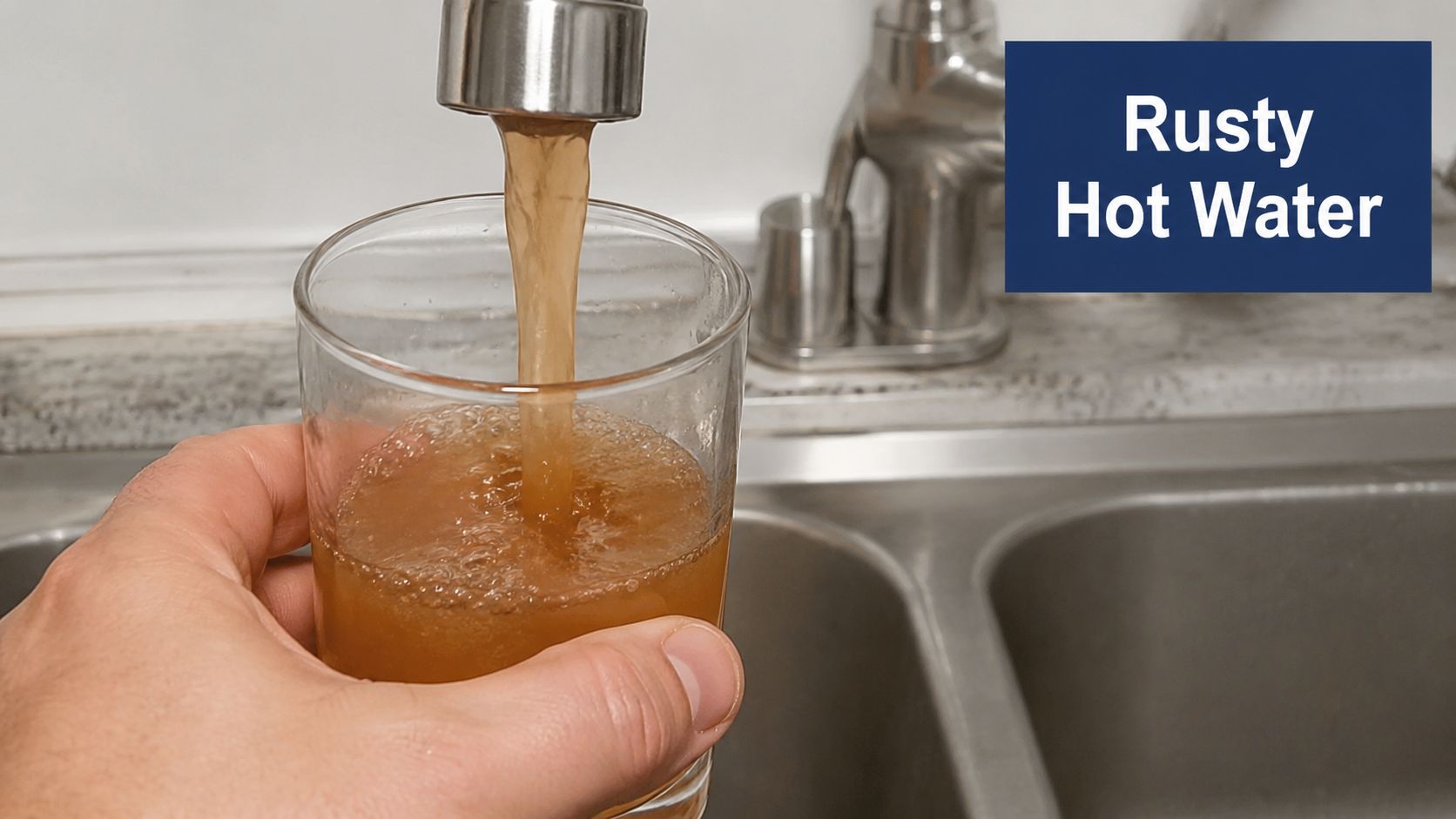
Rust-colored hot water usually points to corrosion inside the tank, a depleted anode rod, or heavy sediment mixing into the water supply. The U.S. Environmental Protection Agency explains that corrosion in plumbing systems can cause reddish or brown water discoloration in its guidance on corrosion control and water quality. With an older heater, that discoloration often means the protective parts inside the tank are no longer doing their job.
A quick test helps narrow it down. Fill one clear glass with cold water and another with hot water from the same faucet. If the cold water stays clear and the hot water looks rusty, cloudy, or orange, focus your attention on the heater, not the whole house. If both sides are discolored, the issue may be in the supply piping or municipal side and needs a different diagnosis.
Here are the patterns that matter most:
- Brief rusty water first thing in the morning: Sediment or corrosion particles have been sitting in the tank or hot line overnight.
- Discoloration only from hot taps: The heater is the likely source.
- Stains in tubs, sinks, or on white laundry: The problem has moved beyond appearance and is starting to damage fixtures and fabrics.
- Water clears, then turns rusty again days later: Flushing may be giving temporary relief, but the tank is still breaking down.
The trade-off is simple. An anode rod replacement or a flush can still make sense if the tank is otherwise sound and the rust is caught early. Once discoloration keeps returning, especially in an older unit, spending money on repeated service calls often delays the replacement you were going to need anyway. Homeowners dealing with recurring sediment, rust, or other common water heater problems that point to internal wear should treat this as a short timeline issue, not a cosmetic one.
Ignoring rusty hot water can lead to more than inconvenience. Corrosion inside the tank keeps progressing until it becomes a leak risk, and in garages, closets, and utility spaces across LA, that can mean water damage, drywall repairs, flooring loss, and cleanup costs that extend into property restoration services. High local utility rates add another penalty because sediment and corrosion force the heater to work harder for the same hot water output.
If rusty water is showing up consistently, EZ Plumbing can inspect the heater the same day and tell you whether the fix is a targeted repair or a 24/7 replacement call. That answer is worth getting before the tank makes the decision for you.
3. Leaks or Pooling Water Around the Tank
A water heater leak is the sign Los Angeles homeowners can least afford to wait on. If you walk into the garage or open a utility closet and find water around the base, treat it as an emergency until you know exactly where it is coming from.
Risk level: emergency.
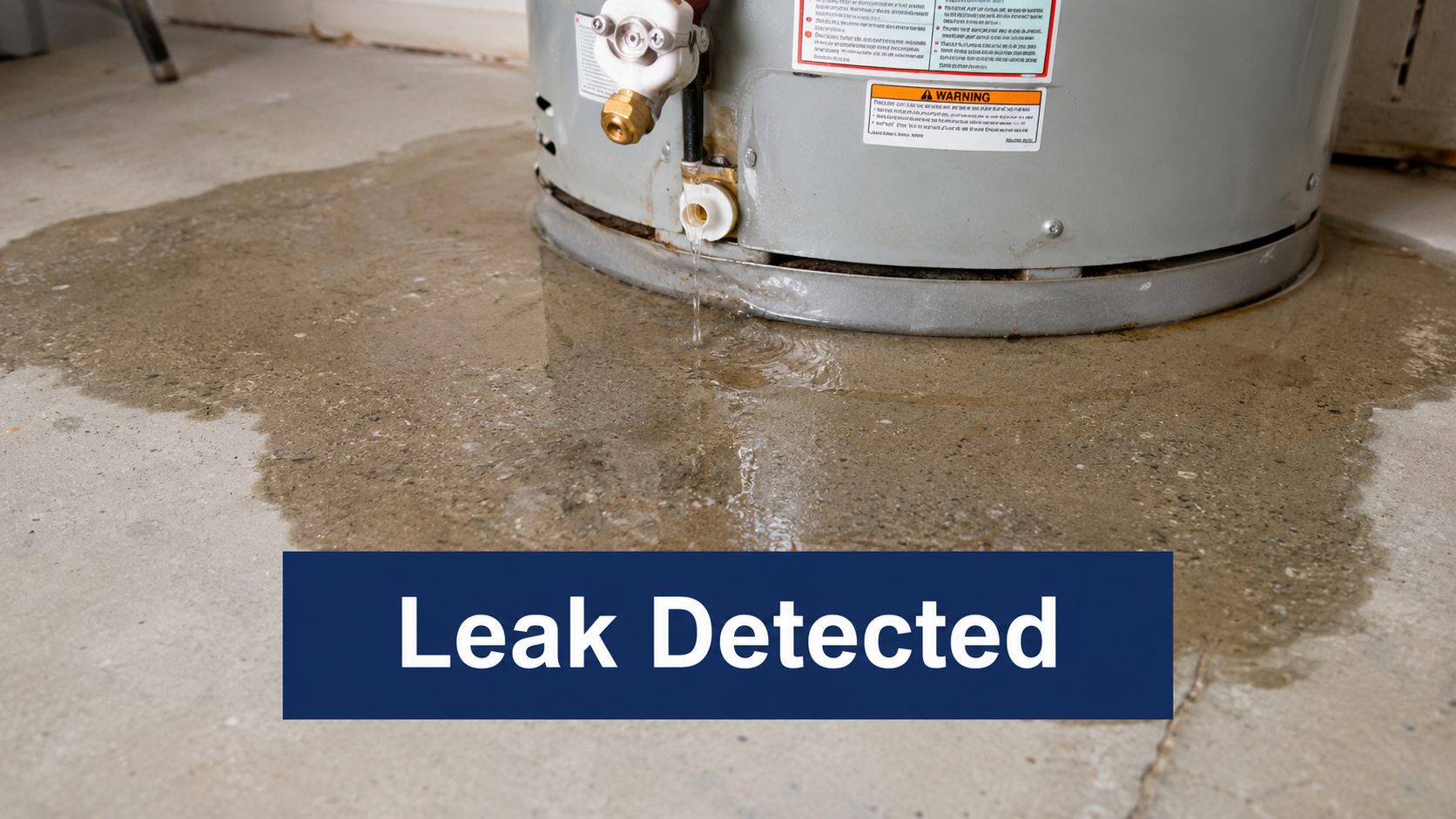
The first job is to identify whether the leak is coming from a repairable part or from the tank itself. A loose supply connection, a flex line, the drain valve, or the temperature and pressure relief valve can often be repaired. Water seeping from the bottom seam or through the tank jacket usually means the steel tank has failed, and replacement is the practical answer.
That distinction matters.
In older LA homes, I often see homeowners mistake condensation or a slow valve drip for a tank leak, then miss the moment the actual failure starts. Coastal air can speed up corrosion on exposed fittings. Hard water can shorten the life of valves and connections. Once the tank body is leaking, patching it does not restore the metal or make the unit safe.
The consequences get expensive fast. In a garage, the water may soak stored items and wall framing. In a hallway closet or condo utility space, it can damage flooring, baseboards, drywall, and ceilings below. After the plumbing repair, some owners also need property restoration services to handle drying and material replacement.
If you are checking the unit yourself, look for these patterns:
- Water at a fitting or shutoff above the tank: Often repairable if caught early.
- Dripping from the relief valve discharge pipe: Pressure or overheating may be part of the problem, and the heater needs prompt service.
- Rust-stained moisture at the tank bottom or lower seam: High chance the tank is done.
- A puddle that returns after you dry the area: Active leaking, not old spillover.
If it is safe, shut off power or gas to the heater, then shut off the cold-water supply. Take photos for insurance or property management. After that, call for service right away. Waiting a day or two can turn a plumbing repair into a cleanup and reconstruction job, especially with LA's high housing and labor costs.
If you want a clearer sense of which water heater problems point to repair versus replacement, that overview helps homeowners sort out what they are seeing before the technician arrives.
A short visual explanation can help if you're not sure what you're seeing:
For active leaking or pooling, don't wait for it to "dry out and see what happens." EZ Plumbing offers same-day service and 24/7 emergency response, which is what this problem calls for.
4. Strange Noises (Popping, Banging, Rumbling Sounds)
A water heater that starts sounding like a kettle, a drum, or loose rocks in a metal tank is usually dealing with sediment buildup. In Los Angeles, that problem shows up often because hard water leaves mineral deposits behind with every heating cycle. As the layer thickens at the bottom of the tank, the burner or heating element has to push heat through that buildup first, which increases run time, fuel use, and wear on the tank itself. The U.S. Department of Energy explains that sediment buildup in storage water heaters can reduce efficiency and shorten equipment life, especially in areas with mineral-heavy water.
Risk level: moderate at first, high if the unit is older or the noise is getting worse.
The sound matters because it points to what is happening inside the tank. Popping usually means small pockets of water are trapped under sediment and flashing into steam during heat-up. Rumbling often means the mineral layer is thicker and shifting as the tank cycles. Banging can mean expansion stress, loose internal scale, or a unit that has been running too hot for too long.
Here is the quick homeowner check I recommend:
- Noise only during active heating: Sediment is a likely cause.
- Noise getting louder month by month: Buildup is increasing, and efficiency is dropping.
- Noise plus longer recovery time: The heater is working harder to deliver the same hot water.
- Noise plus high utility bills: A common LA pattern, especially with older gas tanks and rising energy costs.
- Noise plus age over 8 to 12 years: Replacement deserves serious consideration, not just another flush.
A professional flush can help when the problem is caught early. It is less effective on an older heater that has been noisy for a long time, because hardened scale often sticks to the tank bottom and the damage has already started. I have seen plenty of tanks quiet down briefly after service, then return to the same symptoms because the sediment layer was only part of the problem.
Coastal conditions can make the situation worse. In neighborhoods closer to the ocean, salt air speeds up corrosion on exposed components, and a tank already overheating from sediment stress has less margin for error.
Record the sound on your phone before service if you can do it safely. A short clip helps us tell the difference between sediment noise, pressure issues, and a failing burner or element.
Do not ignore this sign just because you still have hot water. The true cost is usually hidden at first. Higher gas or electric bills, slower recovery, and faster tank wear come before the shutdown or leak. If the unit is newer, same-day service may solve it with a flush and inspection. If it is older, loud, and losing performance, replacement is often the smarter call. EZ Plumbing offers same-day appointments and 24/7 service when the noise points to a heater that may not last much longer.
5. Inconsistent Water Temperature or Inadequate Hot Water Supply
If showers keep turning lukewarm early, the heater is telling you something. Running out of hot water more often, getting temperature swings, or waiting longer for recovery can mean the unit is failing, especially once age and sediment are part of the picture.
Risk level: inconvenience, with potential system failure behind it.
This symptom isn't always a tank replacement situation on day one. A thermostat issue, heating element problem, burner issue, or sediment buildup can all reduce performance. But in older tanks, these symptoms often show up together, and that's when repair starts becoming less attractive.
A quick homeowner check before you assume replacement
Start with the simple stuff. Make sure the thermostat setting is where it should be, and note whether the problem is gradual or sudden. A gradual decline usually points to aging or buildup. A sudden change can point to a component failure.
Here are the patterns that matter most:
- Hot water runs out faster than it used to: Storage capacity may be reduced by sediment occupying space inside the tank.
- Temperature swings during one shower: Heating controls may be unstable, or the heater can't keep up.
- Multiple fixtures expose the problem quickly: The unit may be undersized for current demand, or it may be worn out.
A Pasadena family may notice they can no longer run two showers and a laundry cycle the way they used to. A landlord may only hear "there's not enough hot water" from tenants. Both are signs worth checking promptly, especially if the unit is older.
If the problem is accompanied by noise, rust, or visible wear, replacement moves higher on the list. If it's a younger unit with no other symptoms, diagnosis comes first. A good plumber won't sell a new tank when a clear component repair will solve the issue.
6. Rising Energy Bills Without Increased Usage
Sometimes the water heater doesn't leak, bang, or rust right away. It just gets expensive. That's one of the easiest signs to miss because utility bills drift upward gradually.
Risk level: financial drain now, replacement pressure later.
Expert benchmark data notes that sediment hardening at the bottom of the tank can increase energy consumption by 15 to 20 percent annually, and it also shortens heating element life, according to this industry analysis on aging tank performance. In Los Angeles, where energy costs are already high, homeowners feel that inefficiency faster.

Why older tanks get expensive quietly
An aging water heater can still provide enough hot water to avoid complaints while subtly using more gas or electricity to do the same job. Sediment traps heat where it shouldn't be trapped. Worn components extend heating cycles. Weak insulation allows standby losses to bite harder.
For homeowners tracking monthly costs, compare usage patterns, not just the raw bill. If your household habits haven't changed much but water heating costs seem harder to control, the tank should be part of the discussion. Some owners also review broader home-efficiency ideas from Solar Energy Management LLC insights, but if the water heater is old and inefficient, replacing the unit is often the more direct fix.
- Compare similar seasons: Winter and summer use can differ, so compare like with like.
- Look for a gradual trend: Slow increases often point to declining efficiency rather than one sudden failure.
- Pair bill review with a physical inspection: If bills are up and the tank is noisy, old, or corroded, the case for replacement gets much stronger.
A Santa Monica homeowner may assume rate increases are the whole story. Sometimes they are. But when one old tank starts running longer every day, the utility bill becomes one more sign you need a new water heater.
7. Visible Corrosion, Rust, or Deterioration on Tank Exterior
Exterior corrosion matters because it usually means the tank has been dealing with moisture, age, or chemistry problems for a long time. Rust near fittings, at the base, or around seams is never something I'd call cosmetic on a water heater.
Risk level: urgent.
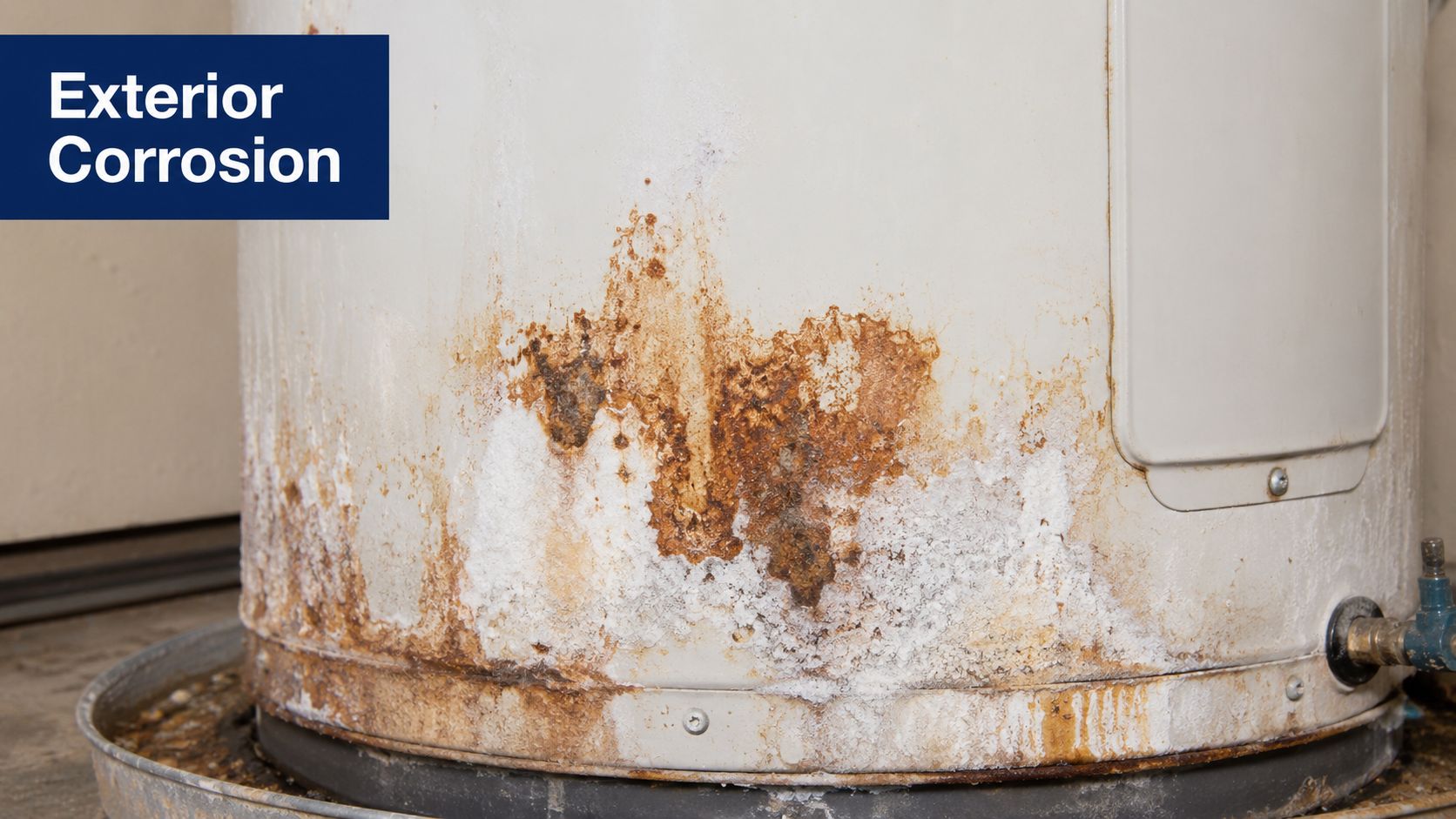
White mineral crust can also tell a story. It often means water has been escaping slowly, evaporating, and leaving deposits behind. Rust stains on the jacket or at the bottom edge can mean the outer shell is showing the damage that has already been developing inside.
What Los Angeles conditions do to exposed tanks
Los Angeles gives water heaters a few challenges at once. Hard water leaves scale. Coastal air can speed corrosion in beach-adjacent neighborhoods. Garage installations face dust, temperature swings, and sometimes moisture from irrigation or nearby laundry equipment.
I see this a lot in older properties where the heater sits untouched for years:
- Rust around the draft hood or upper fittings: Heat and minor moisture exposure may be wearing out the metal above the tank.
- Corrosion at the bottom rim: This raises concern for tank failure because that's where age and condensation often show up.
- Mineral buildup on nearby piping: Slow leaks may have been present longer than anyone realized.
Surface rust on a nearby fitting may be repairable. Rust that has spread across the tank body usually means the clock is running out.
A Burbank homeowner may spot a rusty patch and keep using the heater because there's no leak yet. That's exactly when planning helps most. Replacement before the tank opens up is cheaper, cleaner, and less disruptive than emergency replacement after water is already on the floor.
8. Warranty Expiration or Outdated Technology
Sometimes the strongest replacement signal isn't a dramatic symptom. It's timing. If the warranty has expired and the unit is showing age-related issues, that's often the point where repairs stop making financial sense.
Risk level: moderate, unless other warning signs are already present.
The broader cost question matters most for mid-life and older units. One source discussing this gap notes that in high-sediment areas, flushing and anode rod replacement may extend life by 2 to 3 years in some cases, while standard tank units typically fail after 10 to 15 years and tankless units can last about 20 years, based on U.S. Department of Energy lifespan figures summarized in this repair-versus-replace discussion. That trade-off is especially relevant in Los Angeles.
Replacement timing beats emergency timing
If your heater is old, out of warranty, and starting to show multiple symptoms, replacement usually gives you better control over scheduling, product selection, and installation quality. You're choosing the system. You're not taking whatever is available during a weekend emergency.
Property managers and HOA boards often do well by thinking in cycles instead of one-off reactions. A proactive replacement program avoids repeated service calls, surprise outages, and rushed decisions for aging equipment across multiple units.
Consider these options before the next breakdown:
- Traditional tank: Familiar, straightforward, and often the easiest replacement path.
- Tankless system: Attractive for longer lifespan and on-demand hot water where the property supports it.
- Hybrid or heat pump options: Worth reviewing when efficiency is a major priority.
Los Angeles homeowners also need to consider installation realities. Venting, gas line sizing, electrical capacity, and available space can make one upgrade path better than another. The right answer isn't always the newest technology. It's the system that fits the building, the demand, and the maintenance expectations.
8-Point Comparison: Signs You Need a New Water Heater
| Sign | Complexity 🔄 | Resources ⚡ | Expected Outcome 📊 | Ideal Use Cases 💡 | Key Advantage ⭐ |
|---|---|---|---|---|---|
| Age of Water Heater (8–12+ years) | Low, check manufacture date, simple assessment | Moderate, replacement cost $1.5k–$4k, scheduling/time | 📊 Improved efficiency (≈10–20%), lower failure risk | 💡 Planned replacement for units near end-of-life | ⭐ Predictable upgrade and longer warranties |
| Rusty Water or Discoloration | Low, visual test (glass) but urgent | High, likely immediate replacement + pipe flushing | 📊 Restores water quality, prevents fixture staining | 💡 Immediate action when hot water shows rust | ⭐ Clear, easy-to-diagnose indicator |
| Leaks or Pooling Water Around Tank | High, emergency response, shut-off required | Very high, same-day replacement, possible property repair | 📊 Prevents flooding and large-scale water damage | 💡 Urgent replacement to avoid catastrophic failure | ⭐ Stops immediate risk of major property damage |
| Strange Noises (popping, banging) | Moderate, diagnostic flushing may help | Low–Moderate, professional flushing or partial repair | 📊 Temporarily restores efficiency; signals impending failure | 💡 Schedule maintenance when noise starts (non-emergency) | ⭐ Early audible warning enables planned intervention |
| Inconsistent Temperature / Inadequate Supply | Moderate, needs professional diagnosis | Moderate, thermostat/element repair or capacity upgrade | 📊 Restores consistency if repaired; replacement boosts capacity | 💡 Homes with rising demand or sudden temp swings | ⭐ Helps right-size system or identify repair vs replace |
| Rising Energy Bills Without Usage Change | Moderate, requires monitoring and audit | Moderate, audit cost; replacement may be offset by rebates | 📊 Measurable bill reductions after efficient upgrade | 💡 When bills rise year-over-year without usage change | ⭐ Quantifiable financial justification for replacement |
| Visible Exterior Corrosion or Mineral Deposits | Low, visual inspection indicates severity | High, replacement soon; may need mechanical room fixes | 📊 Prevents internal failure and structural compromise | 💡 Coastal/humid sites or tanks with visible rust/crust | ⭐ Objective visual evidence for timely replacement |
| Warranty Expiration or Outdated Technology | Low, administrative check + evaluation | Variable, higher upfront for modern tech (tankless/heat-pump) | 📊 Better efficiency, features, and longer new warranties | 💡 At warranty end or when upgrading to modern systems | ⭐ Opportunity to adopt efficient tech and extended coverage |
Don't Wait for a Flood Schedule Your Water Heater Inspection
Most water heaters don't fail without warning. They leave clues. Age, rusty water, pooling around the base, rumbling sounds, weak hot water delivery, rising utility costs, and visible corrosion all point to a system that's either declining or already unsafe to trust.
For Los Angeles residents, those warnings deserve even more attention. Hard water speeds sediment buildup. High utility costs make inefficient heaters expensive to keep. Coastal and humid microclimates can push corrosion faster in some areas. What starts as a minor annoyance in a single-family home can become a property damage claim in a condo, rental, or multi-unit building.
The biggest mistake I see is delay. Homeowners wait because the heater still technically works. Property managers wait because the leak is small. Landlords wait because tenants still have some hot water. That delay often turns a controlled replacement into an emergency call with water on the floor.
Good plumbing advice isn't just about replacing equipment. It's about making the right call at the right time. A newer unit with one isolated issue may be worth repairing. An older tank showing multiple symptoms usually isn't. If the heater is leaking from the tank body, producing rusty hot water, or showing advanced corrosion, replacement is almost always the safer path.
EZ Plumbing helps homeowners, HOAs, landlords, and commercial properties across Los Angeles make that call with clear, practical recommendations. The goal is simple. Diagnose the problem accurately, protect the property, and give you a solution that fits the building and the budget. Whether you're in Santa Monica, Pasadena, Beverly Hills, Glendale, Burbank, West Hollywood, or the San Fernando Valley, fast response matters when hot water equipment starts to fail.
Call EZ Plumbing today at (818) 908-2710 or schedule online at EZ Plumbing for same-day service or a 24/7 emergency response. Protect your property and ensure your hot water is always reliable.
If you've noticed any of these signs you need a new water heater, EZ Plumbing can inspect the unit, explain whether repair or replacement makes more sense, and provide same-day or 24/7 emergency service across Los Angeles.