
What Water Mains Do: Functions, Failures, and Fixes
A water main is the large-diameter pressurized pipe buried beneath streets and public rights-of-way that carries treated potable water from treatment plants or storage reservoirs to fire hydrants and individual service lines. Understanding the role of water main infrastructure is the first step toward knowing what to do when something goes wrong on your street or your property.
The four core functions a water main delivers:
- Pressure maintenance: Keeps system pressure in the range needed for reliable flow at every tap and fixture.
- Fire suppression: Supplies the high-volume flow that hydrants need during a fire event.
- Public-health protection: Sustains positive pressure so outside contaminants cannot intrude into the potable supply.
- Commercial and industrial support: Provides the consistent supply that businesses, hospitals, and manufacturing facilities depend on daily.
One distinction matters immediately: the water main is the municipal pipe in the street, owned and maintained by your local utility. The service pipe is the smaller line that branches off the main and runs to your building. That boundary between public and private responsibility shapes everything from repair costs to who you call first.
Key Takeaways
Water mains are the pressurized backbone of every municipal water supply system, and knowing the boundary between utility responsibility and your own is the most practical thing a homeowner can take from this article.
| Point | Details |
|---|---|
| Water main definition | A large-diameter pressurized pipe carrying treated water from reservoirs to hydrants and service lines, typically starting at 6 inches in diameter. |
| Utility vs. homeowner split | Utilities own and maintain the main in the public right-of-way; homeowners are responsible for the service pipe from the curb stop or meter to the building. |
| Immediate homeowner actions | Shut off the interior valve, call the utility, document damage, limit water use, and call a licensed plumber for private-side leaks. |
| Infrastructure investment need | AWWA projects more than $1 trillion in U.S. buried drinking water infrastructure investment is needed over the next 25 years. |
| Ez-plumbing service | Ez-plumbing (C-36 #583868) provides leak detection, service-line repair, and 24/7 emergency plumbing across greater Los Angeles. |
Table of Contents
- What a water main actually is and how it fits in the system
- The four critical functions water mains serve in your community
- How mains connect to the rest of the water distribution system
- Who is responsible for the water main versus your service line
- How to spot signs of a failing main or service line
- What happens when a water main breaks
- How water mains are repaired and rehabilitated
- How utilities prevent breaks through proactive maintenance
- What you should do when you suspect a main or service-line problem
- A note from Ez-plumbing on why this matters locally
- Ez-plumbing is ready when your service line needs attention
- Sources
What a water main actually is and how it fits in the system
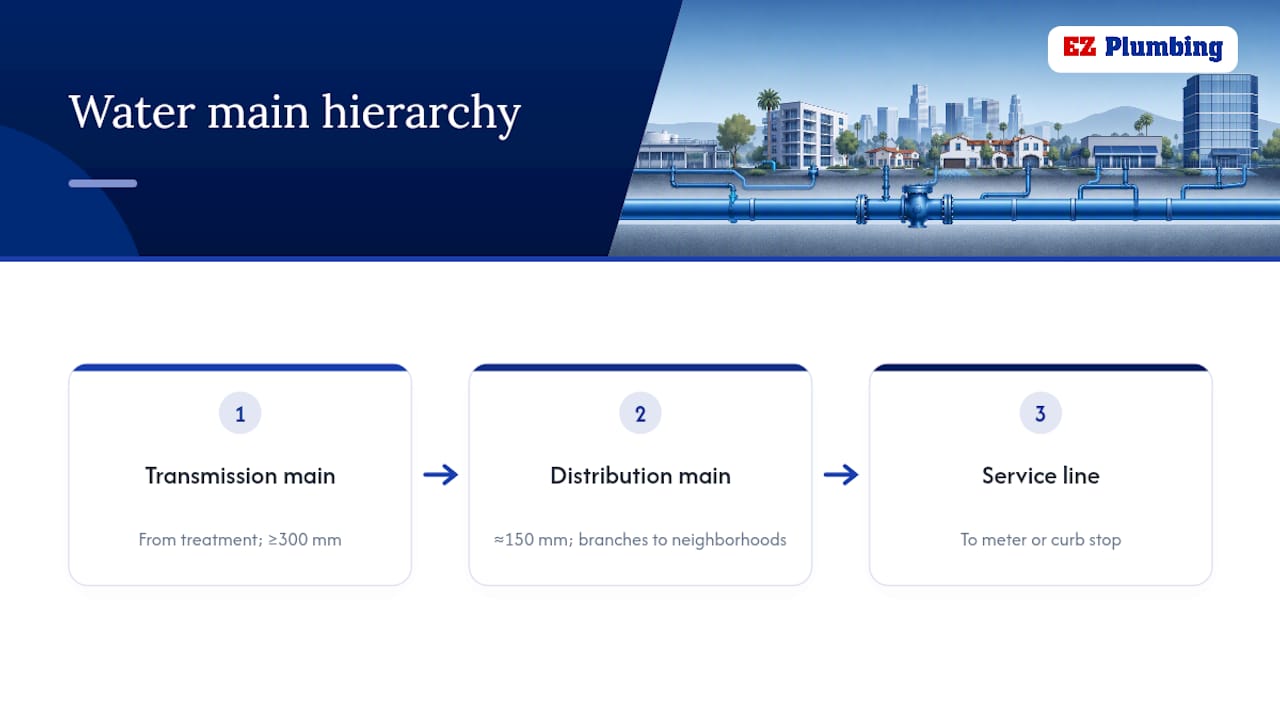
A water main is not a single pipe but a hierarchy of pipes, each sized for a specific job. Transmission mains, sometimes called trunk mains, carry large volumes over long distances from treatment facilities or reservoirs; diameters commonly exceed 300 mm (12 inches) and can reach 500–800 mm or larger on major corridors. Distribution mains branch off the transmission network and run through neighborhoods, typically starting at about 150 mm (6 inches) in diameter. Service lines are the smallest segment, connecting the distribution main to an individual meter or curb stop.
Unlined cast iron and unlined steel are the most problematic legacy materials. Both develop tuberculation, a buildup of iron oxide and mineral deposits on the pipe wall that narrows the effective bore, reduces flow capacity, and can shed particles that discolor water at the tap. Pipes installed 50 or more years ago are frequently operating beyond their original design life, which is why utilities that underfund renewal face steadily rising break rates.
The four critical functions water mains serve in your community
Water mains do more than move water from point A to point B. They must simultaneously maintain pressure, support firefighting, protect public health, and sustain economic activity, and each function places specific demands on pipe sizing and system operations.
-
Pressure maintenance. Distribution systems are typically designed to hold 40–50 psi during peak demand periods, with a maximum design pressure for service connections often capped near 80 psi to protect household fixtures and appliances. Pressure below the minimum means inadequate flow at upper floors; pressure above the maximum accelerates wear on meters and service lines.
-
Fire suppression flow. Fire hydrants draw directly from distribution mains, and the volume required for suppression during a structure fire can far exceed normal residential demand. That requirement drives pipe sizing decisions: a main that is adequate for domestic use may be undersized for simultaneous fire flow, which is why fire-flow testing is a standard part of distribution system planning.
-
Public-health protection. Positive pressure inside the main acts as a barrier. When pressure drops, the risk of backflow or intrusion from surrounding soil increases, which is why utilities issue boil-water notices after a significant break even before any contamination is confirmed.
-
Commercial and industrial support. Hospitals, food-processing plants, hotels, and manufacturing facilities require reliable, high-volume supply. A main that cannot sustain adequate pressure during peak hours creates operational and safety problems for those users.
Pressure callout: Distribution systems commonly target 40–50 psi during peak demand, with service connection pressures generally not exceeding 80 psi. Fire-flow events can temporarily draw pressure below normal service levels, which is why system design accounts for simultaneous demand scenarios.
How mains connect to the rest of the water distribution system
A water main does not operate in isolation. It is one component in a network that includes storage tanks and reservoirs, pumping stations, pressure zones, isolation valves, fire hydrants, and service lines, and the health of that whole network depends on how well each component interacts.
Storage tanks and elevated reservoirs provide the hydraulic head that drives gravity-fed pressure and act as buffers during peak demand or pump outages. Pumping stations boost pressure when elevation changes require it. Isolation valves divide the network into controllable segments so that a crew can shut down one block for repairs without cutting water to an entire neighborhood. Distribution mains should be looped wherever possible rather than run as dead-end branches, because looping allows flow to reach any point from two directions and reduces stagnation that can degrade water quality.
When a section of main needs emergency repair, crews close the nearest isolation valves on either side of the break, depressurize the segment, and sometimes install temporary bypass piping to maintain supply to critical users while the repair is completed. After the repair, the main must be disinfected following AWWA C651 or equivalent standards and tested by an accredited laboratory before it returns to service.
Pro Tip: Your local utility’s website often publishes a GIS map or service-area diagram showing valve locations and pressure zones. Knowing where the nearest isolation valve sits relative to your property helps you understand how a nearby break might affect your service and how quickly crews can restore pressure.
Who is responsible for the water main versus your service line
The ownership boundary between the utility and the property owner is one of the most misunderstood aspects of residential water service. Municipal utilities and water authorities generally own and maintain the water main in the public right-of-way, including the corporation stop where the service line taps the main. From the curb stop or meter forward, the property owner is typically responsible for the service pipe, including any repairs or replacements.
Practical implications of that split:
- Main break in the street: Call your utility’s emergency line. They dispatch crews, bear the repair cost, and issue any public notices.
- Leak between the curb stop and your foundation: Your responsibility. A licensed plumber handles diagnosis and repair; your homeowner’s insurance may cover some costs depending on your policy.
- Meter box damage: Responsibility varies by utility; some own the meter and box, others transfer responsibility to the homeowner at the meter inlet.
- Shared service lines in multifamily buildings: Each unit’s branch is typically the building owner’s responsibility once it leaves the common meter.
One action you can take right now: locate your interior shutoff valve and your curb stop, note your utility’s 24-hour emergency number, and photograph the area around your meter box so you have a baseline if damage occurs later.
How to spot signs of a failing main or service line
The most visible signs of a water main problem are sinkholes or depressions forming in the street, water bubbling up through pavement, muddy or discolored water at the tap, sudden drops in pressure across multiple homes, or repeated service interruptions in the same area. Those symptoms almost always point to a municipal main issue, and the right call is to your utility, not a plumber.
Signs that the problem is on the private service line look different. A persistently wet patch in your yard near the foundation, a spike in your water bill with no change in usage, or low pressure at only your property while neighbors are unaffected all suggest a service-line leak. You can learn more about warning signs of plumbing problems that distinguish private-side issues from street-side ones.
Common causes of main breaks include:
- Corrosion and tuberculation in aging cast iron or unlined steel pipe, which weakens the wall over time.
- Pressure transients and water hammer, which create sudden stress spikes that can crack brittle or corroded pipe. Frequent or loud water hammer is worth investigating before it causes a failure.
- Ground movement and soil loading, particularly in areas with expansive clay soils, seismic activity, or heavy traffic above the pipe.
- Poor bedding or backfill during original installation, which leaves the pipe without uniform support and concentrates stress at low points.
What happens when a water main breaks
A main break creates three categories of impact: service interruption, public-health risk, and economic disruption. Understanding all three explains why utilities treat main failures as emergencies rather than routine maintenance events.
- Service interruption: Homes and businesses lose pressure or supply entirely. Fire protection in the affected zone is compromised until the main is restored or alternative supply is arranged.
- Public-health risk: A pressure drop during a break can allow backflow or soil intrusion into the distribution system, prompting utilities to issue boil-water notices as a precaution until bacteriological testing confirms safety. Aging distribution infrastructure increases the frequency and severity of these events, and deteriorating mains raise the baseline risk of contamination.
- Economic disruption: Restaurants, laundries, medical offices, and other water-dependent businesses may have to close or curtail operations for the duration of the outage.
Scale of the problem: Surveys in the published literature show that U.S. utilities collectively experience a substantial number of main breaks each year, with national estimates indicating the maintenance burden is significant enough to require prioritized rehabilitation programs across most major systems.
How water mains are repaired and rehabilitated
Repair approaches fall into two pathways: emergency repair to stop an active break quickly, and planned rehabilitation or replacement to address structural or hydraulic decline before failure occurs.
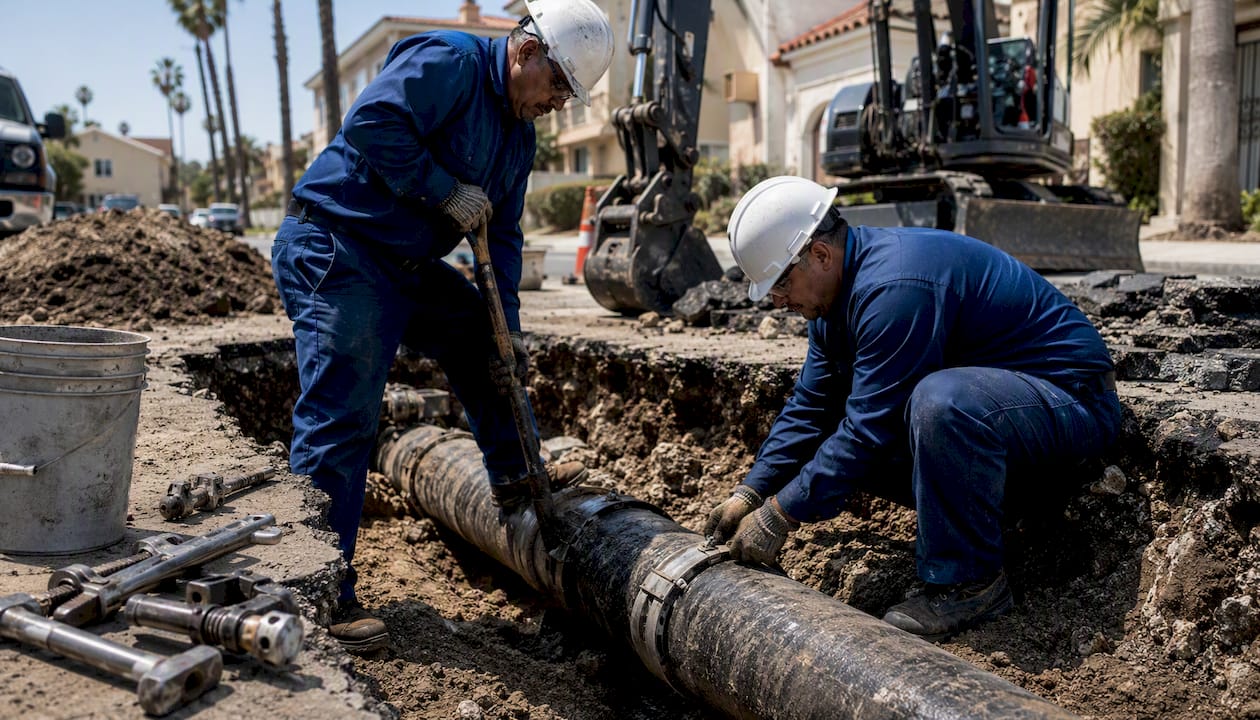
The emergency workflow follows a consistent sequence: isolate the segment by closing valves, depressurize, excavate if needed, make the physical repair (clamp, sleeve, or cut-and-replace), disinfect the repaired section per AWWA C651, collect bacteriological samples, and restore service only after lab results confirm safety.
Planned rehabilitation gives utilities more options, including trenchless methods that minimize surface disruption.
| Method | How It Works | Typical Use Case | Key Tradeoff |
|---|---|---|---|
| CIPP lining | Resin-saturated liner cured in place inside the existing pipe | Structurally sound host pipe with reduced hydraulic capacity or corrosion | Reduces internal diameter slightly; faster and less disruptive than open-cut |
| Pipe bursting | New pipe pulled through while the old pipe is fractured outward | Deteriorated pipe that needs full structural replacement | Can upsize the pipe; requires access pits at each end |
| Open-cut replacement | Trench excavated, old pipe removed, new pipe installed | Severely deteriorated mains or where trenchless access is not feasible | Highest disruption and cost; allows full inspection of surrounding soil |
AWWA guidance frames rehabilitation decisions around three goals: water-quality improvement, hydraulic improvement, and structural improvement. The best method depends on the cause of deterioration, site conditions, expected service life, and lifecycle cost, not simply on which technique is newest.
How utilities prevent breaks through proactive maintenance
Reactive repair is always more expensive than planned rehabilitation, and the gap widens when you factor in emergency labor, traffic control, property damage claims, and the public-health costs of boil-water events. Utilities that invest in proactive asset management consistently achieve lower break rates and longer pipe service lives.
Key preventive programs include acoustic leak detection surveys, which use ground microphones or correlating sensors to locate leaks before they become breaks; continuous pressure monitoring to catch transient events and identify zones operating outside design parameters; cathodic protection systems on metallic mains in corrosive soils; and systematic valve exercising to confirm isolation capability before it is needed in an emergency.
At the national level, AWWA projects that U.S. buried drinking water infrastructure needs more than $1 trillion in investment over the next 25 years. That figure reflects the backlog of pipes operating past their design life and explains why utilities are shifting from break-and-fix cycles toward data-driven renewal schedules that prioritize the highest-risk segments first.
What you should do when you suspect a main or service-line problem
When something goes wrong with your water supply, the sequence of actions you take in the first hour matters for both safety and documentation.
- Shut off your interior main valve if you see active flooding or a sudden pressure loss inside the building. Step-by-step instructions for shutting off your main water supply walk you through the process if you have not done it before.
- Call your utility’s emergency line and describe what you observe: location, symptoms, and when it started. If the problem is in the street or affects multiple neighbors, the utility takes it from there.
- Document everything. Photograph wet areas, pressure gauge readings, meter readings, and any visible damage before cleanup begins. This record supports insurance claims and helps a plumber diagnose the issue faster.
- Limit water use until the cause is identified. Running fixtures during a service-line leak accelerates damage and can introduce contaminants if pressure has dropped.
- Call a licensed plumber if the problem is on your side of the meter. Ask for a camera inspection or professional leak detection before any excavation begins, since locating the leak precisely reduces the scope of the repair.
- Verify credentials before you hire. In California, water-line and plumbing work requires a C-36 plumbing contractor license. Ask for the license number, proof of insurance, and a written estimate before work starts. For California properties, a water damage prevention checklist can help you document conditions and prepare for the repair process.
- Follow boil-water notices. If your utility issues one after a nearby main break, use bottled or boiled water for drinking and cooking until the all-clear is confirmed in writing.
A note from Ez-plumbing on why this matters locally
The water distribution system beneath Los Angeles is a mix of ages and materials, and the private service lines connecting those mains to homes and businesses reflect decades of varied installation practices. When a main break happens on your street, the utility handles the public side. But the service pipe from your meter to your foundation is yours, and a slow leak there can go unnoticed for months while it erodes your foundation, drives up your water bill, and creates conditions that invite mold.
Ez-plumbing holds a C-36 license (#583868) and responds to service-line emergencies across the greater Los Angeles area. When you call us, you get a licensed technician who understands LA’s specific soil conditions, aging galvanized and copper service lines, and the municipal requirements that govern repair and restoration. We do not guess at the source of a leak. We locate it with camera inspection and electronic detection before recommending a repair, which keeps the scope of work honest and the cost predictable.
Ez-plumbing is ready when your service line needs attention
When a water main break affects your street, the utility restores the main. What they do not cover is the private service line from your meter to your home, and that is where Ez-plumbing steps in.
Ez-plumbing provides leak detection in Los Angeles and throughout the greater LA area, using camera inspection and electronic locating to pinpoint service-line leaks before any ground is broken. We handle emergency water-line diagnosis, service-line repair, and full repiping for residential and commercial properties, all under C-36 License #583868, fully insured and code-compliant with LA municipal requirements. Call us to schedule a diagnostic or request 24/7 emergency service, and get a written estimate before any work begins.
Sources
The following sources were used in preparing this article and are recommended for readers who want to verify claims or read deeper on specific topics.
- Water main — Britannica
- Water systems wildfire-fighting capacities and expectations — UCLA Luskin Innovation (2026)
- Customer responsibilities — Philadelphia Water Department
- Potential public health impacts of deteriorating distribution system infrastructure — PMC
- Water main rehabilitation — American Water Works Association (AWWA)
- Water mains — BC Small Water Systems Online Help Center
For location-specific rules, post-break notices, and service-area maps, consult your local water utility directly. Requirements for disinfection, testing, and public notification vary by jurisdiction and are updated periodically.