
60 to 90 Days: Grease Line Checklist for Restaurant Operators
Keep fats, oils, and grease out of the sewer by pairing daily wipe-downs and strainers with scheduled physical cleaning. Most commercial interceptors need pumping every 60 to 90 days, small under-sink traps need weekly attention, and any backup, odor, or city notice means it’s time to call a licensed plumber. As a licensed contractor working across Los Angeles kitchens, Ez-plumbing sees the same maintenance gaps cause the same expensive failures.
TL;DR:
- Regular in-house cleaning should include skimming and solids removal, with documentation and photographs to ensure compliance and proof of maintenance.
- Licensed plumbers are necessary for deep cleaning, hydro jetting, or camera inspections when recurring backups, odors, or inspection notices occur.
- Grease interceptors require pumping every 60 to 90 days, with weekly wipe-downs of small traps, to prevent backups, odors, and code violations.
- Additives like enzymes and hot-water flushing are prohibited, as they can push grease further into the line and violate local regulations.
- Proper disposal of yellow grease for resale and sealed removal of solids prevent costly failures and environmental hazards.
Table of Contents
- Why Restaurant Grease Line Cleaning Matters
- How Do You Clean a Grease Trap Safely In-House?
- When Should You Call a Licensed Plumber?
- How Often Should You Schedule Grease Line Maintenance?
- What Should a Licensed Contractor Provide?
- What Do Grease Trap Failures Look Like From the Field?
- Schedule Grease Trap Service With Ez-plumbing
- Where to Verify Grease Line Compliance Rules
- Sources
- FAQ
Why Restaurant Grease Line Cleaning Matters
A grease interceptor (also called a grease trap) is a plumbing fixture installed between kitchen drains and the sewer line. It slows wastewater down so fats, oils, and grease, known collectively as FOG, separate and float instead of traveling downstream and hardening inside pipes. Under-sink traps handle a single fixture; larger in-ground interceptors serve an entire kitchen and hold far more volume between services.
Not all grease is equal. Yellow grease is the used cooking oil from fryers and grills, and it’s valuable enough that recyclers pick it up for free in many markets. Brown grease is the mixed waste skimmed from the trap itself, food particles, sauces, and dishwater fat that has no resale value and requires proper disposal.
Neglect a grease line and the consequences show up fast:
- Slow drains and backups that shut down a kitchen mid-shift
- Municipal surcharges or fines when discharge exceeds local FOG limits
- Fire risk from grease buildup migrating into hoods and ducts
- Health code violations that can trigger a closure
The EPA identifies FOG from food service establishments as a leading cause of sanitary sewer overflows nationwide.
How Do You Clean a Grease Trap Safely In-House?
Staff can handle a lot of the routine work themselves, but there’s a hard line between what’s safe for a kitchen crew and what needs a licensed plumber. Prep matters as much as the cleaning itself.
Before you start:
Let the water cool completely. Never run hot dishwasher discharge into a trap you’re about to open, and always wear gloves, eye protection, and non-slip boots. Shut off the flow into the trap if there’s an isolation valve, and post a sign so nobody sends dishwater through mid-cleaning.
The cleaning sequence:
- Dry-wipe pans and prep surfaces before washing to keep grease out of the drain in the first place.
- Shut off inflow and remove the trap lid carefully. It’s heavier than it looks and often sealed with old grease.
- Skim floating FOG off the surface with a scoop or ladle into a dedicated yellow-grease container.
- Remove settled solids from the bottom using a shovel or trap-cleaning tool.
- Pull the baffles, scrape them clean, and inspect for cracks or corrosion before reinstalling.
- Reassemble the lid, restore water flow, and run a test cycle to confirm normal drainage.
You’ll need a scoop, a stiff brush, sealed grease storage containers, and heavy-duty trash bags for solids. Yellow grease goes into its own labeled container for a recycler pickup, never down a drain. Brown grease and solids go into sealed bags for regular disposal per your municipality’s waste rules.
Pro Tip: Photograph the trap before and after each cleaning. If an inspector or a hauler ever questions your maintenance history, dated photos back up your logs faster than any written note.
Skip enzyme packets, drain-cleaning chemicals, and hot-water flushing. Portland’s municipal guidance explicitly prohibits additives because they can push FOG through the interceptor instead of removing it, which just relocates your problem downstream and can violate city code. For a full walk-through of tools and technique, Ez-plumbing’s guide on how to clean grease traps in a commercial kitchen covers the process step by step.
When Should You Call a Licensed Plumber?
In-house cleaning handles surface maintenance. It doesn’t touch what’s happening deeper in your grease line, and that’s where a licensed plumber earns their invoice. Certain signs mean it’s time to stop scooping and start dialing:
- Recurring slow drains that come back within days of cleaning
- A backup anywhere in the kitchen, even a minor one
- Persistent sewer odor near floor drains or the trap access panel
- A city enforcement notice or failed inspection
- Visible grease in your discharge water after a routine trap cleaning
Professionals bring equipment and access that in-house crews don’t have. A pump-out removes accumulated FOG and solids from the interceptor in bulk. Wet vacuuming clears standing waste from tight spaces. Hydro jetting uses high-pressure water to break up hardened grease deposits further down the line, deposits that routine pumping never touches. Camera inspection lets a technician see exactly where a blockage sits before cutting into anything.
When you hire someone, ask for a written receipt, the volume of waste hauled, before-and-after photos, and a signed hauler manifest. Those documents are what an inspector wants to see if your restaurant ever gets flagged.
How Often Should You Schedule Grease Line Maintenance?
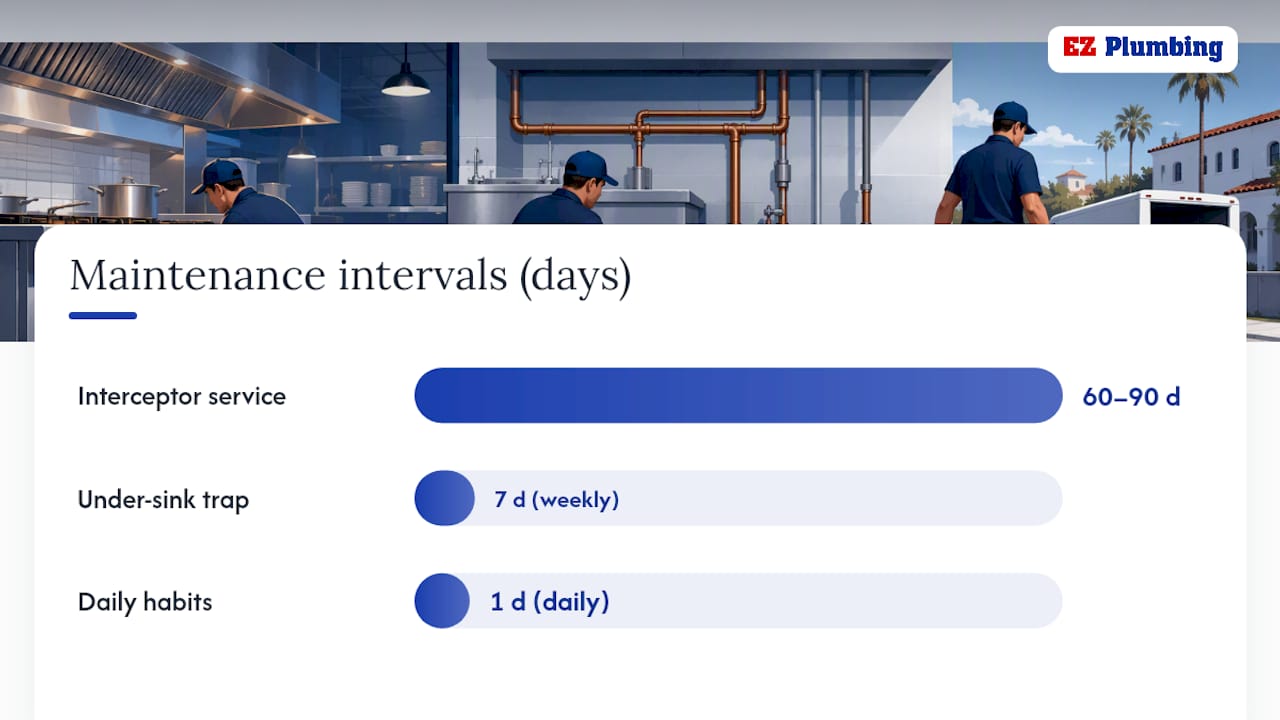
Frequency depends on your kitchen’s volume and how disciplined your daily habits are. Pocatello’s FOG best management guidance recommends servicing interceptors every 60 to 90 days, with small under-sink traps needing a wipe-down weekly.
Daily habits shrink that workload considerably; for expert advice on how to optimize your setup, see this restaurant lighting design guide to help create a well-maintained kitchen environment.
- Dry-wipe pans and cookware before they hit the sink
- Install and empty sink strainers every shift
- Keep a dedicated, labeled yellow-grease container away from prep areas
- Post staff signage reminding cooks not to pour grease down any drain
Interceptors need cleaning at roughly the 25% full mark in many jurisdictions, according to Portland’s guidance, which also notes that additive-based shortcuts violate code rather than reduce cleaning frequency.
Restaurants that document consistent dry-wiping and source separation can sometimes justify a longer interval, but only with logs to prove it. Keep every service date, hauler receipt, and volume figure on file. Municipal programs often require these records be produced on demand, and a missing log can trigger enforcement even if the trap itself looks spotless.
What Should a Licensed Contractor Provide?
Hiring the wrong contractor for grease line work is how restaurants end up with repeat problems and no paperwork to show an inspector. Before you sign anyone up, verify their credentials and confirm exactly what they’ll hand you when the job’s done.
Verify before you hire:
- An active plumbing license, not just a business license
- Liability insurance covering commercial kitchen work
- Familiarity with your city’s specific FOG and pretreatment code
- A registered waste-hauler permit for legal grease disposal
Expect these deliverables on every visit:
- Pump-out volume documented in writing
- A signed hauler manifest showing where the waste went
- Before-and-after photos of the trap or line
- Camera inspection footage when hydro jetting is performed
- A written invoice and a recommended maintenance schedule going forward
Pro Tip: Ask any contractor for a sample invoice before you book them. If they can’t produce documentation on request, they won’t produce it after the job either, and that’s exactly what an inspector will ask you for.
This licensed and insured company provides commercial kitchen plumbing services, hydro-jetting for hardened line buildup, and recurring maintenance plans for restaurants, property managers, and HOAs. For a broader look at trap types and scheduling by property, see the kitchen grease trap guide for Los Angeles properties.
What Do Grease Trap Failures Look Like From the Field?
Most grease line emergencies trace back to the same handful of mistakes: skipping the daily wipe-down, letting yellow grease slip into the trap instead of a separate container, or reaching for an enzyme packet because it’s faster than scooping. None of those fixes cost much to correct, and all of them prevent the majority of backups we see.
If a drain starts running slow, stop running water through it, check the trap for obvious overflow, and call before it becomes a shutdown. Document what you find with a photo and a timestamp. Good kitchen managers treat grease maintenance the way they treat food safety logs: written down, dated, and ready to produce.
— EZ
Schedule Grease Trap Service With Ez-plumbing
Ez-plumbing is the licensed alternative to guessing at your own maintenance schedule or hiring a hauler with no local code experience. As a family-owned plumbing company serving Los Angeles restaurants since 1989, we bring hydro-jetting capability, written pricing, and real local dispatch instead of a call center, plus documentation you can hand an inspector without scrambling.
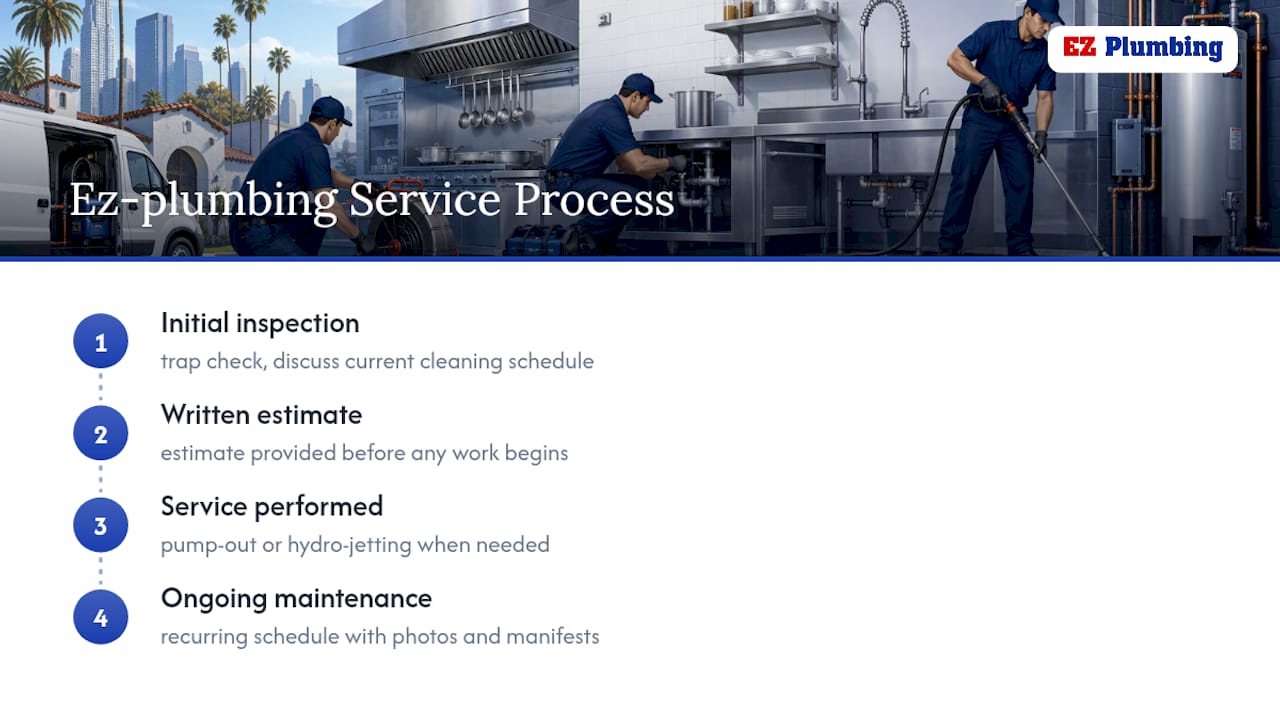
A first visit typically includes a trap inspection, a discussion of your current cleaning schedule, and a written estimate before any work begins. For ongoing kitchens, our commercial maintenance contracts build a recurring pump-out schedule around your actual volume, with photos and manifests provided after every service. If your lines are already backing up or hardened with grease, hydro jetting clears what pumping alone can’t reach. Restaurant, HOA, and property manager clients can also set up a maintenance plan through our drain cleaning team to keep service intervals consistent and documented.
Commercial plumber rates run $120 to $240 per hour depending on scope; you can check current pricing on our calculator before booking. To schedule an inspection or request emergency service, visit Ez-plumbing and a real local dispatcher will get you on the schedule.
Where to Verify Grease Line Compliance Rules
Municipal and federal guidance shapes almost every cleaning schedule and recordkeeping rule mentioned in this guide, and it’s worth bookmarking the primary sources rather than relying on secondhand summaries.
- The EPA’s pretreatment fact sheet on FOG explains why grease interceptors exist and how sizing and maintenance prevent sewer interference.
- Portland’s grease interceptor guidance lays out practical fill-level thresholds, additive restrictions, and hauler requirements.
- Pocatello’s FOG best management practices fact sheet sets out specific cleaning intervals and recordkeeping expectations that mirror what most municipal programs require.
For daily habits that reduce how often you need any of this, Ez-plumbing’s guide on preventing drain clogs covers ten practical tips worth posting in any kitchen.
Sources
- Controlling Fats, Oils, and Grease Discharges from Food Service Establishments — EPA
- Portland
- FOG Best Management Practices (BMP) For Food Services — Pocatello
FAQ
How Much Does It Cost to Clean a Restaurant Grease Trap?
Pricing depends on trap size, FOG volume, and whether hydro jetting is needed. Ez-plumbing’s commercial plumber rate runs $120 to $240 per hour, and current job pricing is available through a direct quote.
How Often Should Restaurant Grease Traps Be Cleaned Out?
Most in-ground interceptors need pumping every 60 to 90 days, while small under-sink traps typically need a wipe-down weekly. Kitchens with strict daily BMPs and documented logs sometimes qualify for longer intervals.
What Will Dissolve Grease in a Sewer Line?
Nothing dissolves hardened grease safely without risking code violations. Municipal guidance prohibits enzymes and chemical additives because they let FOG pass through instead of removing it. Hardened grease deep in a line needs hydro jetting from a licensed plumber, not a chemical shortcut.
What Kills the Smell of a Grease Trap?
Persistent odor almost always means the trap needs physical cleaning, not a masking product. Removing accumulated FOG and solids on schedule, combined with dry-wiping and strainers to cut daily buildup, eliminates the smell at its source rather than covering it up.